

Loading…
Loading…
Loading…
AQA GCSE Sociology · 8192
AQA 8192 Check the specification (PDF) (opens in a new tab)
Crime is an illegal act punishable by law. Deviance is behaviour that breaks a group’s or society’s norms and values. These categories overlap, but they are not identical. Theft breaks criminal law and is generally condemned. Pushing into a queue usually breaks an unwritten rule rather than criminal law. An act can also break the law while gaining approval within a particular group.
Norms are expectations about behaviour; values are beliefs about what matters. Through socialisation, people learn both. Values such as respect for others can support norms against stealing. Following these expectations is conformity. Shared values, or value consensus, can contribute to social cohesion and social order, although agreement is not necessarily complete.
Deviance is socially defined: its meaning depends on the group, place and time. Swimwear may be accepted on a beach but considered inappropriate in a classroom. This makes deviance a social construct, not simply an inherent quality of an act. Changing attitudes can alter what people regard as acceptable, while legislation can change what counts as criminal. Neither public disapproval nor a newspaper headline by itself makes an act a crime.
Anti-social behaviour concerns behaviour that causes harassment, alarm or distress. It can overlap with crime and deviance, but not every example is a criminal offence. Delinquency describes young people’s crime and deviance, usually relatively minor behaviour; youth crime concerns unlawful behaviour by young people.
Social control means the processes that encourage people to follow rules. Its agents include families, schools, peers, the police and courts. They use sanctions: rewards for approved behaviour and penalties for disapproved behaviour.
Informal control operates through everyday relationships. Praise, ridicule, disapproval and the threat of losing friends can all influence conduct. Formal control operates through laws and official agencies. A criminal conviction and court sentence are examples. Surveillance, such as CCTV, makes behaviour visible and can help prevent crime.
The criminal justice system includes the police, courts, prisons and probation services. These have different responsibilities: investigating suspected offences, deciding cases, imposing sentences, holding people in custody and supervising offenders returning to the community. A police caution is a formal warning for a minor offence, such as graffiti. The person must admit the offence and agree to be cautioned. A caution is not a criminal conviction.
Community service is court-imposed unpaid work in the community. Probation involves supervision in the community rather than simply imprisonment. Prisons punish and restrict liberty, but they also aim to rehabilitate offenders and deter future crime.
The legislature makes legislation, whereas the judiciary, including judges and magistrates, applies the law. Parliament is the UK legislature. In the legislative process, a proposed law is a Bill. It is considered by the House of Commons and House of Lords, including committee scrutiny, before receiving Royal Assent and becoming an Act of Parliament.
In England and Wales, all criminal cases start in a magistrates’ court. These courts have no jury: cases are heard by two or three magistrates, or a district judge. Less serious, non-indictable offences, such as minor criminal damage, are dealt with there. The most serious, indictable offences, such as murder, are passed to the Crown Court. Some offences can be tried in either court. In a Crown Court jury trial, the jury decides guilt and the judge sentences those convicted.
A right of appeal provides a route, subject to legal procedures, to challenge a verdict. A miscarriage of justice, such as the wrongful conviction of the Birmingham Six, shows why the outcome of a legal process cannot automatically be treated as proof that the process was fair or correct.
A theoretical perspective is a framework for explaining society. Functionalists examine social order, shared values and the functions of society’s institutions. Marxists emphasise class inequality, ownership and exploitation. Feminists examine gender inequality and male domination. Interactionists focus on meanings, interactions and how people define situations.
These perspectives direct attention towards different aspects of crime. Is offending connected to blocked opportunities? Whose interests do laws protect? How are women controlled? Why does one person receive a criminal label while another does not? Comparing explanations means considering both what each reveals and what it leaves unexplained.
Alienation, associated with Marxism, means workers’ estrangement from their work because they lack control over the work they do and the products they make. This is different from anomie, which concerns the breakdown of the norms that usually regulate behaviour. War or riots can disrupt established rules. Both concepts concern people’s relationship with society, but they identify different problems: lack of control over work versus weakened social regulation.
Robert Merton’s functionalist explanation connects deviance to society’s goals and the opportunities available to achieve them. In his account of American society, material success was widely valued, but access to accepted routes, such as education and secure employment, was unequal. When success matters more than following accepted rules, those rules can lose authority: anomie develops.
Conformity means pursuing accepted goals through accepted means. Some people instead use criminal means to obtain the same desired success. Merton’s explanation therefore links individual behaviour to social structure rather than treating offending simply as a personal defect.
However, shared goals cannot just be assumed. People facing similar disadvantages do not all offend, and focusing on blocked opportunities among poorer groups can underestimate white collar crime. White collar crime is committed by people in relatively high-status positions during their work: an accountant making fraudulent expense claims is an example. Corporate crime is committed by employees on behalf of their company, such as illegally making and selling unsafe products. The distinction concerns the occupational setting and whose behalf the offence serves.
Poverty may restrict life chances and contribute to crimes such as theft or shoplifting, but it is not proof that a person will become criminal.
Albert Cohen’s Delinquent Boys (1955) offers a related explanation of status frustration. He argued that working-class boys could want mainstream success but face educational failure and poor employment prospects. Unable to gain recognition through accepted routes, some joined a criminal subculture.
Within that subculture, behaviour condemned by wider society could bring prestige. Stealing, vandalism or truancy could become ways to gain approval from peers. The important connection is between frustrated recognition and an alternative system of rewards—not merely between poverty and theft.
Cohen’s explanation can help account for group-based delinquency. A criticism is that working-class young people do not necessarily share mainstream success goals in the first place. Resentment towards teachers or successful students may reflect rejection of their values rather than failure to achieve them. Neither Merton nor Cohen explains every form of offending.
Howard Becker’s interactionist account in Outsiders (1963) asks how behaviour comes to be defined as deviant. Whether a label is applied depends on who acts, who observes, where and when the act occurs, and how those involved respond. Agents of social control have particular power to make labels stick.
A criminal label may become a master status: the main characteristic through which others see a person. Other identities, such as employee, friend or parent, are pushed into the background. Stereotypes can then encourage assumptions that the person is untrustworthy or likely to offend again. This creates social stigma and may lead to exclusion.
If the person begins to understand themselves through the label, a self-fulfilling prophecy can develop. Rejection from conventional groups may encourage greater involvement with a deviant group whose values justify offending. Becker described this progression as a deviant career.
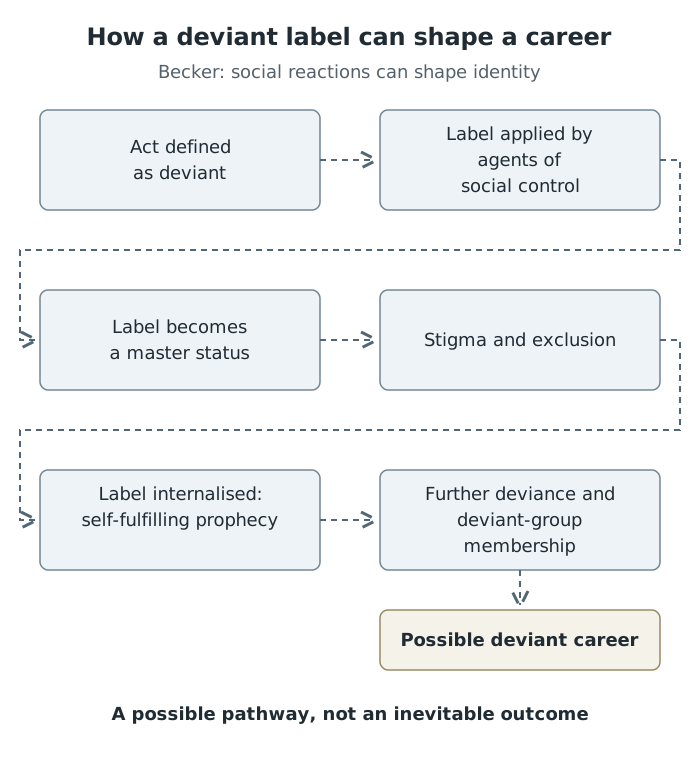
Becker’s explanation connects social reactions, identity and possible continued deviance.
This is a possible process, not an inevitable sequence. Labelling theory explains reactions and continued deviance particularly well, but it does not fully explain why the original act occurred. Its contribution is to show that social control can sometimes reinforce the behaviour it aims to discourage.
Gender and criminality includes differences in offending, opportunities, socialisation and responses by the authorities. Official statistics suggest that women are less likely than men to offend and reoffend. Gender roles are socially learned expectations; they should not be treated as proof that all women or all men behave alike.
The chivalry thesis proposes that predominantly male criminal justice personnel may treat women more leniently because stereotyped ideas present women as needing protection rather than punishment. This treatment may particularly favour women who conform to gender expectations. If women’s offences are less likely to lead to formal action, official records may make the difference between women’s and men’s offending appear greater than it really is.
This is a claim about treatment, not a complete explanation of offending. A contrasting argument is that women can be treated more harshly for breaking both the law and expectations of acceptable female behaviour. A convincing assessment needs comparisons between similar cases, considering offence seriousness and previous offending, rather than simply comparing total numbers of men and women convicted.
Frances Heidensohn’s Women and Crime (1985) uses control theory to explain why women commit fewer crimes. She argued that male-dominated societies control women at home, in public and at work. Domestic responsibilities and financial dependence can restrict opportunities. Daughters may face tighter restrictions than sons on leaving home. Fear of male sexual violence and damage to reputation can constrain behaviour in public. Male-dominated workplaces and sexual harassment can provide further controls.
This explanation connects gender roles to everyday restrictions rather than assuming an inborn difference in morality. However, Heidensohn has been criticised for generalising across women’s different experiences and for not always providing strong research evidence for her claims.
Pat Carlen’s Women, Crime and Poverty (1988) examined 39 mostly working-class women aged between 15 and 46 who had criminal convictions. She used in-depth, unstructured interviews. Her explanation focuses on the rewards that encourage conformity. A class deal promises access to consumer goods through paid work. A gender deal promises material and emotional rewards from a male breadwinner in return for domestic labour and love.
Carlen argued that when these rewards are unavailable or illusory, crime can become a viable alternative. Her study gives detailed accounts of women’s experiences, but its small, selected sample cannot represent all women. Taken together, these explanations suggest that both social controls and justice-system responses matter; no single explanation should be assumed to account for every gender difference.
The mass media select which events to report. News values are media professionals’ judgements about what is newsworthy and deserves prominence. Agenda setting concerns the media’s power to focus public attention and steer debate. Repeated coverage can keep an issue in the public eye: attention to hoodie-wearing youths in the early 2010s is an example.
A media stereotype presents a group through an overgeneralised image. During a moral panic, a group or behaviour is portrayed as a major threat and the reaction is disproportionate. The targeted group becomes a folk devil and may be used as a scapegoat for wider problems.
Stanley Cohen’s Folk Devils and Moral Panics (1972) examined reactions to the mods and rockers. His case study included clashes at Clacton during the 1964 bank holiday period. He argued that newspapers exaggerated the numbers involved, the violence and the damage, helping to portray these youth subcultures as threats to law and order.
Media amplification means exaggerating an issue’s significance through coverage. Deviancy amplification goes further: reactions help produce more deviance. Cohen argued that publicity, public hostility and harsher policing could contribute to further confrontations and arrests, reinforcing the original threatening image.
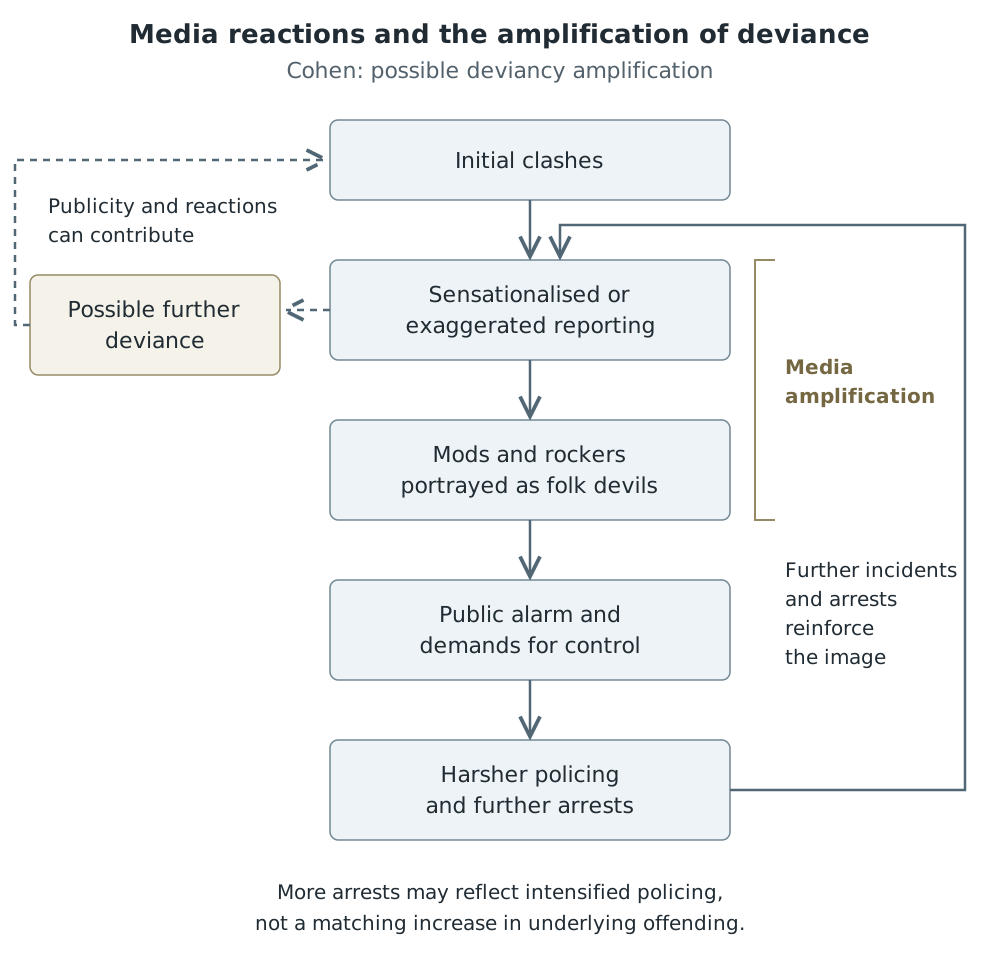
In Cohen’s account, publicity and social control could reinforce the image of a threat and contribute to further deviance.
A serious social problem is not automatically a moral panic. To justify that interpretation, examine the relationship between the coverage, the underlying events and the scale of the response. Reporting can raise awareness of genuine harm. Equally, more arrests may reflect intensified policing rather than a matching increase in underlying offending. Media influence therefore needs investigation, not assumption.
The popular press means tabloids or ‘red tops’, such as The Sun and Daily Mirror. The quality press covers a more serious range of issues, including world news, economics and business. These labels describe types of newspapers; researchers still need to examine their actual coverage. Propaganda promotes a particular view or cause, often using biased or false information. Pluralism, by contrast, recognises multiple views with no single group or argument dominating.
Crime research must distinguish reported crime, which has been reported to the police, from recorded crime, which the police enter into crime records. Neither includes every offence. The dark figure of crime consists of offences missing from recorded statistics because they are unreported or unrecorded.
Official crime statistics provide quantitative information that can reveal trends. Police-recorded figures are collected by the Home Office and published by the Office for National Statistics. A crime rate relates incidents of a particular crime to a specified number of adults during a stated period, such as robberies per 1,000 adults in a year. This makes comparisons more useful than raw totals alone.
However, recording rules, reporting behaviour and policing practices can affect the figures. The introduction of the National Crime Recording Standard in England and Wales in April 2002 increased the number of crimes recorded. A rise caused by improved recording is not evidence of an equivalent rise in actual offending.
A victim survey asks people about offences they have experienced, including unreported incidents. A self-report study asks people about their own offending. The distinction is whose experience is being investigated: victimisation or perpetration.
Suppose a person’s phone is stolen but they do not contact the police. A victim survey could capture that experience, while a police-recorded total would not include it unless it came to police attention and was recorded. A self-report study could instead ask whether a respondent had stolen a phone. These methods reveal different parts of the picture rather than producing interchangeable counts.
The Crime Survey for England and Wales (CSEW) is a large-scale victim survey run by the Office for National Statistics. It uses structured interviews to ask people about crimes experienced during the previous 12 months and whether they reported them to the police. Its findings help uncover unreported crime and identify trends, providing evidence for crime-reduction policies.
However, the CSEW does not measure every offence. It cannot interview someone murdered, and its household interviews do not provide a complete account of crimes against businesses or offences without a direct victim, such as drug possession. People outside its household sampling coverage, such as those who are homeless or living in prisons, are not represented in the same way. Respondents may also forget incidents or be unwilling to disclose sensitive experiences. Self-completion questions allow respondents to answer sensitive questions privately, helping them feel more comfortable disclosing information.
The Offending, Crime and Justice Survey (OCJS) was a national longitudinal self-report offending survey in England and Wales, commissioned by the Home Office and conducted annually from 2003 to 2006. It investigated offending, drug use and anti-social behaviour, helping researchers examine the onset of offending and identify groups at risk.
Self-report studies can reveal offending that never reached the police or courts. However, respondents may forget offences or conceal them because they fear consequences. The OCJS also excluded people in settings such as prisons and care homes and those who were homeless. These exclusions matter because their experiences of offending may differ from those of household respondents.
Neither survey simply removes the dark figure of crime. Each extends knowledge beyond police records while retaining limits in coverage and disclosure. Comparing sources is therefore more useful than assuming one gives a complete count.
Research involves collecting and analysing data. Primary data are collected first-hand by the researcher; secondary data already exist, having been collected by others. A researcher conducting interviews generates primary data, while one reusing published crime statistics works with secondary data. A hypothesis is a clear prediction that research can test.
A questionnaire with closed questions can produce comparable quantitative data. Open questions and unstructured interviews can provide qualitative accounts of motives and experiences. Carlen’s interviews illustrate why detailed accounts may reveal things that a count of convictions cannot. An attitude survey could instead investigate views about crime or confidence in the police: opinions are not themselves a measure of offending. A focus group explores a topic through group discussion, including how participants respond to one another.
Observation examines behaviour directly. Participant observers join activities; non-participant observers do not. In covert observation, participants do not know they are being studied. Participation and concealment are separate choices. Research into a group’s everyday culture can form an ethnography, while a case study investigates one setting, group or event intensively. Neither automatically represents the wider population.
Content analysis can investigate media portrayals. For example, a researcher could define categories such as references to violence, threatening descriptions and mentions of young people. They would code each article using those categories, then count occurrences and compare coverage across newspapers. Applying the same coding rules consistently supports reliability. Choosing only dramatic articles would introduce bias and weaken conclusions about coverage as a whole.
Reliability concerns consistency: repeating research using the same method should produce similar findings. Validity concerns whether it accurately measures what it intends to study. A questionnaire may repeatedly produce similar answers while still missing offending that respondents conceal. Research can therefore be reliable without being valid.
A sample is a subgroup selected for research. A representative sample reflects relevant characteristics of the wider population; an unrepresentative sample does not. Studying only one school year, for example, would not represent all pupils in a school. A census instead seeks information about the whole population.
A sampling frame is a complete list of the population, such as a school register. Random sampling gives each listed member an equal chance of selection. Systematic sampling selects every nth member—for example, every twelfth name. If a list leaves some people out, those people cannot be selected from it.
Quota sampling recruits set numbers from categories in proportion to their presence in the population. Snowball sampling begins with a contact who introduces the researcher to other potential participants. This can help reach hidden groups, including people involved in crime, but the contacts may come from similar social networks. Sample size alone therefore does not establish representativeness.
Mixed methods research uses different methods to obtain a range of evidence, potentially both qualitative and quantitative. Triangulation cross-checks qualitative findings against quantitative data: interview accounts of experiences of crime could be compared with numerical survey findings. The methods may reveal both meanings and patterns, although agreement does not guarantee that every limitation has disappeared.
Longitudinal research follows the same people over time. It can reveal continuity and change rather than just describing one moment. The OCJS provides a crime-related example. A trend is the general direction in which data change over time, but its interpretation still depends on how the information was collected.
Crime research can expose people to legal, social or emotional harm. Informed consent means participants receive an explanation of the study and what taking part involves before agreeing. Confidentiality means keeping their information within the research team. Data protection provides legal safeguards for personal information, particularly identifying data, and includes participants’ rights to see information held about them. Researchers must also protect participants from harm and respect their right to withdraw. Covert research raises particular problems because participants do not know they are being studied and cannot give informed consent to it.
Ethnicity, gender and social class can affect experiences of crime and social control, but group membership is not proof of offending. Ethnicity concerns shared cultural traditions and norms; ethnic diversity means that several ethnic groups are present. Discrimination is unfair treatment, while racism involves prejudices about ethnic superiority or inferiority. Institutional racism occurs when an organisation fails people because of ethnicity, culture or skin colour, even if its members do not recognise that they are discriminating. These concepts require examination of processes and evidence rather than stereotyping whole communities.
Labels also need careful handling. Describing a benefit recipient as a ‘welfare scrounger’ portrays them as undeserving; it does not prove benefit fraud. Likewise, a media image of a group is not evidence that all its members behave alike.
A sound sociological conclusion connects the concept, the mechanism and the evidence. It also recognises alternatives: a statistical difference may reflect offending, reporting, recording, treatment—or a combination. The aim is not to replace one everyday stereotype with another, but to explain how behaviour and social reactions are shaped.
Define crime through law and deviance through social norms. An act can be both, but the terms are not interchangeable.
Apply specialist language: explain how a label might become a master status rather than simply listing both terms.
Distinguish Albert Cohen’s explanation of status frustration from Stanley Cohen’s work on moral panics.
Separate reported crime, recorded crime and actual offending when interpreting statistics.
Treat theories as explanations to assess, not facts that apply automatically to every individual.
For methods questions, connect the strength or limitation to crime research: fear of admitting an offence, for example, can reduce the validity of a self-report study.
Keep media amplification distinct from deviancy amplification: greater publicity does not by itself prove that more deviance has occurred.
It can see this note and what your specification asks for.
Answers are free with an account.
1 free note left this week
Get more free notesYour answer sets when this note comes back for review, or marks it complete.
Was this note helpful?
Log in to tell us whether it helped, or to report a problem.
Last updated
Agenda setting
The media’s influence over which issues receive public attention, helping to shape the direction of public opinion and debate.
Agent of social control
A group or institution that socialises people and encourages conformity, such as a family, school, peer group or police force.
Alienation
In Marxism, workers’ estrangement from their work because they lack control over the work they do and the products they make.
Anomie
A condition of normlessness in which the norms that normally regulate behaviour break down or are no longer followed.
Anti-social behaviour
Behaviour that causes harassment, alarm or distress to other people.
Attitude survey
A survey investigating respondents’ views, attitudes or beliefs about a particular topic.
Bias
A one-sided approach rather than a neutral one, which can distort research or its interpretation.
Case study
A detailed investigation of a particular institution, group or event, which may use several research methods.
Census
A population-wide collection of information, rather than a sample survey; UK censuses normally collect information through questionnaires every ten years.
Chivalry thesis
The argument that the criminal justice system treats women more leniently than men, particularly women who conform to gender stereotypes.
Closed question
A question requiring respondents to choose from a fixed set of answers.
Community service
A punishment imposed by a court requiring an offender to do unpaid work in the community.
Confidentiality
Keeping participants’ research information within the research team rather than disclosing it to others.
Conformity
Behaviour that follows accepted norms and values. In Merton’s explanation, it means accepting society’s success goals and legitimate means of achieving them.
Consensus
Broad agreement within a society about accepted norms and values.
Content analysis
Quantitative analysis of documents or images by defining categories, coding material into them and counting occurrences.
Continuity
Stability in social norms, values, behaviour or attitudes over time.
Control theory
An approach asking why people conform, including how restrictions and promised rewards discourage offending. Heidensohn examined controls over women; Carlen examined rewards for conformity.
Corporate crime
Crime committed by employees on behalf of their company, such as illegally producing and selling unsafe products.
Covert observation
Observation in which participants do not know that they are being studied.
Crime
An illegal act punishable by law.
Crime rate
The number of incidents of a particular crime per specified number of adults over a stated period, such as robberies per 1,000 adults in a year.
Criminal justice system
The agencies involved in enforcing criminal law and dealing with offenders, including the police, courts, prison service and probation service.
Criminal subculture
A group whose shared norms, values and behaviour involve breaking the law.
Dark figure of crime
Crime missing from official recorded statistics because it has not been reported or recorded.
Data
Information collected and analysed during research.
Data analysis
Interpreting collected information to identify patterns, meanings or relationships.
Data protection
Legal protection for participants’ personal information, particularly identifying data, including their right to see information held about them.
Delinquency
Crime and deviance committed by young people, usually referring to relatively minor behaviour.
Deviance
Behaviour that does not conform to a society’s norms and values; it may be illegal but need not be.
Deviancy amplification
A process in which public and media reactions to deviance encourage further deviant behaviour.
Deviant career
A process through which someone develops a deviant identity and may become involved in a deviant subculture.
Discrimination
Unfair or less favourable treatment based on a characteristic such as age, gender or ethnicity.
Economy
The organisation of the production, distribution and consumption of goods and services.
Established church
A church formally linked to the state. The Church of England is established in England, with the monarch as its Supreme Governor.
Ethical consideration
An issue concerning the protection and fair treatment of research participants, including informed consent, confidentiality, withdrawal and protection from harm.
Ethnic diversity
The presence of different ethnic groups within a community or society.
Ethnic group
A group sharing an identity based on cultural traditions or characteristics, such as language or religion.
Ethnic minority
An ethnic group that does not form the majority of a society’s population.
Ethnicity
Shared cultural traditions and norms that distinguish a group from others.
Ethnography
Research into people’s culture and practices in their everyday setting.
Expectation
A hope or belief about society or how people should behave.
Feminism
A movement and perspective concerned with women’s rights, gender equality and challenging male domination.
Feminist
A person who supports or applies feminist ideas; feminist sociologists examine gender inequality and women’s rights.
Focus group
A group interview focused on one topic, allowing researchers to study participants’ views and their responses to one another.
Folk devil
A person or group portrayed as a threat to society, especially during a moral panic.
Functionalism
A perspective examining how society’s institutions contribute to its operation and continuation.
Functionalist
A sociologist who studies the functions that institutions perform for society.
Functionally important role
A social role considered vital to society’s effective operation.
Fundamentalism
Belief in a literal interpretation of religious texts or scriptures.
Gender
Socially constructed or culturally learned differences and expectations associated with masculinity and femininity, rather than biological differences.
Gender and criminality
The study of differences in crime rates and explanations of offending between genders.
Gender deal
Carlen’s term for promised material and emotional rewards from a male breadwinner in return for women’s domestic labour and love.
Gender role
Behaviour expected of someone because of their gender.
Hypothesis
A clear, testable statement predicting what research will find.
Identity
How someone sees themselves and how others see them, shaped by factors such as gender, ethnicity, religion and social class.
Identity theft
Obtaining or stealing another person’s personal information and using it for personal gain.
Image
A representation of a social group presented in the media, often conveying a particular idea or stereotype.
Indictable offence
A serious criminal offence tried in the Crown Court before a judge and jury.
Informed consent
Agreement to participate after the researcher explains the study’s purpose, what will happen and answers the participant’s questions.
Injustice
A lack of fairness that may involve a violation of someone’s rights.
Institutional racism
An organisation’s failure to provide an appropriate service because of people’s ethnicity, culture or skin colour, even when individuals do not recognise that they are discriminating.
Intelligence quotient
A numerical score intended to measure a person’s intelligence and reasoning ability.
Interactionism
A perspective focusing on social interaction, meanings and how people interpret and respond to one another.
Interview
A research method in which a researcher asks a participant questions and obtains their answers.
Judiciary
The judges and magistrates who apply the law in courts.
Labelling
Attaching a description, characteristic or category to a person or group.
Law
A formal rule enforced by the state to regulate behaviour.
Legislation
A law or set of laws, or the process of making laws.
Legislative process
The process through which a Bill is considered by Parliament and becomes an Act following Royal Assent.
Legislature
The institution responsible for making laws, such as the UK Parliament.
Life chances
An individual’s opportunities for outcomes in areas such as health, education, employment and housing.
Longitudinal study
Research following the same group of people over an extended period to study change.
Magistrate
A volunteer, also called a Justice of the Peace, who hears cases in a magistrates’ court and deals with less serious offences.
Male domination
Men’s exercise of power and authority over women in society.
Marxism
A perspective drawing on Karl Marx’s work, emphasising class conflict and the exploitation of workers by capitalist owners.
Marxist
A sociologist who draws on Marx’s ideas to explain capitalist society.
Mass media
Forms of communication reaching large audiences, such as television, radio and newspapers.
Master status
A status or label that overshadows someone’s other identities and becomes the main way others see them.
Media amplification
Exaggeration of an issue’s significance through media coverage, including over-reporting to attract an audience.
Media stereotype
An overgeneralised media representation of people, groups or places that may be inaccurate and harmful.
Miscarriage of justice
A failure by a court to deliver justice, such as finding an innocent person guilty.
Mixed methods research
Research using different methods to obtain a range of data, potentially including both qualitative and quantitative information.
Moral panic
A disproportionate reaction, fuelled by media coverage, that presents a group or behaviour as a threat to society.
National curriculum
A government-set framework specifying subjects taught in primary and secondary schools and the standards pupils should reach, in the schools to which it applies. In England, academies and private schools do not have to follow it.
News value
A judgement used by media professionals to decide what is newsworthy and which stories should receive prominence.
Non-indictable offence
A less serious criminal offence heard in a magistrates’ court rather than the Crown Court.
Non-participant observation
Observation in which the researcher watches a group without joining its activities.
Norm
An expectation about how people should behave in a society or situation.
Observation
A research method involving watching participants and recording their behaviour.
Official crime statistics
Quantitative crime data compiled by official bodies, including police-recorded figures collected by the Home Office and official survey estimates.
Open question
A question allowing respondents to answer in their own words and add detail.
Participant observation
Observation in which the researcher joins the group and takes part in its activities.
Pluralism
An approach recognising multiple views and opinions, with no single argument or group dominating.
Police caution
A formal warning for a minor offence; the person must admit the offence and agree to the caution. It is not a criminal conviction.
Popular press
The tabloid or ‘red top’ press, such as The Sun and Daily Mirror.
Poverty
A lack of resources, understood in absolute or relative terms, which may contribute to acquisitive crimes such as theft or shoplifting but does not inevitably produce offending.
Primary data
Information generated and collected first-hand by the researcher.
Prison system
The part of the criminal justice system that detains offenders in secure institutions.
Privatisation
The transfer of government-owned assets into private ownership.
Probation system
The part of the criminal justice system responsible for supervising offenders returning to the community after prison.
Propaganda
Information used to promote a particular cause or viewpoint, often biased or false.
Qualitative data
Information presented in words or images rather than numbers.
Quality press
Newspapers covering a more serious range of issues, such as world news, economics and business.
Quantitative data
Information presented in numerical form.
Questionnaire
A structured, standardised set of questions given to respondents, which may include open and closed questions.
Quota sample
A sample formed by recruiting set numbers from categories in proportion to their presence in the wider population.
Racial discrimination
Unfair or less favourable treatment based on ethnicity.
Racism
Beliefs or prejudices that one ethnic group is superior or inferior to another, often leading to discrimination.
Random sample
A sample selected by chance in which each member of the sampling frame has an equal chance of selection.
Recorded crime
Crime entered into police records and included in police-recorded crime statistics.
Reliability
Consistency: repeating research using the same method should produce similar findings.
Reported crime
Crime that has been reported to the police.
Representative sample
A sample reflecting the relevant characteristics of the wider population being studied.
Research
Investigation involving the collection and analysis of information using methods such as questionnaires, interviews or observation.
Respondent
A person from whom information is obtained in research.
Right of appeal
The right of a convicted person to challenge a verdict through the appropriate legal procedure.
Role conflict
A clash between the demands of different roles held by the same person.
Role
The pattern of behaviour expected of someone occupying a particular social position.
Rural
Relating to the countryside, generally less densely populated than urban areas.
Sample
A subgroup selected from a population for research.
Sampling frame
A complete list of the population from which a sample is drawn, such as a school register.
Sanction
A reward or punishment used to encourage conformity to rules or norms.
Scapegoat
A person or group blamed for something that is not their fault.
Secondary data
Existing information collected by others and reused by a researcher, such as official statistics or earlier research.
Selective use of data
Choosing which information to include or discard, for example when focusing on a particular subgroup; this may introduce bias if relevant contrary evidence is excluded.
Self-fulfilling prophecy
A process in which someone comes to fit an expectation or label, helping to make the original prediction come true.
Self-report study
Research asking participants about their own behaviour; in crime research, it asks about offences they have committed during a stated period.
Sex discrimination
Unfair treatment based on sex or gender.
Sex equality
Fair and equal treatment regardless of sex or gender.
Sexism
Discrimination or unfair treatment based on sex or gender.
Snowball sample
A sample built by asking participants to introduce the researcher to other members of the population, often used for hard-to-reach groups.
Social change
Alteration over time in society’s structure, attitudes, behaviour, norms or values.
Social class
A grouping based on economic factors such as income, occupation and property ownership.
Social cohesion
The unity and bonds that bring people in society together, including shared values.
Social construct
An idea or category produced through social and cultural decisions, rather than fixed independently of society.
Social control
Ways society constrains behaviour and encourages conformity. Formal control uses laws and official agencies; informal control uses everyday approval or disapproval.
Social convention
An accepted way of behaving in society.
Social exclusion
Being shut out of society or aspects of its political, economic, social or cultural life.
Social order
A condition in which society remains stable and operates without constant disruption.
Social stigma
Shame or disgrace attached to a characteristic, situation or behaviour.
Social stratification
The organisation of society into unequal layers of wealth, privilege and status.
Socialisation
The process through which people learn society’s norms and values.
Socially defined behaviour
Behaviour whose meaning and acceptability are determined by its social context, rather than the act alone.
Society
A group of people sharing a culture or way of life.
Status
A person’s social position, which may be associated with prestige.
Status frustration
Frustration caused by being unable to achieve desired recognition or standing; Albert Cohen linked it to working-class boys’ failure to meet middle-class educational expectations.
Stereotype
A fixed, overgeneralised and often distorted view of a group’s characteristics.
Subculture
A culture within a wider culture, with distinctive norms, values or practices.
Surveillance
Monitoring people and gathering information to help prevent crime, for example through CCTV.
Survey
Research using questionnaires or structured interviews with standardised questions presented in the same order.
Systematic sample
A sample selected by taking every nth member of a sampling frame.
Technological change
Developments in technology, such as the internet or mobile phones, which can change social life.
Terrorism
The use of violence and intimidation to achieve political goals.
Theoretical perspective
A framework of ideas used to explain society and its institutions.
Trend
The overall direction of change in data over time.
Triangulation
Cross-checking findings from qualitative research against quantitative data.
Unrepresentative sample
A sample that does not reflect the relevant characteristics of its population.
Unstructured interview
A conversational interview without a fixed set of standardised questions, allowing its direction to develop through participants’ answers.
Unwritten rule
A social convention learned through socialisation and experience rather than formally documented.
Urban
Relating to towns and cities, often densely populated.
Validity
The extent to which research measures what it intends to study and provides an accurate account.
Value consensus
Broad agreement about the values that society regards as important.
Value
A belief about what is important or desirable in society.
Victim survey
A survey asking people about crimes they have experienced during a specified period and potentially whether they reported them to the police.
Welfare scrounger/benefit cheat
A negative label portraying a benefit recipient as undeserving. A benefit cheat receives benefits fraudulently; receiving benefits alone does not establish wrongdoing.
White collar crime
Crime committed by people in relatively high-status occupations during their work, such as tax evasion or false expense claims.
World view
A perspective through which someone understands society and the social world.
Youth crime
Unlawful behaviour by young people, such as theft, vandalism or assault.
Put your knowledge into practice — try past paper questions for Sociology
Agenda setting
The media’s influence over which issues receive public attention, helping to shape the direction of public opinion and debate.
Agent of social control
A group or institution that socialises people and encourages conformity, such as a family, school, peer group or police force.
Alienation
In Marxism, workers’ estrangement from their work because they lack control over the work they do and the products they make.
Anomie
A condition of normlessness in which the norms that normally regulate behaviour break down or are no longer followed.
Anti-social behaviour
Behaviour that causes harassment, alarm or distress to other people.
Attitude survey
A survey investigating respondents’ views, attitudes or beliefs about a particular topic.
Bias
A one-sided approach rather than a neutral one, which can distort research or its interpretation.
Case study
A detailed investigation of a particular institution, group or event, which may use several research methods.
Census
A population-wide collection of information, rather than a sample survey; UK censuses normally collect information through questionnaires every ten years.
Chivalry thesis
The argument that the criminal justice system treats women more leniently than men, particularly women who conform to gender stereotypes.
Closed question
A question requiring respondents to choose from a fixed set of answers.
Community service
A punishment imposed by a court requiring an offender to do unpaid work in the community.
Confidentiality
Keeping participants’ research information within the research team rather than disclosing it to others.
Conformity
Behaviour that follows accepted norms and values. In Merton’s explanation, it means accepting society’s success goals and legitimate means of achieving them.
Consensus
Broad agreement within a society about accepted norms and values.
Content analysis
Quantitative analysis of documents or images by defining categories, coding material into them and counting occurrences.
Continuity
Stability in social norms, values, behaviour or attitudes over time.
Control theory
An approach asking why people conform, including how restrictions and promised rewards discourage offending. Heidensohn examined controls over women; Carlen examined rewards for conformity.
Corporate crime
Crime committed by employees on behalf of their company, such as illegally producing and selling unsafe products.
Covert observation
Observation in which participants do not know that they are being studied.
Crime
An illegal act punishable by law.
Crime rate
The number of incidents of a particular crime per specified number of adults over a stated period, such as robberies per 1,000 adults in a year.
Criminal justice system
The agencies involved in enforcing criminal law and dealing with offenders, including the police, courts, prison service and probation service.
Criminal subculture
A group whose shared norms, values and behaviour involve breaking the law.
Dark figure of crime
Crime missing from official recorded statistics because it has not been reported or recorded.
Data
Information collected and analysed during research.
Data analysis
Interpreting collected information to identify patterns, meanings or relationships.
Data protection
Legal protection for participants’ personal information, particularly identifying data, including their right to see information held about them.
Delinquency
Crime and deviance committed by young people, usually referring to relatively minor behaviour.
Deviance
Behaviour that does not conform to a society’s norms and values; it may be illegal but need not be.
Deviancy amplification
A process in which public and media reactions to deviance encourage further deviant behaviour.
Deviant career
A process through which someone develops a deviant identity and may become involved in a deviant subculture.
Discrimination
Unfair or less favourable treatment based on a characteristic such as age, gender or ethnicity.
Economy
The organisation of the production, distribution and consumption of goods and services.
Established church
A church formally linked to the state. The Church of England is established in England, with the monarch as its Supreme Governor.
Ethical consideration
An issue concerning the protection and fair treatment of research participants, including informed consent, confidentiality, withdrawal and protection from harm.
Ethnic diversity
The presence of different ethnic groups within a community or society.
Ethnic group
A group sharing an identity based on cultural traditions or characteristics, such as language or religion.
Ethnic minority
An ethnic group that does not form the majority of a society’s population.
Ethnicity
Shared cultural traditions and norms that distinguish a group from others.
Ethnography
Research into people’s culture and practices in their everyday setting.
Expectation
A hope or belief about society or how people should behave.
Feminism
A movement and perspective concerned with women’s rights, gender equality and challenging male domination.
Feminist
A person who supports or applies feminist ideas; feminist sociologists examine gender inequality and women’s rights.
Focus group
A group interview focused on one topic, allowing researchers to study participants’ views and their responses to one another.
Folk devil
A person or group portrayed as a threat to society, especially during a moral panic.
Functionalism
A perspective examining how society’s institutions contribute to its operation and continuation.
Functionalist
A sociologist who studies the functions that institutions perform for society.
Functionally important role
A social role considered vital to society’s effective operation.
Fundamentalism
Belief in a literal interpretation of religious texts or scriptures.
Gender
Socially constructed or culturally learned differences and expectations associated with masculinity and femininity, rather than biological differences.
Gender and criminality
The study of differences in crime rates and explanations of offending between genders.
Gender deal
Carlen’s term for promised material and emotional rewards from a male breadwinner in return for women’s domestic labour and love.
Gender role
Behaviour expected of someone because of their gender.
Hypothesis
A clear, testable statement predicting what research will find.
Identity
How someone sees themselves and how others see them, shaped by factors such as gender, ethnicity, religion and social class.
Identity theft
Obtaining or stealing another person’s personal information and using it for personal gain.
Image
A representation of a social group presented in the media, often conveying a particular idea or stereotype.
Indictable offence
A serious criminal offence tried in the Crown Court before a judge and jury.
Informed consent
Agreement to participate after the researcher explains the study’s purpose, what will happen and answers the participant’s questions.
Injustice
A lack of fairness that may involve a violation of someone’s rights.
Institutional racism
An organisation’s failure to provide an appropriate service because of people’s ethnicity, culture or skin colour, even when individuals do not recognise that they are discriminating.
Intelligence quotient
A numerical score intended to measure a person’s intelligence and reasoning ability.
Interactionism
A perspective focusing on social interaction, meanings and how people interpret and respond to one another.
Interview
A research method in which a researcher asks a participant questions and obtains their answers.
Judiciary
The judges and magistrates who apply the law in courts.
Labelling
Attaching a description, characteristic or category to a person or group.
Law
A formal rule enforced by the state to regulate behaviour.
Legislation
A law or set of laws, or the process of making laws.
Legislative process
The process through which a Bill is considered by Parliament and becomes an Act following Royal Assent.
Legislature
The institution responsible for making laws, such as the UK Parliament.
Life chances
An individual’s opportunities for outcomes in areas such as health, education, employment and housing.
Longitudinal study
Research following the same group of people over an extended period to study change.
Magistrate
A volunteer, also called a Justice of the Peace, who hears cases in a magistrates’ court and deals with less serious offences.
Male domination
Men’s exercise of power and authority over women in society.
Marxism
A perspective drawing on Karl Marx’s work, emphasising class conflict and the exploitation of workers by capitalist owners.
Marxist
A sociologist who draws on Marx’s ideas to explain capitalist society.
Mass media
Forms of communication reaching large audiences, such as television, radio and newspapers.
Master status
A status or label that overshadows someone’s other identities and becomes the main way others see them.
Media amplification
Exaggeration of an issue’s significance through media coverage, including over-reporting to attract an audience.
Media stereotype
An overgeneralised media representation of people, groups or places that may be inaccurate and harmful.
Miscarriage of justice
A failure by a court to deliver justice, such as finding an innocent person guilty.
Mixed methods research
Research using different methods to obtain a range of data, potentially including both qualitative and quantitative information.
Moral panic
A disproportionate reaction, fuelled by media coverage, that presents a group or behaviour as a threat to society.
National curriculum
A government-set framework specifying subjects taught in primary and secondary schools and the standards pupils should reach, in the schools to which it applies. In England, academies and private schools do not have to follow it.
News value
A judgement used by media professionals to decide what is newsworthy and which stories should receive prominence.
Non-indictable offence
A less serious criminal offence heard in a magistrates’ court rather than the Crown Court.
Non-participant observation
Observation in which the researcher watches a group without joining its activities.
Norm
An expectation about how people should behave in a society or situation.
Observation
A research method involving watching participants and recording their behaviour.
Official crime statistics
Quantitative crime data compiled by official bodies, including police-recorded figures collected by the Home Office and official survey estimates.
Open question
A question allowing respondents to answer in their own words and add detail.
Participant observation
Observation in which the researcher joins the group and takes part in its activities.
Pluralism
An approach recognising multiple views and opinions, with no single argument or group dominating.
Police caution
A formal warning for a minor offence; the person must admit the offence and agree to the caution. It is not a criminal conviction.
Popular press
The tabloid or ‘red top’ press, such as The Sun and Daily Mirror.
Poverty
A lack of resources, understood in absolute or relative terms, which may contribute to acquisitive crimes such as theft or shoplifting but does not inevitably produce offending.
Primary data
Information generated and collected first-hand by the researcher.
Prison system
The part of the criminal justice system that detains offenders in secure institutions.
Privatisation
The transfer of government-owned assets into private ownership.
Probation system
The part of the criminal justice system responsible for supervising offenders returning to the community after prison.
Propaganda
Information used to promote a particular cause or viewpoint, often biased or false.
Qualitative data
Information presented in words or images rather than numbers.
Quality press
Newspapers covering a more serious range of issues, such as world news, economics and business.
Quantitative data
Information presented in numerical form.
Questionnaire
A structured, standardised set of questions given to respondents, which may include open and closed questions.
Quota sample
A sample formed by recruiting set numbers from categories in proportion to their presence in the wider population.
Racial discrimination
Unfair or less favourable treatment based on ethnicity.
Racism
Beliefs or prejudices that one ethnic group is superior or inferior to another, often leading to discrimination.
Random sample
A sample selected by chance in which each member of the sampling frame has an equal chance of selection.
Recorded crime
Crime entered into police records and included in police-recorded crime statistics.
Reliability
Consistency: repeating research using the same method should produce similar findings.
Reported crime
Crime that has been reported to the police.
Representative sample
A sample reflecting the relevant characteristics of the wider population being studied.
Research
Investigation involving the collection and analysis of information using methods such as questionnaires, interviews or observation.
Respondent
A person from whom information is obtained in research.
Right of appeal
The right of a convicted person to challenge a verdict through the appropriate legal procedure.
Role conflict
A clash between the demands of different roles held by the same person.
Role
The pattern of behaviour expected of someone occupying a particular social position.
Rural
Relating to the countryside, generally less densely populated than urban areas.
Sample
A subgroup selected from a population for research.
Sampling frame
A complete list of the population from which a sample is drawn, such as a school register.
Sanction
A reward or punishment used to encourage conformity to rules or norms.
Scapegoat
A person or group blamed for something that is not their fault.
Secondary data
Existing information collected by others and reused by a researcher, such as official statistics or earlier research.
Selective use of data
Choosing which information to include or discard, for example when focusing on a particular subgroup; this may introduce bias if relevant contrary evidence is excluded.
Self-fulfilling prophecy
A process in which someone comes to fit an expectation or label, helping to make the original prediction come true.
Self-report study
Research asking participants about their own behaviour; in crime research, it asks about offences they have committed during a stated period.
Sex discrimination
Unfair treatment based on sex or gender.
Sex equality
Fair and equal treatment regardless of sex or gender.
Sexism
Discrimination or unfair treatment based on sex or gender.
Snowball sample
A sample built by asking participants to introduce the researcher to other members of the population, often used for hard-to-reach groups.
Social change
Alteration over time in society’s structure, attitudes, behaviour, norms or values.
Social class
A grouping based on economic factors such as income, occupation and property ownership.
Social cohesion
The unity and bonds that bring people in society together, including shared values.
Social construct
An idea or category produced through social and cultural decisions, rather than fixed independently of society.
Social control
Ways society constrains behaviour and encourages conformity. Formal control uses laws and official agencies; informal control uses everyday approval or disapproval.
Social convention
An accepted way of behaving in society.
Social exclusion
Being shut out of society or aspects of its political, economic, social or cultural life.
Social order
A condition in which society remains stable and operates without constant disruption.
Social stigma
Shame or disgrace attached to a characteristic, situation or behaviour.
Social stratification
The organisation of society into unequal layers of wealth, privilege and status.
Socialisation
The process through which people learn society’s norms and values.
Socially defined behaviour
Behaviour whose meaning and acceptability are determined by its social context, rather than the act alone.
Society
A group of people sharing a culture or way of life.
Status
A person’s social position, which may be associated with prestige.
Status frustration
Frustration caused by being unable to achieve desired recognition or standing; Albert Cohen linked it to working-class boys’ failure to meet middle-class educational expectations.
Stereotype
A fixed, overgeneralised and often distorted view of a group’s characteristics.
Subculture
A culture within a wider culture, with distinctive norms, values or practices.
Surveillance
Monitoring people and gathering information to help prevent crime, for example through CCTV.
Survey
Research using questionnaires or structured interviews with standardised questions presented in the same order.
Systematic sample
A sample selected by taking every nth member of a sampling frame.
Technological change
Developments in technology, such as the internet or mobile phones, which can change social life.
Terrorism
The use of violence and intimidation to achieve political goals.
Theoretical perspective
A framework of ideas used to explain society and its institutions.
Trend
The overall direction of change in data over time.
Triangulation
Cross-checking findings from qualitative research against quantitative data.
Unrepresentative sample
A sample that does not reflect the relevant characteristics of its population.
Unstructured interview
A conversational interview without a fixed set of standardised questions, allowing its direction to develop through participants’ answers.
Unwritten rule
A social convention learned through socialisation and experience rather than formally documented.
Urban
Relating to towns and cities, often densely populated.
Validity
The extent to which research measures what it intends to study and provides an accurate account.
Value consensus
Broad agreement about the values that society regards as important.
Value
A belief about what is important or desirable in society.
Victim survey
A survey asking people about crimes they have experienced during a specified period and potentially whether they reported them to the police.
Welfare scrounger/benefit cheat
A negative label portraying a benefit recipient as undeserving. A benefit cheat receives benefits fraudulently; receiving benefits alone does not establish wrongdoing.
White collar crime
Crime committed by people in relatively high-status occupations during their work, such as tax evasion or false expense claims.
World view
A perspective through which someone understands society and the social world.
Youth crime
Unlawful behaviour by young people, such as theft, vandalism or assault.