

Loading…
Loading…
Loading…
AQA GCSE Sociology · 8192
AQA 8192 · Social stratification key terms Check the specification (PDF) (opens in a new tab)
Social stratification means that society is organised into a hierarchy: some groups have greater access to resources, prestige and power than others. The important feature is not simply that groups are different, but that their positions are unequal.
Social inequality refers to these unequal resources and opportunities. Stratification describes the organised pattern of inequality between groups. In Britain, sociologists examine inequalities connected with social class, age, gender and ethnicity. These can overlap: a person's experiences are not shaped by just one group membership.
Social class groups people with similar economic positions. Occupation is often used to identify class because jobs differ in their pay, responsibilities and employment conditions. Professional and managerial occupations are commonly associated with the middle class; manual, routine and semi-routine occupations are commonly associated with the working class. These are broad groupings, not precise descriptions of every individual.
The upper class is a small, privileged group at the top of the class hierarchy, associated with substantial wealth, often inherited, and access to high status and influence. Families with inherited land and large fortunes illustrate how an upper-class position can rest on accumulated family resources rather than current wages alone.
The aristocracy is a privileged part of the upper class whose members hold hereditary titles, such as duke, duchess or earl. These titles pass down through families, making them examples of ascribed status. Aristocratic families are often wealthy landowners because land has been associated with their titles. Not everyone in the upper class belongs to the aristocracy: substantial wealth does not itself confer a hereditary title.
Wealth is what someone owns: assets such as a home, savings or shares. Income is what someone receives over time, such as wages, a pension, benefits or investment income. A house is wealth; rent received from letting it is income. Income can help someone accumulate wealth, while wealth can itself generate income.
This distinction matters when comparing people's circumstances. Two people receiving similar wages may have very different levels of security if one owns a home and has savings while the other has neither. Class is therefore not simply another word for current earnings.
Subjective class means how someone sees or identifies their own class. This may differ from the class an observer assigns using economic information. For example, suppose someone enters a professional occupation but continues to describe themselves as working class because of their upbringing and sense of belonging. Their occupational classification and subjective class identity do not necessarily match.
Status is the prestige or social standing attached to a person or position. It concerns how a person is regarded, rather than simply how much money they have.
Power is the ability to achieve aims or influence what others do, even against resistance. Wealth can provide resources for exercising power, but power also comes from positions in organisations and from social connections. An elite is a small group with a disproportionate share of resources or power. Its influence may be supported by wealth, income and networks of influential contacts.
Authority is power that people accept as legitimate. For example, pupils normally recognise a teacher's right to organise a lesson. The distinction is between being able to make someone comply and having a recognised right to give the instruction. Authority need not mean that everyone agrees with each particular decision.
Max Weber distinguished three types of authority according to why people recognise a leader's right to exercise power.
Traditional authority rests on long-established customs. People accept it because it fits an established way of doing things. Britain's monarchy illustrates this: King Charles III inherited his position through traditional rules of succession, rather than gaining it through an open competition. This connects traditional authority with ascribed status, although inheritance is not the basis of every example of traditional authority.
Charismatic authority rests on followers' belief in a leader's exceptional personal qualities. Martin Luther King Jr inspired followers in the American civil rights movement through his leadership and commitment to challenging racial injustice. Their acceptance of his leadership did not depend on his holding a government office. Charisma is not simply being famous or likeable: followers regard the person as an exceptional leader. It also does not guarantee that a leader's aims are beneficial.
Legal rational authority rests on recognised laws and formal rules. Authority belongs to the office, not to the particular person holding it. For example, a police officer's recognised authority comes from their official role and its legal powers, rather than from inherited status or personal appeal. When someone else takes over an office, its authority continues.
A bureaucracy is an organisation with a hierarchy of officials, specialised responsibilities and formal procedures. Bureaucratic authority is legal rational authority exercised through these official positions and rules. For example, an official deciding an application should apply the organisation's eligibility rules rather than personal preferences.
The useful distinction is the basis of acceptance: custom, personal qualities or formal rules. These can overlap in practice. An elected leader holds legal rational authority but may also inspire charismatic loyalty among supporters.
An ascribed status is allocated rather than earned. Being born into the royal family is an example: the position comes through family background. An achieved status is gained through effort or accomplishments, such as obtaining qualifications and entering a professional occupation.
These categories help explain how a hierarchy is maintained. Where positions depend heavily on birth, inherited advantages matter greatly. Where achievement matters, people have more opportunities to change their position. However, achievement and family background can operate together: a qualification may be earned, while access to the resources needed to obtain it is unequal.
A traditional caste system illustrates a relatively closed form of stratification. Membership is inherited at birth, and castes have traditionally been associated with particular occupations. In a closed society, movement between levels is severely restricted. In an open society, movement is possible.
Feudalism was a system associated with medieval Europe, including medieval England, in which landownership underpinned wealth and power. The monarch stood at the top of the hierarchy, followed by lords and knights, with serfs and peasants at the bottom. The hierarchy was organised around who owned land, granted downwards by the monarch, and who worked it. Birth strongly shaped a person's position, with limited opportunities to move between levels. This illustrates stratification based on land and inherited position rather than occupational qualifications.
Slavery is a system in which people are treated as property: others claim ownership of them and control over their labour and freedom. In the nineteenth-century southern United States, white slaveholders enslaved Black people, and children born to enslaved mothers inherited enslaved status. This made racial inequality and ascribed status central to that system.
The distinction matters: feudal stratification centred on landownership and unequal estates; slavery involved claimed ownership of people themselves. Both sharply restricted freedom and opportunities, but they were not the same relationship.
Social mobility is movement between positions in a social hierarchy. Upward mobility means moving to a higher position; downward mobility means moving to a lower one. Changing jobs does not necessarily involve mobility: the jobs must represent different social positions.
Intergenerational mobility compares generations. Suppose a parent works in a routine occupation and their adult child becomes a company manager. The comparison is between the parent's position and the child's, so it illustrates upward intergenerational mobility.
Intragenerational mobility concerns one person's lifetime. Suppose someone begins in a routine occupation and later becomes a company manager. This is upward intragenerational mobility. The destination can be the same, but the comparison is different.
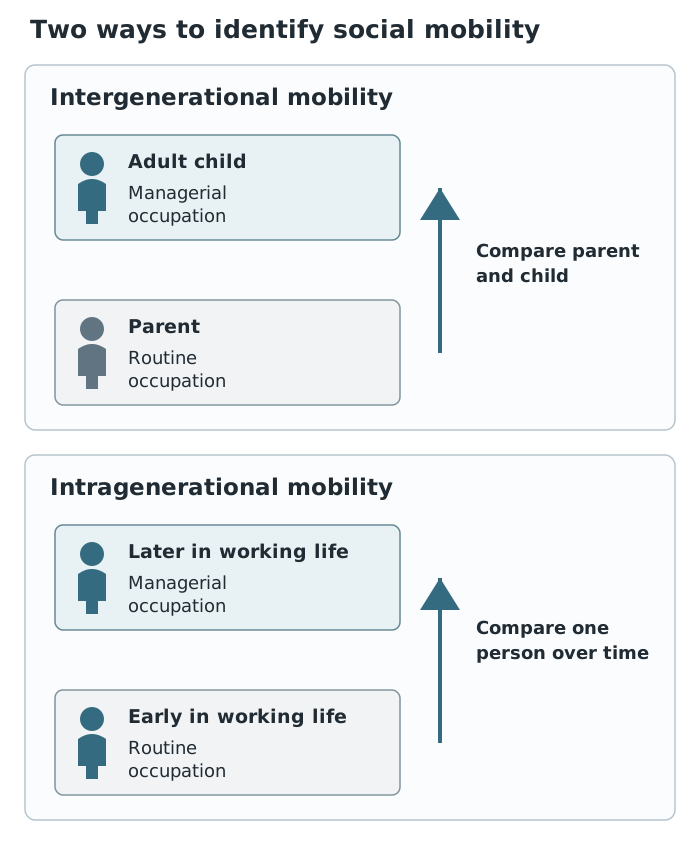
Both examples show upward mobility, but one compares generations and the other follows one person's lifetime.
Mobility can also be downward. Neither type of mobility means that everyone moves upwards or that inherited inequalities have disappeared.
Embourgeoisement is a related but distinct idea: the hypothesis that working-class people become more like the middle class in their attitudes, norms and values as wages and living standards improve. Rising home ownership among the traditional working class is a common example associated with this argument. Its focus is the adoption of middle-class ways of thinking and living, not simply movement into a different occupational class. Becoming better off does not by itself prove that someone's values or class identity have changed.
Life chances are people's opportunities to obtain desirable outcomes and avoid disadvantage. They include access to education, secure employment, good housing and good health. Life expectancy, the average number of years someone is expected to live, is one outcome used when studying unequal life chances.
Resources help explain the connection. Money can support access to suitable housing and educational opportunities. Social networks can provide information and contacts that help people obtain work. Conversely, limited resources and weak access to influential networks can restrict opportunities.
Life chances describe probabilities and opportunities, not a fixed destiny. A person from a disadvantaged background can achieve upward mobility, but this does not show that everyone begins with the same opportunities.
Prejudice is a preconceived judgement about people based on their group membership rather than an assessment of them as individuals. For example, assuming that older workers cannot learn new skills is an age-based prejudice.
Discrimination is unequal treatment because of group membership. Suppose an employer rejects a suitably qualified older applicant simply because of their age. That decision is discrimination. Ageism covers prejudice or discrimination based on age. It can affect younger as well as older people: young people may be dismissed as irresponsible, while older people may be regarded as incapable despite their skills and experience.
Prejudice and discrimination are connected, but one does not automatically prove the other. A person may hold a prejudiced belief without acting on it. Equally, an established organisational practice may disadvantage a group even when the person applying it does not openly express prejudice.
Discrimination may be overt, meaning obvious, or covert, meaning hidden. An openly stated refusal to promote women is overt. A less visible barrier may operate through decisions or practices that disadvantage women without openly announcing that intention.
Gender refers to socially constructed differences between men and women, including expectations about masculinity and femininity, rather than biological differences of sex. Sexism means prejudice or discrimination based on sex or gender. Sex (gender) discrimination specifically concerns unequal treatment on those grounds. For example, assuming that women are unsuitable for leadership is a sexist belief; passing over a qualified woman for promotion because she is a woman is discriminatory treatment.
In contrast, sex (gender) equality means fair and equal treatment regardless of biological sex or gender, such as assessing applicants by relevant qualifications and ability rather than treating their sex or gender as a disadvantage.
The glass ceiling describes an unofficial barrier to women's advancement into higher positions at work. It explains why entry into an occupation does not necessarily bring equal opportunities for promotion. An employer's assumption that a woman will prioritise childcare over her career can restrict advancement despite her ability and performance.
These barriers can reduce access to higher earnings and decision-making power. However, disadvantage varies by outcome: girls' stronger educational performance and men's lower life expectancy show why it is misleading to assume that one gender has better life chances in every area.
Ethnicity is a shared cultural identity associated with characteristics such as ancestry, language, religion and traditions. An ethnic group consists of people sharing such an identity, for example Polish or African-Caribbean communities in Britain. An ethnic minority is an ethnic group that does not form the majority within a particular society, while ethnic diversity describes the presence of a range of different ethnic groups within a community or society.
Racism involves beliefs about racial superiority or inferiority, and attitudes or practices that disadvantage people on racial grounds. Racial discrimination is unequal treatment on those grounds, for example rejecting a qualified applicant because of their perceived race or ethnic background.
Institutional racism concerns the policies, procedures and established practices of organisations that systematically disadvantage people on racial grounds. It is not limited to an individual making an openly racist statement.
For example, suppose an organisation recruits mainly through recommendations from its existing, overwhelmingly white workforce. This practice could repeatedly exclude qualified ethnic minority applicants who lack access to those networks, even without an explicit racial ban. The sociological question is how the recruitment process operates and whom it disadvantages, not simply whether a manager admits to racist beliefs.
Racial discrimination can restrict recruitment and advancement, affecting earnings, security and social mobility. However, an unequal outcome alone does not establish its cause: explanations must examine the practices involved and consider other relevant differences, such as qualifications and economic background. Ethnic minority groups also differ from one another, so their experiences should not be treated as identical.
Social exclusion is broader than a single discriminatory decision. It involves being prevented from participating fully in society. Poor housing, ill health, debt, low status and limited access to work or leisure can reinforce one another, leaving people with fewer opportunities and less influence over decisions affecting them.
Different disadvantages can overlap. An older woman, for example, may face assumptions about both age and gender. This helps explain why studying just one group membership may miss important barriers to opportunity.
A meritocracy allocates positions and rewards according to ability and effort rather than inherited advantage. It is a stronger claim than saying a society is open: movement between classes may be possible even though the chances of moving are unequal.
Arguments that Britain is relatively open point to achieved qualifications and movement into professional or managerial occupations. Improvements in women's and ethnic minorities' opportunities, associated with changing attitudes and challenges to discrimination, also support the argument that positions are not completely fixed at birth.
Against the claim that Britain is fully meritocratic, inherited wealth, family background and influential networks can give some people advantages. Discrimination and glass ceilings can restrict others despite their ability and effort. The royal family also illustrates the continuing existence of ascribed positions.
A justified conclusion distinguishes possibility from equality: Britain allows social mobility, but the existence of mobility alone does not prove that rewards depend only on merit.
Authority is power accepted as legitimate.
Life chances concern opportunities in education, employment, housing and health. Resources, networks and discrimination can shape them.
For: achieved qualifications, social mobility and improved opportunities.
Against: inherited advantages, influential networks and discrimination.
Judgement: an open society is not necessarily fully meritocratic; mobility does not prove equal opportunity. Egalitarian expresses the idea that people are equal.
Distinguish wealth, which is a stock of assets, from income, which is received over time.
For mobility examples, identify both the direction of movement and whether the comparison is between generations or within one person's lifetime.
Do not treat an open society and a meritocracy as identical: movement between classes can occur without everyone having equal opportunities.
Distinguish an unequal outcome from an explanation for it. Explain how resources, social connections or discrimination could produce the difference.
Use group patterns carefully: unequal life chances do not mean that every member of a group has the same experience.
Identify the basis of authority: long-established custom, followers' belief in personal qualities, or recognised rules and an official position.
Distinguish prejudice, an attitude, from discrimination, unequal treatment. Institutional racism concerns organisational practices, not just openly racist individuals.
It can see this note and what your specification asks for.
Answers are free with an account.
1 free note left this week
Get more free notesYour answer sets when this note comes back for review, or marks it complete.
Was this note helpful?
Log in to tell us whether it helped, or to report a problem.
Last updated
Social stratification
The organisation of society into a hierarchy of groups with unequal access to resources, status and power.
Social inequality
Unequal access to resources and opportunities between individuals or social groups.
Social class
A grouping based on similar economic positions, commonly identified through occupation, income and wealth.
Subjective class
How a person sees or identifies their own social class, which may differ from a classification based on occupation, income or wealth.
Upper class
A small, privileged social class at the top of the class hierarchy, associated with substantial wealth, often inherited, and access to high status and influence.
Aristocracy
A privileged part of the upper class holding hereditary titles, such as duke or earl, passed down through families; its members are often wealthy landowners.
Middle class
A social class commonly associated with professional, managerial and other non-manual occupations.
Working class
A social class commonly associated with manual, routine and semi-routine occupations.
Embourgeoisement
The hypothesis that working-class people become more like the middle class in attitudes, norms and values as wages and living standards improve.
Proletarianisation
The idea that some white-collar workers, such as clerical staff, move down into the working class as their work becomes less skilled and more routine.
Wealth
Assets owned, such as property, land, savings and shares.
Income
Money received over time, for example from employment, pensions, benefits or investments.
Affluence
Having substantial money and material possessions.
Wage
Income received from paid work, usually calculated or paid hourly, daily, weekly or monthly.
Employment
Being engaged in paid work, whether as an employee or through self-employment.
Unemployment
Being without a job while actively seeking work and available to start, or having found a job and being due to start it shortly.
Under-employment
Working fewer than full-time hours while being willing to work more hours if they become available.
White collar worker
A worker doing non-manual, usually office-based work that primarily involves mental rather than physical effort.
Market situation
Weber's concept of a person's position in the labour market, where factors such as skills in demand affect employment opportunities, earnings and class position.
Distribution of power and wealth
How power and wealth are shared, or concentrated, among different groups in society.
Status
The prestige or social standing attached to a person, group or social position.
Power
The ability to achieve one's aims or influence others, even when others resist.
Authority
Power accepted as legitimate: people recognise the right of a person or organisation to give instructions.
Traditional authority
Authority accepted because it rests on long-established customs and traditions.
Charismatic authority
Authority accepted because followers believe a leader has exceptional personal qualities.
Legal rational authority
Authority accepted because it rests on recognised laws and rules; it belongs to an official position rather than the individual holding it.
Bureaucracy
An organisational system involving a hierarchy of officials, specialised responsibilities and formal rules and procedures.
Bureaucratic authority
Authority attached to an official position within a bureaucracy and exercised according to formal rules; a form of legal rational authority.
Ascribed status
A social position allocated through birth or characteristics not earned through personal effort.
Achieved status
A social position gained through personal effort, qualifications or accomplishments.
Social mobility
Movement between positions in a social hierarchy, especially movement between social classes.
Intergenerational mobility
Movement in social position identified by comparing a person's position with that of their parents.
Intragenerational mobility
Movement in social position during one person's lifetime.
Open society
A society in which movement between positions in the social hierarchy is possible.
Closed society
A society in which social positions are largely ascribed and movement between levels is severely restricted.
Meritocracy
A system in which rewards and positions are allocated according to ability and effort rather than inherited advantage.
Egalitarian
Expressing the idea that people are equal.
Life chances
The opportunities people have to obtain desirable outcomes, such as good health, education and secure employment, and avoid disadvantage.
Life expectancy
The average number of years a person is expected to live.
Prejudice
A preconceived judgement or attitude towards people based on their membership of a group rather than an assessment of them as individuals.
Discrimination
Unequal treatment of people because of their membership of a social group.
Ageism
Prejudice or discrimination based on a person's age.
Ethnicity
A shared cultural identity associated with characteristics such as ancestry, language, religion and traditions.
Ethnic group
People who share an identity based on cultural traditions or characteristics, such as language or religion.
Ethnic minority
An ethnic group that does not form the majority within a particular society.
Ethnic diversity
The presence of a range of different ethnic groups within a community or society.
Racism
Beliefs that racial groups are superior or inferior, and attitudes or practices that disadvantage people on racial grounds.
Racial discrimination
Unequal treatment of people on racial grounds.
Institutional racism
Organisational policies, procedures or established practices that systematically disadvantage people on racial grounds, whether or not individuals openly express racist beliefs.
Gender
Socially constructed differences between men and women, including ideas about masculinity and femininity, rather than differences based on biological sex.
Sexism
Prejudice or discrimination based on sex or gender, often involving beliefs that one sex is superior to the other.
Sex (gender) discrimination
Unequal treatment of people because of their sex or gender.
Sex (gender) equality
Fair and equal treatment of people regardless of their biological sex or gender.
Glass ceiling
An unofficial barrier that prevents women from reaching higher positions in employment despite their qualifications or ability.
Migration
Movement of people from one area to another within a country or between countries.
Immigration
Moving into another country to live or work there.
Immigrant
A person who has moved to another country to live or work there.
Emigration
Leaving one country to live in another.
Asylum seeker
A person who has left their own country to seek safety and protection in another, often after experiencing persecution.
Assimilation
The process through which immigrants adopt the dominant culture's norms, values and ways of life, moving away from their previous culture.
Multiculturalism
The view that different cultural groups' cultures and identities should be respected and maintained.
Social network
Relationships and connections between people that can provide information, support and access to opportunities.
Elite
A small, privileged group with a disproportionate share of power or resources.
Social exclusion
A process through which people are prevented from participating fully in society and accessing its opportunities and resources.
Caste
A stratification system in which membership is inherited at birth and traditionally linked to particular occupations and restrictions on social relationships.
Feudalism
A stratification system associated with medieval Europe, organised around landownership, with the monarch above lords and knights, and serfs and peasants at the bottom.
Slavery
A system in which people are treated as property, with others claiming ownership of them and control over their labour and freedom.
Put your knowledge into practice — try past paper questions for Sociology
Social stratification
The organisation of society into a hierarchy of groups with unequal access to resources, status and power.
Social inequality
Unequal access to resources and opportunities between individuals or social groups.
Social class
A grouping based on similar economic positions, commonly identified through occupation, income and wealth.
Subjective class
How a person sees or identifies their own social class, which may differ from a classification based on occupation, income or wealth.
Upper class
A small, privileged social class at the top of the class hierarchy, associated with substantial wealth, often inherited, and access to high status and influence.
Aristocracy
A privileged part of the upper class holding hereditary titles, such as duke or earl, passed down through families; its members are often wealthy landowners.
Middle class
A social class commonly associated with professional, managerial and other non-manual occupations.
Working class
A social class commonly associated with manual, routine and semi-routine occupations.
Embourgeoisement
The hypothesis that working-class people become more like the middle class in attitudes, norms and values as wages and living standards improve.
Proletarianisation
The idea that some white-collar workers, such as clerical staff, move down into the working class as their work becomes less skilled and more routine.
Wealth
Assets owned, such as property, land, savings and shares.
Income
Money received over time, for example from employment, pensions, benefits or investments.
Affluence
Having substantial money and material possessions.
Wage
Income received from paid work, usually calculated or paid hourly, daily, weekly or monthly.
Employment
Being engaged in paid work, whether as an employee or through self-employment.
Unemployment
Being without a job while actively seeking work and available to start, or having found a job and being due to start it shortly.
Under-employment
Working fewer than full-time hours while being willing to work more hours if they become available.
White collar worker
A worker doing non-manual, usually office-based work that primarily involves mental rather than physical effort.
Market situation
Weber's concept of a person's position in the labour market, where factors such as skills in demand affect employment opportunities, earnings and class position.
Distribution of power and wealth
How power and wealth are shared, or concentrated, among different groups in society.
Status
The prestige or social standing attached to a person, group or social position.
Power
The ability to achieve one's aims or influence others, even when others resist.
Authority
Power accepted as legitimate: people recognise the right of a person or organisation to give instructions.
Traditional authority
Authority accepted because it rests on long-established customs and traditions.
Charismatic authority
Authority accepted because followers believe a leader has exceptional personal qualities.
Legal rational authority
Authority accepted because it rests on recognised laws and rules; it belongs to an official position rather than the individual holding it.
Bureaucracy
An organisational system involving a hierarchy of officials, specialised responsibilities and formal rules and procedures.
Bureaucratic authority
Authority attached to an official position within a bureaucracy and exercised according to formal rules; a form of legal rational authority.
Ascribed status
A social position allocated through birth or characteristics not earned through personal effort.
Achieved status
A social position gained through personal effort, qualifications or accomplishments.
Social mobility
Movement between positions in a social hierarchy, especially movement between social classes.
Intergenerational mobility
Movement in social position identified by comparing a person's position with that of their parents.
Intragenerational mobility
Movement in social position during one person's lifetime.
Open society
A society in which movement between positions in the social hierarchy is possible.
Closed society
A society in which social positions are largely ascribed and movement between levels is severely restricted.
Meritocracy
A system in which rewards and positions are allocated according to ability and effort rather than inherited advantage.
Egalitarian
Expressing the idea that people are equal.
Life chances
The opportunities people have to obtain desirable outcomes, such as good health, education and secure employment, and avoid disadvantage.
Life expectancy
The average number of years a person is expected to live.
Prejudice
A preconceived judgement or attitude towards people based on their membership of a group rather than an assessment of them as individuals.
Discrimination
Unequal treatment of people because of their membership of a social group.
Ageism
Prejudice or discrimination based on a person's age.
Ethnicity
A shared cultural identity associated with characteristics such as ancestry, language, religion and traditions.
Ethnic group
People who share an identity based on cultural traditions or characteristics, such as language or religion.
Ethnic minority
An ethnic group that does not form the majority within a particular society.
Ethnic diversity
The presence of a range of different ethnic groups within a community or society.
Racism
Beliefs that racial groups are superior or inferior, and attitudes or practices that disadvantage people on racial grounds.
Racial discrimination
Unequal treatment of people on racial grounds.
Institutional racism
Organisational policies, procedures or established practices that systematically disadvantage people on racial grounds, whether or not individuals openly express racist beliefs.
Gender
Socially constructed differences between men and women, including ideas about masculinity and femininity, rather than differences based on biological sex.
Sexism
Prejudice or discrimination based on sex or gender, often involving beliefs that one sex is superior to the other.
Sex (gender) discrimination
Unequal treatment of people because of their sex or gender.
Sex (gender) equality
Fair and equal treatment of people regardless of their biological sex or gender.
Glass ceiling
An unofficial barrier that prevents women from reaching higher positions in employment despite their qualifications or ability.
Migration
Movement of people from one area to another within a country or between countries.
Immigration
Moving into another country to live or work there.
Immigrant
A person who has moved to another country to live or work there.
Emigration
Leaving one country to live in another.
Asylum seeker
A person who has left their own country to seek safety and protection in another, often after experiencing persecution.
Assimilation
The process through which immigrants adopt the dominant culture's norms, values and ways of life, moving away from their previous culture.
Multiculturalism
The view that different cultural groups' cultures and identities should be respected and maintained.
Social network
Relationships and connections between people that can provide information, support and access to opportunities.
Elite
A small, privileged group with a disproportionate share of power or resources.
Social exclusion
A process through which people are prevented from participating fully in society and accessing its opportunities and resources.
Caste
A stratification system in which membership is inherited at birth and traditionally linked to particular occupations and restrictions on social relationships.
Feudalism
A stratification system associated with medieval Europe, organised around landownership, with the monarch above lords and knights, and serfs and peasants at the bottom.
Slavery
A system in which people are treated as property, with others claiming ownership of them and control over their labour and freedom.