Loading…


Loading…
Loading…
Loading…
AQA GCSE Business · 8132
AQA 8132 · Product Development and Lifecycle Check the specification (PDF) (opens in a new tab)
A product portfolio is the range of products or services offered by a business. A drinks business might sell bottled water, fruit juice and energy drinks; a hairdresser might offer haircuts, colouring and styling services.
Businesses can broaden their portfolios by developing new products or improving existing ones to create additional offerings. This can encourage existing customers to buy more and attract customers with different needs. A wider range can also reduce dependence on one product or market: if demand for one product falls, sales elsewhere may help support the business.
However, a larger portfolio is not automatically better. Developing and supporting additional products requires money, staff time and other resources. Businesses therefore need to consider not just how many products they offer, but how those products work together financially.
The Boston Matrix, also called the Boston Box, helps managers analyse a portfolio and decide where to direct resources. It classifies products using two measures:
These measures answer different questions. A business’s energy drink could have a small share of a rapidly expanding energy-drink market. Meanwhile, its bottled water could have a large share of a market growing very slowly.
The product life cycle follows one product’s sales over time. The Boston Matrix instead compares the positions of products across a portfolio using market share and market growth.
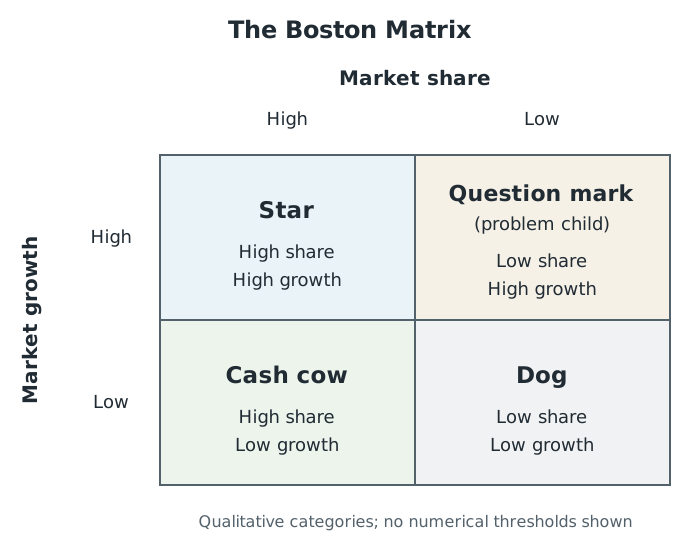
Classify each product using both its market share and the growth of its whole market.
A star has high market share in a high-growth market. It is doing well in a market with opportunities for further expansion.
Stars can generate substantial revenue, but they often need continued investment to maintain their position as competitors try to capture the growing market. Managers may fund promotion or additional production capacity rather than assume that a successful product needs no support.
If market growth later slows while the product keeps its high market share, a star can become a cash cow.
A cash cow has high market share in a low-growth market. It is usually well established, so it may need less investment than a product competing in a rapidly growing market.
Cash cows can provide a steady source of cash. Managers can use this money to support stars or develop promising question marks. They still need to maintain the product’s appeal and market position; ‘cash cow’ does not mean a product can simply be ignored.
A question mark, also called a problem child, has low market share in a high-growth market. The market offers opportunities, but the product has not yet secured a strong position.
Investment in developing, promoting or distributing the product may help it gain market share and become a star. However, this outcome is uncertain. Spending heavily on a product that customers do not choose could waste funds, so managers must decide which question marks have the strongest prospects.
A dog has low market share in a low-growth market. It has a weak competitive position and limited opportunities to benefit from market expansion.
Managers may reduce investment or stop selling the product, releasing resources for products with better prospects. Withdrawal is not automatic, however: the business should consider whether the product still earns a worthwhile return or could be improved.
Consider this fictional drinks business. The descriptions illustrate how to classify products; they are not claims about real brands.
| Product | Position in its market | Category |
|---|---|---|
| Energy drink | High share of a rapidly growing market | Star |
| Bottled water | High share of a slowly growing market | Cash cow |
| New fruit drink | Low share of a rapidly growing market | Question mark |
| Older fizzy drink | Low share of a slowly growing market | Dog |
The business could use cash from bottled water to support its energy drink and invest selectively in the new fruit drink. It could review whether continuing the older fizzy drink is worthwhile. These decisions depend on available finance and the prospects of each product, not simply its category.
A balanced portfolio combines products that generate cash now with products that offer future growth. This is not a requirement to have equal numbers in each box.
A portfolio dominated by question marks may need more investment than the business can afford. One dominated by cash cows may provide cash today but lack opportunities for future growth. Many dogs may tie up resources without offering strong prospects.
The matrix therefore helps a business connect marketing decisions with finance and operations: funds generated by established products can support selected growth opportunities, while production and staffing must be able to deliver them. It is a planning aid, not a guarantee of success; market share and market growth alone do not reveal every product’s costs, profitability or customer appeal.
Get unlimited access to all revision notes, key terms, and exam tips.
| Category | Market share | Market growth | Typical decision |
|---|---|---|---|
| Star | High | High | Invest to maintain its strong position |
| Cash cow | High | Low | Maintain; use generated cash to fund other products |
| Question mark / problem child | Low | High | Invest selectively if prospects justify the risk |
| Dog | Low | Low | Review; reduce investment or consider withdrawal |
Get unlimited access to all revision notes, key terms, and exam tips.
Identify both market share and market growth when explaining a product’s Boston Matrix category.
Market growth refers to growth of the whole market, not just the sales of one business’s product.
Apply recommendations to the business: explain which products could provide funds, which need investment and whether the business can afford it.
Do not assume that every dog should be withdrawn or every question mark will become a star. Justify the decision using the information given.
A balanced portfolio does not mean having equal numbers of products in all four categories.
Product portfolio
The range of products or services offered by a business.
Boston Matrix
A tool for analysing a business’s product portfolio by classifying products according to market share and market growth. It is also called the Boston Box.
Market share
The percentage of total sales in a market accounted for by a business or its product.
Market growth
The increase in total sales across a market over time.
Star
A product with high market share in a high-growth market.
Cash cow
A product with high market share in a low-growth market.
Question mark
A product with low market share in a high-growth market; also called a problem child.
Dog
A product with low market share in a low-growth market.
Put your knowledge into practice — try past paper questions for Business
Product portfolio
The range of products or services offered by a business.
Boston Matrix
A tool for analysing a business’s product portfolio by classifying products according to market share and market growth. It is also called the Boston Box.
Market share
The percentage of total sales in a market accounted for by a business or its product.
Market growth
The increase in total sales across a market over time.
Star
A product with high market share in a high-growth market.
Cash cow
A product with high market share in a low-growth market.
Question mark
A product with low market share in a high-growth market; also called a problem child.
Dog
A product with low market share in a low-growth market.