Loading…


Loading…
Loading…
Loading…
AQA GCSE Business · 8132
AQA 8132 · Product Development and Lifecycle Check the specification (PDF) (opens in a new tab)
The product life cycle describes the stages a product or service passes through, from its development to its eventual decline in sales. It helps a business understand how demand might change and decide how to respond.
Demand means customers' willingness and ability to buy a product. A life cycle diagram normally plots sales against time, using sales to show the pattern of customer demand. The height of the curve shows the level of sales; its slope shows whether sales are rising, staying steady or falling.
During research and development, the business investigates customer needs, designs the product and tests it before launch. For a service, this might involve developing and testing what customers will receive rather than making a physical item.
There are no sales of the new product yet, but research, design and testing cost money. The business therefore needs funding before it earns sales revenue from the product. This stage is part of the life cycle even though the product is not yet available for customers to buy.
Introduction begins when the product is launched. Sales are usually low and increase slowly because many customers do not yet know about it or are unsure whether to try it.
Advertising can explain its benefits and build awareness. The business may also need to establish distribution so customers can actually obtain it. With low sales and launch costs to cover, a successful launch does not necessarily mean the product is already profitable.
During growth, sales increase rapidly as more customers become aware of the product and decide to buy it. Recommendations and repeat purchases can help demand grow.
The business needs enough production or service capacity to meet this demand. For example, a manufacturer may need to make more units, while a service business may need more staff. Marketing can focus on keeping customers loyal as competing products become available.
During maturity, sales remain high, but their rate of growth slows and may level off. Much of the potential market has already been reached, so attracting additional customers becomes harder.
A mature product can still be valuable: it may generate substantial revenue from established customers. The challenge is to maintain those sales against competition and changing customer preferences. This is often a suitable time to consider an extension strategy rather than waiting for a steep decline.
During decline, sales fall. Customers may switch to newer technology, prefer different styles or find a rival product more attractive. Decline means a downward sales trend, not necessarily that sales have already become very low.
The business must decide whether to invest in extending the product's life, reduce spending on it or eventually withdraw it. Spending more is unlikely to be worthwhile if customers no longer have a use for the product.
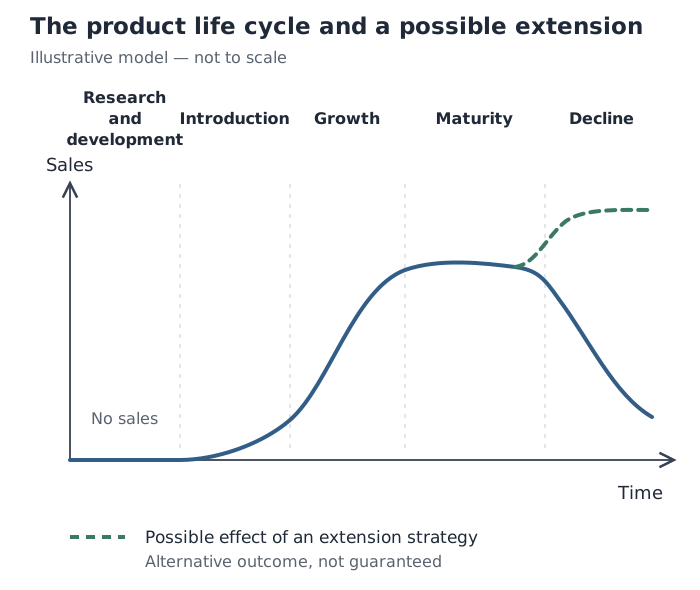
A typical sales pattern, not a forecast. An extension strategy may renew sales or delay decline, but success is not guaranteed.
Read the diagram from left to right. The steep upward section represents growth; the high, flatter section represents maturity; the downward section represents decline. The alternative extension path shows what a business hopes to achieve, not a guaranteed result.
The life cycle is a model, not a fixed timetable. Products can spend very different lengths of time at each stage. Some fail soon after introduction, while others remain mature for many years. Businesses should examine actual sales trends rather than assume that a product must decline simply because it is old.
An extension strategy aims to maintain or increase sales of an existing product and delay its decline. Strategies are often used during late maturity or decline, although acting before sales fall sharply may be more effective.
The right approach depends on why interest is weakening. A tired appearance, missing features, an exhausted target market and a price customers cannot afford are different problems, so they need different responses.
New packaging can make a familiar product look fresh and attract attention without changing the product itself. Coca-Cola has used people's names and place names on bottles of Coca-Cola and Diet Coke, giving customers a new reason to notice an established drink.
This approach is suitable when customers still value the product but its presentation has become less appealing. However, redesigning and producing packaging costs money, and customers may dislike the change. Attractive packaging is unlikely to solve a problem with the product's usefulness or quality.
A business can improve what a product does or offer a new variation. Cadbury's Wispa Gold, which contains caramel, illustrates how a different feature can renew interest in an existing product range.
This is suitable when customers want something the current product lacks. A useful improvement can attract new buyers and encourage existing customers to buy again. However, development and production changes can be expensive and take time. Features will only help if customers value them enough to buy the product.
A business can seek customers in a different age group, country or other market segment. This gives the product another potential source of demand when sales to its existing customers have stopped growing.
The strategy is suitable if the product meets the needs of a group the business has not previously reached. Advertising, presentation or features may need to change to appeal to that group. Market research and reaching new customers require investment, and a product popular with one group may not appeal to another.
Renewed advertising can remind existing customers of a product's benefits and introduce it to people who have not bought it before. Kellogg's continued advertising of Corn Flakes illustrates how promotion can support a long-established product.
Advertising is suitable when the product remains appealing but awareness or interest needs strengthening. It can also support a change of target market. However, campaigns cost money and may produce only a temporary boost. If customers are leaving because the product is outdated, advertising alone may not address the reason for decline.
A lower price can encourage price-sensitive customers to buy and make a product more competitive. It may be suitable when customers still want the product but consider it too expensive compared with alternatives.
The trade-off is that the business receives less revenue from each unit sold. If costs per unit stay the same, it also earns less profit per unit. Sales volume must rise sufficiently to compensate, and a lower price may weaken a premium image. Reducing prices to clear remaining stock is not necessarily a successful extension: it may simply help the business withdraw the product.
An effective strategy must do more than briefly raise sales. The business should compare the likely extra revenue with the costs of the strategy and consider how long any improvement might last.
For a technological product losing customers because it lacks useful functions, adding features may be more suitable than changing its packaging. For a familiar product that still satisfies customers but is being overlooked, refreshed packaging and advertising may be a better fit. Strategies can be combined, but a larger programme also requires more funding.
Ultimately, the decision depends on customer needs, the reason for declining demand, the business's resources and the likely financial return. Extending a product's life is not always better than withdrawing it.
Get unlimited access to all revision notes, key terms, and exam tips.
Research and development → introduction → growth → maturity → decline
On a sales–time graph, height = sales level; slope = sales trend. The model does not predict fixed stage lengths.
| Strategy | Suitable when… | Main limitation |
|---|---|---|
| Update packaging | The product still appeals but looks tired | Cost; customers may dislike it |
| Add more or different features | Customers want improvements or variety | Development cost and time; features may not appeal |
| Change target market | Another customer group could want the product | Research and marketing costs; uncertain demand |
| Advertise | Awareness or interest needs renewing | Expense; boost may be temporary |
| Reduce price | Price is discouraging potential buyers | Less profit per unit if unit costs are unchanged |
Usually consider extension during late maturity or decline. Match the strategy to the cause of falling demand.
Weigh likely sales gains and their duration against costs, budget and customer response. Higher sales do not automatically mean higher profit. Withdrawal may be better if little demand remains.
Get unlimited access to all revision notes, key terms, and exam tips.
Identify a life cycle stage from the sales trend, not just the sales level: high but falling sales indicate decline, not maturity.
For an extension strategy, explain the chain: action → customer response → effect on sales → possible effect on profit.
Evaluate suitability using the business's budget, target market and reason for declining sales. A strategy that works for one product may not work for another.
Do not assume that higher sales mean higher profit. Advertising, product changes and price reductions can all affect profitability.
Make a justified recommendation rather than simply listing the advantages and disadvantages of every strategy.
Product life cycle
The stages a product or service passes through from research and development to introduction, growth, maturity and decline, showing how its sales may change over time.
Research and development
The stage before launch when a business researches customer needs and designs, develops and tests a product.
Introduction
The stage when a product is launched onto the market and sales are usually low and grow slowly.
Growth
The stage when a product's sales increase rapidly as more customers buy it.
Maturity
The stage when a product's sales remain high but sales growth slows or levels off.
Decline
The stage when a product's sales fall over time.
Extension strategy
An action intended to maintain or increase sales of an existing product, delaying its decline and extending its life.
Target market
The particular group of customers a business aims to sell its product or service to.
Put your knowledge into practice — try past paper questions for Business
Product life cycle
The stages a product or service passes through from research and development to introduction, growth, maturity and decline, showing how its sales may change over time.
Research and development
The stage before launch when a business researches customer needs and designs, develops and tests a product.
Introduction
The stage when a product is launched onto the market and sales are usually low and grow slowly.
Growth
The stage when a product's sales increase rapidly as more customers buy it.
Maturity
The stage when a product's sales remain high but sales growth slows or levels off.
Decline
The stage when a product's sales fall over time.
Extension strategy
An action intended to maintain or increase sales of an existing product, delaying its decline and extending its life.
Target market
The particular group of customers a business aims to sell its product or service to.