

Loading…
Loading…
Loading…
Eduqas GCSE Food Preparation and Nutrition · C560
Eduqas C560 · Making Sauces Check the specification (PDF) (opens in a new tab)
A sauce adds flavour and moisture to a dish. A reduction sauce becomes thicker because heating removes some of its water by evaporation. Tomato pasta sauce, curry sauce, gravy and meat sauce can all be reduced in this way.
As a sauce simmers, water changes into water vapour and escapes into the air. The amount of sauce decreases, while ingredients such as tomato solids, salt and spices become more concentrated in the remaining liquid. This makes the flavour stronger. With less water relative to its other ingredients, the sauce also becomes thicker: its viscosity, or resistance to flowing, increases.
Imagine a watery tomato sauce that runs straight off a spoon. After reduction, it flows more slowly and coats the spoon and pasta more effectively. No flour needs to be added: here, removing water is the thickening method, rather than starch gelatinisation.
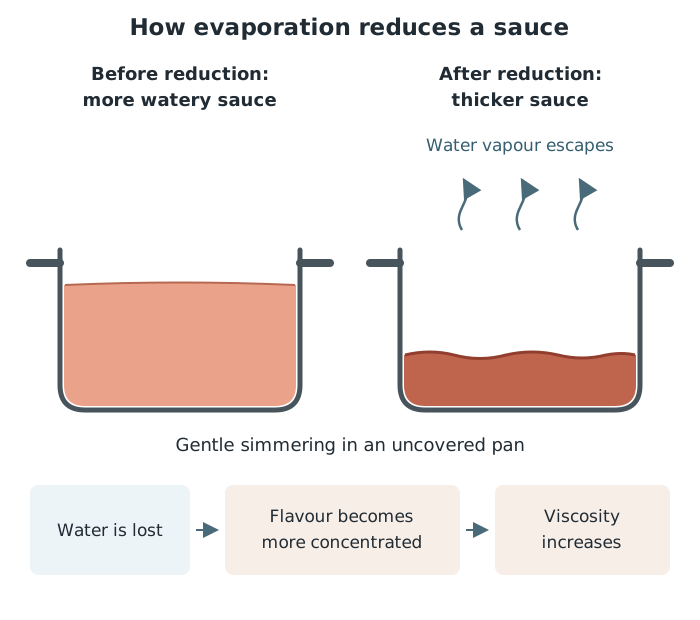
Reduction removes water, leaving a smaller volume of thicker, more strongly flavoured sauce.
A tomato sauce provides a clear way to demonstrate reduction. For a batch of eight portions, prepare 4 tablespoons of olive oil, 2 finely chopped onions, 2 finely chopped carrots, 2 finely chopped celery sticks, 2 crushed garlic cloves, 2 bay leaves, 1 teaspoon of sugar, four 400 g cans of chopped tomatoes and 150 ml of water.
Wash your hands and prepare the vegetables on a stable chopping board, keeping fingers away from the knife blade. Use a pan large enough to hold the ingredients safely, and turn its handle away from the edge of the hob.
This method produces a very thick sauce, reduced by roughly two-thirds of its starting volume. Larger batches may take longer. Look for a lower sauce level, less watery liquid and a sauce that coats a spoon rather than running off immediately. The vegetables should also be tender.
Keep your face and hands away from rising steam, and take care with hot splashes. Use a clean spoon for tasting and allow the sample to cool first. Remove the bay leaves before serving.
A gentle simmer gives you control over reduction. A vigorous boil can cause splashing and make it harder to prevent the sauce catching. Leaving the pan uncovered lets vapour escape rather than condensing on a lid and dripping back into the sauce.
Stop when the sauce has the consistency needed for its dish. A pasta sauce should cling to the pasta; a gravy still needs to pour. Too much reduction can leave a sauce overly thick or strongly seasoned. If the tomato sauce becomes too thick, stir in a small splash of water to loosen it.
Taste again near the end before adding more seasoning. Salt and other flavouring ingredients become more concentrated as water is lost, so seasoning that seemed mild at the start may be strong enough after reduction.
Reduction can also thicken a sauce containing meat, myco-protein, such as Quorn mince, or textured vegetable protein (TVP). The protein ingredient changes the dish, but water still needs to escape for reduction to occur.
For example, a Quorn Bolognese can begin with softened onion, carrot, celery and garlic. Add 400 g chopped tomatoes, 200 ml vegetable stock, 1 tablespoon tomato purée and 1 teaspoon dried mixed herbs, then simmer gently for about 15 minutes. Add 300 g Quorn mince and simmer for another 10 minutes, until the vegetables are cooked and the sauce has thickened.
Follow the product instructions when preparing meat alternatives, including any soaking needed for dried TVP. If using raw meat, keep it and its utensils separate from ready-to-eat food and cook it thoroughly according to the recipe. A thick sauce is evidence of reduction, not proof that meat is safely cooked.
Heat the sauce → water evaporates → volume decreases → flavour becomes more concentrated → viscosity increases.
Reduction thickens by removing water, not by adding starch.
Tomato pasta sauce, curry sauce, gravy and meat sauce can be reduced. Meat sauces may use meat, myco-protein or TVP.
Avoid steam and splashes. Cook protein ingredients according to their instructions; sauce thickness alone does not show that meat is safely cooked.
Explain the full chain: water evaporates → less liquid remains → flavour becomes more concentrated and viscosity increases.
Reduction does not mean adding flour. Starch gelatinisation and reduction are different thickening methods.
Judge the endpoint by the sauce’s consistency as well as the cooking time; larger quantities can take longer to reduce.
For a practical explanation, include heat control, stirring to prevent catching and the signs that the sauce is ready.
It can see this note and what your specification asks for.
Answers are free with an account.
1 free note left this week
Get more free notesYour answer sets when this note comes back for review, or marks it complete.
Was this note helpful?
Log in to tell us whether it helped, or to report a problem.
Last updated
Reduction sauce
A sauce thickened by heating it so that some of its water evaporates.
Evaporation
The change of liquid water into water vapour, which escapes from the surface of a sauce during reduction.
Viscosity
A liquid’s resistance to flowing. A sauce with higher viscosity is thicker and flows less readily.
Simmering
Cooking a liquid gently with small bubbles, rather than a vigorous rolling boil.
Flavour concentration
An increase in the amount of flavour-producing ingredients relative to the water remaining in a sauce.
Put your knowledge into practice — try past paper questions for Food Preparation and Nutrition
Reduction sauce
A sauce thickened by heating it so that some of its water evaporates.
Evaporation
The change of liquid water into water vapour, which escapes from the surface of a sauce during reduction.
Viscosity
A liquid’s resistance to flowing. A sauce with higher viscosity is thicker and flows less readily.
Simmering
Cooking a liquid gently with small bubbles, rather than a vigorous rolling boil.
Flavour concentration
An increase in the amount of flavour-producing ingredients relative to the water remaining in a sauce.