

Loading…
Loading…
Loading…
Eduqas GCSE Food Preparation and Nutrition · C560
Eduqas C560 · Making Sauces Check the specification (PDF) (opens in a new tab)
A white sauce can coat pasta, hold ingredients together or provide a smooth base for other flavours. Its success depends on both the method used and the proportions of ingredients. Flour supplies starch, milk supplies liquid, and fat is used in the roux and all-in-one methods.
Gelatinisation is the thickening of a liquid when starch is heated with it. As the mixture heats, starch granules absorb liquid and swell. They eventually burst, releasing starch into the surrounding liquid and making the sauce thicker. Both heat and liquid are needed: simply mixing flour into cold milk does not produce a cooked, thickened sauce.
The starch must be distributed evenly before and during thickening. If it collects in clumps, the outside can thicken while dry flour remains trapped inside, producing lumps rather than a smooth sauce.
Viscosity means resistance to flowing. A thin sauce has low viscosity and pours readily; a thick sauce has higher viscosity and flows less easily.
With the amount of liquid kept the same, increasing the starch produces a thicker sauce. With the amount of starch kept the same, adding more liquid produces a thinner sauce. The right consistency therefore depends on what the sauce needs to do.
These white-sauce proportions show how the same volume of milk can produce different consistencies:
| Intended consistency | Milk | Fat | Flour | Finished character and use |
|---|---|---|---|---|
| Pouring | 500 ml | 30 g | 30 g | At boiling point, thinly coats the back of a spoon and pours freely; suitable for a pouring sauce such as custard. |
| Coating | 500 ml | 50 g | 50 g | At boiling point, coats the back of a spoon; suitable for macaroni cheese. |
| Binding, or panada | 500 ml | 100 g | 100 g | Thick enough to bind dry ingredients together; suitable for fish cakes. |
These are practical guides, not one recipe for every sauce. Notice that the milk volume stays constant while the flour increases. It is the starch-to-liquid proportion that explains the increase in thickness.
A roux is a cooked mixture of flour and fat. Preparing it first helps distribute the flour before the liquid is added. For a coating white sauce, use 50 g fat, 50 g flour and 500 ml milk.
Before starting, wash your hands, use clean equipment and measure the ingredients. Keep the saucepan handle turned away from the edge of the hob. Hot sauce can splash and cause burns, so stir carefully and use a dry oven glove when handling hot cookware.
The roux stage prepares the flour and fat mixture; the sauce thickens through gelatinisation after the milk has been added and the mixture is heated.
The all-in-one method makes a white sauce without preparing a roux separately. Put the measured fat, flour and cold milk into the saucepan together. Heat gently, whisking continuously to keep the flour evenly dispersed and prevent lumps. Bring to the boil, then lower the heat and simmer for about 3 minutes until the sauce is thickened and glossy. Remove from the heat before adding seasoning or cheese.
A separate blended method is commonly used with cornflour or arrowroot, often for sweet sauces. First mix the starch with a small amount of cold liquid to make a thin, smooth paste. Heat the remaining liquid to boiling, then carefully pour it over the paste while stirring. Return the mixture to the saucepan and bring it to the boil, stirring continuously. Remove it from the heat once it has thickened. Sugar and flavouring can then be added to a cornflour sauce.
These methods use different ways of distributing starch, but all rely on heating starch with liquid to thicken the sauce.
Conduction transfers heat through direct contact. On a solid hotplate, heat passes from the hotplate into the metal saucepan base touching it, then through the metal and into the sauce touching the hot base and sides.
Convection transfers heat through movement within the liquid. Warmer liquid rises, while cooler liquid moves down to replace it, setting up circulating currents that carry heat through the sauce.
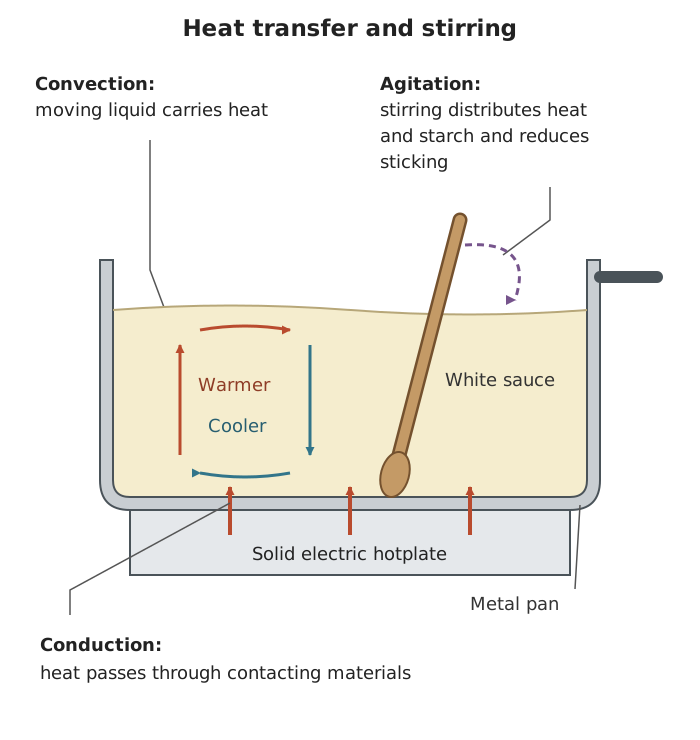
The hotplate touches the pan: conduction transfers heat through the metal into adjacent sauce. Convection and stirring distribute heat through the mixture.
As the sauce becomes more viscous, it circulates less readily. Agitation, through stirring or whisking, helps move the sauce and distribute heat evenly. It also keeps starch dispersed and moves sauce away from the hot base, reducing lumps, sticking and burning. Stirring therefore supports both a smooth texture and even cooking; it is not a substitute for controlling the heat.
An infusion flavours a liquid by leaving ingredients in it before straining them out. This changes flavour without leaving pieces in the finished smooth sauce.
For an infused béchamel, put a small piece of carrot, a small onion, six whole peppercorns and one bay leaf into the milk. Bring it very slowly to the boil, then leave it to infuse for about 20 minutes. Carefully strain out the flavouring ingredients and use the milk to make the sauce by the roux method. Handle the hot milk and strainer carefully to avoid splashes.
Velouté uses stock instead of milk, thickened by the roux method. It is often simmered for longer to allow flavours to develop and infuse. Béchamel and velouté can be used in fillings for vol-au-vents. Changing the liquid or flavourings changes the sauce’s character, while starch gelatinisation remains the thickening process.
Link each action to its purpose: gradual liquid addition and continuous beating help prevent lumps; stirring across the base helps prevent sticking and burning.
Explain gelatinisation using both heat and liquid: starch granules absorb liquid, swell and burst, thickening the sauce.
When comparing thickness, state what stays constant: more starch with the same amount of liquid produces a more viscous sauce.
Distinguish the heat-transfer routes: conduction through the metal pan and into sauce touching it; convection through movement within the liquid.
Keep a white roux pale. Browning the butter or flour changes the intended colour and flavour.
It can see this note and what your specification asks for.
Answers are free with an account.
1 free note left this week
Get more free notesYour answer sets when this note comes back for review, or marks it complete.
Was this note helpful?
Log in to tell us whether it helped, or to report a problem.
Last updated
Gelatinisation
The thickening of a liquid when starch is heated with it: starch granules absorb liquid, swell and burst, releasing starch into the surrounding liquid.
Viscosity
A fluid’s resistance to flowing. A highly viscous sauce is thick and flows less readily than a sauce with low viscosity.
Roux
A cooked mixture of flour and fat used as the starting point for a starch-thickened sauce.
All-in-one method
A sauce-making method in which fat, flour and liquid are combined at the start, then heated while being whisked.
Conduction
Heat transfer through direct contact, from a hotter region to a cooler region.
Convection
Heat transfer through the movement of a liquid or gas, with warmer material rising and cooler material moving in to replace it.
Agitation
Movement caused by stirring, beating or whisking to mix ingredients and distribute heat.
Infusion
Allowing ingredients to flavour a liquid before they are removed, for example steeping onion and bay leaf in warm milk.
Béchamel
A white sauce made using milk, which can be infused with flavouring ingredients before being thickened with a roux.
Velouté
A sauce made by thickening stock rather than milk using a roux.
Put your knowledge into practice — try past paper questions for Food Preparation and Nutrition
Gelatinisation
The thickening of a liquid when starch is heated with it: starch granules absorb liquid, swell and burst, releasing starch into the surrounding liquid.
Viscosity
A fluid’s resistance to flowing. A highly viscous sauce is thick and flows less readily than a sauce with low viscosity.
Roux
A cooked mixture of flour and fat used as the starting point for a starch-thickened sauce.
All-in-one method
A sauce-making method in which fat, flour and liquid are combined at the start, then heated while being whisked.
Conduction
Heat transfer through direct contact, from a hotter region to a cooler region.
Convection
Heat transfer through the movement of a liquid or gas, with warmer material rising and cooler material moving in to replace it.
Agitation
Movement caused by stirring, beating or whisking to mix ingredients and distribute heat.
Infusion
Allowing ingredients to flavour a liquid before they are removed, for example steeping onion and bay leaf in warm milk.
Béchamel
A white sauce made using milk, which can be infused with flavouring ingredients before being thickened with a roux.
Velouté
A sauce made by thickening stock rather than milk using a roux.