

Loading…
Loading…
Loading…
Eduqas GCSE Food Preparation and Nutrition · C560
Eduqas C560 · Making Sauces Check the specification (PDF) (opens in a new tab)
Oil and water are immiscible: they do not normally mix. Vinegar contains water, so oil and vinegar also separate into layers when left standing. Yet these ingredients can be combined into a smooth sauce by forming an emulsion — tiny droplets of one liquid dispersed through another.
Whisking breaks oil into small droplets and spreads them through the watery liquid. This process is called emulsification. The oil has not dissolved: it is still present as droplets, but they are small enough for the mixture to look uniform.
A simple oil-and-vinegar dressing demonstrates a temporary emulsion. Shaking or whisking brings the ingredients together, but the droplets gradually join together again and the dressing separates. It needs mixing again before serving.
A stabilised emulsion resists separation because it contains an emulsifier. Egg yolk contains an emulsifier called lecithin, which makes it useful in mayonnaise and hollandaise.
An emulsifier has a part attracted to water and a part attracted to fat. It acts at the boundary between an oil droplet and the surrounding watery liquid, helping prevent droplets from joining together. Whisking creates the droplets; the emulsifier helps keep them separate. Both are important.
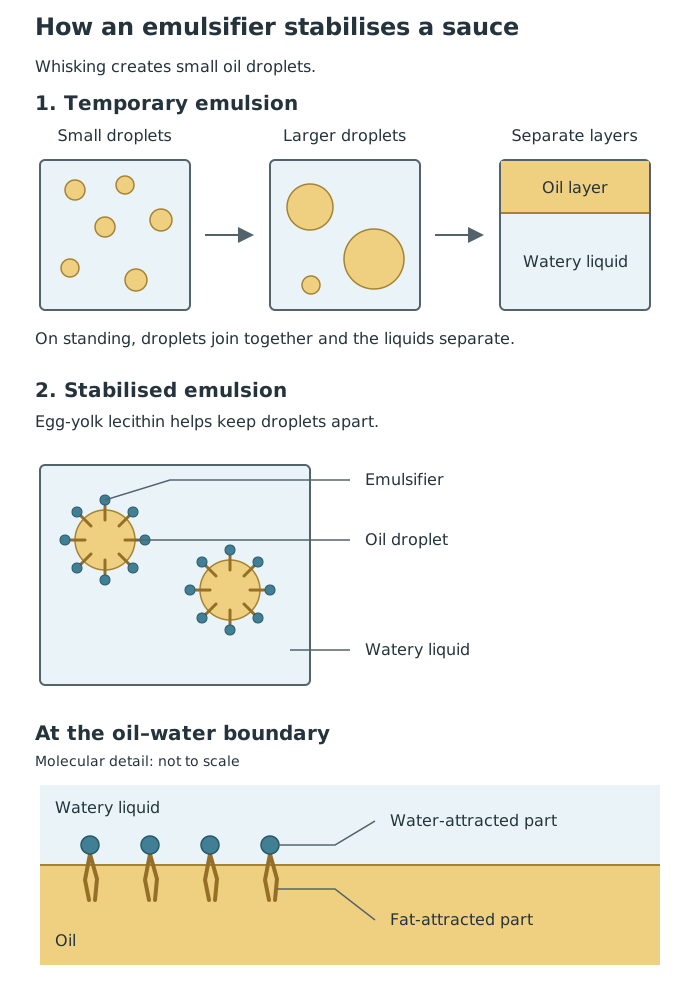
Whisking disperses oil into droplets; an emulsifier helps prevent them joining together again.
In mayonnaise, oil droplets are dispersed through the watery ingredients supplied by the egg yolk and vinegar or lemon juice. As more oil is incorporated as small droplets, the sauce becomes thick and creamy rather than forming a separate oily layer.
Mayonnaise is a useful way to demonstrate the technical skill of making a stabilised emulsion. For one batch, use 3 egg yolks, 2 teaspoons of vinegar or lemon juice, ½ teaspoon of English mustard, 250 ml of olive oil and a small pinch of salt. Have 1 teaspoon of boiling water available to thin the sauce if needed.
Use a large bowl and a balloon whisk. Set the bowl on a damp cloth so that it stays steady while you whisk and pour.
The important control is not simply how long you whisk: it is coordinating small additions of oil with thorough whisking. Adding oil faster than you can incorporate it can cause the sauce to split, leaving visible oil and a less uniform mixture.
Mayonnaise is not cooked, so use pasteurised egg yolks where possible, particularly when serving people who are more vulnerable to foodborne illness. Wash your hands after handling eggs, use clean equipment and prevent raw egg from contaminating other foods. Keep the finished mayonnaise refrigerated rather than leaving it at room temperature.
Take care with boiling water: add only a small amount and avoid splashing. Thinning mayonnaise with boiling water does not cook the whole sauce or make raw egg safe.
Hollandaise uses melted butter rather than oil, but the same principle applies: disperse the fat gradually and use egg yolk to stabilise the droplets.
Whisk egg yolks with a little reduced white wine vinegar in a heatproof bowl over a pan of simmering water. Whisk continuously until a golden, foam-like mixture forms. Remove it from the heat, then gradually whisk in melted, skimmed butter until the sauce has a thick, mayonnaise-like consistency. A little warm water can loosen it if necessary.
Gentle heating and continuous whisking matter here: excessive heat can cook the yolks into lumps instead of producing a smooth sauce. Keep the bowl above, rather than in contact with, the simmering water, and use oven gloves when handling the hot bowl. Avoid the rising steam. The successful result is a smooth, thick sauce without separate pools of butter.
Whisk yolks, vinegar or lemon juice, mustard and seasoning → add oil a little at a time → whisk each addition in fully → continue until smooth and thick.
When explaining a stabilised emulsion, link whisking to the formation of small oil droplets and the emulsifier to preventing those droplets from joining together.
Describe the practical control: add a little oil, whisk until incorporated, then add more. Simply listing the ingredients does not explain the technique.
Do not describe oil as dissolving in vinegar: it is dispersed as droplets.
Distinguish a temporary vinaigrette emulsion from a stabilised sauce such as mayonnaise.
It can see this note and what your specification asks for.
Answers are free with an account.
1 free note left this week
Get more free notesYour answer sets when this note comes back for review, or marks it complete.
Was this note helpful?
Log in to tell us whether it helped, or to report a problem.
Last updated
Emulsion
A mixture containing tiny droplets of one liquid dispersed through another liquid with which it would not normally mix.
Emulsification
The process of dispersing one liquid as tiny droplets through another liquid with which it would not normally mix.
Emulsifier
A substance that helps prevent the droplets in an emulsion from joining together and separating into a layer.
Lecithin
An emulsifier found in egg yolk that helps keep oil droplets dispersed in mayonnaise.
Stabilised emulsion
An emulsion in which an emulsifier helps the dispersed droplets remain separate, so the mixture resists separating into layers.
Immiscible
Describes liquids, such as oil and water, that do not normally mix together.
Put your knowledge into practice — try past paper questions for Food Preparation and Nutrition
Emulsion
A mixture containing tiny droplets of one liquid dispersed through another liquid with which it would not normally mix.
Emulsification
The process of dispersing one liquid as tiny droplets through another liquid with which it would not normally mix.
Emulsifier
A substance that helps prevent the droplets in an emulsion from joining together and separating into a layer.
Lecithin
An emulsifier found in egg yolk that helps keep oil droplets dispersed in mayonnaise.
Stabilised emulsion
An emulsion in which an emulsifier helps the dispersed droplets remain separate, so the mixture resists separating into layers.
Immiscible
Describes liquids, such as oil and water, that do not normally mix together.
Success: uniform sauce, no separate oil. Control oil addition and whisking together.
Whisk yolks and reduced vinegar gently over simmering water → remove from heat → gradually whisk in melted butter.
Avoid excessive heat, which can make the yolks form lumps.
Use clean equipment, prevent raw-egg contamination and refrigerate mayonnaise. Prefer pasteurised yolks, especially for vulnerable people. Protect against hot water, bowls and steam.