

Loading…
Loading…
Loading…
Eduqas GCSE Design and Technology · C600
Eduqas C600 · Prototyping Techniques and Assembly Check the specification (PDF) (opens in a new tab)
Joining turns separate plastic components into an assembly. The best method depends on more than strength: consider whether the product must open, whether damaged parts need replacing, and whether the plastic can tolerate heat or pressure from a fastener.
A permanent joint is not intended to be taken apart without damaging the joint or destroying its fastener. Plastic welding and riveting are examples. A temporary joint can be undone and reassembled without damaging the parts; nuts and bolts or removable screws can provide this.
A lid introduces another requirement. It may need to stay connected while opening, using a hinge, and remain shut when closed, using a catch. These fittings provide movement and closure rather than simply fixing two parts rigidly together.
In hot gas plastic welding, a welding gun directs heated air onto the edges being joined and onto a plastic welding rod. Both soften and melt locally. Pressure brings the molten material together so that it fuses; cooling produces a solid, permanent joint.
This process works with thermoforming plastics, also called thermoplastics, because they can be softened and melted repeatedly. Thermosetting plastics have cross-linked structures that prevent them from melting and flowing again, so they cannot be joined by this hot gas welding process.
The rod and the parts must be the same compatible material and chemical type. A rod that looks similar is not necessarily suitable. Common weldable materials include polypropylene, polyethylene and PVC. Hot gas welding is used in products such as plastic ventilation ducting and in repairs to plastic mouldings.
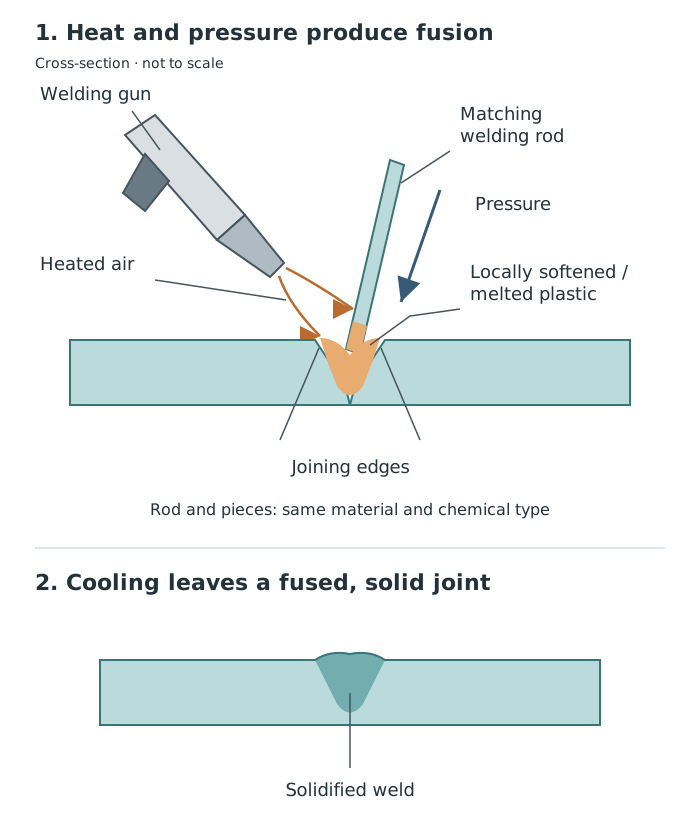
Heated air softens the matching rod and joining surfaces; pressure brings them together to form a fused joint.
Begin by identifying the plastic and selecting the matching rod. Prepare clean joining surfaces and hold the parts in alignment; contamination can weaken the weld. The air supply must also be clean and dry.
During welding, control four linked factors: temperature, pressure, travel speed and gun position. The gun setting alone does not determine how much heat reaches the joint. Moving too quickly may leave insufficient fusion, while excessive heating can damage the plastic. Apply steady pressure and move consistently so that the rod fuses with both sides of the joint rather than merely sitting on top.
Work under trained supervision, following the equipment instructions and the plastic's safety information. Use suitable ventilation or extraction and eye protection, with other protective clothing as required by the risk assessment. Keep hands away from the hot nozzle and softened plastic. Place the gun in its safe holder, away from flammable materials, and allow the joint to cool before handling or loading it.
After cooling, check that the parts remain aligned and that the weld is continuous, without obvious gaps, lifting or scorching. These checks help identify poor workmanship, but a neat appearance alone does not prove that a weld is strong: suitable testing is needed where strength is important.
A bolt passes through aligned clearance holes in the components. A matching nut screws onto its threaded end; tightening it clamps the parts together. Undoing the nut releases the assembly, making this useful where inspection, repair or replacement is needed.
A washer beneath the bolt head or nut spreads the clamping load over a larger area. This is especially useful with plastics, where a small contact area could indent the surface or pull through a thin sheet. A washer is not a substitute for careful tightening: excessive force can still crush or crack the plastic.
For example, a removable plastic cover could be bolted to a frame, with washers protecting the cover around its fixing holes. Both sides of an ordinary nut-and-bolt joint must be accessible during assembly. Support and align the parts, then tighten until they are held securely without distorting the plastic.
Mechanical fasteners can join plastic to another material, such as a metal frame, without melting either part. However, they add components and weight, and their holes concentrate stress in the surrounding plastic.
A screw engages with a receiving thread. A machine screw can fit a threaded hole, a threaded insert or a matching nut. A suitable screw designed for plastic may form or cut its own thread in a prepared hole. Where the receiving thread is in the component, a screw can secure a casing without needing access to a nut behind it.
Choose a screw suitable for the plastic and prepare the correct hole. Support the component and tighten carefully: an unsuitable hole or excessive tightening can split the plastic or strip the thread. Screws can provide removable joints, although repeatedly dismantling a thread formed directly in plastic may wear it. A metal threaded insert is useful where repeated removal is expected.
A rivet passes through aligned holes and is deformed to hold the parts together. Unlike a bolt, it cannot simply be unscrewed: removal normally destroys the rivet, so this is a permanent joint.
For plastic sheet, choose a suitable rivet and spread the bearing load where necessary, for example with a backing washer. Support and align the parts before fastening, wear eye protection and avoid excessive setting force that could damage the plastic. Once set, check that the parts are held firmly and that the plastic around the holes is not cracked or distorted.
A hinge lets a lid or door pivot while remaining attached. A catch holds it closed until released. For example, a plastic storage box could have a hinged lid with a catch opposite the hinge. These fittings can be secured using suitable screws or machine screws and nuts.
Position the hinge so the lid clears the surrounding parts as it opens. Align the catch with its mating part so it engages without forcing or distorting the plastic. After assembly, check that the lid moves freely and that the catch holds securely and releases properly.
Whether the fitting itself can be removed depends on its attachment: screws may allow removal, whereas rivets make the attachment permanent. A hinged lid opening is therefore not the same as the hinge being detachable.
Rivets normally make permanent joints: removing one usually requires destroying it. Do not classify every mechanical fastening as temporary.
Link your choice to the product: access for maintenance, load spreading, material compatibility or the need for movement.
For hot gas plastic welding, specify compatible thermoforming plastic and a matching welding rod. Thermosetting plastic cannot be remelted for this process.
Distinguish the jobs of components: a bolt and nut secure parts, a washer spreads load, a hinge allows movement and a catch holds a closure shut.
It can see this note and what your specification asks for.
Answers are free with an account.
1 free note left this week
Get more free notesYour answer sets when this note comes back for review, or marks it complete.
Was this note helpful?
Log in to tell us whether it helped, or to report a problem.
Last updated
Permanent joint
A connection that cannot normally be separated without damaging the joint or removing and destroying its fastener.
Temporary joint
A connection designed to be undone and reassembled without damaging the joined parts.
Plastic welding
A joining process in which compatible thermoforming plastic surfaces are heated and fused together, sometimes using a matching plastic welding rod.
Bolt
A threaded fastener normally used with a nut to clamp components together.
Nut
An internally threaded fastener that fits onto a matching bolt or machine screw.
Washer
A flat ring placed beneath a fastener head or nut to spread its load over a larger area.
Screw
A threaded fastener that engages with a thread in the material or a receiving component.
Rivet
A fastener whose end is deformed during assembly to secure components permanently.
Hinge
A fitting that connects parts while allowing one to pivot relative to the other.
Catch
A fitting that holds a lid or door closed and can be released to open it.
Put your knowledge into practice — try past paper questions for Design and Technology
Permanent joint
A connection that cannot normally be separated without damaging the joint or removing and destroying its fastener.
Temporary joint
A connection designed to be undone and reassembled without damaging the joined parts.
Plastic welding
A joining process in which compatible thermoforming plastic surfaces are heated and fused together, sometimes using a matching plastic welding rod.
Bolt
A threaded fastener normally used with a nut to clamp components together.
Nut
An internally threaded fastener that fits onto a matching bolt or machine screw.
Washer
A flat ring placed beneath a fastener head or nut to spread its load over a larger area.
Screw
A threaded fastener that engages with a thread in the material or a receiving component.
Rivet
A fastener whose end is deformed during assembly to secure components permanently.
Hinge
A fitting that connects parts while allowing one to pivot relative to the other.
Catch
A fitting that holds a lid or door closed and can be released to open it.
Use suitable extraction and eye protection for welding; avoid hot surfaces and allow cooling. Support components during fastening. Check secure fixing, undamaged plastic, correct alignment and free movement of closures.