

Loading…
Loading…
Loading…
Eduqas GCSE Design and Technology · C600
Eduqas C600 · Prototyping Techniques and Assembly Check the specification (PDF) (opens in a new tab)
Moulding gives plastic a shape by making it conform to a shaped tool called a mould. A former similarly provides a shape over which material is formed. Unlike cutting, which removes material to create a contour, these processes reshape softened material.
A thermoforming plastic, also called a thermoplastic, softens when heated and hardens again when cooled. This makes it suitable for processes in which plastic must change shape and then retain that shape. Different moulding processes start with different forms of material: blow moulding uses a softened tube, while vacuum forming and press moulding use sheet.
Blow moulding forms hollow products such as bottles. A hot, softened plastic tube, called a parison, is positioned inside a mould. The mould closes around it, and compressed air is introduced inside the tube.
The air inflates the tube, pushing its walls out against the inside of the mould cavity. The cavity determines the product's external shape, while the air-filled space becomes its hollow interior. The plastic is allowed to cool and harden before the mould opens and the product is removed. Excess material at the ends may need trimming.
This explains why blow moulding suits bottles: it creates a shaped outer wall enclosing an empty space, rather than making a solid block that would have to be hollowed out afterwards.
Vacuum forming starts with a plastic sheet, such as HIPS (high-impact polystyrene) or acrylic. The sheet is held securely in a frame and heated until it is soft enough to form.
The softened sheet is positioned over the mould or former. Air is extracted from beneath the sheet using a vacuum. With less air pressure underneath, the air pressure above pushes the sheet closely against the former. It is not compressed air blown into a tube: the process works by removing air from beneath a sheet.
The plastic cools while held in shape. Once it has hardened sufficiently to retain that shape, it can be released and removed. The surrounding sheet material may then be trimmed away. This method can turn flat sheet into an open shape, such as a tray.
In press moulding, a polymer sheet is heated, placed over a mould and pressed down onto it. Direct pressure makes the softened sheet take the mould's shape. The material is allowed to cool and harden before it is removed.
The important distinction from vacuum forming is how the force is applied: a press acts directly on the sheet rather than air being extracted beneath it. Both processes begin with heated sheet, whereas blow moulding inflates a softened tube to make a hollow product.
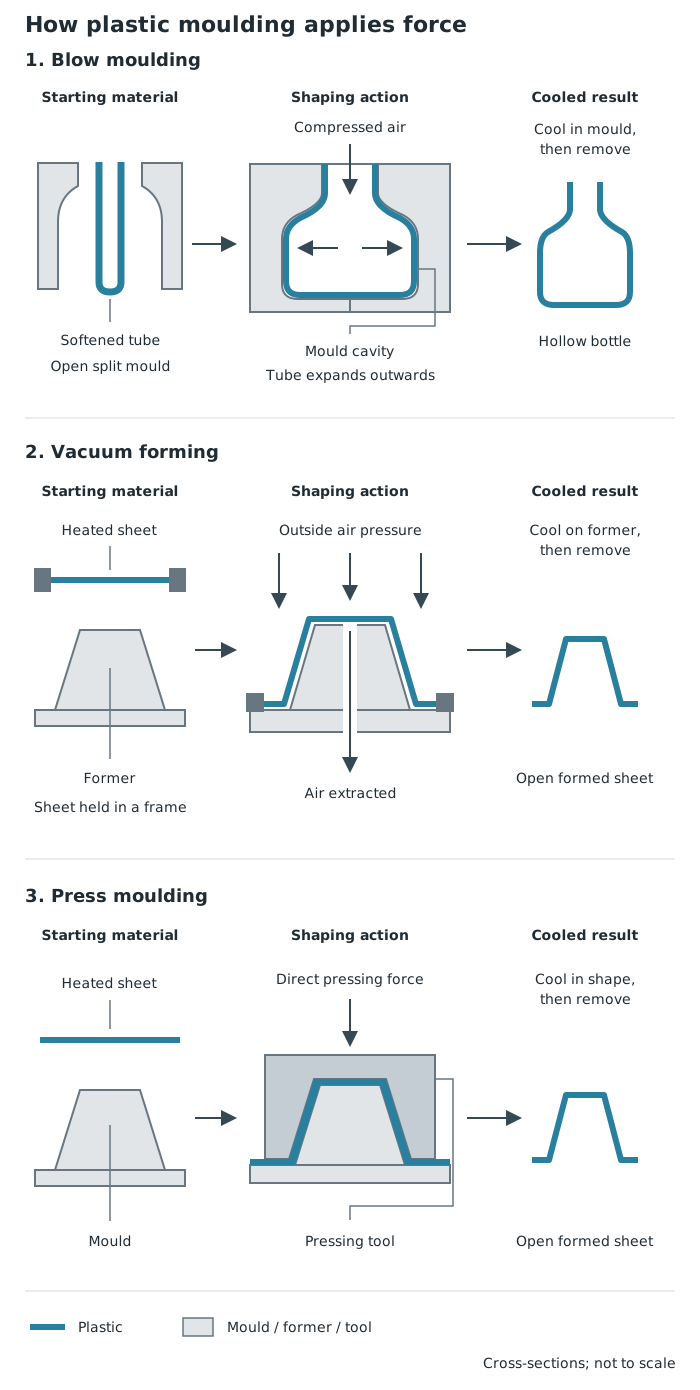
The processes differ in their starting material and the force that shapes it.
Some plastics are self-finishing: once moulded, their surface needs no further finishing. In vacuum forming, a flat, glossy sheet takes the shape of the former, and the surface in contact with it copies its surface detail. A good-quality former therefore helps produce a good-quality moulding. Self-finishing does not mean that surplus material never needs trimming.
Heating equipment, hot plastic and moving moulds or presses all create hazards. Use equipment only under the teacher's supervision and follow its operating instructions. Secure the sheet as instructed, wear eye protection, keep hands clear of heaters and closing parts, and use the specified handling tools or heat protection for hot material.
Do not judge readiness by touching heated plastic. Follow the machine's heating procedure and check that the material forms closely to the mould. Before removal, allow enough cooling for it to retain its shape without distorting; release pressure or vacuum using the machine's controls before handling the moulding.
| Process | Starting material | Shaping action |
|---|---|---|
| Blow moulding | Softened plastic tube | Compressed air inflates it against a mould cavity; used for bottles. |
| Vacuum forming | Heated HIPS or acrylic sheet | Air is extracted beneath the sheet, so outside air pressure forces it onto a former. |
| Press moulding |
Distinguish the shaping force: blow moulding uses compressed air inside a tube; vacuum forming removes air beneath a sheet; press moulding uses direct pressure on a heated sheet.
When explaining suitability, connect the process to the product: blow moulding creates the hollow body of a bottle.
For Eduqas press moulding, describe heated polymer sheet pressed onto a mould. Do not replace this with a description of compression moulding.
Self-finishing describes the surface: a moulded product may still need excess material trimmed away.
It can see this note and what your specification asks for.
Answers are free with an account.
1 free note left this week
Get more free notesYour answer sets when this note comes back for review, or marks it complete.
Was this note helpful?
Log in to tell us whether it helped, or to report a problem.
Last updated
Thermoforming plastic
A plastic that softens when heated and hardens when cooled, allowing it to be reshaped.
Mould
A shaped tool that gives softened material its required form.
Blow moulding
A process that makes a hollow plastic product by inflating a softened plastic tube inside a mould.
Vacuum forming
A process that shapes a heated plastic sheet over a mould or former by extracting the air beneath it.
Press moulding
A process in which a heated polymer sheet is placed over a mould and pressed onto it to take its shape.
Self-finishing
A property of a moulded plastic whose surface needs no further finishing after forming.
Put your knowledge into practice — try past paper questions for Design and Technology
Thermoforming plastic
A plastic that softens when heated and hardens when cooled, allowing it to be reshaped.
Mould
A shaped tool that gives softened material its required form.
Blow moulding
A process that makes a hollow plastic product by inflating a softened plastic tube inside a mould.
Vacuum forming
A process that shapes a heated plastic sheet over a mould or former by extracting the air beneath it.
Press moulding
A process in which a heated polymer sheet is placed over a mould and pressed onto it to take its shape.
Self-finishing
A property of a moulded plastic whose surface needs no further finishing after forming.
| Heated polymer sheet |
| Direct pressure presses it onto a mould. |