

Loading…
Loading…
Loading…
Edexcel GCSE Design and Technology · 1DT0
Edexcel 1DT0 · 6.8.1 Surface Finishes and Treatments Check the specification (PDF) (opens in a new tab)
A textile treatment can change how a product looks, feels or performs. Decorative techniques add colour, pattern and texture, but they can also affect flexibility, weight, comfort and care. A suitable treatment must therefore work with both the fabric and the intended use.
For example, a cushion might need a bold design that withstands rubbing and cleaning. A silk scarf needs decoration that preserves its lightness and drape: the way fabric hangs in folds. A quilt needs warmth as well as an attractive surface. The same technique is not automatically suitable for all three.
Before decorating the final material, make a small sample. Check the appearance, whether stitching distorts the fabric, whether added layers make it too stiff, and whether the finished decoration withstands the intended care method. Natural, synthetic, woven, knitted and non-woven textiles behave differently; even fabrics with similar appearances may respond differently to heat or colourants.
Fabric painting applies textile paint directly to fabric, usually with brushes or other applicators. It is useful for individual images, detailed colour choices and one-off designs. Once the paint is dry, it must be fixed according to its instructions so that the design can withstand its intended use and cleaning.
Painting gives the maker direct control without having to prepare a printing screen. However, reproducing exactly the same hand-painted design is slow, and a heavy application of paint can alter the fabric's softness. Test the paint on the chosen material rather than assuming it will behave like paint on paper.
In silk painting, colour can spread through the fabric. A gutta outline acts as a resist: a barrier that limits the movement of the paint. Draw a continuous outline with gutta, allow it to become ready for painting according to the product instructions, and fill the enclosed spaces with silk paint. Gaps in the outline allow colour to escape into neighbouring areas. Fix the finished colour using the method specified for the paint; suitable products may require heat-setting.
Silk painting suits flowing, colourful scarf designs. Its limitation is the care needed to control spreading and produce complete boundaries. A successful sample has the intended colour areas and outlines, without unwanted bleeding.
Resist dyeing protects selected parts of fabric while the exposed parts take up dye. This creates a pattern by controlling where colour cannot reach, rather than by drawing every coloured area directly.
In tie-dye, fold, gather or twist the fabric and tie selected areas tightly before immersing it in dye. The compressed areas resist dye penetration. After dyeing, remove the ties and rinse and fix the colour as required by the dye instructions. Opening out the fabric reveals the pattern.
Tie-dye is useful for lively, individual designs and does not require a printing screen. Its less predictable edges can be attractive, but they make exact repeat patterns and identical products difficult to achieve. The tightness and position of the ties affect the result.
Batik uses wax as the resist. Apply wax to areas that should retain their current colour, then immerse the fabric in a suitable cold dye bath so the wax remains in place. Exposed areas take up the dye. Further waxing and dyeing can build a multicoloured design. Heat is used to remove the wax after the dyeing stages.
Batik allows planned patterns and layered colours, making it suitable for decorative panels or cushion fabrics. However, several colours require several stages, and applying and removing wax adds time and requires controlled handling of heat. Completion means that the intended pattern is revealed, unwanted wax has been removed and the dye has been properly rinsed and fixed.
For painting and dyeing, protect clothing and work surfaces, follow the product's handling instructions and use gloves and ventilation where required. Hot wax and irons can cause burns: use them under teacher supervision, keep heated equipment stable and never leave it unattended.
Embroidery decorates fabric using hand or machine stitches. Coloured threads can create outlines, filled shapes, lettering, borders or repeated motifs. Unlike painting, embroidery adds a stitched texture as well as colour.
Hand embroidery gives close control over small details but is labour-intensive. Machine embroidery can produce designs more quickly and evenly, especially where a motif is repeated. Both need suitable thread, needles and support for the base fabric. Dense or heavy stitching can pucker a lightweight fabric or restrict its movement.
A small embroidered motif can personalise a garment without covering its whole surface. A dense design may be better suited to a firm decorative panel than to a light, flowing scarf. Check that stitches are secure, the intended design is complete and the fabric lies as intended rather than gathering unintentionally.
Couching creates a raised line by laying thick yarn or cord on the fabric and securing it with smaller stitches. The thick material stays on the surface instead of being repeatedly pulled through the fabric.
Couching is useful for bold outlines and textured decoration. It allows a thick cord to be used where ordinary embroidery would be awkward. However, raised cords may snag, and widely spaced securing stitches can leave loose sections. It is therefore often more suitable for a decorative panel than for a surface exposed to constant abrasion. Check that the cord follows the planned line and is held securely along its length.
When stitching, store needles and pins safely. At a sewing machine, tie back long hair, keep fingers away from the needle and stop the machine before making adjustments.
Appliqué attaches cut fabric shapes onto a base fabric. Arrange the shapes to form the design, hold them in position, then secure them by stitching, bonding or a suitable combination of both. Stitching around the shapes can also create a decorative outline.
Appliqué produces bold colour blocks and can make use of small fabric remnants. A large flower on a cushion cover, for example, can be built from contrasting fabric petals rather than filled entirely with embroidery stitches.
Its limitations include extra thickness and the possibility of edges lifting or fraying. Fabrics used together should suit the intended care method; different shrinkage can distort the finished design. Check that the shapes are correctly placed, edges are secure and the base fabric has not puckered. Follow adhesive instructions and use any heat required for bonding at a setting safe for the fabrics.
Printing places colour onto selected areas of fabric. It is particularly useful when a design must be repeated across a surface or reproduced on several products. Textile printing can use screens, rollers or inkjet equipment.
For screen printing, prepare a stencil on a mesh screen. Place the screen over the fabric and use a squeegee to push printing colour through its open areas. The blocked areas prevent colour reaching the fabric. Lift the screen, allow the print to dry and fix it using the method required by the printing colourant.
Once prepared, a screen can reproduce the same motif repeatedly, making it suitable for matching cushion covers or a run of printed bags. Preparing the screen takes time, however, so it may be less worthwhile for a single simple design. Multicoloured patterns also require careful alignment of the colour stages.
A successful print has the intended placement, clear design edges and even colour coverage. Test fixing and care on a sample before production: a sharp-looking print is not enough if the colour rubs off or washes out.
Patchwork joins smaller pieces of fabric edge to edge to form a larger surface. The shapes, colours and arrangement create the pattern. Unlike appliqué, the pieces make up the surface itself rather than sitting on top of a complete base fabric.
Patchwork can use remnants and create striking geometric designs for cushions or quilt tops. However, cutting and joining many pieces takes time. Inaccurate shapes or seams can stop corners meeting neatly and distort the overall pattern. Fabrics must also be compatible with the intended washing and use.
Quilting stitches layers together, usually a top fabric, a middle layer of wadding and a backing. The stitches hold the layers in position and form a surface pattern. Wadding provides padding and helps trap air, making quilting useful for warm bed covers as well as textured decorative products.
Quilting adds bulk and weight, so it is less suitable where a light, freely draping fabric is needed. The layers must be held in position during stitching to prevent shifting and puckering. Completion means that the layers are secure, the stitching pattern is finished and the wadding is not loose inside the product.
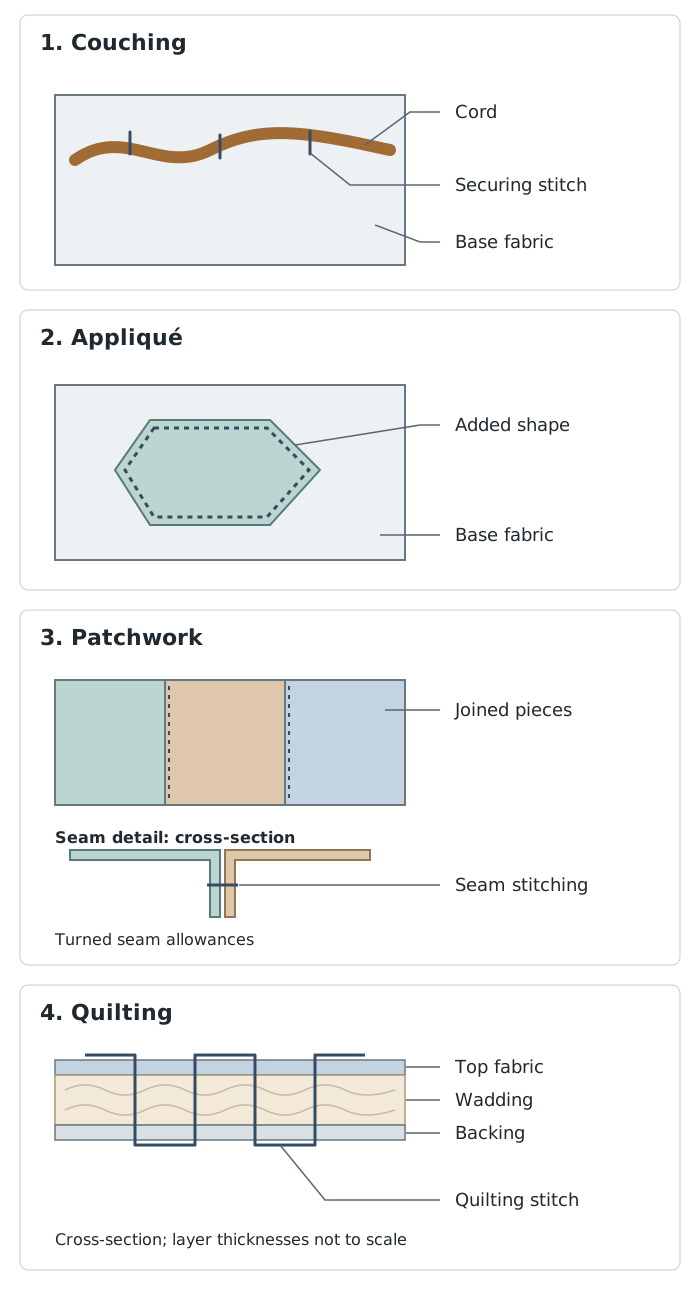
Appliqué adds shapes, patchwork joins pieces, quilting stitches layers, and couching secures a surface cord.
Patchwork and quilting can be combined: a patchwork top can be quilted to wadding and backing. They are not interchangeable terms, though. A patchwork surface need not be quilted, and quilting can use one unpieced top fabric.
Laminating bonds layers together to combine their properties. For example, a textile can combine a waterproof outer layer with a warm inner layer. Unlike quilting, the layers are bonded rather than held together by a decorative stitch pattern.
This can provide several useful properties in one material. However, the combined layers may be heavier, stiffer or less breathable than the original fabric, depending on their construction. Their care requirements must also be compatible. Laminating should be selected for a needed performance benefit, not simply because adding another layer seems desirable.
Start with the product's needs, then compare suitable methods. For matching cushion covers, screen printing offers repeatability; hand painting offers individuality but takes longer to reproduce. For a bold fabric image, appliqué provides colour and texture, while embroidery allows finer stitched detail. For a warm bed cover, quilting offers a functional benefit that surface alone does not.
A justified choice balances appearance, durability, care, production time and the behaviour of the base fabric. Use sample results to decide whether the chosen method achieves those needs and whether its disadvantages are acceptable.
When explaining a technique, describe what happens to the fabric: naming embroidery or batik alone does not explain the process.
Link each advantage or disadvantage to the product. Raised decoration may suit a wall hanging but snag on frequently handled clothing.
Distinguish appliqué from patchwork, and patchwork from quilting: attaching shapes, joining pieces and stitching layers are different operations.
For a design proposal, identify the technique, colours and placement, then explain why they suit the intended use.
Do not assume every paint or dye is fixed in the same way. Specify a fixing method suitable for the chosen colourant and fabric.
It can see this note and what your specification asks for.
Answers are free with an account.
1 free note left this week
Get more free notesYour answer sets when this note comes back for review, or marks it complete.
Was this note helpful?
Log in to tell us whether it helped, or to report a problem.
Last updated
Fabric painting
Applying textile paint to fabric to create colour, images or patterns.
Resist
A barrier that prevents dye or paint reaching selected areas of fabric.
Batik
A resist-dyeing technique in which wax protects selected areas of fabric from dye.
Couching
A decorative stitching technique in which yarn or cord is laid on the fabric surface and secured with smaller stitches.
Embroidery
Decorating fabric with stitches made by hand or machine.
Appliqué
Attaching cut fabric shapes to a base fabric to form a design.
Printing
Transferring colour to selected areas of a textile surface to create a design.
Screen printing
A printing technique in which a squeegee pushes colour through the open areas of a mesh screen while a stencil blocks other areas.
Resist dyeing
Colouring fabric while protecting selected areas so that they remain undyed or retain an earlier colour.
Patchwork
Joining smaller fabric pieces edge to edge to make a larger textile surface.
Quilting
Stitching textile layers together, usually with wadding between a top fabric and backing, to create structure and texture.
Laminating
Bonding layers together to produce a combined textile with chosen surface or performance properties.
Put your knowledge into practice — try past paper questions for Design and Technology
Fabric painting
Applying textile paint to fabric to create colour, images or patterns.
Resist
A barrier that prevents dye or paint reaching selected areas of fabric.
Batik
A resist-dyeing technique in which wax protects selected areas of fabric from dye.
Couching
A decorative stitching technique in which yarn or cord is laid on the fabric surface and secured with smaller stitches.
Embroidery
Decorating fabric with stitches made by hand or machine.
Appliqué
Attaching cut fabric shapes to a base fabric to form a design.
Printing
Transferring colour to selected areas of a textile surface to create a design.
Screen printing
A printing technique in which a squeegee pushes colour through the open areas of a mesh screen while a stencil blocks other areas.
Resist dyeing
Colouring fabric while protecting selected areas so that they remain undyed or retain an earlier colour.
Patchwork
Joining smaller fabric pieces edge to edge to make a larger textile surface.
Quilting
Stitching textile layers together, usually with wadding between a top fabric and backing, to create structure and texture.
Laminating
Bonding layers together to produce a combined textile with chosen surface or performance properties.
Compare appearance, fabric compatibility, durability, care, time and repeatability. Sample first. Fix paints and dyes using their specific instructions.