

Loading…
Loading…
Loading…
Edexcel GCSE Design and Technology · 1DT0
Edexcel 1DT0 · 6.8.1 Surface Finishes and Treatments Check the specification (PDF) (opens in a new tab)
A woven, knitted or non-woven fabric does not necessarily have all the qualities its final product needs. A shirt may need to resist creasing, a blanket may need a softer surface, and an umbrella must resist rain. A textile finish is a treatment that changes a textile's appearance, feel or performance so that it is more suitable for its intended use.
Appearance and function often overlap. A smoother surface may look more attractive and also feel more comfortable against the skin. The textile's handle means how it feels when touched; its drape describes how it hangs and falls.
Finishes must be selected for the actual fabric, not just the product name. Cotton responds to different treatments from thermoplastic synthetic fibres. For a blended or mixed-fibre textile, a treatment must be compatible with the fibres present. Designers also consider the fabric's construction and whether a finish will remain effective after washing and wear.
Bleaching chemically removes colour to produce a whiter fabric. It is useful for white textiles or when preparing a fabric for dyeing or printing, particularly in pale colours. Fabrics intended for medium or dark colours may not need bleaching. The bleaching agent must suit the fibre: an unsuitable or excessive treatment can damage the material.
Mercerising is a treatment for cotton. The cotton is treated with concentrated sodium hydroxide while held under tension. This improves its strength, lustre and absorbency. Greater dye uptake allows brighter colours, making mercerising useful when a cotton textile needs both an attractive finish and good performance. It requires an additional chemical-processing stage rather than simply changing the fabric mechanically.
An easy-care or crease-resistant finish reduces wrinkling and the need for ironing. A resin is applied to a cellulosic textile, such as cotton, and cured using heat. A cotton shirt is a useful application because it needs to retain a neat appearance after washing and wearing.
This benefit involves a compromise: the treatment can make the fabric stiffer and less absorbent, and can reduce tensile strength and abrasion resistance. Easy-care therefore means easier maintenance, not an improvement in every property.
Carbonising cleans wool by using sulphuric acid to destroy vegetable matter, such as leaves and twigs caught in the fibres. Its benefit is the removal of unwanted plant material before further processing. Unlike bleaching, its purpose is not to whiten the textile. The use of a strong acid also brings chemical-handling and waste-treatment requirements, so it is an industrial process rather than an ordinary washing treatment.
A coating deposits a material on a textile's surface. Its purpose depends on the coating used: it can provide a barrier or change how the surface interacts with liquids and dirt. Coating with polyurethane or vinyl can create a waterproof barrier.
Laminating bonds a textile to another layer, such as a thin waterproof membrane. Coating applies material to the surface; laminating joins an additional layer to it. Both can combine the strength and flexibility of a fabric with the protective properties of another material.
Water-repellent and waterproof are not interchangeable. A water-repellent finish resists wetting and penetration for a limited time, while leaving the textile porous. This can make clothing more comfortable because moisture vapour can escape. Water may nevertheless penetrate after prolonged exposure or under pressure.
A waterproof barrier is intended to stop liquid water passing through. This is valuable for products such as tarpaulins, but an impermeable coating or laminate can make the fabric stiff and prevent perspiration vapour escaping. For a garment, a designer must balance protection from rain against comfort during activity.
Not every waterproof laminate is impermeable to vapour. GORE-TEX combines a fabric with a fine waterproof membrane that allows water vapour to escape. This makes it useful for outdoor clothing where both rain protection and breathability matter. The important selection question is therefore what the particular coating or laminated layer does, rather than assuming that every waterproof fabric has the same properties.
Stain-resistant treatments help prevent stains from penetrating the fabric. They are useful for upholstery and carpets, where keeping the surface clean is important and frequent washing may be difficult. Surface treatments can keep liquid in droplets rather than letting it spread and soak in.
Resistance does not mean that all spills can be ignored: performance depends on the stain, the treatment and its condition. Some treatments resist oily stains, while others resist water-based stains. Soil, creasing and cleaning residues can reduce their effectiveness, and some finishes need reapplication. Stain resistance also differs from a soil-release finish, which helps dirt wash out rather than primarily preventing it from entering.
Fire proofing is the specification's term for a protective treatment intended to reduce burning. In practice, flame resistance must not be understood as a guarantee that a fabric cannot burn. Fire-retardant chemicals can be applied to a textile, including through a resin that attaches protective microcapsules to the fabric. Some treatments include substances that expand when exposed to fire, creating an insulating barrier.
Military tent fabrics provide an example of why this matters: they need flame resistance alongside strength, low weight and ease of deployment. A protective treatment is useful, but it may reduce softness and drape or make the fabric harsher. Some flame-resistant finishes also reduce fabric strength. Cleaning chemicals and excessive dirt can impair particular treatments, so care instructions are part of maintaining their protection. These disadvantages vary between finishes; they do not affect every treatment equally.
Antistatic finishes reduce the build-up of static electricity, particularly on synthetic textiles. Static can cause clothing to cling to the wearer and attract dust. Some antistatic treatments help the surface retain a small amount of moisture, reducing the dryness that encourages static build-up. Their effectiveness can diminish through laundering.
Wool fibres have surface scales that can catch on one another during washing and agitation. The fibres become entangled, producing felting and shrinkage. A chemical shrink-resistant finish modifies or coats these scales so that the fibres are less likely to lock together.
One route treats wool with chlorine, which partly dissolves the scales and reduces their ability to felt. This helps a wool garment retain its size during washing, but the treatment can weaken the fabric and give it a rougher handle. Those disadvantages make it less attractive when softness and strength are priorities.
Alternatively, wool can be coated with a polyamide solution that lets fibres move without tangling. This also reduces pilling and fuzzing and improves abrasion resistance. Resin coatings can flatten or bind the scales in place. These finishes are useful when selecting wool for washable clothing, but the treatment and care conditions must suit the product.
Cotton and rayon can also receive resin-based shrinkage control. Compressive shrinking followed by a resin treatment reduces further shrinkage and adds crease resistance. As with easy-care treatment, reduced ironing must be balanced against possible losses of absorbency, softness and strength.
Physical finishing changes a fabric through mechanical action or controlled heat rather than simply adding a chemical treatment.
Calendering passes fabric between rotating rollers. Pressure flattens and smooths the surface; heated rollers can increase its lustre. This is useful when a smooth, neat appearance is wanted. Compressing the structure can reduce thickness and air permeability, and the effect may not survive repeated washing.
Raising uses rollers fitted with fine wires or hooks to pull fibre ends up from the fabric. The resulting hairy surface is called a nap. It makes the fabric feel softer and traps air, improving warmth. Blankets and winter clothing are suitable applications. A raised surface also requires consideration of loose fibres and pilling during use; excessive raising can reduce the fabric's wear life.
Emerising passes fabric over emery-covered abrasive rollers. It produces a fine, soft nap with a suede-like or peach-skin feel. Raising pulls fibres upwards; emerising uses abrasion to develop a finer surface texture. Both can improve handle, but their surface effects differ. Abrasion can reduce tensile strength, so the desired softness must be balanced against durability.
Singeing does almost the opposite of raising: protruding fibres are burnt away by passing fabric rapidly over a flame. This creates a smoother, less hairy surface and improves the clarity of subsequent printing. Controlled speed is important because the aim is to remove the projecting fibres, not burn the fabric itself.
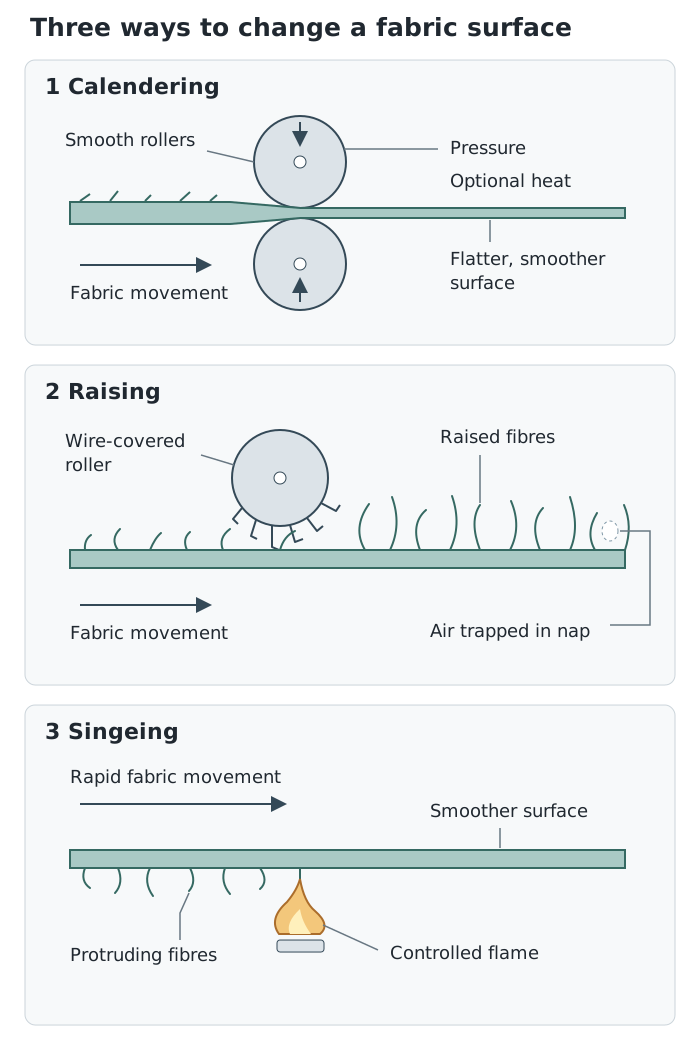
Calendering compresses the surface, raising pulls fibres upwards, and singeing removes projecting fibres.
Heat-setting uses controlled heat to stabilise thermoplastic synthetic textiles. Manufacturing can leave internal stresses that would otherwise cause later dimensional changes. Heat-setting helps the fabric retain its intended dimensions and can also fix features such as pleats. This makes it useful when a synthetic garment must keep a particular shape. Temperature must be controlled for the material, and later excessive heat can affect the set shape.
Shrink resistance is a desired result, not the name of one universal process. Mechanical compressive shrinking deliberately shrinks damp fabric during manufacture so that less shrinkage occurs later in use. It is suitable for textiles such as cotton and linen. Unlike a chemical shrink-resistant finish, it uses mechanical compression rather than modifying or coating the fibres. It also differs from heat-setting, which suits thermoplastic fibres.
Desizing removes size, such as starch used to strengthen warp yarns during weaving. Removing it allows the fabric to absorb subsequent dyes and finishes more evenly. Although desizing appears in the specification's physical-treatment list, removal can use washing, dilute acids or enzymes. The important distinction is its purpose: removing a manufacturing aid rather than creating a decorative surface. Enzyme desizing can save water and energy, but may be slower and more expensive.
Fulling is controlled felting of wool fabric. Walking describes the traditional method of treading the cloth underfoot, while milling uses machinery to carry out the fulling action. These are related ways of producing a denser wool textile, not three unrelated surface effects.
The wool cloth is first cleaned to remove grease and dirt. Moisture, soap, warmth and agitation are then applied, by treading or mechanical action such as hammers. The scales on the wool fibres hook together, and the fabric shrinks in both length and width. Finally, it is washed to remove the soap and processing materials.
The result is thicker, denser cloth with greater cover and a softer handle. It provides warmth and is harder for water to penetrate, although this does not make it a completely waterproof barrier. Boiled wool is a heavily fulled wool jersey knit, suitable for warm outerwear.
Fulling is useful when warmth and a substantial, tightly felted structure matter more than lightness or stretch. Its disadvantages are the considerable shrinkage that must be allowed for and controlled, and the heavier, less stretchy result. Whereas chemical shrink resistance tries to prevent later felting, fulling deliberately uses felting to create the desired fabric during manufacture.
An enzyme is a biological catalyst: it helps a particular reaction take place. In biopolishing, a cellulase enzyme acts on protruding fibres on cotton fabric, removing them to create a smoother surface. This gives a softer handle and reduces pilling, making it useful for cotton clothing worn against the skin.
Biopolishing offers a different route to surface smoothing from singeing. Singeing burns off projecting fibres, whereas biopolishing uses enzyme action. Removing fibre material can reduce fabric strength and weight, so treatment must be controlled rather than continued beyond the desired surface improvement.
Biostoning uses enzymes on cotton denim to produce a worn, washed-out or distressed appearance. The enzyme action on the cotton surface helps remove some of the indigo dye, giving denim shirts or jeans a faded look. It also makes the fabric softer and more flexible, improving comfort.
Traditional stonewashing tumbles denim with abrasive pumice stones. Biostoning provides a milder alternative without needing pumice stones or harsh chemical agents. It is easier to control, allowing a more uniform distressed appearance and better control over where dye is removed. However, the enzyme treatment can reduce strength and fabric weight. A manufacturer must balance the fashionable worn effect against the garment's required durability.
A smart material responds to a change in its surroundings. For colour-changing textile finishes, selecting the correct stimulus is essential: heat, light, solvents and electricity are different triggers.
Thermochromic finishes change colour in response to temperature. They can be printed onto textiles to create designs that respond to body warmth, such as a T-shirt pattern that changes when touched. They can also provide a visible temperature indication. Many systems change back when they cool, allowing the effect to be repeated.
Photochromic finishes change colour in response to light, commonly ultraviolet light. Photochromic inks have been used on T-shirts and embroidery threads to create designs that change outdoors and return towards their original appearance when the activating light is removed. A colour response can also make UV exposure visible; changing colour is not itself proof that the textile provides UV protection.
Both finishes add interest or communicate a change without needing a conventional display. Their disadvantages include additional cost and the need to preserve the colour-changing effect during use and cleaning. Exposure and laundering can reduce performance, while excessive drying heat or bleach can damage some thermochromic finishes. The designer must choose the response range and care requirements for the intended product.
Solvation chromism, also called solvatochromism, is colour change caused by the solvent environment, particularly its polarity. Polarity describes how electrical charge is distributed within the solvent's molecules. Changing that environment can reversibly change the colourant's appearance.
Solvatochromic colourants can be applied to textiles using microencapsulation. A fabric carrying suitable microspheres can change colour when wetted and change back as it dries. This offers a way to make wetting visible through a colour response. Not every fabric that looks different when wet is solvatochromic: the response must come from the solvent-sensitive finish, rather than ordinary darkening of wet cloth.
Textile applications remain limited, so availability is a selection constraint. Resistance to washing and light also needs consideration: a wetting indicator is only useful if its response survives the product's expected use and cleaning. It should not be selected as though it were as widely available or durable as a conventional colourfast finish.
Electrochromic finishes change colour when an electrical stimulus is applied. Conducting coatings on textiles can produce reversible colour changes. Proposed uses include curtains that alter light transmission and textiles that display information or change appearance for camouflage.
Electrical control allows a colour change to be triggered deliberately rather than waiting for the surroundings to become warmer or brighter. However, it requires an electrical supply and suitable conducting components, making integration more complex than a passive colour-changing print. Switching speed, repeated-cycle durability and washing stability matter when judging whether a system is suitable.
An anti-bacterial finish inhibits bacterial growth on a textile. Warm, moist conditions can encourage microorganisms, so this treatment is useful for products such as sportswear and healthcare clothing. It can help control odour and protect the fabric from microbial damage.
The agents can be applied by methods such as spraying, coating or applying a treatment followed by drying and curing. Although grouped with smart finishes in the specification, an anti-bacterial treatment need not visibly change in response to a stimulus: it may simply provide a continuing protective function.
It does not make washing unnecessary or guarantee that a garment is sterile. Some anti-bacterial dye treatments have limited wash fastness, so their effectiveness can decline with laundering. The method of bonding the agent to the textile affects its durability and may also affect comfort. Selection therefore requires a balance between lasting protection, the fabric's handle and the product's cleaning requirements.
Microencapsulation encloses small quantities of a substance in tiny protective shells. The capsules can be attached to a fabric surface or incorporated within fibres. The shell separates the active contents from their surroundings, helping protect them from evaporation or unwanted chemical interactions.
Some capsules release their contents when an appropriate trigger acts on them, such as rubbing or pressure. A fragrance-coated floor cloth, for example, releases fragrance during normal use. Microencapsulated essential oils have also been used in shoe liners and insoles for odour-control applications. Controlled release can prolong an effect compared with leaving the substance unprotected on the surface, but a released supply is finite: it cannot provide the effect indefinitely.
Other capsules retain their contents. Thermochromic and photochromic colourants can respond inside protective capsules rather than being released. Encapsulation helps protect these sensitive materials, but it does not make them immune to damage or guarantee permanent performance.
Microencapsulated phase-change materials provide another application. They absorb energy as they melt and release it as they solidify, helping slow temperature changes around the wearer. They have been incorporated into products such as gloves, socks and outdoor clothing. They buffer temperature changes rather than providing unlimited cooling or replacing insulation.
The advantages of microencapsulation therefore depend on the contents: protection, controlled release or a contained response can add useful properties. Limitations include the cost of capsules and their application, compatibility with manufacturing and washing, and the need for the shell to survive until the intended trigger occurs.
Start with the property the product needs, then compare the treatments that could provide it. For a warm blanket, raising offers a soft, air-trapping surface; calendering would smooth and compress that surface instead. For a cotton shirt, easy-care treatment may reduce ironing, whereas mercerising improves lustre and dye uptake. These treatments solve different problems.
A justified selection explains both the benefit and an accepted limitation. A water-repellent finish may suit clothing used in light rain because it preserves comfort, but it would not provide the same protection as a waterproof barrier during prolonged exposure. A breathable waterproof laminate may offer a better combination for active outdoor clothing.
Also consider manufacturing impacts. Finishing can consume substantial quantities of water, energy and chemicals. Reducing chemical toxicity, resource use and polluted discharge matters alongside product performance. The best finish is the one whose overall performance suits the product, its material and its care requirements.
Link a finish to a product requirement: name the process, explain the property it changes, then justify why that matters in use.
Distinguish water-repellent from waterproof: repellent fabric can eventually allow water through.
Do not describe fire proofing as making a textile impossible to burn.
Heat-setting is suitable for thermoplastic synthetic fibres; it is not a universal treatment for every textile.
Desizing removes manufacturing size, not the dimensions of the fabric. Although listed under physical treatments in the specification, it can use chemicals or enzymes.
Consider disadvantages as well as benefits, including changes to strength, absorbency, breathability, handle and durability after washing.
Distinguish colour-change triggers: thermochromic means temperature, photochromic means light, solvation chromism means solvent environment, and electrochromic means electricity.
Microencapsulation does not always involve bursting capsules: some capsules retain a material that responds inside them.
Biostoning removes some indigo dye to produce a faded or distressed appearance; it does not preserve the original denim colour.
Distinguish fulling from shrink resistance: fulling deliberately felts and shrinks wool during manufacture, whereas a chemical shrink-resistant finish limits later felting and shrinkage.
It can see this note and what your specification asks for.
Answers are free with an account.
1 free note left this week
Get more free notesYour answer sets when this note comes back for review, or marks it complete.
Was this note helpful?
Log in to tell us whether it helped, or to report a problem.
Last updated
Textile finish
A treatment applied to a textile to improve its appearance, feel or performance.
Handle
The way a textile feels when touched or handled, such as soft, stiff, smooth or rough.
Chemical finish
A treatment using chemicals to change a textile's properties or deposit a substance on its surface.
Physical finish
A treatment that changes a textile using physical action, such as pressure, brushing, abrasion or heat.
Easy-care finish
A treatment that reduces creasing and the need for ironing, commonly by applying and curing a resin.
Mercerising
Treatment of cotton with concentrated sodium hydroxide under tension to improve lustre, strength and dye uptake.
Carbonising
Treatment of wool with acid to destroy vegetable impurities such as leaves and twigs.
Laminating
Bonding a textile to another layer, such as a membrane, to combine their properties.
Chemical shrink-resistant finish
A chemical treatment that reduces later shrinkage, for example by modifying or coating wool's surface scales to limit felting.
Calendering
Pressing fabric between rollers to flatten and smooth its surface; heated rollers can also increase lustre.
Raising
Pulling fibre ends out from a fabric's surface to form a soft, hairy layer called a nap.
Heat-setting
Using controlled heat to stabilise a thermoplastic synthetic textile's shape or retain features such as pleats.
Desizing
Removal of size, such as starch applied to yarns to protect them during weaving.
Fulling
Controlled felting of wool fabric using moisture, warmth and agitation, causing shrinkage and a denser, thicker structure.
Milling
Mechanical fulling of wool fabric, using a machine to agitate and felt it.
Walking
Fulling wool cloth by treading it underfoot while it is moist and warm.
Biostoning
An enzyme treatment of denim that removes some surface fibres and dye to create a softer, faded or distressed appearance.
Biopolishing
An enzyme treatment that removes protruding fibres from cotton fabric to produce a smoother surface.
Anti-bacterial finish
A treatment that inhibits bacterial growth on a textile.
Thermochromic material
A material that changes colour in response to a change in temperature.
Photochromic material
A material that changes colour in response to light, commonly ultraviolet light.
Solvation chromism
A colour change caused by a change in solvent environment, particularly solvent polarity; also called solvatochromism.
Electrochromic material
A material that changes colour when an electrical stimulus is applied.
Microencapsulation
Enclosing small quantities of a substance within tiny protective shells that can be incorporated into or applied to a textile.
Put your knowledge into practice — try past paper questions for Design and Technology
Textile finish
A treatment applied to a textile to improve its appearance, feel or performance.
Handle
The way a textile feels when touched or handled, such as soft, stiff, smooth or rough.
Chemical finish
A treatment using chemicals to change a textile's properties or deposit a substance on its surface.
Physical finish
A treatment that changes a textile using physical action, such as pressure, brushing, abrasion or heat.
Easy-care finish
A treatment that reduces creasing and the need for ironing, commonly by applying and curing a resin.
Mercerising
Treatment of cotton with concentrated sodium hydroxide under tension to improve lustre, strength and dye uptake.
Carbonising
Treatment of wool with acid to destroy vegetable impurities such as leaves and twigs.
Laminating
Bonding a textile to another layer, such as a membrane, to combine their properties.
Chemical shrink-resistant finish
A chemical treatment that reduces later shrinkage, for example by modifying or coating wool's surface scales to limit felting.
Calendering
Pressing fabric between rollers to flatten and smooth its surface; heated rollers can also increase lustre.
Raising
Pulling fibre ends out from a fabric's surface to form a soft, hairy layer called a nap.
Heat-setting
Using controlled heat to stabilise a thermoplastic synthetic textile's shape or retain features such as pleats.
Desizing
Removal of size, such as starch applied to yarns to protect them during weaving.
Fulling
Controlled felting of wool fabric using moisture, warmth and agitation, causing shrinkage and a denser, thicker structure.
Milling
Mechanical fulling of wool fabric, using a machine to agitate and felt it.
Walking
Fulling wool cloth by treading it underfoot while it is moist and warm.
Biostoning
An enzyme treatment of denim that removes some surface fibres and dye to create a softer, faded or distressed appearance.
Biopolishing
An enzyme treatment that removes protruding fibres from cotton fabric to produce a smoother surface.
Anti-bacterial finish
A treatment that inhibits bacterial growth on a textile.
Thermochromic material
A material that changes colour in response to a change in temperature.
Photochromic material
A material that changes colour in response to light, commonly ultraviolet light.
Solvation chromism
A colour change caused by a change in solvent environment, particularly solvent polarity; also called solvatochromism.
Electrochromic material
A material that changes colour when an electrical stimulus is applied.
Microencapsulation
Enclosing small quantities of a substance within tiny protective shells that can be incorporated into or applied to a textile.
Match the finish to the fibre, construction, required property and care conditions. Justify a benefit and a relevant disadvantage, including environmental impacts where appropriate.