

Loading…
Loading…
Loading…
AQA Level 2 Certificate Further Mathematics · 8365
AQA 8365 · 6.1 Geometric Measurements and Properties Check the specification (PDF) (opens in a new tab)
An angle measures the turn between two rays meeting at a point. A complete turn is , a half-turn is and a right angle is . These turns explain two rules used throughout geometry: angles around a point add to , and adjacent angles making a straight line add to .
To find a missing angle, identify the complete turn or straight angle, then subtract the angles already known. For example, if four angles around a point are , , and , then
Sometimes an unknown appears more than once. If three adjacent angles on a straight line are , and , their equation is . The two equal angles share the remaining , so each is .
Two straight lines crossing produce four angles. Each angle has a partner directly opposite it: these are vertically opposite angles, and they are equal. ‘Vertically’ here does not mean that the diagram must be upright.
This equality follows from the straight-line rule. Each of two opposite angles adds to with the same neighbouring angle, so the opposite angles must have the same size. If one angle is , its opposite is also , while each neighbouring angle is .
Parallel lines never meet and stay the same distance apart. A line crossing them is called a transversal. The angle relationships depend on where the angles sit, not on whether the diagram is horizontal, tilted or reflected.
Corresponding angles occupy matching positions at the two crossings: for example, above each parallel line and to the right of the transversal. They are equal. An ‘F’ shape can help you recognise them.
Alternate interior angles lie between the parallel lines, on opposite sides of the transversal. They are equal. Their connecting lines form a ‘Z’ shape.
Co-interior angles lie between the parallel lines, on the same side of the transversal. They add to . An alternate-angle equality and the straight-line rule explain this: one co-interior angle equals an angle adjacent to the other.
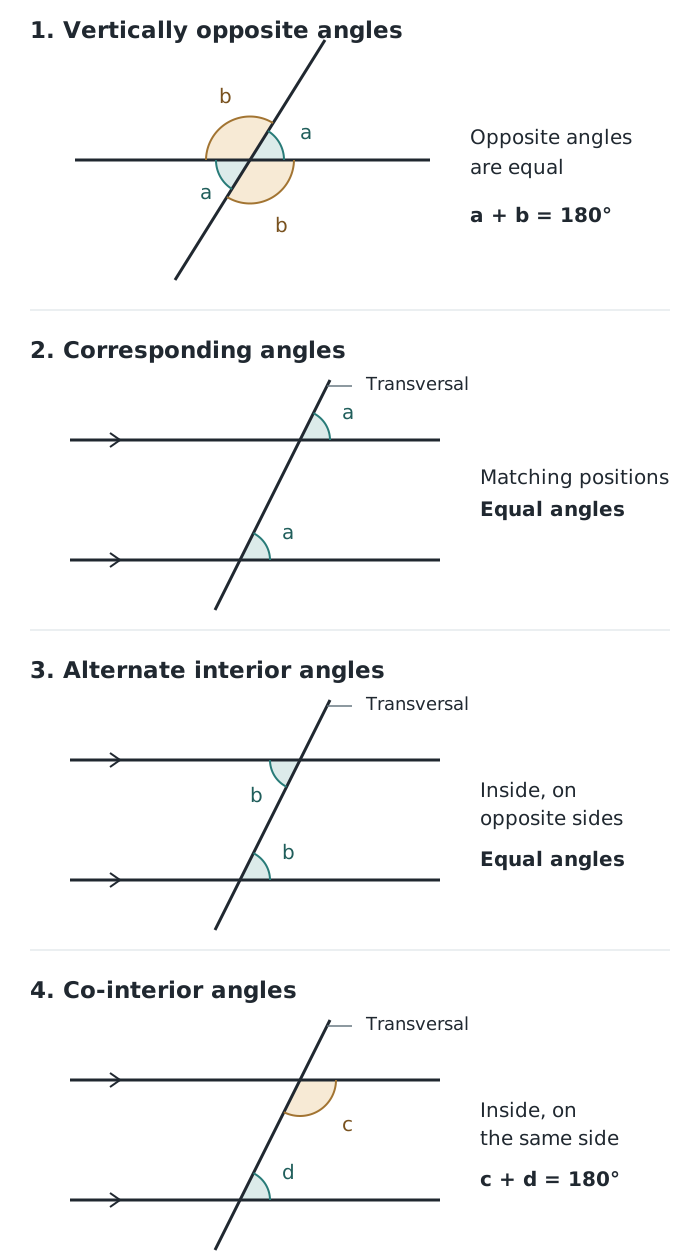
Locate the angle pair first: opposite, matching position, alternate interior, or co-interior.
For example, if a corresponding angle to a given angle is needed, it is also . An angle adjacent to it on a straight line is then . This is a typical two-step deduction: first transfer an angle using parallel lines, then subtract using a straight line.
The corresponding, alternate and co-interior rules require parallel lines. Vertically opposite angles and the straight-line rule do not.
The three interior angles of every triangle add to :
To see why, draw a line through the top vertex parallel to the base. Alternate angles place copies of the two base angles beside the top angle. Together they make a straight angle, so their total is .
A triangle’s side properties can give extra angle information. An isosceles triangle has two equal sides, and the angles opposite those sides are equal. An equilateral triangle has three equal sides and three equal angles; each angle is . A scalene triangle has no equal sides or equal angles.
A right-angled triangle has one angle, so the other two angles add to . A triangle can be both right-angled and isosceles; its two remaining angles are then each.
Extending one side of a triangle creates an exterior angle. It adds to with the adjacent interior angle. Since the three interior angles also total , the exterior angle equals the sum of the two non-adjacent interior angles.
A diagonal divides a quadrilateral into two triangles. Its four interior angles therefore add to . This applies to irregular quadrilaterals as well as familiar named shapes.
Special quadrilaterals provide additional information:
| Shape | Properties useful for finding angles |
|---|---|
| Parallelogram | Both pairs of opposite sides are parallel. Opposite sides are equal, opposite angles are equal, and adjacent angles add to . |
| Rectangle | All four angles are ; opposite sides are parallel and equal. |
| Rhombus | All four sides are equal and opposite sides are parallel. Opposite angles are equal; adjacent angles add to . |
The parallel-line rules explain the parallelogram’s angle properties. A rectangle and a rhombus are special parallelograms, while a square has the properties of both a rectangle and a rhombus.
An isosceles trapezium has a line of symmetry perpendicular to its parallel sides. Reflection in this line matches the two angles at each parallel side, explaining why those angles are equal.
In a kite, take care to identify the correct equal pair: not both pairs of opposite angles are necessarily equal. Its line of symmetry joins the two vertices where equal sides meet and bisects the angles at those vertices, dividing each into two equal parts.
For example, if the equal opposite angles are each and another angle is , the remaining whole interior angle is
The kite’s line of symmetry bisects that remaining angle, so each half is . This distinguishes a whole vertex angle from a labelled part of it.
A polygon is a closed shape with straight sides. For a convex polygon, where every interior angle is less than , draw diagonals from one vertex to all non-adjacent vertices. An -sided polygon splits into triangles, giving
A pentagon splits into three triangles, so its interior angles total . A hexagon splits into four, giving . A decagon has ten sides and splits into eight triangles, giving . These are totals, not the sizes of individual angles.
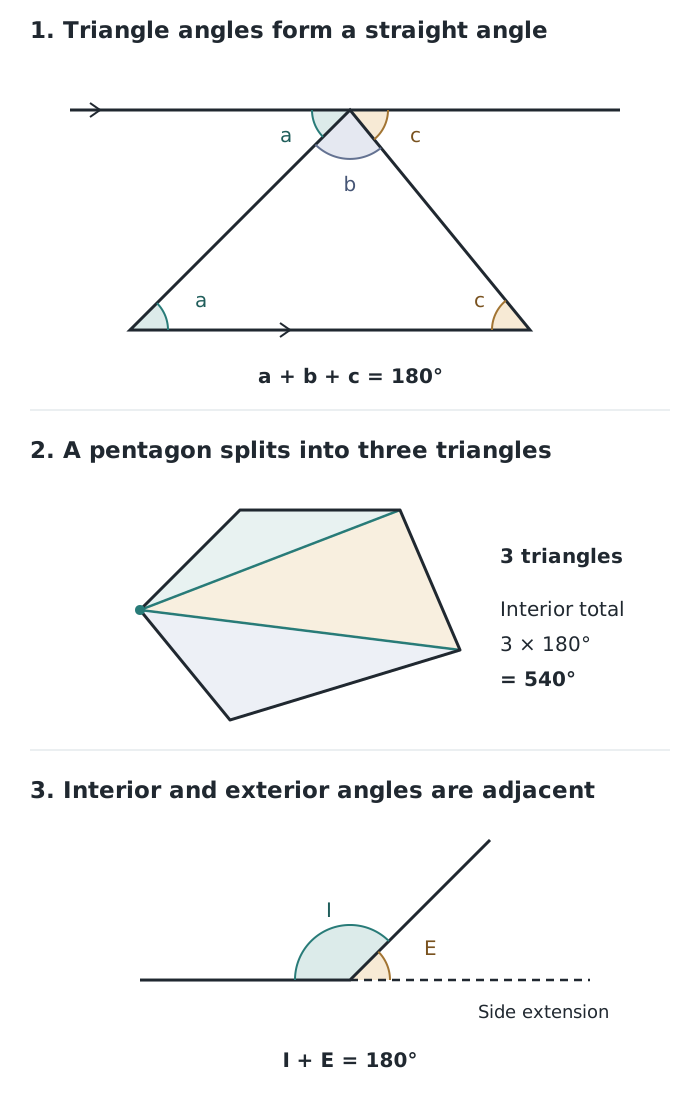
Parallel lines explain the triangle total; triangles explain polygon totals; extending a side links interior and exterior angles.
In a regular polygon, all sides and all interior angles are equal. Only then can you divide the total by the number of sides to find each interior angle:
An exterior angle lies between a side and the extension of its neighbouring side. The adjacent interior and exterior angles make a straight angle:
Imagine walking around a convex polygon, turning at every corner. After one circuit you face your original direction again: the exterior turns total . Take one exterior angle at each vertex, turning consistently in the same direction.
For a regular polygon these turns are equal, so
You can reverse this relationship to find the number of sides. For example, a regular polygon with interior angles of has exterior angles of . Its number of sides is , so it is an octagon.
Angle problems often need several rules rather than one formula. Identify the straight lines, parallel pairs, equal sides and any named shapes. Use these to find an intermediate angle, then carry that information into a triangle, quadrilateral or polygon total. Each step should explain why an angle is equal to another, or why a group of angles has a particular total.
Give a geometrical reason for each step, such as ‘alternate angles in parallel lines are equal’, rather than just showing arithmetic.
Use stated properties and diagram markings, not appearance or measurement. Matching ticks indicate equal lengths; matching arrow markings indicate parallel lines.
Mark useful intermediate angles on the diagram, even if they are not the angle requested.
Only divide an angle total equally when the angles are known to be equal. A polygon need not be regular.
In an isosceles triangle, identify the angles opposite the equal sides before using their equality.
When finding the number of sides from an interior angle, first calculate the adjacent exterior angle.
It can see this note and what your specification asks for.
Answers are free with an account.
1 free note left this week
Get more free notesYour answer sets when this note comes back for review, or marks it complete.
Was this note helpful?
Log in to tell us whether it helped, or to report a problem.
Last updated
Interior angle
An angle inside a polygon, between two sides meeting at a vertex.
Exterior angle
An angle between a side of a polygon and the extension of an adjacent side. It adds to with the adjacent interior angle.
Polygon
A closed plane shape made from straight sides.
Regular polygon
A polygon with all sides equal in length and all interior angles equal in size.
Parallel lines
Straight lines in the same plane that remain the same distance apart and never meet.
Transversal
A straight line that crosses two or more other lines.
Vertically opposite angles
Angles directly opposite one another where two straight lines intersect. They are equal.
Corresponding angles
Angles in matching positions at two intersections made by a transversal. They are equal when the crossed lines are parallel.
Alternate interior angles
Angles between two lines on opposite sides of a transversal. They are equal when the two lines are parallel.
Co-interior angles
Angles between two lines on the same side of a transversal. They add to when the two lines are parallel.
Quadrilateral
A polygon with four sides.
Put your knowledge into practice — try past paper questions for Further Mathematics
Interior angle
An angle inside a polygon, between two sides meeting at a vertex.
Exterior angle
An angle between a side of a polygon and the extension of an adjacent side. It adds to with the adjacent interior angle.
Polygon
A closed plane shape made from straight sides.
Regular polygon
A polygon with all sides equal in length and all interior angles equal in size.
Parallel lines
Straight lines in the same plane that remain the same distance apart and never meet.
Transversal
A straight line that crosses two or more other lines.
Vertically opposite angles
Angles directly opposite one another where two straight lines intersect. They are equal.
Corresponding angles
Angles in matching positions at two intersections made by a transversal. They are equal when the crossed lines are parallel.
Alternate interior angles
Angles between two lines on opposite sides of a transversal. They are equal when the two lines are parallel.
Co-interior angles
Angles between two lines on the same side of a transversal. They add to when the two lines are parallel.
Quadrilateral
A polygon with four sides.
| Square | All four sides are equal, opposite sides are parallel, and all four angles are . |
| Trapezium | One pair of opposite sides is parallel. The two angles at either non-parallel side add to . |
| Isosceles trapezium | One pair of opposite sides is parallel and the non-parallel sides are equal. The two angles at either parallel side are equal. |
| Kite | There are two pairs of equal adjacent sides. The opposite angles between the unequal sides are equal. |
For sides:
For a regular polygon:
Adjacent interior + exterior angle = . One exterior angle per vertex of a convex polygon totals .