

Loading…
Loading…
Loading…
AQA Level 2 Certificate Further Mathematics · 8365
AQA 8365 · 6.1 Geometric Measurements and Properties Check the specification (PDF) (opens in a new tab)
Surface area measures the outside of a solid: imagine the amount of material needed to cover it completely. Volume measures the space it occupies: imagine how much space is enclosed within its boundary. A solid can therefore have both a surface area and a volume, but these measure different things.
Surface area is measured in square units, such as , because it adds areas. Volume is measured in cubic units, such as , because it counts three-dimensional space. One cubic centimetre is the volume of a cube whose edges are each 1 cm long.
For solids with flat faces, find the area of each face and add them. A net helps you see all the faces without overlooking a hidden one. For curved solids, use the appropriate curved-area formula and add any flat surfaces needed for the total.
A prism has an identical polygonal cross-section throughout its length. A cuboid is a rectangular prism; a triangular prism has matching triangular ends. Think of a prism as a stack of identical thin slices: the area of each slice determines how much space is occupied per unit length.
If the cross-sectional area is and the length is , then
Find using the relevant plane-shape formula, then multiply by the distance between the matching ends. For a triangular prism with triangle base , perpendicular triangle height and prism length ,
Here measures the height of the triangular cross-section, while measures how far that triangle extends through the solid. They play different roles.
For surface area, count both matching ends and every side face. In a right triangular prism, the side faces are rectangles. If the triangle’s side lengths are , and , their areas are , and . Thus the total is . More generally, for a right prism with cross-sectional perimeter ,
A cuboid with length , width and height has three pairs of matching rectangular faces, so
A cylinder has two circular ends and a curved surface. Its circular cross-section has area , so multiplying by its perpendicular height gives
For example, a cylinder with radius 8 cm and height 20 cm has volume . This is approximately to three significant figures: it measures the space inside, not the area of its outside.
Imagine cutting the curved surface vertically and unrolling it. It becomes a rectangle with height and width equal to the circumference of the base, . Its area is therefore .
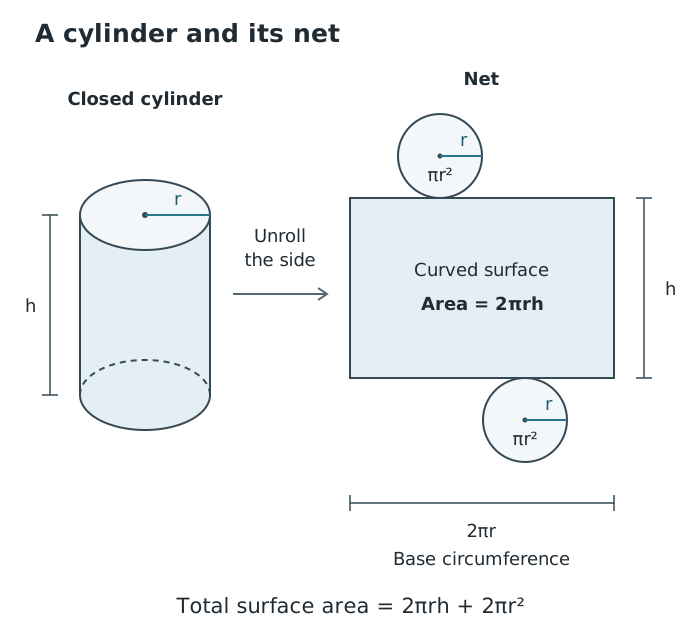
Unrolling the curved surface produces a rectangle; the two circular ends complete the total surface area.
A complete, closed cylinder also has two circular ends, each of area . Therefore
The first term covers the curved surface; the second covers the two ends. If a question describes an open container, count only the surfaces that are actually present.
A cone has a circular base and narrows to an apex. A pyramid has a polygonal base and triangular faces meeting at an apex. Unlike a prism or cylinder, their cross-sections shrink towards the top, so base area multiplied by height would overestimate their volume.
A cone or pyramid has one-third of the volume of a cylinder or prism with the same base area and perpendicular height:
For a cone, , giving
For a square-based pyramid with base side , , so . Other pyramids use the area of their own base, whether it is triangular, rectangular or another polygon.
The height is always measured at right angles to the base, not along a sloping edge or face.
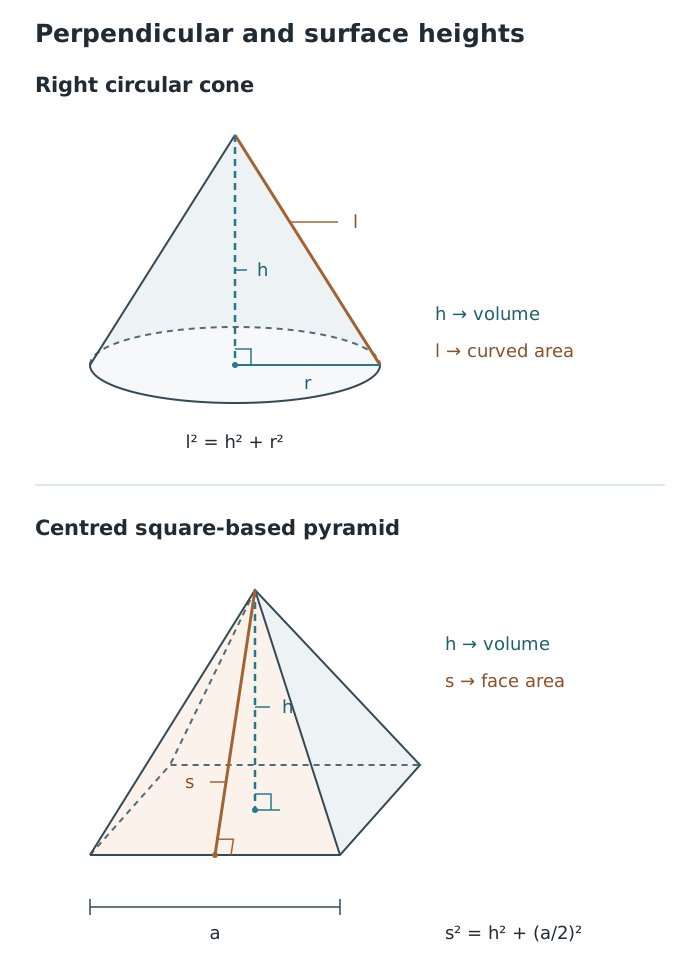
Perpendicular height measures through the solid; slant height or triangular face height measures along its surface.
For a cone, let be the slant height, measured from the apex to the rim along the curved surface. Its curved surface area is . Adding its circular base gives
The distinction between and matters: volume uses , while curved surface area uses . In a right cone, the apex is directly above the centre of the base. Its perpendicular height, radius and slant height form a right-angled triangle, so if a missing length needs to be found.
For a pyramid, calculate the base area and the area of every triangular face, then add them. Each triangle needs its own base length and perpendicular height within that face.
A square-based pyramid whose apex is directly above the centre of the base has four identical isosceles triangular faces. If the square side is and each triangular face has height , then
Here runs down a face from the apex to the midpoint of a base edge; it is neither the vertical height nor a sloping corner edge. For this centred pyramid, . If the faces are not identical, calculate them separately rather than multiplying one face area by four.
A sphere has no flat base or separate side faces. Every point on its surface is the same distance from its centre. Its surface area and volume are
The powers help distinguish the measurements: surface area involves and square units; volume involves and cubic units. If a diameter is given, halve it before substituting.
Start by deciding whether the question asks about the outside area or the enclosed volume. Identify the solid and label the relevant radius, cross-section, length or height. For volume, calculate the base or cross-sectional area first where needed. For surface area, make a list of the exposed surfaces before adding their areas.
When solids are joined, their volumes can be added if they do not overlap. Their total external surface area needs more care: touching faces lie inside the combined solid and must not be included.
is base or cross-sectional area; is perpendicular height; is prism length.
For AQA Level 2 Further Mathematics (8365), memorise volume of a prism, curved surface area of a cylinder and volume of a cylinder. The cone curved-area, sphere area and volume, and cone/pyramid volume formulae are supplied in relevant questions.
Use perpendicular height for volume. For cone surface area, use slant height; for a pyramid’s triangular faces, use the perpendicular height within each face.
Check whether a circular measurement is a radius or a diameter: r = d/2.
For total surface area, include every exposed surface, including bases. Do not count surfaces hidden where solids join.
Keep π and unrounded values throughout your working, then round the final answer as requested.
Convert lengths to a common unit before calculating. Surface area needs square units; volume needs cubic units.
It can see this note and what your specification asks for.
Answers are free with an account.
1 free note left this week
Get more free notesYour answer sets when this note comes back for review, or marks it complete.
Was this note helpful?
Log in to tell us whether it helped, or to report a problem.
Last updated
Total surface area
The sum of the areas of all the surfaces forming the outside of a three-dimensional solid, measured in square units.
Volume
The amount of three-dimensional space occupied by a solid, measured in cubic units.
Prism
A three-dimensional solid with identical polygonal cross-sections throughout its length.
Cross-section
The two-dimensional shape formed by cutting through a solid.
Net
A flat arrangement of surfaces that can be folded to form a three-dimensional solid.
Perpendicular height
The distance from a base to the opposite end or apex, measured at right angles to the base.
Slant height
For a cone, the distance along its surface from the apex to the edge of its circular base.
Pyramid
A solid with a polygonal base and triangular faces meeting at one point, called the apex.
Put your knowledge into practice — try past paper questions for Further Mathematics
Total surface area
The sum of the areas of all the surfaces forming the outside of a three-dimensional solid, measured in square units.
Volume
The amount of three-dimensional space occupied by a solid, measured in cubic units.
Prism
A three-dimensional solid with identical polygonal cross-sections throughout its length.
Cross-section
The two-dimensional shape formed by cutting through a solid.
Net
A flat arrangement of surfaces that can be folded to form a three-dimensional solid.
Perpendicular height
The distance from a base to the opposite end or apex, measured at right angles to the base.
Slant height
For a cone, the distance along its surface from the apex to the edge of its circular base.
Pyramid
A solid with a polygonal base and triangular faces meeting at one point, called the apex.
| Solid | Volume |
|---|---|
| Prism | |
| Cuboid | |
| Cylinder | |
| Pyramid | |
| Cone | |
| Sphere |
| Solid | Total surface area |
|---|---|
| Right prism | , where is cross-sectional perimeter |
| Cuboid | |
| Closed cylinder | |
| Cone | |
| Pyramid | Base area + all triangular face areas |
| Sphere |