

Loading…
Loading…
Loading…
AQA Level 2 Certificate Further Mathematics · 8365
AQA 8365 · 6.1 Geometric Measurements and Properties Check the specification (PDF) (opens in a new tab)
Circle theorems connect angles and lengths in a circle. Their usefulness comes from recognising the relevant points and lines, even when a diagram contains several overlapping triangles.
A chord joins two points on the circumference. An arc is a curved part of the circumference between two points. A chord divides the circle into two segments, each bounded by the chord and one of the arcs.
Suppose and lie on a circle and you join them to another point on the circumference. The angle is said to be subtended by chord , or by the arc that does not contain . In three-letter angle notation, the middle letter is the vertex: is the angle at .
This gives you a reliable way to read a diagram: start at the vertex of an angle and follow its two arms to their endpoints on the circle. Those endpoints tell you which chord and arc the angle uses.
Let be the centre, with , and on the circumference. If the central angle and the circumference angle subtend the , then
You double the circumference angle to find the central angle, or halve the central angle to find the circumference angle. For example, a central angle of gives a circumference angle of on the same arc.
There are two angles between the radii and : a smaller angle and a reflex angle. Choose the one that follows the same arc as the circumference angle. A circumference angle standing on the major arc must be paired with the reflex angle at the centre.
A useful special case occurs when is a diameter, a chord passing through the centre. The central angle is then , so the angle at the circumference is . This is the theorem .
If and lie on the circumference on the same side of chord , then
Both angles stand on the same chord and subtend the same arc. Each is half the same central angle, which explains why they are equal.
The angles need not be next to one another, and their arms may cross inside the circle. The centre need not be drawn. To recognise the relationship, trace one angle back to endpoints and , then look for another angle formed by lines from those same endpoints, with its vertex in the same segment.
A cyclic quadrilateral has all four vertices on one circle. If its vertices are , , and in order around the circumference, its opposite angles satisfy
and
For example, an interior angle opposite is .
Why does this work? The two opposite angles subtend the two arcs between the other pair of vertices. Those arcs make a complete circle, so their central angles total . The circumference angles are half those central angles, giving a total of .
A tangent touches a circle at exactly one point. Suppose it touches at , and is a chord. The angle between the tangent and chord equals the angle subtended by in the .
To locate the matching angle, choose a point on the arc in that opposite segment and join it to both ends of the chord. The matching angle is : its arms end at and . It is not simply any angle near the tangent.
The four arrangements below show which points and lines each theorem connects.
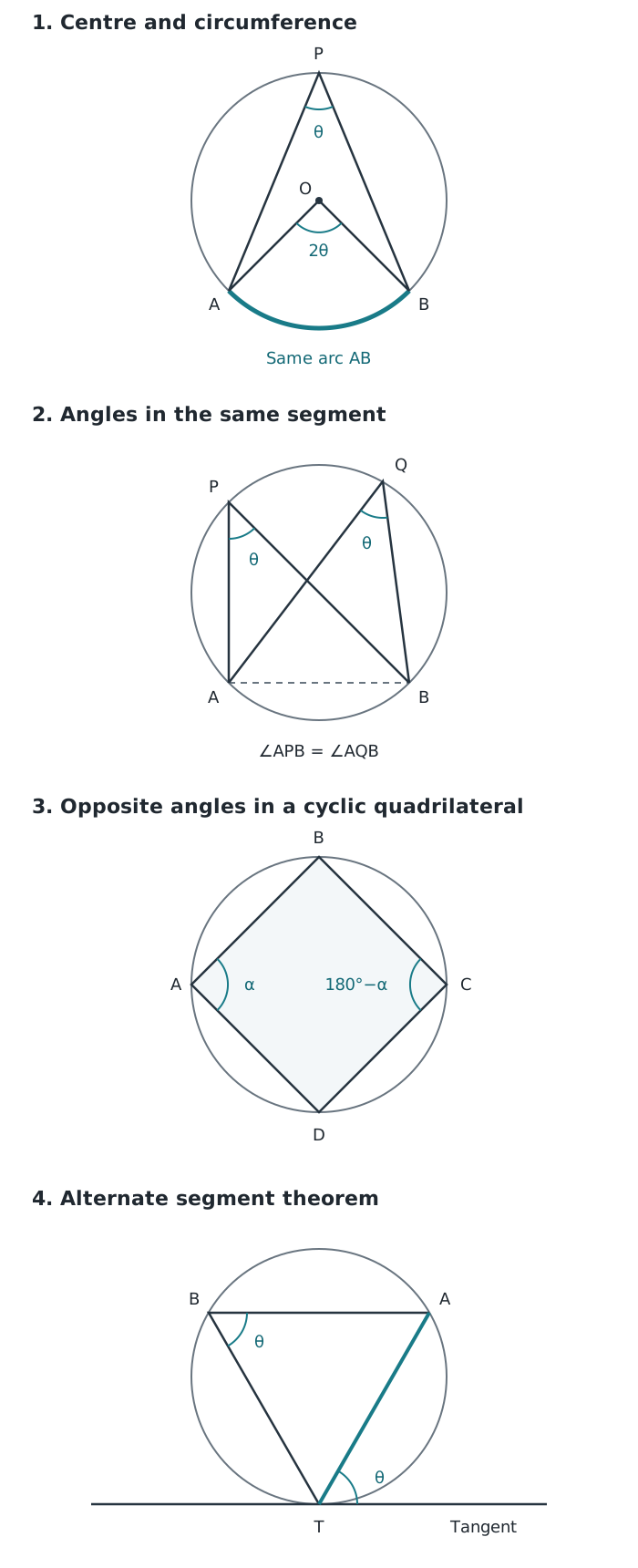
Match angles by their chord endpoints and arcs, not by how close they are in the diagram.
A circle problem may require you to transfer an angle using one theorem before calculating with another. Ordinary angle facts still apply: angles in a triangle sum to , angles on a straight line sum to , and angles around a point sum to .
For example, consider a circle with centre , a tangent at , and a triangle whose three vertices lie on the circumference. The angle between the tangent and chord is , and the central angle on the same as is .
The alternate segment theorem gives . The angle at the centre is twice this angle, so
Expanding gives , hence . The tangent–chord angle is therefore and the central angle is , consistent with the doubling relationship.
The important connection is that both the transferred circumference angle and the central angle use the endpoints and .
A radius joins the centre to the circumference. All radii of one circle have equal length, so two radii and a chord form an isosceles triangle. Its two base angles are equal, which can help you find angles before applying another circle theorem.
A radius to the point where a tangent touches the circle is perpendicular to the tangent. Thus and the tangent at meet at . This right angle can be split into smaller angles by a chord through .
Two tangents drawn from the same external point have equal lengths. If tangents from touch at and , then . Joining the centre to and gives two right-angled triangles with equal radii and a shared hypotenuse .
The perpendicular from the centre to a chord bisects the chord. If meets chord at , then . This splits the isosceles triangle formed by radii , and chord into two matching right-angled triangles. You can therefore use half the chord length in either triangle when applying Pythagoras’ theorem or trigonometry. Equivalently, the of a chord passes through the centre.
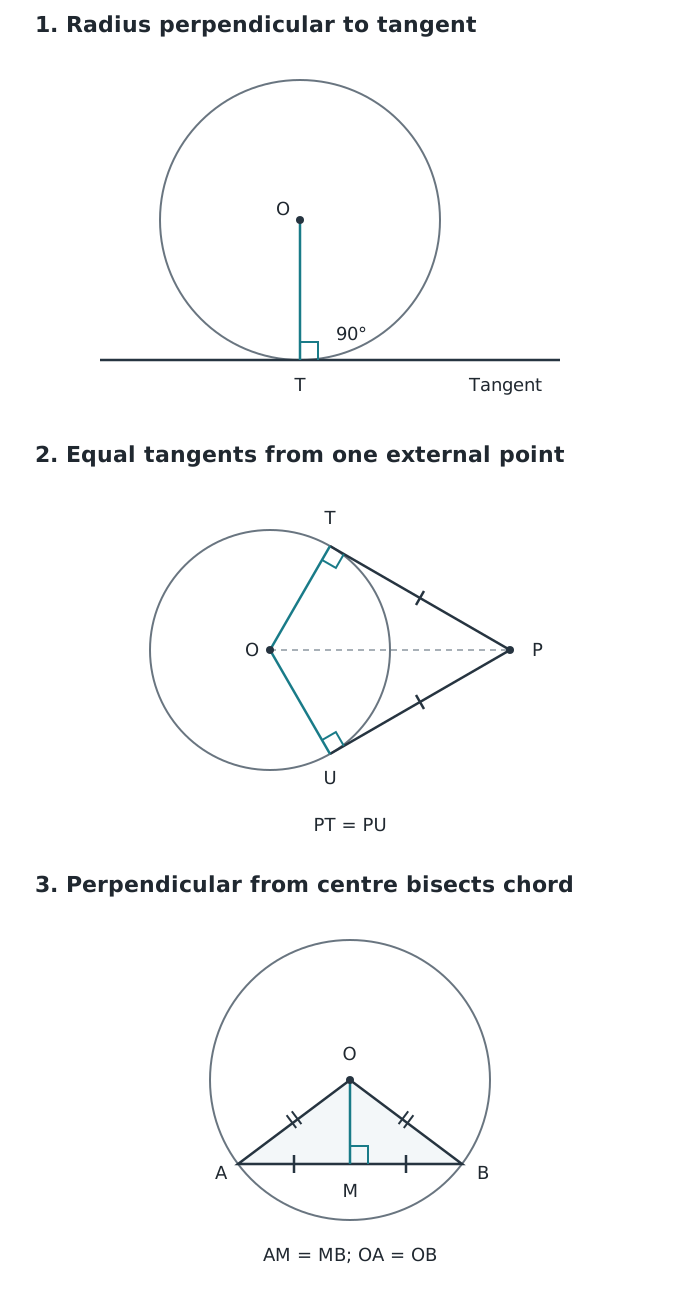
A radius is perpendicular to a tangent at contact; a perpendicular from the centre bisects a chord.
Give a reason for each deduction, such as ‘angles in the same segment are equal’, rather than writing only ‘circle theorem’.
Trace both arms of an angle to their endpoints on the circumference. Check that the angles you are comparing subtend the same arc.
For the centre–circumference theorem, check whether the required central angle is the smaller angle or the reflex angle.
Opposite angles in a cyclic quadrilateral sum to 180°; adjacent angles do not generally do so.
For the alternate segment theorem, identify the chord first. Match the tangent–chord angle to the angle standing on that chord in the opposite segment.
Do not assume a line is a diameter, a point is the centre or a line is a tangent just because it looks that way.
It can see this note and what your specification asks for.
Answers are free with an account.
1 free note left this week
Get more free notesYour answer sets when this note comes back for review, or marks it complete.
Was this note helpful?
Log in to tell us whether it helped, or to report a problem.
Last updated
Circumference
The boundary of a circle.
Chord
A straight line segment joining two points on the circumference of a circle.
Arc
A part of the circumference between two points.
Segment
A region of a circle bounded by a chord and an arc.
Subtended angle
An angle formed by joining the two endpoints of an arc or chord to another point. The angle is said to be subtended by that arc or chord.
Cyclic quadrilateral
A quadrilateral whose four vertices all lie on the circumference of one circle.
Tangent
A straight line that touches a circle at exactly one point.
Alternate segment theorem
The angle between a tangent and a chord through the point of contact equals the angle subtended by that chord in the opposite segment of the circle.
Perpendicular bisector
A line that passes through the midpoint of a line segment at to it.
Put your knowledge into practice — try past paper questions for Further Mathematics
Circumference
The boundary of a circle.
Chord
A straight line segment joining two points on the circumference of a circle.
Arc
A part of the circumference between two points.
Segment
A region of a circle bounded by a chord and an arc.
Subtended angle
An angle formed by joining the two endpoints of an arc or chord to another point. The angle is said to be subtended by that arc or chord.
Cyclic quadrilateral
A quadrilateral whose four vertices all lie on the circumference of one circle.
Tangent
A straight line that touches a circle at exactly one point.
Alternate segment theorem
The angle between a tangent and a chord through the point of contact equals the angle subtended by that chord in the opposite segment of the circle.
Perpendicular bisector
A line that passes through the midpoint of a line segment at to it.
Trace each angle to its chord endpoints → identify the theorem → transfer or calculate the angle → combine with triangle, straight-line or around-a-point angle facts. For algebraic angles, turn the theorem into an equation and solve.