Loading…


Loading…
Loading…
Loading…
AQA GCSE Design and Technology · 8552
AQA 8552 · Shaping and forming techniques Check the specification (PDF) (opens in a new tab)
A polymer product might begin as a sheet, rod or liquid resin. Its starting form and its behaviour determine how it can be shaped. Cutting, drilling and abrasion remove material. Deforming changes the shape of existing material. Casting shapes a liquid inside a mould, while 3D printing adds material in layers. Welding joins separate pieces.
Thermoplastics, such as acrylic, high-impact polystyrene (HIPS), ABS and PLA, soften when heated and harden when cooled. This makes them suitable for heat forming and several welding methods. Thermosetting polymers, including casting resins, cure into a permanent solid that cannot simply be melted and reshaped.
Workshop processes require training, suitable personal protective equipment and the appropriate guards, extraction or ventilation. These precautions depend on the tool and material being used.
The cutting tool must suit the thickness of the polymer and the shape of the cut. A hacksaw or junior hacksaw can make straight cuts through plastic sheet, rod or lengths. A hacksaw has a more robust blade for heavier work; a junior hacksaw suits lighter work. A coping saw or Abrafile can follow curves in thin material, such as a curved outline in acrylic sheet.
For thinner polypropylene sheet, a craft knife can score and cut the material. Very thin vinyl can be cut by a computer-controlled cutting plotter, which follows a design with a sharp blade.
Powered scroll saws and band saws can make straight or curved cuts. Cutting must be controlled because friction can overheat the plastic. Melted material may clog the blade or cause the cut edges to bond back together.
A laser cutter follows a computer-generated design to cut suitable polymer sheet accurately. The material, thickness, power, speed and beam focus must be appropriate. The laser removes a narrow width of material, called the kerf, which matters when parts must fit together. Not every polymer is safe to laser cut: PVC must not be used because it releases hazardous fumes when heated.
After cutting, a file can refine the outline and remove rough edges. Wet-and-dry abrasive paper then smooths the surface. Work from coarser towards finer grades: lower grit numbers are coarser, while higher numbers give a finer finish. Hand finishing is particularly useful in areas that are difficult for a machine to reach.
A pillar drill provides controlled, accurate drilling, including larger holes in thicker material. A handheld electric drill is more adaptable, but the workpiece still needs to be held securely.
Choose a suitable bit of the required diameter: a 6 mm hole requires a 6 mm drill bit. A twist drill is used for ordinary holes; a hole saw cuts larger holes. A countersink bit creates a recess so that a countersunk screw head can sit flush with the surface.
Clamp the polymer securely and place scrap timber or MDF beneath sheet material. This supports the work and protects the surface below when the bit breaks through. Rods and lengths also need secure clamping and clearance beneath the hole. Fit the bit into the chuck and tighten it, then drill to the required depth or through the material. A depth stop can control the depth on a pillar drill.
Speed and feed pressure both matter. Larger-diameter bits require slower speeds than smaller ones to reduce overheating and melting. Feed the bit steadily: excessive pressure can crack the polymer rather than produce a clean hole.
Resin casting is suitable for thermosetting materials such as epoxy or polyester resin. Liquid resin is mixed with the correct hardener or catalyst for that resin system, poured into a mould and allowed to cure. Epoxy uses a hardener; polyester casting resin typically uses a catalyst to initiate curing.
Prepare a suitable, smooth mould from which the finished casting can be released. Measure and thoroughly mix the resin components in the specified proportions, then pour the mixture into the mould. Leave it until it has fully cured before carefully removing the casting.
The mould controls the outside shape of the product. Curing permanently sets that shape: unlike a thermoplastic formed by heating, the finished thermosetting casting cannot be softened and bent again. Resin handling requires the protective equipment and ventilation specified for the particular product.
Heat forming works by softening a thermoplastic, shaping it and holding it in position until it cools. Where the heat is applied determines how much of the material can be reshaped.
For line bending, mark the bend position on acrylic sheet and place that line over a strip heater. Allow the material to soften through its thickness; thicker sheet may need heating from both sides. Bend it to the required angle, using a jig or former for accuracy, and hold it until it has cooled and set. This is useful for a product such as an acrylic display stand because only a narrow strip needs to bend.
A heat gun can apply local heat to a sheet, rod or length before bending. A polymer convection oven heats the whole workpiece when a larger area needs shaping. Too little heat can cause cracking during bending; overheating can scorch or blister the material.
Vacuum forming shapes a sheet over a three-dimensional former. HIPS is commonly used in school workshops, while PETG, ABS and acrylic can also be vacuum formed. Products include plastic egg boxes and shaped packaging trays.
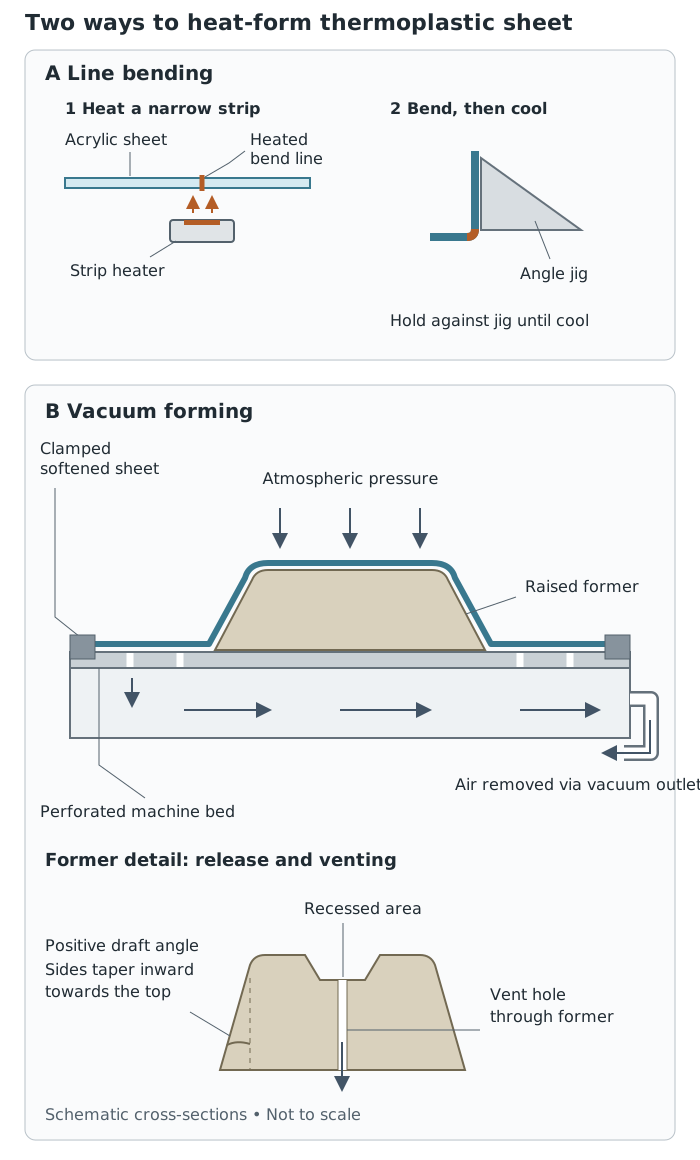
Line bending softens a narrow strip; vacuum forming softens a sheet and uses a pressure difference to shape it over a former. Both shapes set as the thermoplastic cools.
The former must allow both accurate shaping and easy removal. Tapered sides with a positive draft angle help the product slide off; a draft angle greater than 3° is a useful guideline. Avoid undercuts, which can trap the former inside the cooled product. Rounded corners and a smooth surface also aid release. Vent holes allow air to escape from recessed areas so that the sheet follows the detail properly. An excessively deep shape stretches the sheet too thin and may cause it to split.
3D printing is additive manufacturing: material is added to build the object rather than cut away from a larger piece. A CAD model provides the shape, and printing software converts it into instructions for the printer to follow.
A common school method is fused deposition modelling (FDM). A reel of thermoplastic filament, typically PLA or ABS, feeds into a heated print head. The material softens and is extruded through a nozzle onto the print bed. The nozzle follows the outline and deposits material for one layer, then further layers are added until the object is complete.
This can produce complex polymer shapes and prototypes directly from a digital design. Unlike line bending, it does not start with a sheet that is bent into shape; the object is built from deposited filament.
Welding joins compatible polymer surfaces by making the material at the joint soft enough to merge. Thermoplastics can be welded using heat or a suitable solvent.
In hot-air welding, a special hot-air gun heats the adjoining surfaces and a compatible plastic filler rod. The softened materials join at the seam and solidify as they cool.
In friction welding, two parts of the same thermoplastic are rapidly rubbed or vibrated against each other. Friction generates heat that melts their contacting surfaces. When movement stops and the joint cools, the parts remain welded together without a separate glue layer.
In solvent welding, a suitable solvent softens or dissolves the surfaces of the pieces being joined. The surfaces merge, and the joint sets as the solvent evaporates. This is commonly used to join acrylic parts.
Thin liquid solvent cement needs accurately fitting surfaces because it does not fill gaps. It can be applied with a fine brush or suitable applicator and drawn along the narrow joint by capillary action. A thicker product such as Tensol 12 can fill small gaps in acrylic joints, but an accurate fit still gives a stronger result. Apply solvent carefully to avoid damaging surrounding surfaces, and use the required ventilation and protective equipment.
Get unlimited access to all revision notes, key terms, and exam tips.
Get unlimited access to all revision notes, key terms, and exam tips.
When explaining a process, give the stages in order and explain why important controls are needed: for example, excessive drilling pressure can crack the polymer.
In vacuum forming, air is removed from beneath the sheet; atmospheric pressure above it pushes the softened sheet against the former.
Distinguish resin curing from thermoplastic cooling: a cured thermosetting resin cannot simply be reheated and reshaped.
For a tool-selection question, connect the tool to the material and task: a coping saw follows curves in thin acrylic, whereas a junior hacksaw suits light straight-cutting work.
Do not describe solvent welding as simply sticking two unchanged surfaces together with glue. The solvent softens or dissolves the polymer surfaces so that they join.
Thermoplastic
A plastic that softens when heated and hardens when cooled, allowing it to be reheated and reshaped. Also called a thermoforming polymer.
Thermosetting polymer
A polymer that sets permanently during curing and cannot subsequently be melted and reshaped.
Abrasion
Removing material by rubbing it with an abrasive tool or material, such as a file or wet-and-dry paper.
Resin casting
Pouring liquid resin into a mould and allowing it to cure into a solid shape.
Curing
The chemical process by which a resin hardens and sets permanently.
Line bending
Heating a narrow line across a thermoplastic sheet, bending it along that line and allowing it to cool in position.
Vacuum forming
Shaping a heated thermoplastic sheet over a former by removing air beneath it so that atmospheric pressure presses it against the former.
Former
A shaped tool around which material is formed to produce a required shape.
Draft angle
A taper on the sides of a mould or former that allows the formed product to be removed more easily.
Additive manufacturing
Making an object by adding material, usually layer by layer, rather than cutting material away.
Fused deposition modelling
A 3D-printing method in which thermoplastic filament is heated and extruded through a nozzle to build an object in layers.
Solvent welding
Joining compatible polymer surfaces by applying a solvent that softens or dissolves them; the joint sets as the solvent evaporates.
Put your knowledge into practice — try past paper questions for Design and Technology
Thermoplastic
A plastic that softens when heated and hardens when cooled, allowing it to be reheated and reshaped. Also called a thermoforming polymer.
Thermosetting polymer
A polymer that sets permanently during curing and cannot subsequently be melted and reshaped.
Abrasion
Removing material by rubbing it with an abrasive tool or material, such as a file or wet-and-dry paper.
Resin casting
Pouring liquid resin into a mould and allowing it to cure into a solid shape.
Curing
The chemical process by which a resin hardens and sets permanently.
Line bending
Heating a narrow line across a thermoplastic sheet, bending it along that line and allowing it to cool in position.
Vacuum forming
Shaping a heated thermoplastic sheet over a former by removing air beneath it so that atmospheric pressure presses it against the former.
Former
A shaped tool around which material is formed to produce a required shape.
Draft angle
A taper on the sides of a mould or former that allows the formed product to be removed more easily.
Additive manufacturing
Making an object by adding material, usually layer by layer, rather than cutting material away.
Fused deposition modelling
A 3D-printing method in which thermoplastic filament is heated and extruded through a nozzle to build an object in layers.
Solvent welding
Joining compatible polymer surfaces by applying a solvent that softens or dissolves them; the joint sets as the solvent evaporates.