

Loading…
Loading…
Loading…
OCR GCSE Psychology · J203
OCR J203 · Development of Treatments Check the specification (PDF) (opens in a new tab)
Treatment for schizophrenia and clinical depression aims to reduce symptoms and distress, while helping people manage everyday life. Improvement might mean being less frightened by voices, feeling able to meet friends again or returning to ordinary activities. It does not necessarily mean that every symptom disappears permanently.
Drug treatments change chemical communication in the brain. Psychotherapy involves working with a therapist to understand and manage thoughts, feelings and behaviour. These approaches can complement one another: medication may reduce symptoms enough for someone to engage with therapy, while therapy develops coping skills that medication alone does not teach.
A neuron is a nerve cell that transmits information. At a synapse, one neuron releases chemical messengers called neurotransmitters into a tiny gap. These bind to matching receptors on the receiving neuron and influence its activity. The releasing neuron is called the presynaptic neuron; the receiving neuron is the postsynaptic neuron.
After release, some neurotransmitter can be taken back into the presynaptic neuron. This is called reuptake. Drugs can alter communication by changing whether neurotransmitters bind to receptors or how quickly they are removed from the gap.
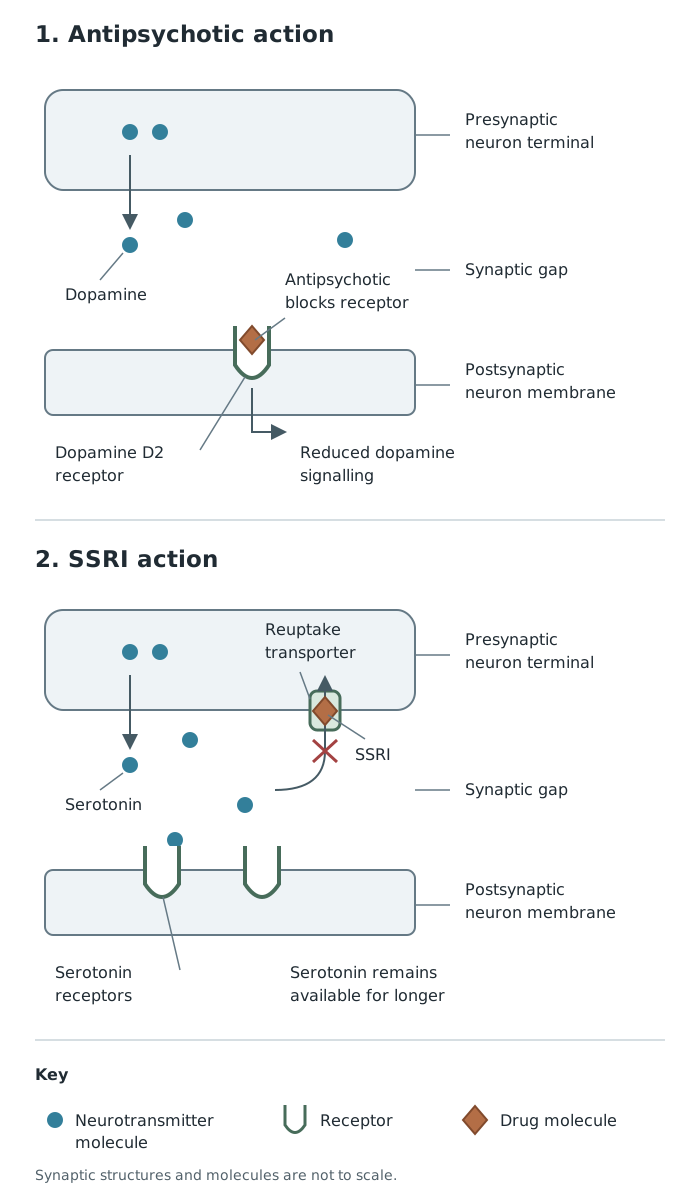
Antipsychotics reduce dopamine’s action at receptors; SSRIs block serotonin reuptake into the releasing neuron.
Schizophrenia can involve positive symptoms, such as hallucinations and delusions. ‘Positive’ means experiences added to ordinary functioning, not beneficial experiences. Hallucinations are perceptions without a corresponding external stimulus, such as hearing voices that others cannot hear. Delusions are strongly held false beliefs. Negative symptoms involve reductions in ordinary functioning, such as a lack of motivation or social withdrawal.
Dopamine is a neurotransmitter. A biological explanation links excessive dopamine activity in certain brain pathways to positive symptoms of schizophrenia. Antipsychotic medication reduces dopamine’s action, commonly by blocking dopamine D2 receptors on the postsynaptic neuron. Dopamine then has less effect on the receiving neuron, reducing excessive signalling.
This can lessen hallucinations and delusions, reduce distress and support clearer thinking. Someone who is less preoccupied by frightening voices may find it easier to concentrate, interact with others and take part in therapy. Antipsychotics manage symptoms rather than guarantee a permanent cure; improvement in hallucinations and delusions can take days or weeks.
Typical antipsychotics, such as chlorpromazine and haloperidol, are first-generation drugs developed from the 1950s. They strongly block dopamine receptors and can reduce positive symptoms. However, they can cause movement-related side effects, including stiffness, tremors and involuntary movements known as tardive dyskinesia. Drowsiness can also interfere with daily activities.
Atypical antipsychotics, such as risperidone and olanzapine, affect dopamine and serotonin receptors. Some have a lower risk of movement-related side effects than typical drugs, but they can still cause problems, including weight gain and changes in blood sugar or cholesterol. Being a newer drug does not mean being free of side effects.
Clinical depression involves persistent low mood and can affect motivation, concentration, sleep and everyday functioning. Biological explanations consider the involvement of neurotransmitters such as serotonin and noradrenaline in mood regulation. Depression should not simply be treated as a proven shortage of one chemical: psychological and social factors also matter.
A commonly used group of antidepressants is selective serotonin reuptake inhibitors, or SSRIs. Examples include fluoxetine and sertraline.
SSRIs block the reuptake of serotonin into the presynaptic neuron. More serotonin therefore remains available in the synaptic gap for longer and can continue to act on receptors on the postsynaptic neuron. This changes serotonin communication between neurons and can help reduce depressive symptoms.
As symptoms improve, a person may find it easier to concentrate, carry out everyday activities and participate in psychotherapy. However, antidepressants can have side effects such as nausea, headaches, weight changes and reduced sex drive. These need to be weighed against the benefits of treatment.
Psychotherapy is a psychological treatment in which a person works with a therapist to understand and manage their difficulties. Cognitive behavioural therapy, or CBT, combines two connected elements:
CBT focuses mainly on current difficulties. Therapist and client work collaboratively, examining thoughts rather than simply telling the client to ‘think positively’. The aim is to develop realistic, balanced interpretations and useful ways of responding. Thought diaries, agreed behavioural experiments and practice between sessions help transfer these skills into everyday life.
In depression, negative thinking and withdrawal can reinforce one another. A person may interpret a setback as evidence that they always fail, feel worse and stop attempting activities. Withdrawal then reduces opportunities for enjoyment or achievement, maintaining low mood.
CBT helps the person identify this pattern and examine the evidence for their interpretation. For example, ‘I always fail’ can be tested against occasions when they have succeeded. A balanced alternative might be, ‘This attempt went badly, but that does not mean every attempt will.’ The aim is accuracy, not unrealistic optimism.
The behavioural part includes behavioural activation: gradually increasing rewarding or meaningful activities. Setting an achievable goal can help interrupt withdrawal and provide new experiences against which negative beliefs can be tested.
Together, these changes can improve mood, motivation and everyday functioning. Learning to recognise and challenge negative thoughts independently also provides skills for managing future difficulties and reducing the risk of relapse.
CBT for schizophrenia helps people manage hallucinations, delusions and difficulties such as low motivation. It is commonly used alongside antipsychotic medication.
The therapist takes a non-judgemental approach and explores beliefs collaboratively. For example, if a person believes the therapist’s chair contains a hidden microphone, they may examine the chair together and consider whether the evidence supports that belief. This is different from ridiculing the person or demanding that they abandon the belief.
For someone hearing threatening voices, therapy can explore what the person believes the voices mean and whether their claims are reliable. Developing coping strategies and learning not to act automatically on distressing experiences can reduce fear and improve daily functioning, even if the experiences do not disappear entirely.
Small, achievable activity goals can also help with low motivation. Recognising signs that symptoms are worsening allows the person to use coping strategies and seek support earlier.
Medication can provide important symptom relief. Reducing psychotic experiences or depressive symptoms may make ordinary activities and therapy more manageable. However, side effects can themselves reduce quality of life. People also differ in their response, so medication and its effects need monitoring. For schizophrenia, stopping medication without clinical guidance can increase the risk of relapse.
CBT offers practical skills rather than only symptom control. Clients can learn ways of interpreting experiences, solving problems and coping with future difficulties. It does not cause medication’s physical side effects. However, it requires participation and practice; its benefit depends partly on whether the person can engage with this work. Therapy therefore should not be assumed to remove every symptom or work equally well for everyone.
A purely biological approach can be criticised as reductionist if it explains mental health only through brain chemistry and overlooks thoughts or circumstances. Equally, focusing only on thoughts can overlook biological contributions. Combining medication with psychotherapy addresses different aspects of the problem. A justified conclusion is that treatment should be tailored to the person’s symptoms, needs, response and preferences, rather than assuming one approach is always best.
Shared method: identify unhelpful thoughts → examine evidence → develop balanced interpretations and practise helpful behaviour.
Explain the full link from a drug’s action at the synapse to improved symptoms. Naming dopamine or serotonin alone does not explain how treatment works.
Distinguish blocking receptors from blocking reuptake: antipsychotics reduce dopamine’s action at receptors, whereas SSRIs keep serotonin available in the synaptic gap for longer.
For CBT, explain both changing thoughts and changing behaviour, and apply these to the named disorder.
When evaluating treatment, link each benefit or limitation to its consequences for the person. Symptom reduction is not the same as a permanent cure.
It can see this note and what your specification asks for.
Answers are free with an account.
1 free note left this week
Get more free notesYour answer sets when this note comes back for review, or marks it complete.
Was this note helpful?
Log in to tell us whether it helped, or to report a problem.
Last updated
Neuron
A nerve cell that transmits information through electrical and chemical signals.
Synapse
A junction between neurons where a neurotransmitter carries a chemical signal across a small gap.
Neurotransmitter
A chemical messenger released by a neuron that binds to receptors on another cell.
Receptor
A structure on a cell to which a particular chemical messenger can bind, affecting the cell’s activity.
Reuptake
The reabsorption of a neurotransmitter by the neuron that released it.
Antipsychotic
Medication used to reduce psychotic symptoms, such as hallucinations and delusions, by altering neurotransmitter activity in the brain.
Antidepressant
Medication used to treat clinical depression by changing neurotransmitter activity involved in mood.
SSRI
A selective serotonin reuptake inhibitor: an antidepressant that blocks serotonin reuptake, keeping serotonin available in the synaptic gap for longer.
Psychotherapy
A psychological treatment in which a person works with a therapist to understand and manage thoughts, feelings and behaviour.
CBT
Cognitive behavioural therapy: a psychotherapy that helps people identify and challenge unhelpful thoughts and change unhelpful behaviour.
Relapse
A return or worsening of symptoms after a period of improvement.
Put your knowledge into practice — try past paper questions for Psychology
Neuron
A nerve cell that transmits information through electrical and chemical signals.
Synapse
A junction between neurons where a neurotransmitter carries a chemical signal across a small gap.
Neurotransmitter
A chemical messenger released by a neuron that binds to receptors on another cell.
Receptor
A structure on a cell to which a particular chemical messenger can bind, affecting the cell’s activity.
Reuptake
The reabsorption of a neurotransmitter by the neuron that released it.
Antipsychotic
Medication used to reduce psychotic symptoms, such as hallucinations and delusions, by altering neurotransmitter activity in the brain.
Antidepressant
Medication used to treat clinical depression by changing neurotransmitter activity involved in mood.
SSRI
A selective serotonin reuptake inhibitor: an antidepressant that blocks serotonin reuptake, keeping serotonin available in the synaptic gap for longer.
Psychotherapy
A psychological treatment in which a person works with a therapist to understand and manage thoughts, feelings and behaviour.
CBT
Cognitive behavioural therapy: a psychotherapy that helps people identify and challenge unhelpful thoughts and change unhelpful behaviour.
Relapse
A return or worsening of symptoms after a period of improvement.