

Loading…
Loading…
Loading…
OCR GCSE Psychology · J203
OCR J203 · Psychological Explanations of Depression Check the specification (PDF) (opens in a new tab)
Tandoc, Ferrucci and Duffy’s 2015 study, Facebook use, envy, and depression among college students: Is Facebooking depressing?, investigated whether Facebook use was linked to depression, and whether envy helped explain that relationship.
Starting university can involve leaving home, gaining independence, forming new friendships and romantic relationships, and managing demanding coursework and exams. These changes can make students vulnerable to depression. Researchers had suggested that heavy use of social networking sites might also contribute, but earlier findings disagreed. Wright et al. (2012) found a positive correlation between hours spent on Facebook and depression, whereas Jelenchick et al. (2013) found no link.
Tandoc and colleagues therefore looked beyond simply counting time online. They considered what students did on Facebook and how they felt about the information they saw.
Envy occurs when someone else has something that we want but cannot have. Facebook envy is the envy experienced after viewing other people’s personal information on Facebook.
For example, a student might see friends’ holiday photographs and feel that everyone else has a more exciting life. The important step is not just seeing the photographs: it is comparing lives and feeling worse about one’s own position.
The researchers used social rank theory of depression, which proposes that feelings of inferiority or subordination can contribute to depression. They suggested that repeated Facebook comparisons might produce envy, dissatisfaction with life and feelings of inferiority. Heavy users might encounter more opportunities for comparison, while having more Facebook friends might provide more people to compare themselves with. These were proposed explanations to test, not established facts.
This connects with psychological explanations such as the ABC Model: an event alone need not determine the emotional consequence; how someone interprets it also matters. Tandoc and colleagues investigated envy and social comparison rather than directly testing the ABC Model.
The study aimed to investigate whether heavy Facebook use was linked to depression among college students, using social rank theory to explore the role of envy.
The researchers asked three questions:
A mediating variable helps explain a relationship by acting as an intermediate step. Here, the proposed intermediate step was envy: Facebook use might be associated with envy, which in turn might be associated with depression symptoms.
They tested three hypotheses:
The researchers used an online self-report questionnaire. Participants answered questions about their own Facebook behaviour and feelings, and their responses were coded numerically for statistical analysis. This investigated relationships between measured variables; it was not an experiment in which researchers assigned students different amounts of Facebook use.
Researchers visited classes and sent email invitations to 854 students from four sections of introductory journalism courses at a large Midwestern university in the USA. 736 students participated.
Their average age was about 19 years. Approximately 68% were female, 32% were male, and 78% were White Americans. All were Facebook users, with average use across the sample of approximately two hours per day. This average does not mean that each student used Facebook for exactly two hours.
Facebook use: Students reported their average daily hours of use. They also rated how often they performed seven activities on a five-point scale, from 1 = never to 5 = very frequently:
The last four activities involved observing other people rather than contributing posts. This type of activity was called surveillance use: keeping track of other people’s activities on Facebook.
Facebook envy: Students rated their agreement with eight statements using a five-point Likert scale. The statements concerned inferiority, frustration at others having a good time, unfairness about others having fun, wishing to travel as much as friends, friends having better lives, friends being happier, one’s own life being more fun than friends’ lives, and life being fair. For example, one statement was ‘Many of my friends are happier than me.’ These ratings turned feelings about comparison into numerical data.
Depression symptoms: Students completed the Center for Epidemiology Studies Depression Scale (CES-D), a questionnaire containing 20 items about symptoms associated with depression. It measured reported symptoms rather than providing a clinical diagnosis.
Participants completed and submitted the questionnaire online.
There was no significant direct relationship between frequency of Facebook use and depression. This did not support a simple explanation that more time on Facebook automatically means more depression symptoms.
Of the uses examined, only surveillance use was positively associated with Facebook envy. Keeping track of other people’s lives was therefore particularly relevant to the proposed comparison process.
The findings for the hypotheses were:
| Hypothesis | Finding | Outcome |
|---|---|---|
| H1: Heavy use is associated with greater envy | Heavy users reported stronger envy than light users | Supported |
| H2: Larger friend networks are associated with greater envy | Network size was not associated with envy | Not supported |
| H3: Greater envy is associated with more depression symptoms | Students reporting more envy also reported more symptoms | Supported |
Although the total effect of surveillance use on depression was not significant, the analysis identified an indirect relationship through Facebook envy. Surveillance use without envy was associated with fewer depression symptoms; when envy was involved, it was associated with more symptoms.
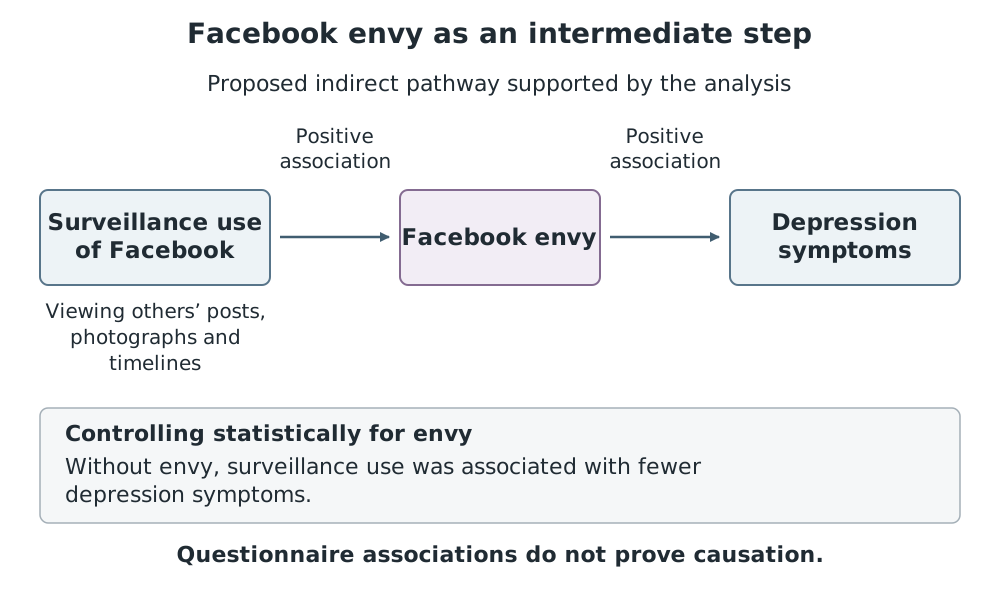
Envy helped explain the association between surveillance use and depression symptoms; the study did not prove cause and effect.
The researchers concluded that Facebook use alone did not directly lead to depression. Instead, Facebook envy helped explain the relationship between surveillance use and depression symptoms. When envy was statistically controlled for, Facebook use could be associated with less depression.
They regarded social rank theory as a useful explanation: feeling inferior during social comparison may matter more than simply being online. This also helps make sense of earlier conflicting research, because studies focusing only on hours of use may overlook different activities and emotional responses.
However, the questionnaire findings cannot establish that surveillance use caused envy or that envy caused depression. The results support the proposed explanation without proving its causal sequence.
A large sample and consistent measures: The 736 participants provided substantial numerical data. Using the same questionnaire and a named depression scale gave the researchers a consistent way to compare responses. Nevertheless, a large sample is not necessarily representative.
Limited generalisability: Participants came from journalism courses at one US university and were mostly around 19 years old. Their Facebook behaviour and social comparisons may differ from those of younger teenagers, older adults or people in other cultures. The findings are therefore most relevant to students resembling this sample, rather than all Facebook users.
Self-report bias: Participants might have underestimated their Facebook hours or under-reported envy and depression symptoms to appear more socially acceptable. This could make the recorded scores less accurate and distort the relationships found.
Construct validity: Numerical scales make feelings easier to compare, but envy and depression are complex experiences. Agreement with a short statement may not capture the full context of someone’s feelings. The CES-D provides a consistent symptom measure, but symptoms should not be treated as a confirmed diagnosis.
Cause and effect remain uncertain: Facebook use was not manipulated. Students already experiencing depression might compare themselves more negatively with friends, rather than comparison being the original cause. Other pressures, such as academic demands, might also influence their feelings. Overall, the study provides useful evidence about associations, but not proof that Facebook envy causes clinical depression.
Tandoc, Ferrucci and Duffy (2015): investigated Facebook use, envy and depression among college students.
Strengths: large sample; consistent numerical measures; established depression symptom scale.
Limitations: one university and narrow age range; self-report and social desirability bias; scales may oversimplify feelings; associations cannot establish cause and effect.
Keep the sample numbers separate: 854 students were invited, but 736 participated.
For the hypotheses, remember: H1 supported, H2 not supported, H3 supported.
Distinguish time spent on Facebook, surveillance use and Facebook envy. They are not interchangeable.
Describe the findings as relationships between variables, not proof that Facebook causes depression. The researchers did not manipulate Facebook use.
Develop criticisms by linking a study detail to its consequence: for example, students from one US university may not represent Facebook users in other cultures.
Depression symptom scores are not the same as a clinical diagnosis of depression.
It can see this note and what your specification asks for.
Answers are free with an account.
1 free note left this week
Get more free notesYour answer sets when this note comes back for review, or marks it complete.
Was this note helpful?
Log in to tell us whether it helped, or to report a problem.
Last updated
Facebook envy
Envy experienced after viewing other people’s personal information on Facebook.
Social rank theory
An explanation of depression which proposes that feeling inferior or subordinate to other people can contribute to depressive symptoms.
Surveillance use
Using Facebook to keep track of other people’s activities, such as reading their updates and viewing their photographs.
Self-report
A research method in which participants provide information about their own behaviour, thoughts or feelings.
Likert scale
A rating scale on which participants indicate their degree of agreement with a statement.
Mediation
A relationship in which an intermediate variable helps explain the association between two other variables. In this study, Facebook envy mediated the relationship between surveillance use and depression symptoms.
Social desirability bias
A tendency to give answers that seem socially acceptable rather than fully truthful.
Construct validity
The extent to which a measure captures the psychological concept it is intended to measure.
Put your knowledge into practice — try past paper questions for Psychology
Facebook envy
Envy experienced after viewing other people’s personal information on Facebook.
Social rank theory
An explanation of depression which proposes that feeling inferior or subordinate to other people can contribute to depressive symptoms.
Surveillance use
Using Facebook to keep track of other people’s activities, such as reading their updates and viewing their photographs.
Self-report
A research method in which participants provide information about their own behaviour, thoughts or feelings.
Likert scale
A rating scale on which participants indicate their degree of agreement with a statement.
Mediation
A relationship in which an intermediate variable helps explain the association between two other variables. In this study, Facebook envy mediated the relationship between surveillance use and depression symptoms.
Social desirability bias
A tendency to give answers that seem socially acceptable rather than fully truthful.
Construct validity
The extent to which a measure captures the psychological concept it is intended to measure.