

Loading…
Loading…
Loading…
OCR GCSE Combined Science B · J260
OCR J260 · Scientific Models and Theories Check the specification (PDF) (opens in a new tab)
Scientific observations tell us what happens; explanations suggest why it happens. An explanation does not emerge automatically from a collection of results. Scientists use creative thinking to propose ideas, then work out how to test them.
A scientific theory is an evidence-supported explanation that connects observations and makes testable predictions. In science, ‘theory’ does not simply mean a guess. A well-established theory has survived many tests, but it can still be modified if convincing new evidence becomes available.
Scientists might begin with a question, propose a hypothesis and predict what they should observe if it is correct. They then investigate and compare the results with the prediction. Agreement supports the explanation; disagreement prompts them to check the investigation and consider whether the explanation needs changing. One unexpected result is not automatically enough to overturn a theory: errors and alternative explanations must also be considered.
Scientific methods develop as scientists find new ways to investigate questions. Improved equipment can reveal things that earlier methods could not detect, allowing explanations to be tested more thoroughly.
The development of ideas about atoms shows this connection. An atom is a tiny particle of an element. In 1803, John Dalton presented an atomic theory in which matter consisted of tiny, indivisible atoms. Different elements had different atoms, and atoms combined to form new substances. This provided a useful explanation of matter, but later experiments showed that atoms were not indivisible.
In 1897, J. J. Thomson investigated beams in a cathode-ray tube. Their deflection towards a positive plate provided evidence for negatively charged particles: electrons. Finding particles smaller than an atom meant that Dalton’s description needed changing.
Thomson proposed the plum pudding model: negative electrons embedded in material with positive charge spread throughout it. This accounted for the presence of electrons while explaining how an atom could have no overall charge.
In the gold-foil experiments carried out by Geiger and Marsden under Rutherford’s direction in 1909, a beam of positively charged particles was directed at thin gold foil. This was a different investigative method: rather than studying a beam of electrons, scientists used particles to probe the structure of atoms.
With positive charge spread throughout an atom, the plum pudding model did not predict the very large deflections that were observed. Most particles passed through the foil, but some changed direction and a very small number were deflected back.
These observations supported a new explanation:
The resulting nuclear model placed a small, positively charged nucleus at the centre of the atom, with electrons outside it. The important development was not simply that a scientist suggested a different picture: the new description explained evidence that the earlier description could not.
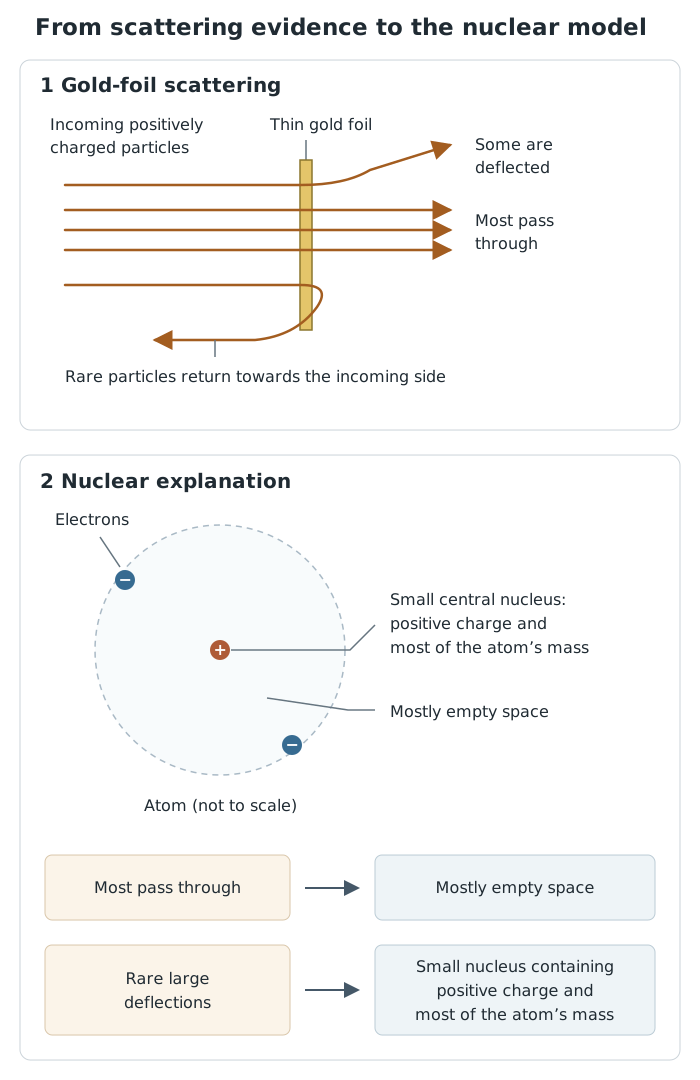
The nuclear model explains both the passage of most particles through the foil and the rare large deflections.
In 1913, Niels Bohr further developed the nuclear model by proposing that electrons occupy shells at set distances from the nucleus. His calculations agreed with experimental results. Scientific explanations can therefore develop in stages: useful parts of an earlier explanation may be retained while other parts are changed.
Before a new claim is widely accepted, other scientists examine the work behind it. Researchers write a scientific paper describing their question, methods, results and conclusions and submit it for publication.
In peer review, other scientists with relevant expertise assess the paper. They consider whether the methods are suitable, whether the evidence is convincing and whether the conclusions are justified by the results. For example, a reviewer might question whether a fair comparison was made or whether the authors have claimed more than their data support.
Reviewers may recommend publication, request changes or recommend rejection. Authors may need to explain their choices more clearly, correct errors or provide further evidence. This checking helps improve the quality and trustworthiness of published research.
Peer review is not the same as repeating an experiment, and it cannot guarantee that a claim is correct. Reviewers may miss mistakes, bias or manipulated data. Other scientists can carry out independent investigations to check whether the findings hold up.
Confidence grows when different investigations provide consistent, strong evidence. Nevertheless, an accepted theory remains open to testing. If reliable new evidence conflicts with it, scientists may modify or replace it. This willingness to change explanations in response to evidence is a strength of science, not a sign that all scientific knowledge is equally uncertain.
When explaining a change in a theory, link the old explanation, the new evidence and the change made. Naming scientists alone does not explain the development.
Distinguish peer review from repeating an experiment: reviewers assess the reported work; independent investigations provide further evidence.
Peer review increases confidence in a claim but does not prove it correct or guarantee that every error has been found.
It can see this note and what your specification asks for.
Answers are free with an account.
1 free note left this week
Get more free notesYour answer sets when this note comes back for review, or marks it complete.
Was this note helpful?
Log in to tell us whether it helped, or to report a problem.
Last updated
Scientific theory
An explanation supported by evidence that connects observations and can be used to make testable predictions.
Hypothesis
A proposed explanation that can be tested against evidence.
Prediction
A statement about what should happen under particular conditions if an explanation is correct.
Peer review
The evaluation of scientific work by other scientists with relevant expertise, who examine its methods, evidence and conclusions.
Plum pudding model
An early description of the atom in which negatively charged electrons are embedded in material with spread-out positive charge.
Nuclear model
A description of the atom with a small, positively charged central nucleus containing most of its mass, surrounded by electrons and mostly empty space.
Put your knowledge into practice — try past paper questions for Combined Science B
Scientific theory
An explanation supported by evidence that connects observations and can be used to make testable predictions.
Hypothesis
A proposed explanation that can be tested against evidence.
Prediction
A statement about what should happen under particular conditions if an explanation is correct.
Peer review
The evaluation of scientific work by other scientists with relevant expertise, who examine its methods, evidence and conclusions.
Plum pudding model
An early description of the atom in which negatively charged electrons are embedded in material with spread-out positive charge.
Nuclear model
A description of the atom with a small, positively charged central nucleus containing most of its mass, surrounded by electrons and mostly empty space.