

Loading…
Loading…
Loading…
OCR GCSE Combined Science B · J260
OCR J260 · Scientific Models and Theories Check the specification (PDF) (opens in a new tab)
A scientific model is a simplified representation of an object, process or relationship. Scientists use models to make complicated situations manageable: a model keeps the features needed for a particular question and leaves out others. It can help us solve a problem, predict what will happen or develop an explanation.
Choosing what to include requires judgement. A more detailed model is not always better: extra detail may make it harder to use without improving the answer we need.
A representational model stands for something being studied. It might be a drawing or a physical object. A spatial model focuses on shape, dimensions, position or arrangement. These categories can overlap: a physical model can also show spatial relationships.
Consider modelling a coin. A flat circular disc could be sufficient for investigating its outline or planning how coins fit side by side. It represents the coin’s shape when viewed from above, but ignores its thickness. A three-dimensional cylinder would be more suitable if thickness mattered, such as when considering the space occupied by a stack of coins.
Neither representation includes every feature of a real coin. The important question is whether the omitted features matter for the problem being solved.
A descriptive model summarises a phenomenon. For example, a graph of observations of a bacterial population over time can make its growth pattern easier to see than a long list of measurements. This tells us how the population changed, but the graph alone does not explain why.
An explanation needs ideas about the process involved. Bacteria reproduce, so a growing population can produce increasing numbers of new bacteria. A model based on a constant reproduction rate can connect this process to a prediction of rapid population growth. However, that explanation must account for the conditions in which the model applies.
A mathematical model expresses relationships using mathematics. Suppose we model a bacterial population starting with 100 bacteria and assume that the population doubles every hour, with no bacteria dying. This is a chosen scenario, not a measured growth rate.
The rule for each hourly step is:
Here, is the number of bacteria. Applying the rule gives predicted populations of 200 after one hour, 400 after two hours and 800 after three hours. This solves a prediction problem by repeatedly applying the same relationship.
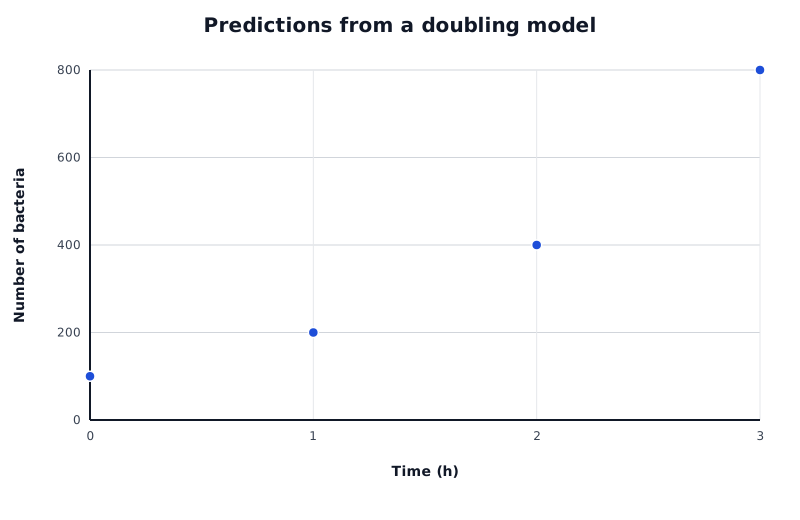
Predicted population when 100 bacteria are assumed to double every hour, with no deaths or limits on growth. The points are predictions, not observations.
Data for Predictions from a doubling model
| Series | Time (h) | Number of bacteria |
|---|---|---|
| Predicted bacterial population | 0 | 100 |
| Predicted bacterial population | 1 | 200 |
| Predicted bacterial population | 2 | 400 |
| Predicted bacterial population | 3 | 800 |
Each point shows a prediction at a whole-hour interval. The increasingly large rises occur because doubling a larger population adds more bacteria than doubling a smaller one.
A computational model uses a computer to apply rules such as this. In a spreadsheet, we could enter the starting population and make each following row twice the previous row. Changing the starting population or the assumed reproduction rate lets us explore different predictions quickly. The computer performs the calculations; it does not decide whether the assumptions are realistic.
To evaluate a model, first identify its purpose and assumptions. Then compare its predictions with relevant observations. Agreement supports using the model under those conditions; disagreement may mean that an assumption needs changing or an important feature is missing.
The bacterial model assumes continued doubling and ignores limits on growth. In a real colony, food can run short and waste can accumulate. Predictions of uninterrupted doubling therefore become unsuitable once these conditions affect reproduction or survival. The model may still be useful for a limited period when its assumptions are reasonable.
A useful evaluation connects a limitation to its consequence. Saying that the coin model is ‘only two-dimensional’ is less informative than explaining that it cannot represent thickness, so it is unsuitable for predicting the height of a stack.
Different models can contribute different kinds of understanding. A representation can make a structure easier to picture, a descriptive model can reveal a pattern, and a mathematical or computational model can generate predictions. No single model has to do all these jobs, and successful predictions do not mean that every detail of reality has been captured.
These categories can overlap.
For an assumed population that doubles each time step:
When evaluating a model, link a specific assumption or omitted feature to its effect on the prediction or explanation.
Judge whether a model is suitable for its intended purpose: being simplified does not automatically make it useless.
Distinguish a model’s predictions from observations used to test those predictions.
It can see this note and what your specification asks for.
Answers are free with an account.
1 free note left this week
Get more free notesYour answer sets when this note comes back for review, or marks it complete.
Was this note helpful?
Log in to tell us whether it helped, or to report a problem.
Last updated
Scientific model
A simplified representation of an object, process or relationship used to describe, explain or predict its behaviour.
Representational model
A drawing, physical object or other representation that stands for something being studied.
Spatial model
A model that represents shape, position, dimensions or the arrangement of objects.
Descriptive model
A model that describes or summarises a pattern or phenomenon, without necessarily explaining its cause.
Computational model
A model in which a computer applies rules or calculations to investigate how a system behaves.
Mathematical model
A model that uses mathematical relationships to represent how quantities are connected.
Assumption
A condition or simplification taken to be true when constructing or using a model.
Put your knowledge into practice — try past paper questions for Combined Science B
Scientific model
A simplified representation of an object, process or relationship used to describe, explain or predict its behaviour.
Representational model
A drawing, physical object or other representation that stands for something being studied.
Spatial model
A model that represents shape, position, dimensions or the arrangement of objects.
Descriptive model
A model that describes or summarises a pattern or phenomenon, without necessarily explaining its cause.
Computational model
A model in which a computer applies rules or calculations to investigate how a system behaves.
Mathematical model
A model that uses mathematical relationships to represent how quantities are connected.
Assumption
A condition or simplification taken to be true when constructing or using a model.
Predictions depend on the starting value and assumptions; they are not observations.
Identify its purpose → assumptions → omitted features → consequences. Compare predictions with observations and improve the model where needed.
A simplified model can still be useful within the conditions where its assumptions are reasonable.