

Loading…
Loading…
Loading…
OCR GCSE Combined Science B · J260
OCR J260 · Cell Structures, DNA, and Protein Synthesis Check the specification (PDF) (opens in a new tab)
All organisms contain genetic material. This material provides instructions that help control how cells function and how an organism develops. The genome is the entire genetic material of an organism, not just the instructions for one characteristic.
In plant and animal cells, most genetic material is located in the nucleus. It is packaged into chromosomes: long molecules of DNA carrying many genes. A gene is a section of DNA that provides instructions for making a particular protein. The relationship is therefore one of parts within a whole: genes are sections of the DNA in chromosomes, and the genome includes all the genetic material.
DNA, short for deoxyribonucleic acid, is a polymer. A polymer is a large molecule made by joining many smaller units, called monomers, together. The monomers that make up DNA are nucleotides.
Many nucleotides join together to form a long strand. DNA has two such strands, which wind around each other to form a double helix. Imagine a ladder twisted along its length: this gives a useful picture of the overall shape. A chromosome contains a very long DNA molecule, and a gene is a particular section along it.
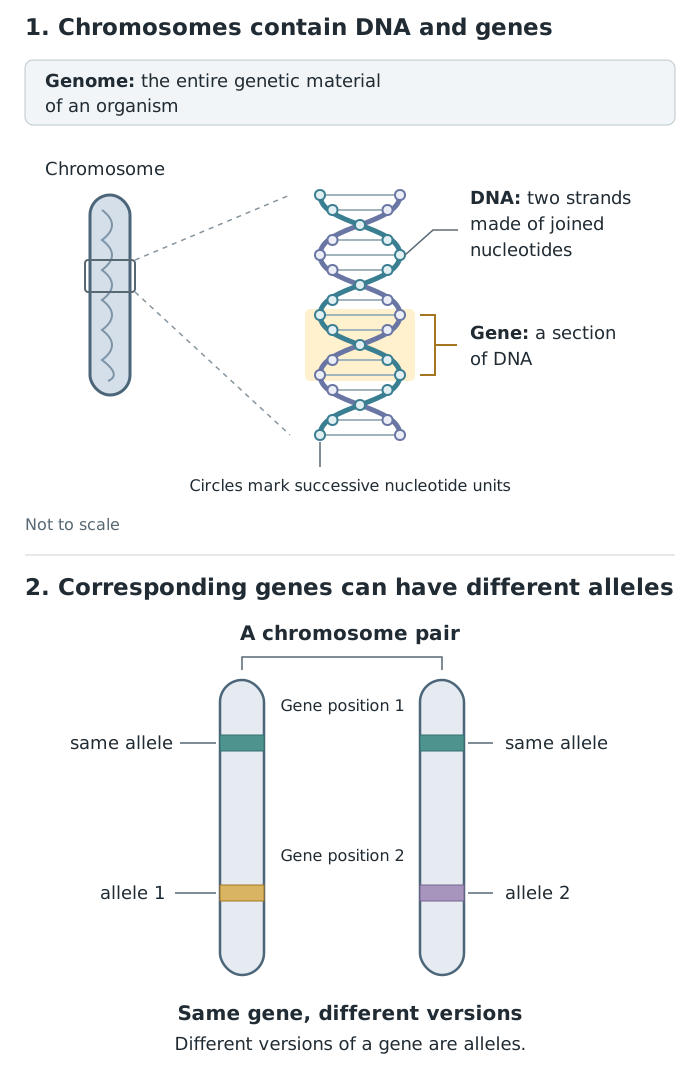
Genes are sections of DNA. Paired chromosomes carry the same genes, but the alleles at a corresponding position can be the same or different.
In most plant and animal body cells, chromosomes occur in pairs. The two chromosomes in a pair carry the same genes at corresponding positions. However, they need not carry the same version of each gene.
A version of a gene is an allele. A different version is also called a genetic variant. For example, two paired chromosomes might carry the same allele at one gene position but different alleles at another. The gene is still the same gene; its version differs.
An organism's genotype is its combination of alleles. Its phenotype is its characteristics, resulting from those alleles and interaction with the environment. Phenotype includes features that can be seen, such as skin colour, and features that must be tested, such as blood group.
Genetic instructions affect characteristics through the proteins that cells make. Proteins have important jobs: some provide structure, some transport molecules, and others act as enzymes that help chemical reactions take place.
Amino acids are the small building blocks of proteins. During protein synthesis, amino acids are joined together into a chain in a particular order. Joining these small units to make a large molecule is polymerisation. A protein is therefore a polymer of amino acids, whereas DNA is a polymer of .
Amino acids supply the material for a protein, but they must be assembled according to instructions. Genes in the genome specify the order in which amino acids are joined. Different instructions can produce different proteins, helping explain how genetic differences can lead to differences in cell function and phenotype.
Most characteristics depend on instructions in the genome, but the organism's interaction with its environment can modify how those characteristics develop. The genotype alone does not describe the whole phenotype.
For example, skin colour depends on genetic instructions, but it is also influenced by exposure to sunlight. Increased sunlight exposure can lead to darker skin through tanning. This change in phenotype does not mean that the person has acquired a different combination of alleles.
The key connection is: genetic instructions guide protein production and development, while environmental conditions can modify the resulting characteristics.
Keep the levels distinct: a gene is a section of DNA, a chromosome is a long DNA molecule carrying genes, and the genome is the entire genetic material.
When describing DNA, include all three points: it is a polymer of nucleotides, it has two strands, and these form a double helix.
Distinguish the building blocks: nucleotides make DNA; amino acids make proteins.
For a phenotype influenced by the environment, link the genetic instructions to a named environmental factor and its effect.
It can see this note and what your specification asks for.
Answers are free with an account.
1 free note left this week
Get more free notesYour answer sets when this note comes back for review, or marks it complete.
Was this note helpful?
Log in to tell us whether it helped, or to report a problem.
Last updated
Genome
The entire genetic material of an organism.
DNA
Deoxyribonucleic acid: the molecule that carries genetic instructions. It is a polymer of nucleotides arranged in two strands forming a double helix.
Polymer
A large molecule made by joining many smaller units, called monomers, together.
Nucleotide
A small molecular unit that joins with other nucleotides to form a DNA strand.
Double helix
The shape formed by two strands winding around each other, as in DNA.
Chromosome
A long DNA molecule carrying genetic information in the form of genes.
Gene
A section of DNA that provides instructions for making a particular protein.
Allele
A version of a gene.
Variant
A different version of a gene; also called a genetic variant or allele.
Genotype
The combination of alleles an organism has.
Phenotype
The characteristics of an organism resulting from its genotype and interaction with its environment.
Amino acid
A small molecule that can be joined to other amino acids to make a protein.
Protein synthesis
The process of making proteins by joining amino acids together in a particular order, using genetic instructions.
Put your knowledge into practice — try past paper questions for Combined Science B
Genome
The entire genetic material of an organism.
DNA
Deoxyribonucleic acid: the molecule that carries genetic instructions. It is a polymer of nucleotides arranged in two strands forming a double helix.
Polymer
A large molecule made by joining many smaller units, called monomers, together.
Nucleotide
A small molecular unit that joins with other nucleotides to form a DNA strand.
Double helix
The shape formed by two strands winding around each other, as in DNA.
Chromosome
A long DNA molecule carrying genetic information in the form of genes.
Gene
A section of DNA that provides instructions for making a particular protein.
Allele
A version of a gene.
Variant
A different version of a gene; also called a genetic variant or allele.
Genotype
The combination of alleles an organism has.
Phenotype
The characteristics of an organism resulting from its genotype and interaction with its environment.
Amino acid
A small molecule that can be joined to other amino acids to make a protein.
Protein synthesis
The process of making proteins by joining amino acids together in a particular order, using genetic instructions.