

Loading…
Loading…
Loading…
OCR GCSE Combined Science B · J260
OCR J260 Check the specification (PDF) (opens in a new tab)
During sexual reproduction, a sperm and an egg join at fertilisation. These gametes are sex cells with one set of chromosomes. For a gene involved in a simple inheritance cross, each gamete carries just one allele—a version of that gene. The offspring therefore receives two alleles: one from each parent.
The combination of alleles is its genotype. The characteristic produced, such as a pea plant being tall or short, is its phenotype. Genetic diagrams connect these two ideas: they show which allele combinations offspring could inherit, then help us predict their characteristics.
Some characteristics follow single-gene inheritance. A useful example is pea plant height, studied by Gregor Mendel. In this example, the allele for tall plants is dominant and the allele for short plants is recessive. We use T for the dominant allele and t for the recessive allele.
A dominant allele affects the phenotype even when only one copy is present. A recessive allele affects the phenotype only when two copies are present, with no dominant allele.
| Genotype | Description | Phenotype |
|---|---|---|
| TT | Homozygous dominant | Tall |
| Tt | Heterozygous | Tall |
| tt | Homozygous recessive | Short |
Homozygous means that the two alleles of a gene are identical. Heterozygous means that they are different. A heterozygous plant still carries the recessive allele and can pass it to offspring, even though the plant itself is tall.
A Punnett square organises the possible combinations of parental alleles. Start with the parents’ genotypes, work out the alleles their gametes can carry, and place these around the outside of the square. Each box inside combines one allele from each parent.
First, cross a homozygous tall plant with a short plant: . Every gamete from the tall parent carries T, and every gamete from the short parent carries t.
| Gametes | T | T |
|---|---|---|
| t | Tt | Tt |
| t | Tt | Tt |
All possible offspring are Tt, so all are tall. Although each parent has two alleles, each passes on only one.
Now cross two of these heterozygous plants: . Each parent produces gametes carrying either T or t, with equal probability.
| Gametes | T | t |
|---|---|---|
| T | TT | Tt |
| t | Tt | tt |
There are four equally likely combinations: one TT, two Tt and one tt. The genotype ratio is therefore . Both TT and Tt plants are tall, so the phenotype ratio is .
A different cross produces a different prediction. For , one parent produces T or t gametes, while the other produces only t gametes.
| Gametes | T | t |
|---|---|---|
| t | Tt | tt |
| t | Tt | tt |
Half the combinations are Tt and half are tt: the predicted phenotype ratio is 1 tall : 1 short.
For equally likely boxes in a Punnett square:
In the cross, the probability of a short offspring is , or 25%. The probability of a tall offspring is , or 75%.
Direct proportion lets us use this probability to predict numbers. Suppose the cross produces 80 offspring. The expected number of short plants is , and the expected number of tall plants is .
These are expected numbers, not a guarantee. Fertilisation involves chance, so actual results can differ. Each offspring is a new event: getting a short plant does not make a tall plant more likely next time. Four offspring do not necessarily include exactly three tall plants and one short plant.
A family tree, also called a pedigree, traces a characteristic across generations. Squares usually represent males and circles females. A line joins two parents, with offspring linked below them. Always read the key to see how the characteristic is marked.
Suppose a condition is caused by a recessive allele, a, and A is dominant. Two parents without the condition have a child with the condition. The child must be aa, so each parent supplied an a allele. Since neither parent has the condition, both must be Aa: they carry the recessive allele without showing its effect.
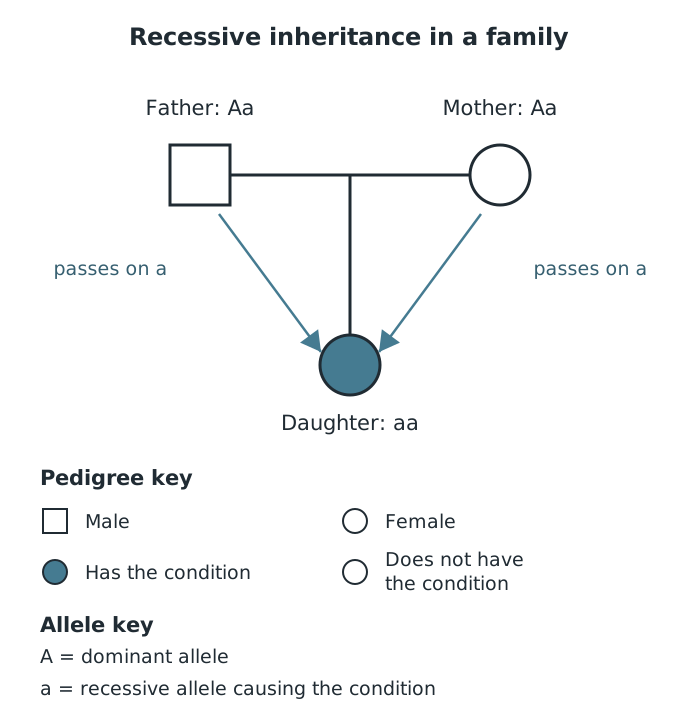
An aa child inherited an a allele from each parent. Neither parent shows the recessive condition, so both are Aa.
A cross of then predicts a probability of the condition in each child. The family tree helps infer the parental genotypes; the Punnett square predicts possible future outcomes.
Most phenotypic features depend on multiple genes, rather than one gene with a simple dominant–recessive pair of alleles. This is called polygenic inheritance. Eye colour, for example, involves several genes and has more possibilities than just brown or blue.
A single-gene Punnett square is therefore useful for particular inheritance patterns, but it cannot fully predict most characteristics. Environmental influences can also contribute to phenotype.
Humans usually have 23 pairs of chromosomes. One pair consists of the sex chromosomes: females typically have XX and males typically have XY.
Egg cells carry an X chromosome. Sperm cells carry either X or Y. At fertilisation, an X-bearing sperm produces XX, while a Y-bearing sperm produces XY.
| Egg chromosome / sperm chromosome | X | Y |
|---|---|---|
| X | XX | XY |
| X | XX | XY |
The usual prediction is 1 XX : 1 XY, giving approximately a 50% probability of either outcome at each fertilisation. It is the chromosome carried by the fertilising sperm that determines which combination forms.
The chromosomes affect development through the genes they carry. Genes on the Y chromosome trigger the development of testes; a key example is SRY. This connects the inheritance of a sex chromosome to the development of biological sex, rather than treating X and Y as labels alone.
Give a key for your allele letters. Use the same letter in upper and lower case for dominant and recessive alleles.
Put one allele from each parent in every offspring box. Gametes contain one allele for the gene, not a pair.
Distinguish genotype ratios from phenotype ratios: Tt × Tt gives 1 TT : 2 Tt : 1 tt, but 3 tall : 1 short.
A dominant phenotype does not identify a unique genotype: a tall pea plant could be TT or Tt.
Predicted ratios describe probabilities, not guaranteed numbers in a small family or group of offspring.
In a sex-determination diagram, X and Y represent chromosomes, not dominant and recessive alleles.
It can see this note and what your specification asks for.
Answers are free with an account.
1 free note left this week
Get more free notesYour answer sets when this note comes back for review, or marks it complete.
Was this note helpful?
Log in to tell us whether it helped, or to report a problem.
Last updated
Gamete
A sex cell, such as a sperm or egg cell, containing one set of chromosomes and one allele of each gene.
Allele
A version of a gene.
Genotype
The combination of alleles an organism has, for example Tt for a particular gene.
Phenotype
An organism’s observable characteristics, resulting from its genetic information and its interaction with the environment.
Homozygous
Having two identical alleles of a particular gene, for example TT or tt.
Heterozygous
Having two different alleles of a particular gene, for example Tt.
Dominant allele
An allele whose effect is expressed in the phenotype when only one copy is present.
Recessive allele
An allele whose effect is expressed in the phenotype only when two copies are present, in simple dominant–recessive inheritance.
Punnett square
A genetic diagram showing the possible combinations of alleles inherited from two parents.
Single-gene inheritance
Inheritance of a characteristic controlled by one gene.
Polygenic inheritance
Inheritance in which multiple genes contribute to a characteristic.
Sex chromosome
A chromosome involved in determining biological sex; humans typically have XX or XY sex chromosomes.
Put your knowledge into practice — try past paper questions for Combined Science B
Gamete
A sex cell, such as a sperm or egg cell, containing one set of chromosomes and one allele of each gene.
Allele
A version of a gene.
Genotype
The combination of alleles an organism has, for example Tt for a particular gene.
Phenotype
An organism’s observable characteristics, resulting from its genetic information and its interaction with the environment.
Homozygous
Having two identical alleles of a particular gene, for example TT or tt.
Heterozygous
Having two different alleles of a particular gene, for example Tt.
Dominant allele
An allele whose effect is expressed in the phenotype when only one copy is present.
Recessive allele
An allele whose effect is expressed in the phenotype only when two copies are present, in simple dominant–recessive inheritance.
Punnett square
A genetic diagram showing the possible combinations of alleles inherited from two parents.
Single-gene inheritance
Inheritance of a characteristic controlled by one gene.
Polygenic inheritance
Inheritance in which multiple genes contribute to a characteristic.
Sex chromosome
A chromosome involved in determining biological sex; humans typically have XX or XY sex chromosomes.
Identify parental genotypes → identify gametes → complete the Punnett square → count genotypes → identify phenotypes.
For tall T dominant to short t:
| Cross | Predicted genotypes | Tall : short |
|---|---|---|
| TT × tt | All Tt | 1 : 0 |
| Tt × Tt | 1 TT : 2 Tt : 1 tt | 3 : 1 |
| Tt × tt | 1 Tt : 1 tt | 1 : 1 |
Each fertilisation is independent. Predicted ratios are not guaranteed actual results.
A family tree can help infer genotypes: two unaffected parents with a child showing a recessive condition must both carry the recessive allele.
Most phenotypic features involve multiple genes. Eye colour is polygenic, not a simple single-gene characteristic.