

Loading…
Loading…
Loading…
OCR GCSE Combined Science B · J260
OCR J260 · Photosynthetic Processes and Rates Check the specification (PDF) (opens in a new tab)
Living cells carry out many chemical reactions, including those involved in photosynthesis and respiration. Enzymes control the rates of these reactions. An enzyme is a protein that acts as a biological catalyst: it speeds up a reaction without being used up. This means the same enzyme molecule can catalyse a reaction repeatedly.
The reactant an enzyme acts on is called its substrate. For example, amylase catalyses the breakdown of starch into smaller sugars, including maltose. Starch is the substrate; the sugars formed are products.
An enzyme has a region called its active site, where the substrate binds. The active site has a particular shape that is complementary to the substrate’s shape. This is often represented by the lock-and-key model: a particular key fits a particular lock.
When the substrate binds, an enzyme–substrate complex forms. The enzyme catalyses the reaction, the products leave, and the active site becomes available again. The enzyme remains unchanged.
This explains enzyme specificity. A substrate with the wrong shape cannot fit the active site, so the enzyme cannot catalyse its reaction. Amylase acts on starch, whereas catalase acts on hydrogen peroxide.
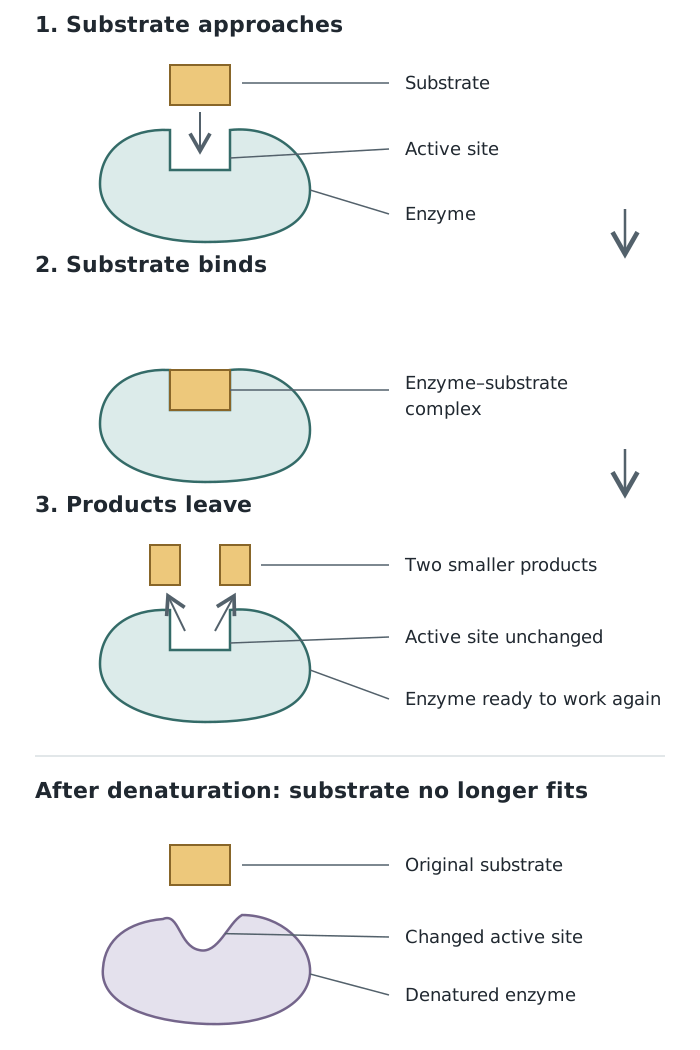
A complementary substrate binds to the active site. Products leave and the enzyme can work again; denaturation changes the active site’s shape.
At low temperatures, enzyme and substrate molecules move slowly. They collide less frequently, so fewer substrates bind to active sites each second and the reaction is slow.
As temperature rises, the molecules gain kinetic energy and move faster. More frequent successful collisions increase the reaction rate, up to the enzyme’s optimum temperature, where its activity is greatest.
At sufficiently high temperatures, the enzyme’s shape changes. Its active site is no longer complementary to the substrate, so the substrate cannot bind. This is denaturation, and it causes the rate to fall sharply.
Cooling an enzyme does not normally denature it: it slows molecular movement rather than destroying the active site’s shape. Different enzymes have different optimum temperatures, so there is no single optimum for all enzymes.
Each enzyme also has an optimum pH. Moving away from this pH reduces its activity because changes in pH affect the active site. Extreme pH conditions can denature the enzyme.
The optimum depends on the enzyme’s working environment. Pepsin, a digestive enzyme in the stomach, works best in strongly acidic conditions, around pH 2. Amylase in the mouth works best near neutral conditions, around pH 7.
A graph of rate against pH therefore has a maximum at the enzyme’s optimum pH and lower rates on either side.
Substrate concentration is the amount of substrate in a given volume of solution. At a low concentration, some active sites are unoccupied because substrate molecules reach them relatively infrequently.
Increasing substrate concentration increases the frequency of collisions with enzymes, so more enzyme–substrate complexes form and the rate rises. Eventually, the enzymes are working at their maximum rate: their active sites are occupied as often as possible. Adding more substrate then produces little or no further increase, so the rate graph levels off.
This explanation assumes that enzyme concentration, temperature and pH stay constant. Increasing enzyme concentration can also increase the rate, provided enough substrate is available, because there are more active sites.
You can follow an enzyme-controlled reaction by measuring either the disappearance of a substrate or the formation of a product.
The units depend on the measurement. For example, measuring oxygen volume in cubic centimetres over a time in seconds gives a rate in .
Another approach is to time how long a fixed amount of substrate takes to disappear. A shorter time means a faster reaction. When the amount is the same in every trial, a comparative rate can be calculated using , where is the time taken. If time is measured in seconds, this comparative rate has units of .
Amylase breaks down starch. Iodine solution provides a way to detect the starch remaining: it turns blue-black when starch is present, but stays yellow-brown when starch is absent.
You need amylase and starch solutions, buffer solution, test tubes, measuring equipment, a water bath, a thermometer, a stopwatch, dropping pipettes, iodine solution and a spotting tile.
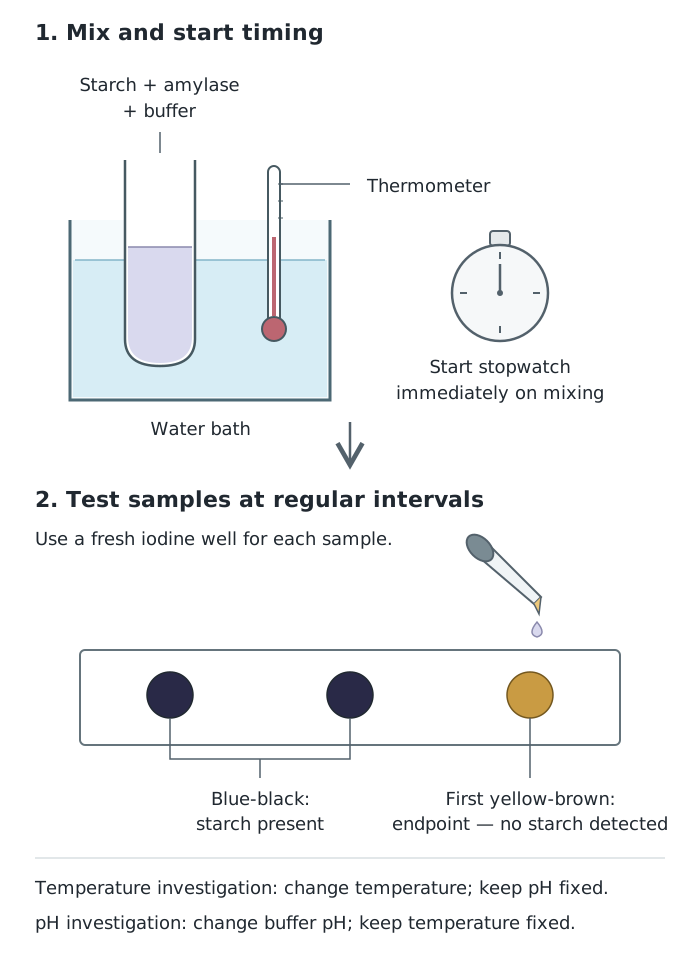
Test separate samples with iodine and record when the first sample stays yellow-brown.
To investigate pH, use the same sampling method but change the pH using different buffer solutions. Keep temperature constant, along with the volumes and concentrations of starch and amylase.
Repeat trials at each condition and calculate a mean time or comparative rate. Regular sampling means that the true endpoint lies between the last blue-black sample and the first yellow-brown sample. Shorter sampling intervals narrow this range. Compare the endpoint colour with iodine alone to make the judgement more consistent.
Wear eye protection, avoid skin contact with iodine and enzyme solutions, and take care with hot water and glassware. Do not taste any solutions or pipette by mouth.
Catalase breaks down hydrogen peroxide into water and oxygen. Hydrogen peroxide is the substrate, and the oxygen produced can be collected to measure the reaction rate.
Prepare a range of hydrogen peroxide concentrations by dilution, using the same total volume in each trial. Add the same volume and concentration of catalase solution to each. Use a flask connected by a bung and delivery tube to a gas syringe, and record the volume of oxygen collected during the same short time interval after mixing.
Keep temperature, pH and enzyme concentration constant. Repeat each concentration and compare the mean volumes of oxygen produced per second. Use a short interval so that substrate depletion does not dominate the comparison. At first, increasing substrate concentration should increase the rate; at sufficiently high concentrations, the rate should level off because enzyme availability limits it.
Wear eye protection and use dilute hydrogen peroxide as directed by the teacher. Avoid contact with skin and eyes. Check that gas can enter the syringe freely: never seal an oxygen-producing reaction in a container with no outlet.
Explain specificity using complementary shapes: the substrate fits the enzyme’s active site, not the whole enzyme.
Distinguish low temperature from denaturation: cooling slows enzyme activity without changing the active site’s shape.
When describing an investigation, name the variable changed, what is measured and the variables kept constant.
Use 1/time to compare endpoint tests only when the same amount of substrate is broken down in each test. Changing substrate concentration changes that amount.
An enzyme’s optimum temperature or pH is not the same for every enzyme.
It can see this note and what your specification asks for.
Answers are free with an account.
1 free note left this week
Get more free notesYour answer sets when this note comes back for review, or marks it complete.
Was this note helpful?
Log in to tell us whether it helped, or to report a problem.
Last updated
Enzyme
A protein that acts as a biological catalyst, speeding up a reaction without being used up.
Active site
The region of an enzyme where a substrate binds and the reaction takes place.
Substrate
A reactant on which an enzyme acts.
Enzyme specificity
The property of an enzyme that allows it to catalyse a particular reaction because its active site has a shape complementary to its substrate.
Denaturation
A change in an enzyme’s shape that prevents its substrate fitting the active site, so the enzyme can no longer catalyse the reaction.
Optimum
The temperature or pH at which a particular enzyme works fastest.
Buffer solution
A solution that resists changes in pH.
Rate of reaction
The amount of substrate used up or product formed per unit time.
Put your knowledge into practice — try past paper questions for Combined Science B
Enzyme
A protein that acts as a biological catalyst, speeding up a reaction without being used up.
Active site
The region of an enzyme where a substrate binds and the reaction takes place.
Substrate
A reactant on which an enzyme acts.
Enzyme specificity
The property of an enzyme that allows it to catalyse a particular reaction because its active site has a shape complementary to its substrate.
Denaturation
A change in an enzyme’s shape that prevents its substrate fitting the active site, so the enzyme can no longer catalyse the reaction.
Optimum
The temperature or pH at which a particular enzyme works fastest.
Buffer solution
A solution that resists changes in pH.
Rate of reaction
The amount of substrate used up or product formed per unit time.
For the same amount of substrate reaching the same endpoint, comparative rate . A shorter time means a higher rate.