

Loading…
Loading…
Loading…
OCR GCSE Combined Science B · J260
OCR J260 · Photosynthetic Processes and Rates Check the specification (PDF) (opens in a new tab)
Plants are producers: they make their own food by photosynthesis rather than obtaining it by eating other organisms. Photosynthesis makes glucose from carbon dioxide and water, and releases oxygen. The glucose provides fuel for cellular respiration and materials for growth. Some is converted into starch for storage; some helps build other carbohydrates, lipids and, with elements obtained from mineral ions, proteins. This plant biomass also supplies food chains.
The overall word summary is:
The balanced symbol equation is:
Photosynthesis is an endothermic process: it requires energy transferred from its surroundings. Light from the Sun, or another light source, provides this energy. Light is not a substance that becomes part of glucose; the atoms in glucose come from the chemical reactants.
A chloroplast is a small structure inside a plant cell where photosynthesis takes place. Chloroplasts contain chlorophyll, a green pigment that absorbs light. Energy transferred to chlorophyll enables the reactions of photosynthesis to occur. Chloroplasts therefore connect the supply of light energy to the production of glucose.
Photosynthesis occurs in cells containing chloroplasts in green parts of plants. Leaves also have pores called stomata, through which carbon dioxide can diffuse into the leaf and oxygen can diffuse out.
The overall equation summarises many chemical reactions. A two-stage model shows more clearly how the reactants are used.
In the first stage, light energy is required to split water into hydrogen and oxygen. Hydrogen is passed on for use in the second stage. Oxygen is a waste product and can be released from the plant. This stage cannot occur without light.
In the second stage, hydrogen combines with carbon dioxide to make glucose. This stage does not directly require light, but it depends on the hydrogen supplied by the first stage. It is therefore not an independent process that can continue indefinitely without the first stage.
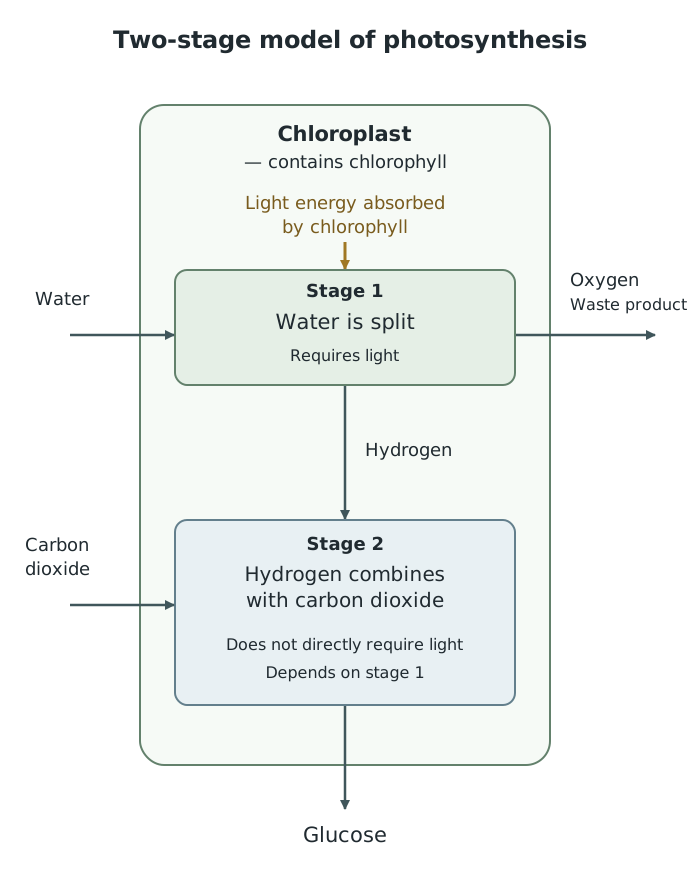
Light drives the first stage. Hydrogen links that stage to glucose production in the second.
The model also explains why oxygen production is evidence of photosynthesis: oxygen is released when water is split in the first stage.
Photosynthesis makes glucose, but leaves often convert some of that glucose into starch. Testing a leaf for starch therefore provides evidence that photosynthesis has occurred. Iodine solution gives a clear result: blue-black means starch is present; orange-brown means starch is absent.
Starch is indirect evidence, not proof that every tissue containing it carried out photosynthesis. For example, a potato plant makes glucose in its leaves but stores starch in underground tubers. Materials made in one part of a plant can be transported to another.
Before investigating a requirement for photosynthesis, remove starch already stored in the leaves. Otherwise, a positive starch test could reflect photosynthesis before the investigation rather than during it.
Keep a healthy, watered plant in complete darkness for about 24–48 hours. Without light, photosynthesis cannot replenish its glucose supply. Stored starch is broken down to provide glucose for cellular respiration, gradually using up the starch reserves. This is called destarching.
Test a starting leaf for starch using the method below. An orange-brown result confirms that the leaf has been destarched; a blue-black result means more time in darkness is needed. Prepare the comparison plants in the same way before applying their different treatments.
You need a beaker of hot water or an electric water bath, a boiling tube and holder, forceps, ethanol, cold rinse water, a white tile or Petri dish, iodine solution and a dropper. Wear safety goggles. Hot water and hot ethanol can cause burns, so use forceps and a tube holder rather than handling hot equipment directly.
Avoid getting iodine solution in your eyes; it also stains. Put used ethanol in the labelled solvent-waste container as directed by your teacher, rather than pouring it down the sink.
One approach compares leaves enclosed in a transparent bag with leaves enclosed in a black bag. Use destarched plants. The transparent bag allows light to reach the leaves; the black bag excludes it. Other conditions, such as the plant type, water supply and time allowed, should be comparable.
After the treatment, test the leaves for starch. Leaves exposed to light turn blue-black with iodine, whereas leaves kept without light do not. This supports the conclusion that light is required for photosynthesis.
A more local comparison uses an opaque black-paper mask over part of a leaf, leaving another part exposed to light. Cover both surfaces of the masked area so that light cannot reach it from either side. Leave the plant in bright light for several hours, and record the mask's position before removing it for starch testing.
The uncovered area turns blue-black, while the covered area remains orange-brown. Comparing areas of the same leaf helps keep many other conditions similar.
A variegated leaf has both green and white areas. Use a destarched plant and record the positions of these areas before testing, because ethanol will remove the green colour. Expose the leaf to light with water and carbon dioxide available, then test it for starch.
The originally green areas turn blue-black; the white areas do not. Both areas received light, but only the green areas contained chlorophyll. This supports the conclusion that chlorophyll is needed for photosynthesis, rather than light alone being sufficient.
Compare leaves from destarched plants in two sealed transparent bags. One bag contains sodium hydroxide, which removes carbon dioxide from the enclosed air; the comparison bag retains carbon dioxide. Keep both in the light, with other conditions as similar as possible.
After a day or two, starch testing gives different results. Leaves in the bag without carbon dioxide do not turn blue-black, while leaves in the comparison bag do. Light was available in both, so the difference supports the conclusion that carbon dioxide is required.
Sodium hydroxide is corrosive. This investigation needs teacher supervision, eye protection and secure containment of the chemical so that it cannot contact skin or the leaves.
An aquatic plant allows gas released during photosynthesis to be collected. Place the plant underwater in bright light and collect the gas in an inverted, water-filled test tube above it. Gas from the cut end of the stem rises and accumulates at the top of the tube, displacing water.
An oxygen probe can show that the collected gas contains more oxygen than air. This supports the conclusion that photosynthesis produces oxygen. A glowing splint may relight if the gas is sufficiently rich in oxygen, but this test is less reliable when only a small amount of extra oxygen has collected. Failure to relight does not, by itself, establish that no oxygen was produced. Any splint test should be supervised and performed separately from the starch test, away from ethanol and other flammable materials.
The investigation is ready for testing when enough gas has collected for the chosen test. Keep electrical lighting away from spills and avoid touching a hot lamp.
Distinguish chloroplasts, the structures where photosynthesis occurs, from chlorophyll, the light-absorbing pigment inside them.
Give the inputs and outputs of both stages: water is split using light energy; hydrogen then combines with carbon dioxide to make glucose.
Light supplies energy, not matter. It is not a chemical reactant in the balanced equation.
In practical conclusions, connect the treatment, the iodine colour and the presence or absence of starch.
Destarch plants before investigating photosynthesis requirements, so that previously stored starch is not mistaken for starch made during the investigation.
Heat ethanol in a hot-water bath, never over a naked flame. Remove chlorophyll before adding iodine so the test colour can be seen.
A glowing splint may not relight if the collected gas contains too little oxygen. An oxygen probe can detect enrichment more reliably.
It can see this note and what your specification asks for.
Answers are free with an account.
1 free note left this week
Get more free notesYour answer sets when this note comes back for review, or marks it complete.
Was this note helpful?
Log in to tell us whether it helped, or to report a problem.
Last updated
Photosynthesis
The series of chemical reactions by which producers make glucose from carbon dioxide and water using energy transferred by light, releasing oxygen.
Endothermic process
A chemical process that requires energy to be transferred into it from its surroundings.
Chloroplast
A subcellular structure in plant cells in which photosynthesis takes place.
Chlorophyll
The green pigment in chloroplasts that absorbs light, transferring energy for photosynthesis.
Glucose
A sugar made during photosynthesis that can be used in respiration or to make substances needed for growth and storage.
Starch
A storage carbohydrate made from glucose. Iodine solution turns blue-black when starch is present.
Stomata
Pores in the surface of a leaf through which gases, including carbon dioxide and oxygen, diffuse.
Control
A comparison treatment used to help establish whether the factor being investigated caused an observed difference.
Destarching
Keeping a plant in darkness so that stored starch is used up, providing leaves without starch at the start of an investigation.
Put your knowledge into practice — try past paper questions for Combined Science B
Photosynthesis
The series of chemical reactions by which producers make glucose from carbon dioxide and water using energy transferred by light, releasing oxygen.
Endothermic process
A chemical process that requires energy to be transferred into it from its surroundings.
Chloroplast
A subcellular structure in plant cells in which photosynthesis takes place.
Chlorophyll
The green pigment in chloroplasts that absorbs light, transferring energy for photosynthesis.
Glucose
A sugar made during photosynthesis that can be used in respiration or to make substances needed for growth and storage.
Starch
A storage carbohydrate made from glucose. Iodine solution turns blue-black when starch is present.
Stomata
Pores in the surface of a leaf through which gases, including carbon dioxide and oxygen, diffuse.
Control
A comparison treatment used to help establish whether the factor being investigated caused an observed difference.
Destarching
Keeping a plant in darkness so that stored starch is used up, providing leaves without starch at the start of an investigation.
Destarch plants in darkness for about 24–48 hours; check a starting leaf gives a negative starch test.
Hot water → ethanol in a hot-water bath until pale → cold-water rinse → iodine.
Use destarched plants, matched controls and comparable conditions. Starch is evidence of glucose production, but transported materials can also lead to starch storage elsewhere in a plant.