

Loading…
Loading…
Loading…
OCR GCSE Combined Science B · J260
OCR J260 · Covalent Bonding and Cracking Check the specification (PDF) (opens in a new tab)
Many substances, including water, oxygen and the hydrocarbons in crude oil, contain molecules. A molecule is a discrete group of atoms joined by covalent bonds. In a simple molecular substance, each molecule is a separate unit: its atoms are bonded together, but it is not covalently joined to every neighbouring molecule.
Covalent bonding usually occurs between non-metal atoms. Instead of transferring electrons, the atoms share them. A single covalent bond contains one shared pair of electrons, usually with one electron contributed by each atom.
Electrons are negatively charged, while atomic nuclei are positively charged. Both nuclei attract the shared electrons. This strong electrostatic attraction holds the bonded atoms together; a bond is not a physical rod between them.
For example, each hydrogen atom has one electron. Two hydrogen atoms share their electrons to form . Each atom now has access to both electrons in the shared pair, giving it a full first shell of two electrons. The electrons are shared, not copied or transferred permanently to one atom.
A dot-and-cross diagram shows the outer-shell electrons involved in bonding. Dots represent electrons originally belonging to one atom and crosses represent those from another. All electrons are identical: the symbols simply help us keep track of them.
For the molecules considered here, hydrogen achieves a full shell with two electrons; carbon, nitrogen, oxygen and chlorine achieve eight. Their starting numbers of outer-shell electrons are:
| Atom | Outer-shell electrons | Usual number of covalent bonds in these examples |
|---|---|---|
| Hydrogen | 1 | 1 |
| Carbon | 4 | 4 |
| Nitrogen | 5 | 3 |
| Oxygen | 6 | 2 |
| Chlorine | 7 | 1 |
To construct a diagram, first identify the atoms and their outer-shell electrons. Choose dots and crosses, then place shared pairs between bonded atoms, in the overlapping shell regions if shells are drawn. Place the remaining electrons around their original atoms. Finally, count all the electrons available to each atom, including the shared ones.
In water, , oxygen contributes one electron to a shared pair with each hydrogen. This makes two O–H bonds. Oxygen's other four outer-shell electrons remain as two lone pairs: pairs that are not shared in bonds. Oxygen has access to eight electrons altogether, and each hydrogen has access to two.
In methane, , carbon shares one of its four outer-shell electrons with each of four hydrogen atoms. There are four single bonds and no lone pairs on the carbon atom. Carbon has access to eight electrons; each hydrogen has two.
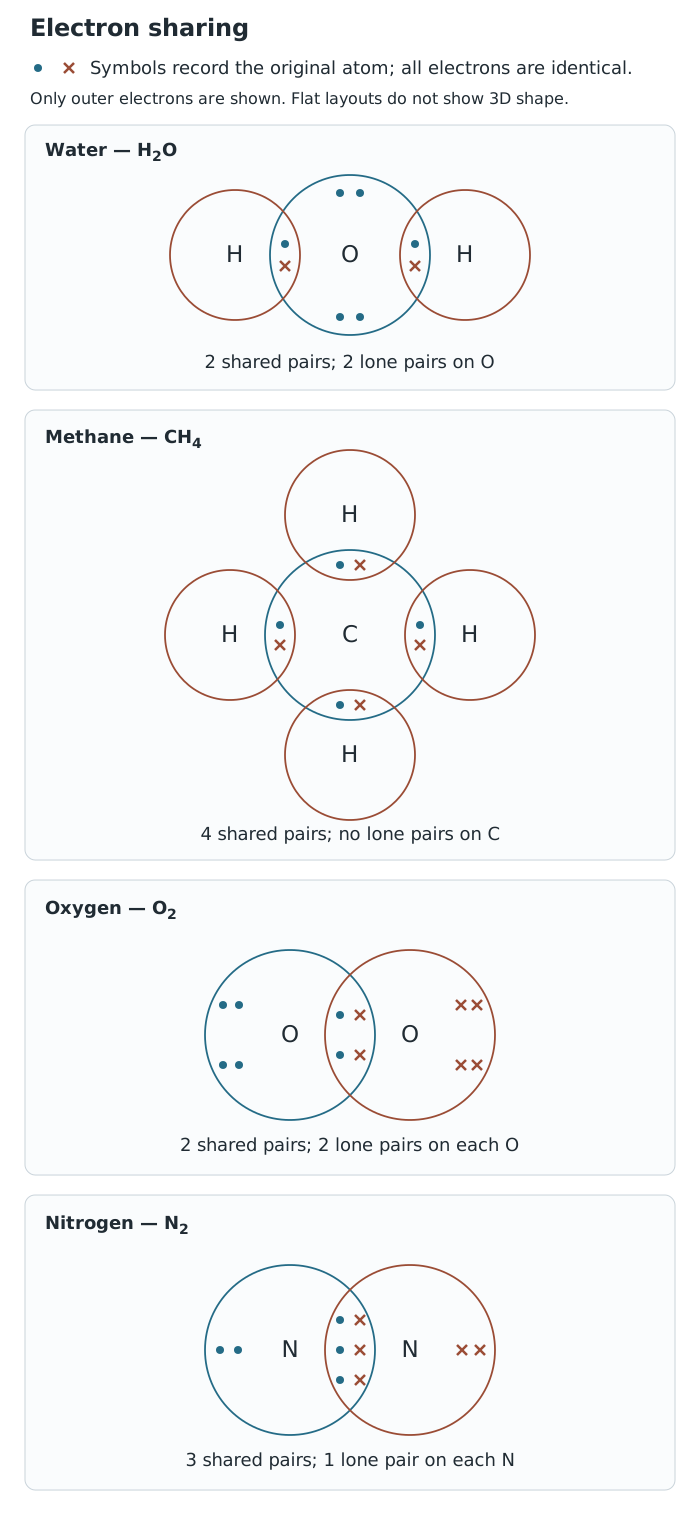
Shared pairs sit between bonded atoms; lone pairs remain outside the bonding regions.
Atoms can share more than one pair of electrons with the same neighbouring atom. A double bond contains two shared pairs, while a triple bond contains three.
In oxygen, , each atom begins with six outer-shell electrons. Each contributes two electrons to the shared region, making two shared pairs. Each oxygen also keeps two lone pairs. In nitrogen, , each atom contributes three electrons to three shared pairs and keeps one lone pair.
A displayed formula replaces each shared pair with a line:
| Molecule | Bond arrangement | Shared pairs in the whole molecule |
|---|---|---|
| Hydrogen, | H–H | 1 |
| Hydrogen chloride, | H–Cl | 1 |
| Water, |
The unshared electrons still matter even when a displayed formula hides them. For example, chlorine in HCl has three lone pairs, and nitrogen in ammonia has one.
A flat drawing can show which atoms are connected without showing their actual arrangement in space. Methane is often drawn with hydrogen atoms above, below, left and right of carbon. The real molecule is not a flat cross. Its four C–H bonds point towards the corners of a tetrahedron, a three-dimensional shape with four triangular faces.
A ball-and-stick model makes this spatial arrangement easier to see. To represent it on paper, ordinary lines can show bonds lying in the plane of the page, a solid wedge can show a bond pointing towards you, and a dashed wedge can show one pointing away.
When translating from a 3D model into a displayed formula, preserve which atoms are bonded and whether each bond is single, double or triple. When translating back, distinguish this connectivity from the molecule's spatial arrangement: an ordinary flat displayed formula does not, by itself, tell you the 3D shape.
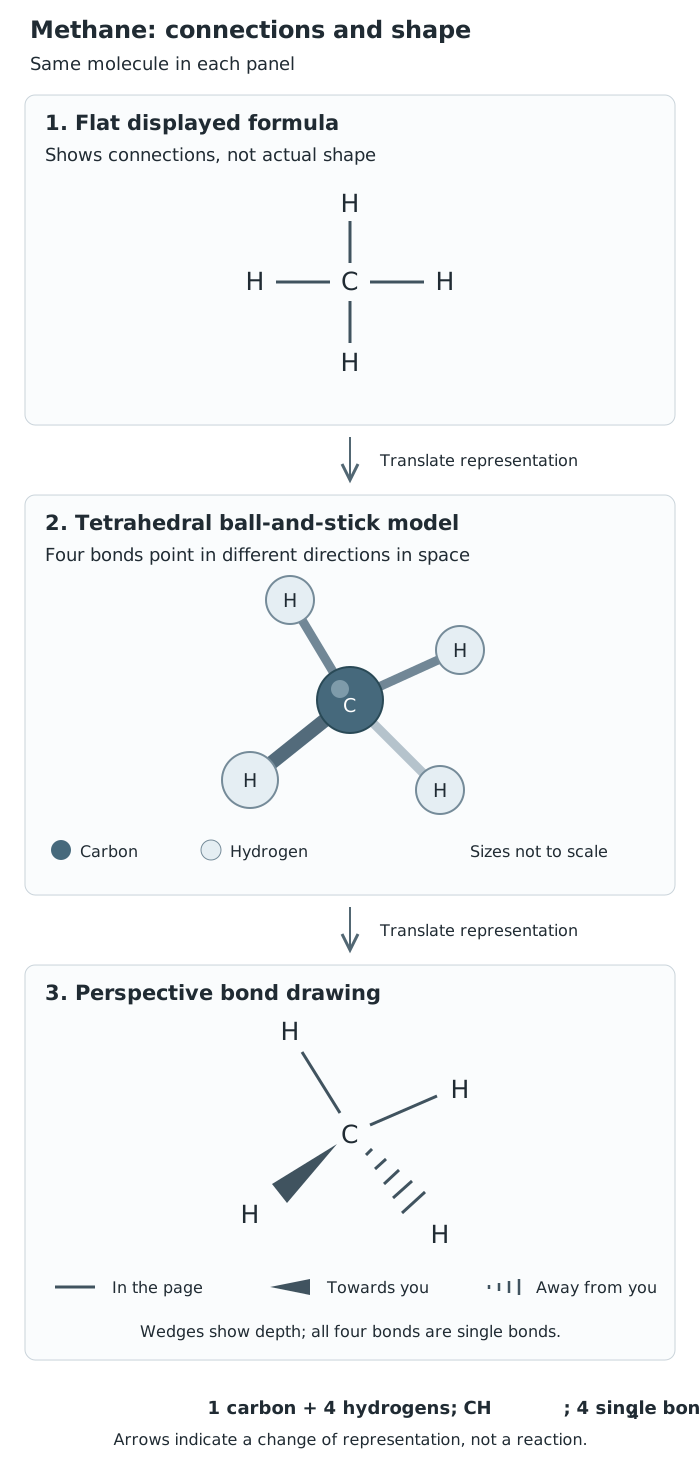
The representations describe the same molecule, but only the spatial models show that methane is not flat.
Diagrams also contain numerical information. Counting the atoms in a methane model gives one carbon and four hydrogens, so its molecular formula is and it contains five atoms altogether. Its four single bonds contain four shared pairs: eight shared electrons. Conversely, tells you which atoms to include, while the bonding information tells you how to connect them.
For ethane, counting two carbon atoms and six hydrogen atoms in its displayed structure gives . The molecular formula records these numbers, but does not show the individual bonds or the molecule's shape.
Every molecular representation is a model: it makes selected features clear while leaving others out.
| Representation | What it shows well | Important limitations |
|---|---|---|
| Molecular formula | Number of atoms of each element | Does not show connections, electrons or shape |
| Dot-and-cross diagram | Shared pairs and |
For methane, a dot-and-cross diagram is useful for explaining how carbon obtains a full outer shell. A ball-and-stick model is better for showing that the molecule is not flat. Neither shows every feature of the real molecule, and neither normally shows the forces between separate molecules.
A sample of a simple molecular substance contains many molecules. There are two different attractions to distinguish: strong covalent bonds within each molecule and weaker intermolecular forces between molecules.
During melting, molecules become able to move past one another. During boiling, they separate much further. These changes require energy to overcome intermolecular attractions, but the covalent bonds within the molecules remain intact. Boiling water produces water vapour containing molecules, not separate hydrogen and oxygen atoms.
Because intermolecular forces are relatively weak, simple molecular substances usually have low melting and boiling points. Many are gases or liquids at room temperature, although some are solids. Their state depends on their melting and boiling points, not merely on the presence of covalent bonds.
Among similar hydrocarbons, larger molecules generally have stronger intermolecular forces. More energy is needed to separate them, so their boiling points are generally higher. Octane therefore has a higher boiling point than methane. This connects molecular size with the different boiling ranges of crude-oil fractions.
Simple molecular substances also generally do not conduct electricity. Their molecules are neutral overall, and they lack mobile ions or delocalised electrons to carry charge. Electrons shared in covalent bonds are not free to move through the substance as an electric current.
In a dot-and-cross diagram, include non-bonding outer-shell electrons as well as shared pairs. Check that hydrogen has access to two electrons and the other atoms in these examples have eight.
Dots and crosses identify where electrons came from; they are not different kinds of electron.
For melting and boiling, explain that weak intermolecular forces are overcome. Do not say that the strong covalent bonds within molecules break.
When describing a model's limitation, name what it leaves out or misrepresents and explain how the real molecule differs.
Count atoms to obtain a molecular formula. Count shared electron pairs, not just connections between atoms, when identifying single, double and triple bonds.
It can see this note and what your specification asks for.
Answers are free with an account.
1 free note left this week
Get more free notesYour answer sets when this note comes back for review, or marks it complete.
Was this note helpful?
Log in to tell us whether it helped, or to report a problem.
Last updated
Covalent bond
A strong electrostatic attraction between a shared pair of electrons and the nuclei of the bonded atoms.
Molecule
A discrete group of atoms joined together by covalent bonds.
Simple molecular substance
A substance made of separate small molecules, with strong covalent bonds within each molecule and weaker intermolecular forces between molecules.
Lone pair
A pair of outer-shell electrons that is not shared in a covalent bond.
Dot-and-cross diagram
A diagram showing outer-shell electrons, using dots and crosses to distinguish electrons originally belonging to different atoms.
Displayed formula
A representation showing every atom in a molecule and each covalent bond as a line.
Ball-and-stick model
A representation in which spheres stand for atoms and sticks stand for bonds, making the arrangement of atoms in three dimensions easier to see.
Intermolecular force
An attraction between molecules, rather than a covalent bond joining atoms within a molecule.
Molecular formula
A formula giving the number of atoms of each element in one molecule, such as .
Put your knowledge into practice — try past paper questions for Combined Science B
Covalent bond
A strong electrostatic attraction between a shared pair of electrons and the nuclei of the bonded atoms.
Molecule
A discrete group of atoms joined together by covalent bonds.
Simple molecular substance
A substance made of separate small molecules, with strong covalent bonds within each molecule and weaker intermolecular forces between molecules.
Lone pair
A pair of outer-shell electrons that is not shared in a covalent bond.
Dot-and-cross diagram
A diagram showing outer-shell electrons, using dots and crosses to distinguish electrons originally belonging to different atoms.
Displayed formula
A representation showing every atom in a molecule and each covalent bond as a line.
Ball-and-stick model
A representation in which spheres stand for atoms and sticks stand for bonds, making the arrangement of atoms in three dimensions easier to see.
Intermolecular force
An attraction between molecules, rather than a covalent bond joining atoms within a molecule.
Molecular formula
A formula giving the number of atoms of each element in one molecule, such as .
| Two O–H single bonds |
| 2 |
| Ammonia, | Three N–H single bonds | 3 |
| Methane, | Four C–H single bonds | 4 |
| Oxygen, | O=O | 2 |
| Nitrogen, | N≡N | 3 |
| Carbon dioxide, | O=C=O | 4 |
| Does not reliably show 3D shape or relative atom sizes; dots and crosses may suggest that electrons are different |
| Displayed formula | Which atoms are bonded and the number of shared pairs | Ordinary flat drawings do not show 3D geometry or lone pairs |
| Ball-and-stick model | Connections and 3D arrangement | Sticks suggest solid rods and exaggerated gaps; electrons are hidden and atom sizes may not be to scale |
| Space-filling model | Overall 3D shape and relative atom sizes | Bonds can be difficult to see, and electron sharing is not shown |