

Loading…
Loading…
Loading…
OCR GCSE Combined Science B · J260
OCR J260 · Covalent Bonding and Cracking Check the specification (PDF) (opens in a new tab)
Crude oil is a finite mixture of hydrocarbons: compounds containing only carbon and hydrogen. It supplies both fuels and the raw materials, or feedstocks, used to make many chemicals and consumer products.
Fractional distillation separates crude oil into fractions containing molecules of similar size. However, the amounts obtained do not necessarily match the amounts people need. There is high demand for shorter-chain hydrocarbons used in fuels such as petrol, while some fractions containing larger molecules are available in excess.
Cracking converts some of these larger hydrocarbon molecules into smaller, more useful molecules. Rather than simply separating what is already present, it changes the molecules themselves.
In catalytic cracking, a fraction containing long-chain hydrocarbons is heated so that it vaporises. The vapour passes over a hot catalyst, such as a zeolite. The high temperature provides energy for the reaction, and the catalyst increases its rate without being used up.
Carbon–carbon covalent bonds in the larger molecules break, and the atoms rearrange to form smaller molecules. Cracking is a form of thermal decomposition: a substance is broken down using heat. Another method uses steam at very high temperatures without a catalyst.
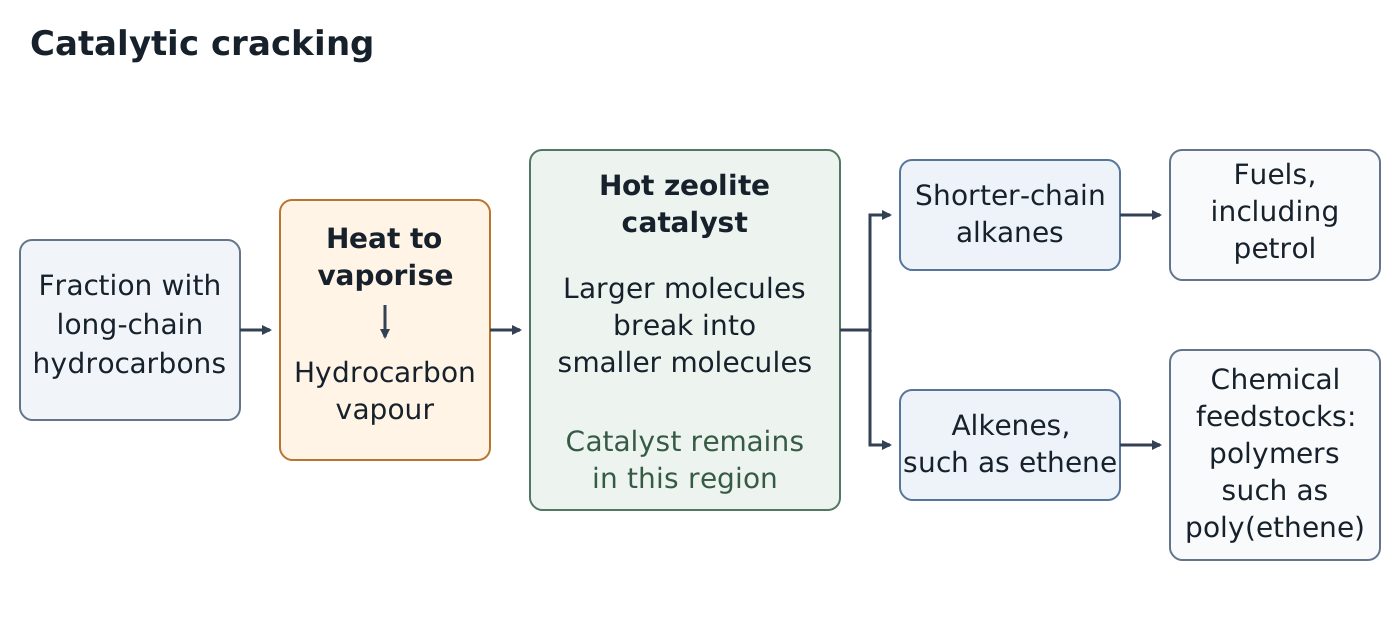
Catalytic cracking turns larger hydrocarbons into smaller molecules useful as fuels and chemical feedstocks.
Cracking is a chemical change because new substances form. This differs from fractional distillation, a physical separation in which the hydrocarbon molecules remain unchanged.
Cracking long-chain alkanes produces a mixture containing shorter-chain alkanes and alkenes. An alkane has only single bonds between its carbon atoms; an alkene contains a carbon–carbon double bond.
One possible reaction is the breakdown of decane into octane and ethene:
The ten carbon atoms in the original molecule are shared between the two smaller molecules: eight in octane and two in ethene. The hydrogen atoms are also conserved: . Atoms are rearranged, not created or destroyed.
This equation shows one possible outcome, not a rule that every molecule splits into the same products. Different cracking conditions can produce different mixtures.
The shorter-chain alkanes can be used as fuels. Cracking therefore helps increase the supply of fuel molecules for which demand is high.
The alkenes provide feedstocks for making new materials. For example, ethene can be used to make the polymer poly(ethene), a widely used plastic. Cracking is therefore important not just for supplying fuels, but also for manufacturing materials.
By converting surplus larger molecules into products with greater demand, cracking makes better use of crude oil. It does not, however, make crude oil renewable: the original resource is still finite.
Cracking: larger hydrocarbons → smaller, more useful molecules.
When explaining why cracking is useful, link both products to their uses: shorter-chain alkanes for fuels and alkenes for making polymers.
Distinguish cracking, which makes new substances, from fractional distillation, which separates an existing mixture.
Describe the conditions as well as the change: vaporise the hydrocarbons, then pass the vapour over a hot catalyst.
It can see this note and what your specification asks for.
Answers are free with an account.
1 free note left this week
Get more free notesYour answer sets when this note comes back for review, or marks it complete.
Was this note helpful?
Log in to tell us whether it helped, or to report a problem.
Last updated
Hydrocarbon
A compound containing only carbon and hydrogen atoms.
Fraction
A group of hydrocarbons separated from crude oil that have similar molecular sizes and boiling points.
Cracking
The breakdown of larger hydrocarbon molecules into smaller, more useful molecules using high temperatures, often with a catalyst.
Alkane
A hydrocarbon with only single bonds between its carbon atoms.
Alkene
A hydrocarbon containing a carbon–carbon double bond, .
Catalyst
A substance that increases the rate of a chemical reaction without being used up.
Feedstock
A raw material used to manufacture other chemicals or materials.
Put your knowledge into practice — try past paper questions for Combined Science B
Hydrocarbon
A compound containing only carbon and hydrogen atoms.
Fraction
A group of hydrocarbons separated from crude oil that have similar molecular sizes and boiling points.
Cracking
The breakdown of larger hydrocarbon molecules into smaller, more useful molecules using high temperatures, often with a catalyst.
Alkane
A hydrocarbon with only single bonds between its carbon atoms.
Alkene
A hydrocarbon containing a carbon–carbon double bond, .
Catalyst
A substance that increases the rate of a chemical reaction without being used up.
Feedstock
A raw material used to manufacture other chemicals or materials.
Fractional distillation separates existing molecules; cracking is a chemical reaction that makes new substances.