

Loading…
Loading…
Loading…
OCR GCSE Combined Science B · J260
OCR J260 · Fractional Distillation and Alkanes Check the specification (PDF) (opens in a new tab)
A chemical formula uses element symbols and small numbers called subscripts to represent the elements present and their proportions. For example, represents two carbon atoms and six hydrogen atoms in one ethane molecule. When no subscript is written, it means one.
A molecular formula gives the actual number of atoms of each element in one molecule. An empirical formula gives the simplest whole-number ratio of those atoms. It describes their proportions rather than the size of the molecule.
For ethane, the carbon-to-hydrogen ratio is . Dividing both numbers by two gives , so its empirical formula is . This does not mean that an ethane molecule contains only one carbon and three hydrogen atoms: it means that there are three hydrogen atoms for every carbon atom.
Start by writing the numbers of atoms as a ratio, keeping the elements in a clear, stated order. Then divide every number by their highest common factor: the largest whole number that divides exactly into all the counts. Use the simplified numbers as the formula’s subscripts, leaving out any subscript of one.
Suppose a diagram represents a molecule containing four carbon atoms, eight hydrogen atoms and two oxygen atoms. The ratio is:
The highest common factor is two. Dividing all three counts by two gives:
The empirical formula is therefore . The oxygen matters when simplifying: although four divides both the carbon and hydrogen counts, it does not divide the oxygen count to give a whole number.
In a ball-and-stick model, the balls represent atoms and the sticks represent bonds. Use the key to identify each element, then count its atoms. In a displayed formula, count each written element symbol. Once you have the counts, the ratio method is the same.
The diagram below separates the atoms into groups to make counting clear; it does not show their positions or bonds within a molecule.
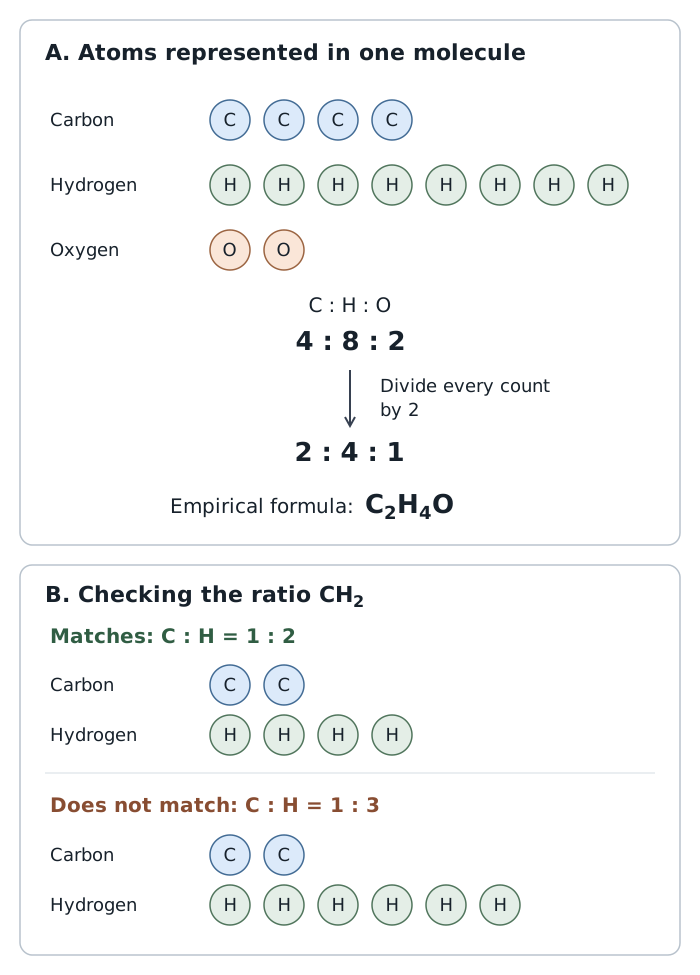
Count each element, simplify all counts together, and check that a proposed model has the required proportions. These grouped atom symbols do not show molecular shape.
The four-carbon, eight-hydrogen, two-oxygen inventory gives the ratio worked through above. Grouping the symbols helps you see that simplifying a ratio changes how you describe the proportions, not which atoms the molecule actually contains.
You can also start directly from a molecular formula. Glucose, , has the ratio . Dividing every count by six gives , so its is . Some molecular formulae cannot be simplified: the ratio in water, , is already , so its empirical formula is also .
An empirical formula lets you check whether a model has the correct proportions. For , a matching model must contain twice as many hydrogen atoms as carbon atoms. Two carbon atoms and four hydrogen atoms fit; two carbon atoms and six hydrogen atoms do not.
To generate possible atom counts, multiply every subscript by the same whole number. Thus is compatible with molecular formulae such as and , the formulae of ethene and propene respectively. Both have the same simplest .
This also shows the limit of an empirical formula: it cannot, on its own, tell you the molecule’s actual atom counts, identify the compound uniquely or show how its atoms are arranged.
Atom counts → ratio → simplest whole-number ratio → formula.
Divide every count by the highest common factor. Omit subscripts of one.
Count atoms, not bonds or sticks. Use the diagram’s key to identify each element.
Simplify all the atom counts by the same common factor. The final ratio must contain whole numbers and be in its simplest form.
An empirical formula gives a ratio, not necessarily the actual number of atoms in one molecule. Do not use atomic numbers or relative atomic masses when you are given atom counts.
It can see this note and what your specification asks for.
Answers are free with an account.
1 free note left this week
Get more free notesYour answer sets when this note comes back for review, or marks it complete.
Was this note helpful?
Log in to tell us whether it helped, or to report a problem.
Last updated
Empirical formula
The simplest whole-number ratio of atoms of each element in a compound.
Molecular formula
The actual number of atoms of each element in one molecule of a compound.
Ratio
A comparison of quantities in a stated order. For example, a carbon-to-hydrogen atom ratio of means twice as many hydrogen atoms as carbon atoms.
Subscript
A small number written after an element symbol in a chemical formula, showing how many atoms of that element are represented. An omitted subscript means one.
Highest common factor
The largest whole number that divides exactly into every number in a set.
Put your knowledge into practice — try past paper questions for Combined Science B
Empirical formula
The simplest whole-number ratio of atoms of each element in a compound.
Molecular formula
The actual number of atoms of each element in one molecule of a compound.
Ratio
A comparison of quantities in a stated order. For example, a carbon-to-hydrogen atom ratio of means twice as many hydrogen atoms as carbon atoms.
Subscript
A small number written after an element symbol in a chemical formula, showing how many atoms of that element are represented. An omitted subscript means one.
Highest common factor
The largest whole number that divides exactly into every number in a set.
From a model or diagram, identify each element and count its atoms before simplifying.
Multiply every empirical-formula subscript by the same whole number to obtain compatible atom counts.
An empirical formula fixes the proportions, not the molecule’s size or arrangement.