

Loading…
Loading…
Loading…
OCR GCSE Combined Science B · J260
OCR J260 · Particle Model and Atmospheric Evolution Check the specification (PDF) (opens in a new tab)
An atmosphere is the mixture of gases surrounding a planet. Earth's atmosphere has changed enormously since the planet formed about 4.6 billion years ago. Today it contains abundant nitrogen and about 21% oxygen, but the early atmosphere is thought to have contained very little oxygen.
Scientists cannot collect a sample of air from the newly formed Earth. Instead, they build explanations using evidence from ancient rocks and fossils, gases released by volcanoes, and the atmospheres of other planets. These clues support a broad sequence of changes, although the exact composition and timing of the earliest atmosphere remain uncertain.
The young Earth was very hot. As its surface cooled and a crust formed, intense volcanic activity released gases from its interior. This release is called outgassing. It is thought to have produced an atmosphere rich in carbon dioxide and water vapour, with nitrogen and smaller amounts of other gases, but little or no oxygen.
Modern volcanoes release gases including carbon dioxide and water vapour. This supports volcanic outgassing as a possible source of the early atmosphere. However, present-day volcanoes cannot reveal exactly how much of each gas was released billions of years ago.
The atmospheres of Mars and Venus are mainly carbon dioxide and contain little oxygen. They show that carbon-dioxide-rich atmospheres can exist on rocky planets, making the proposed early atmosphere of Earth plausible. They are supporting comparisons, not proof: the planets have experienced different conditions and histories.
As Earth cooled further, water vapour condensed into liquid water, eventually forming oceans. This removed much of the water vapour from the atmosphere. Carbon dioxide dissolved in the oceans, reducing its atmospheric abundance. Carbon later became stored in carbonate sediments and rocks such as limestone, including through the shells and skeletons of marine organisms.
Oxygen did not become abundant simply because Earth cooled. Its major source was photosynthesis by living organisms. Photosynthetic bacteria were followed by algae and, much later, land plants. These organisms used light energy to take in carbon dioxide and water, make glucose and release oxygen:
These changes happened over billions of years, rather than in a single event. Early photosynthetic microorganisms appeared long before land plants. As photosynthetic organisms became more widespread, oxygen gradually became a substantial part of the atmosphere. This allowed organisms that use oxygen in respiration, including more complex animals, to develop.
Photosynthesis also removed carbon dioxide. When some organisms died and their remains were buried, their carbon became stored for long periods in sediments and, eventually, fossil fuels. Together, ocean uptake, carbonate rock formation and the burial of organic material helped reduce atmospheric carbon dioxide.
The overall sequence is therefore a carbon-dioxide-rich early atmosphere → ocean formation → photosynthetic life → an increasingly oxygen-rich atmosphere. These processes overlapped; one did not have to finish before another began.
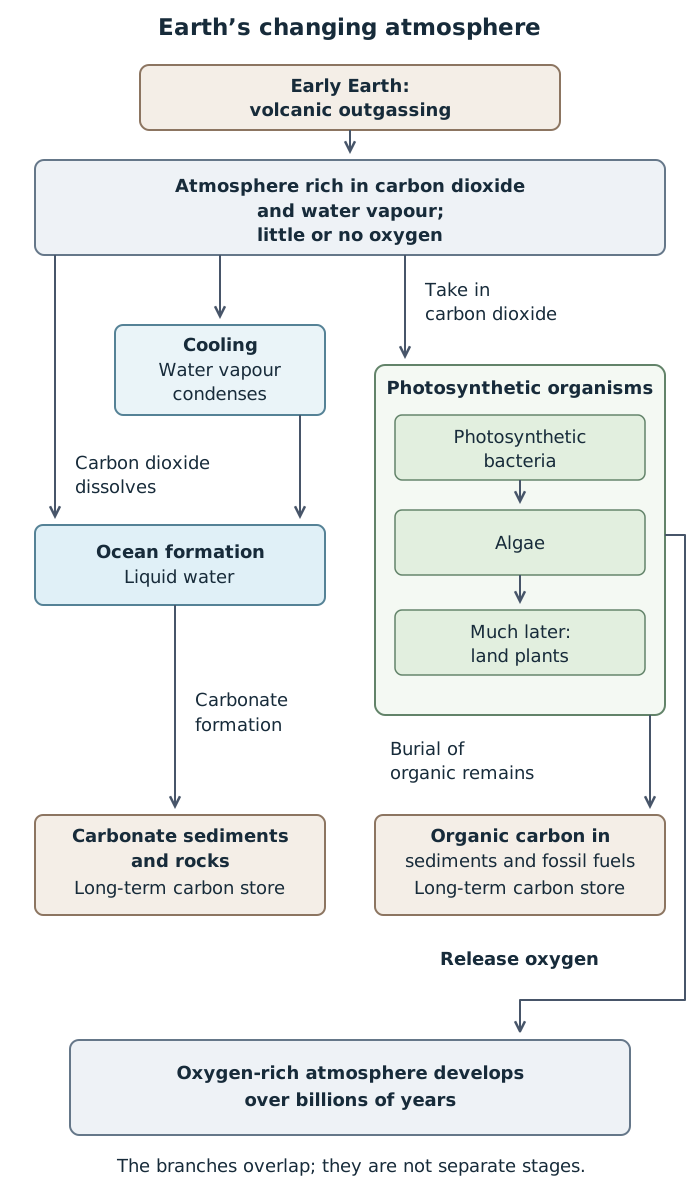
Cooling, carbon storage and photosynthesis changed the atmosphere through overlapping processes over billions of years.
Ancient rocks provide clues about the gases present when they formed. For example, some very old rocks contain iron compounds that were not oxidised. Their preservation is consistent with little oxygen being available at the time. This supports the idea of an early oxygen-poor atmosphere, although one rock sample alone cannot establish the composition of the entire atmosphere.
The fossil record also helps establish the sequence. Fossils of simple microorganisms occur earlier than those of complex animals. The later appearance of animals that depend on oxygen is consistent with oxygen becoming more available over time.
When interpreting evidence, separate the observation from the inference. Finding a particular iron compound is an observation; suggesting that oxygen levels were low when it formed is an inference. A stronger explanation brings together several independent clues rather than relying on just one. Because the events are so ancient and the surviving evidence is incomplete, explanations can be refined as new evidence is discovered.
Modern transport, heating and electricity generation create a high demand for energy. Burning fossil fuels releases energy, but can also produce atmospheric pollutants. Different pollutants form for different reasons.
With enough oxygen, the complete combustion of a hydrocarbon fuel produces carbon dioxide and water. With insufficient oxygen, incomplete combustion occurs: some carbon forms carbon monoxide, CO, or solid carbon particles called soot, rather than being fully oxidised to carbon dioxide.
Vehicle engines, fires and poorly functioning fuel-burning heaters can therefore release carbon monoxide and particulates. Diesel exhaust is an important source of soot particles. Carbon monoxide is a gas, whereas soot consists of tiny solid particles carried in the air. Both can arise from incomplete combustion, but they are different substances.
Some fossil fuels, particularly coal and oil, contain sulfur impurities. When the fuel burns, these sulfur-containing substances also react with oxygen, producing sulfur dioxide, SO₂. Power stations and industrial furnaces burning sulfur-containing fuels are major sources.
The simplified reaction is:
Unlike carbon monoxide and soot formation, this does not require an oxygen shortage. Sulfur dioxide forms because sulfur is present in the fuel and is oxidised during combustion.
Vehicle engines and power-station furnaces reach temperatures high enough for nitrogen and oxygen from the air to react. Nitrogen is oxidised to nitrogen monoxide, NO:
After leaving the engine or furnace, nitrogen monoxide reacts with more oxygen in the air. This further oxidation produces nitrogen dioxide, NO₂:
These gases are collectively called oxides of nitrogen, often written as NOₓ. Their formation depends on high temperature, not on sulfur impurities or an insufficient oxygen supply. A combustion system can therefore produce nitrogen oxides even when its fuel burns completely.
When interpreting evidence, link the observation to an inference: identify what was found, explain what it suggests about the atmosphere, and consider any limitation.
Describe early-atmosphere explanations as scientific models supported by evidence, not as directly observed facts.
Keep the three pollutant-forming conditions distinct: insufficient oxygen, sulfur impurities in the fuel, and high temperature.
For nitrogen oxides, include both stages: nitrogen reacts with oxygen at high temperature, then nitrogen monoxide undergoes further oxidation in air.
Carbon monoxide is CO; carbon dioxide is CO₂. Soot is a solid particulate, not a gas.
It can see this note and what your specification asks for.
Answers are free with an account.
1 free note left this week
Get more free notesYour answer sets when this note comes back for review, or marks it complete.
Was this note helpful?
Log in to tell us whether it helped, or to report a problem.
Last updated
Atmosphere
The mixture of gases surrounding a planet, held there by gravity.
Outgassing
The release of gases from inside the Earth, including through volcanic activity.
Photosynthesis
The process in which organisms use light energy to convert carbon dioxide and water into glucose, releasing oxygen.
Combustion
Burning in which a fuel reacts with oxygen and releases energy.
Incomplete combustion
Burning with insufficient oxygen for all the carbon in a fuel to be converted into carbon dioxide; carbon monoxide and/or carbon particles can form.
Carbon monoxide
A colourless, odourless, toxic gas, CO, formed during incomplete combustion of carbon-containing fuels.
Particulate
A tiny particle suspended in air; combustion can produce solid carbon particles called soot.
Sulfur dioxide
A gas, SO₂, produced when sulfur impurities in fuels burn in oxygen.
Oxides of nitrogen
Gases including nitrogen monoxide, NO, and nitrogen dioxide, NO₂. They form when nitrogen is oxidised at high temperatures and the products undergo further oxidation in air.
Put your knowledge into practice — try past paper questions for Combined Science B
Atmosphere
The mixture of gases surrounding a planet, held there by gravity.
Outgassing
The release of gases from inside the Earth, including through volcanic activity.
Photosynthesis
The process in which organisms use light energy to convert carbon dioxide and water into glucose, releasing oxygen.
Combustion
Burning in which a fuel reacts with oxygen and releases energy.
Incomplete combustion
Burning with insufficient oxygen for all the carbon in a fuel to be converted into carbon dioxide; carbon monoxide and/or carbon particles can form.
Carbon monoxide
A colourless, odourless, toxic gas, CO, formed during incomplete combustion of carbon-containing fuels.
Particulate
A tiny particle suspended in air; combustion can produce solid carbon particles called soot.
Sulfur dioxide
A gas, SO₂, produced when sulfur impurities in fuels burn in oxygen.
Oxides of nitrogen
Gases including nitrogen monoxide, NO, and nitrogen dioxide, NO₂. They form when nitrogen is oxidised at high temperatures and the products undergo further oxidation in air.
| Pollutant | Formation and major sources |
|---|---|
| CO and soot particulates | Incomplete combustion with insufficient oxygen; engines, fires and fuel-burning heaters |
| SO₂ | Sulfur impurities burn; sulfur-containing fuels in power stations and industry |
| NO and NO₂ | Nitrogen and oxygen react at high temperatures in engines and furnaces; NO is further oxidised in air |