

Loading…
Loading…
Loading…
OCR GCSE Combined Science B · J260
OCR J260 · Particle Model and Atmospheric Evolution Check the specification (PDF) (opens in a new tab)
Solids, liquids and gases are three states of matter. The particle model explains these states by representing a substance as many tiny particles. Depending on the substance, these may be atoms, molecules or ions. Simple diagrams use circles or spheres to stand for them.
The important differences between states are how the particles are arranged, how far apart they are and how they move. A substance can change state without becoming a different chemical substance.
In a solid, particles are close together in a regular arrangement. They vibrate about fixed positions rather than moving freely from place to place. This gives a solid a fixed shape and volume.
In a liquid, particles are still close together, but their arrangement is irregular. They can move past one another, so a liquid flows and takes the shape of its container. Because the particles remain close together, a liquid has a nearly fixed volume and is difficult to compress.
In a gas, particles are far apart and randomly arranged. They move rapidly in all directions, spreading through the available space. A gas therefore has neither a fixed shape nor a fixed volume. It can be compressed because there are large gaps into which its particles can move.
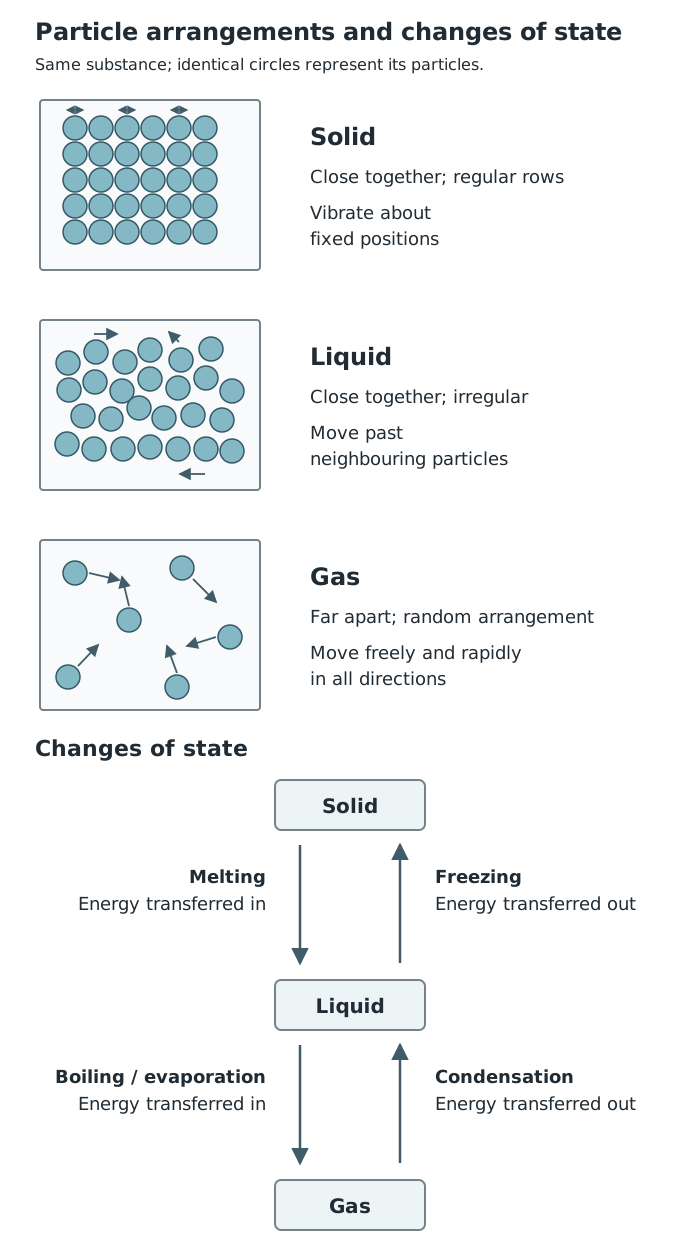
The same particles have different arrangements and movements in each state. Changes of state alter these features, not the chemical identity of the particles.
When reading a particle diagram, look first at the spacing and arrangement. Close, ordered particles represent a solid; close, irregular particles represent a liquid; widely separated particles represent a gas. Movement needs arrows or an accompanying explanation: a still diagram alone cannot show particles vibrating or moving.
Heating transfers energy to a substance. Away from a change of state, this generally makes its particles move or vibrate faster and raises its temperature. To change from solid to liquid, or liquid to gas, energy is needed to overcome attractions between particles.
Melting changes a solid into a liquid. Particles leave their fixed positions and become able to move past one another. Freezing is the reverse: energy is transferred to the surroundings and the particles become held in fixed positions.
Boiling changes a liquid into a gas throughout the liquid, at its boiling point. Particles become widely separated and move freely. Evaporation also changes liquid into gas, but happens at the surface and can occur below the boiling point. Condensation changes gas into liquid as energy is transferred to the surroundings and particles come closer together. Some substances can also change directly from solid to gas; this is sublimation.
For a pure substance at a fixed pressure, melting and freezing occur at the same temperature. Boiling and the reverse change occur at the boiling point. During melting or boiling, transferred energy is used to overcome attractions rather than raise the temperature, so the temperature stays constant until that change is complete.
Particles attract one another, but these attractions are not equally strong in every substance. Stronger attractions require more energy to overcome, so substances with stronger attractions generally have higher melting and boiling points.
For molecular substances, the attractions between molecules are called intermolecular forces. Melting overcomes enough of these attractions to allow molecules to move past one another. Boiling separates the molecules much more completely. It does not break the chemical bonds within each molecule.
This connects a visible measurement—a melting or boiling temperature—to what is happening between particles. Saying that a substance has a high boiling point is not itself an explanation: the explanation is that strong attractions require a larger energy transfer to separate its particles.
A change of state is a physical change: no new substance forms. Ice, liquid water and water vapour all contain water molecules. Their spacing, arrangement and movement change, but their chemical identity does not. Cooling water vapour can turn it back into liquid water.
A chemical change produces new substances. The particles of the reactants are rearranged into chemically different products. This is more than a change in how the original particles are spaced or how quickly they move. Although changes of state are readily reversed by heating or cooling, the decisive distinction is whether new substances form.
A bulk property belongs to many particles acting together. A single particle does not have all the properties of a visible sample. For example, a piece of copper conducts electricity, but an individual copper atom does not itself have the electrical conductivity of that piece.
Similarly, one water molecule cannot be described as a tiny drop of liquid water or a tiny piece of ice. Solid, liquid and gas describe the collective arrangement and behaviour of many particles. When ice melts, the molecules do not themselves melt.
Compare the given temperature with a substance's melting and boiling points:
Suppose three substances have the following transition temperatures at the same fixed pressure:
| Substance | Melting point (°C) | Boiling point (°C) |
|---|---|---|
| A | −20 | 60 |
| B | 40 | 150 |
| C | −100 | 10 |
At 20°C, A is a liquid because 20°C lies between −20°C and 60°C. B is a solid because 20°C is below its melting point of 40°C. C is a gas because 20°C is above its boiling point of 10°C.
At exactly a transition temperature, temperature alone may not identify a single state. For example, at A's melting point of −20°C, solid and liquid can coexist while melting or freezing takes place. These comparisons apply at the pressure for which the data were given.
Representing particles as inelastic spheres, like tiny rigid bowling balls, helps show arrangement and spacing. However, it leaves out important features needed to explain changes of state.
The spheres do not show the forces of attraction between particles. Simply moving balls apart cannot explain why energy must be transferred to change state, or why different substances have different melting and boiling points. The model needs the additional idea that attractions differ in strength.
The spheres also do not accurately represent the sizes and shapes of different particles or the relative spaces between them. Real substances contain different kinds of particles and have different structures; they are not all collections of identical solid balls. The model is therefore useful for describing broad differences between states, but is not a complete account of the particles or the energy involved.
| State | Arrangement and spacing | Movement |
|---|---|---|
| Solid | Close together, regular | Vibrate about fixed positions |
| Liquid | Close together, irregular | Move past one another |
| Gas | Far apart, random | Move rapidly in all directions |
Large gaps make gases compressible. Liquids and solids are difficult to compress.
Describe both particle arrangement and particle movement when comparing states.
During a change of state, the particles themselves do not melt, expand or turn into different particles.
Explain a higher melting or boiling point by linking stronger attractions to more energy needed to overcome them.
Use the melting and boiling points at the stated pressure. At an exact transition temperature, two states may coexist.
Identify a chemical change by the formation of new substances, not simply by whether it is difficult to reverse.
It can see this note and what your specification asks for.
Answers are free with an account.
1 free note left this week
Get more free notesYour answer sets when this note comes back for review, or marks it complete.
Was this note helpful?
Log in to tell us whether it helped, or to report a problem.
Last updated
Particle model
A representation of matter as particles, used to explain their arrangement, movement and changes during changes of state.
Bulk property
A property of a substance that arises from many particles acting together, rather than a property of an individual particle.
Physical change
A change in which no new substance forms; the chemical identity of the particles remains the same.
Chemical change
A change in which a chemical reaction produces new substances from the reactants.
Melting point
The temperature at which a substance changes between solid and liquid at a specified pressure.
Boiling point
The temperature at which a liquid boils at a specified pressure.
Force of attraction
A force that draws particles towards one another.
Inelastic sphere
A rigid spherical object that does not spring back elastically after deformation, used as a simplified representation of a particle.
Put your knowledge into practice — try past paper questions for Combined Science B
Particle model
A representation of matter as particles, used to explain their arrangement, movement and changes during changes of state.
Bulk property
A property of a substance that arises from many particles acting together, rather than a property of an individual particle.
Physical change
A change in which no new substance forms; the chemical identity of the particles remains the same.
Chemical change
A change in which a chemical reaction produces new substances from the reactants.
Melting point
The temperature at which a substance changes between solid and liquid at a specified pressure.
Boiling point
The temperature at which a liquid boils at a specified pressure.
Force of attraction
A force that draws particles towards one another.
Inelastic sphere
A rigid spherical object that does not spring back elastically after deformation, used as a simplified representation of a particle.
Below melting point: solid. Between melting and boiling points: liquid. Above boiling point: gas. At a transition temperature, two states may coexist. Use data for the stated pressure.
Inelastic spheres do not show attractions or accurately represent particle sizes, shapes and spacing. Arrangement alone cannot explain the energy needed for changes of state or differences in transition temperatures.