

Loading…
Loading…
Loading…
OCR GCSE Combined Science B · J260
OCR J260 · Pollution Mitigation and Chemical Formulae Check the specification (PDF) (opens in a new tab)
Burning fossil fuels supplies energy for transport, heating and electricity generation, but it also releases pollutants into the atmosphere. Increased amounts of these substances can damage human health, ecosystems and buildings. The effects depend on which substances are present: not all pollutants cause the same problems.
Four important examples are carbon monoxide, particulates, sulfur dioxide and oxides of nitrogen. Their origins help explain how their emissions can be reduced, but first we need to distinguish their effects.
Carbon monoxide, , is a poisonous gas produced by incomplete combustion. It binds to haemoglobin, the substance in red blood cells that normally carries oxygen. This reduces the blood's ability to supply oxygen to body tissues. Severe exposure can cause unconsciousness or death. Carbon monoxide is colourless and odourless, so people cannot reliably detect it using their senses.
Particulates are tiny particles suspended in air. Incomplete combustion can produce carbon particles, or soot. Breathing polluted air containing these particles can cause respiratory problems. Soot also settles on surfaces, blackening buildings and monuments.
These are different types of harm: carbon monoxide interferes with oxygen transport, whereas inhaled particulates affect respiratory health.
Sulfur dioxide, , forms when sulfur impurities in fuels burn. Oxides of nitrogen, often written as , form when nitrogen and oxygen react at the high temperatures found in engines and furnaces.
Both can irritate the respiratory system and worsen breathing problems such as asthma. They also enter water droplets in clouds and undergo reactions that form acids. Rain containing these acids is called acid rain.
Acid rain has several connected effects:
Nitrogen oxides also contribute to photochemical smog. Sunlight drives reactions involving nitrogen oxides and other pollutants, including unburned hydrocarbons. The resulting mixture can irritate the eyes, throat and lungs.
One approach is to prevent a pollutant from forming. Sulfur compounds can be removed from fuels during processing, producing low-sulfur petrol.
The connection is straightforward: less sulfur in the petrol means less sulfur dioxide is formed when it burns. This reduces the contribution of the exhaust gases to acid rain and respiratory irritation.
Low-sulfur petrol is not pollution-free petrol. It still burns, so it can still produce other combustion products. Removing sulfur specifically tackles sulfur dioxide emissions.
Power stations can use gas scrubbers to treat waste gases before they leave the chimney. These waste gases are also called flue gases.
In a wet scrubber, the gases contact an alkaline mixture, such as powdered lime mixed with water. Sulfur dioxide is acidic, so it reacts with the alkaline material in a neutralisation reaction. For example, calcium hydroxide reacts with sulfur dioxide to form calcium sulfite and water.
The sulfur-containing product is collected rather than allowing the sulfur dioxide to escape into the atmosphere. Further treatment can turn calcium sulfite into calcium sulfate, which can be used to make gypsum for building products.
The key distinction is the stage at which action is taken: low-sulfur petrol reduces sulfur in the fuel, while a scrubber removes sulfur dioxide from the waste gases.
A catalytic converter is fitted in a vehicle's exhaust system. Exhaust gases pass over catalysts, such as platinum and rhodium, which speed up reactions without being used up overall.
These reactions convert several pollutants into less harmful substances:
For example, carbon monoxide can react with nitrogen monoxide to produce carbon dioxide and nitrogen. This removes two harmful exhaust pollutants in the same reaction.
The catalyst is spread over a large surface area so that the gases have plenty of contact with it. Catalytic converters work best when hot. They reduce harmful emissions, but do not eliminate all environmental effects: carbon dioxide is still released and contributes to global warming.
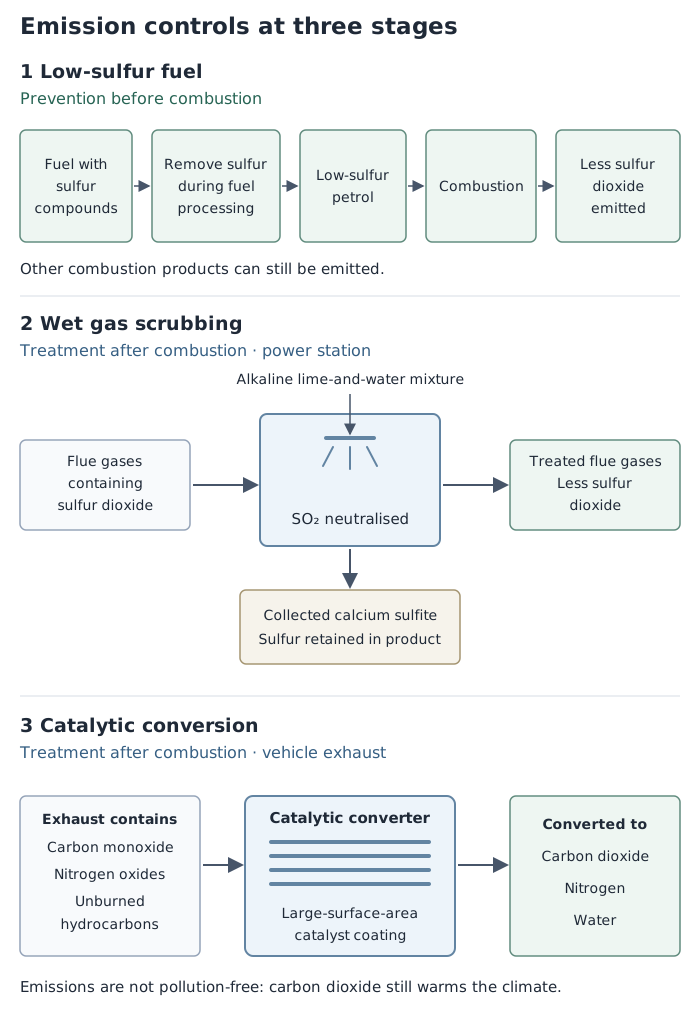
Emission controls act at different stages: removing sulfur from fuel, removing sulfur dioxide from flue gases, or chemically converting vehicle exhaust pollutants.
Treating fuels and exhaust gases tackles particular pollutants. Another approach is to burn less fossil fuel in the first place. Using energy more efficiently, reducing fuel use in transport and replacing fossil-fuel electricity generation with renewable sources can reduce combustion-related emissions.
These approaches complement one another. Reducing fuel consumption lowers the amount of combustion, while low-sulfur fuels, scrubbers and catalytic converters reduce particular pollutants from the combustion that still takes place.
Acid rain: damages plants, harms aquatic organisms and attacks limestone buildings and metal structures.
Link each pollutant to a specific effect: carbon monoxide reduces oxygen transport; particulates damage respiratory health; sulfur dioxide and nitrogen oxides contribute to acid rain.
For an emission-control question, name the pollutant, describe the method and explain why it reduces emissions.
Low-sulfur petrol reduces sulfur dioxide emissions, not every pollutant produced by burning petrol.
Catalytic converters chemically change pollutants; they do not simply trap them or make exhaust gases completely harmless.
It can see this note and what your specification asks for.
Answers are free with an account.
1 free note left this week
Get more free notesYour answer sets when this note comes back for review, or marks it complete.
Was this note helpful?
Log in to tell us whether it helped, or to report a problem.
Last updated
Pollutant
A substance that causes harm to living organisms or the environment when present in sufficient amounts.
Emission
The release of a substance into the environment, such as a gas entering the atmosphere from a vehicle exhaust.
Particulate
Tiny solid particles or liquid droplets suspended in air; soot particles from incomplete combustion are one example.
Acid rain
Rain made more acidic by atmospheric pollutants, particularly sulfur dioxide and oxides of nitrogen.
Photochemical smog
A harmful mixture of air pollutants formed when sunlight drives reactions involving nitrogen oxides and other pollutants.
Catalyst
A substance that speeds up a chemical reaction without being used up overall.
Catalytic converter
A device in a vehicle's exhaust system that uses catalysts to convert pollutants into less harmful substances.
Gas scrubber
Equipment that removes pollutants from waste gases, for example by reacting acidic sulfur dioxide with an alkaline material.
Put your knowledge into practice — try past paper questions for Combined Science B
Pollutant
A substance that causes harm to living organisms or the environment when present in sufficient amounts.
Emission
The release of a substance into the environment, such as a gas entering the atmosphere from a vehicle exhaust.
Particulate
Tiny solid particles or liquid droplets suspended in air; soot particles from incomplete combustion are one example.
Acid rain
Rain made more acidic by atmospheric pollutants, particularly sulfur dioxide and oxides of nitrogen.
Photochemical smog
A harmful mixture of air pollutants formed when sunlight drives reactions involving nitrogen oxides and other pollutants.
Catalyst
A substance that speeds up a chemical reaction without being used up overall.
Catalytic converter
A device in a vehicle's exhaust system that uses catalysts to convert pollutants into less harmful substances.
Gas scrubber
Equipment that removes pollutants from waste gases, for example by reacting acidic sulfur dioxide with an alkaline material.
| Approach | How it reduces emissions |
|---|---|
| Low-sulfur petrol | Less sulfur in the fuel → less sulfur dioxide formed |
| Gas scrubber | Alkaline material reacts with sulfur dioxide in waste gases |
| Catalytic converter | Converts carbon monoxide into carbon dioxide, nitrogen oxides into nitrogen, and unburned hydrocarbons into carbon dioxide and water |
| Burn less fossil fuel | Reduces combustion-related emissions |
Distinction: low-sulfur fuel acts before combustion; scrubbers and catalytic converters treat gases after combustion.
Catalytic converters reduce harmful exhaust pollutants but still release carbon dioxide.