

Loading…
Loading…
Loading…
Eduqas GCSE Religious Studies (Short Course) · C125
Eduqas C125 Check the specification (PDF) (opens in a new tab)
Hindu worship includes many named deities, but their significance cannot be understood simply by counting them. Deities express divine roles and powers, and different Hindu traditions give particular deities different importance. A devotee may therefore concentrate on one deity without denying the significance of others.
The trimurti consists of Brahma, Vishnu and Shiva. Together, their roles connect creation, preservation and destruction. The Kūrma Purana describes all three as derived from Brahman, ultimate reality. Brahma and Brahman are therefore not interchangeable names: Brahma is a particular deity, whereas Brahman refers to ultimate reality.
Brahma is the creator. His role is to bring the universe and its living beings into existence. Vishnu is the preserver, protecting creation so that life can continue. Shiva is the destroyer. Here, destruction belongs within a repeating cosmic cycle: the ending of a universe is followed by renewed creation, rather than being simply the final defeat of life.
Each member of the trimurti has a consort, a divine partner or spouse. Brahma’s consort is Sarasvati, the goddess of learning and the arts. Vishnu’s is Lakshmi, the goddess of wealth and fortune. Shiva’s is Shakti, represented as Parvati. These pairings connect the male deities with the goddesses who are their divine energies or powers. The goddesses are not merely background figures: Shakti herself is a major focus of worship.
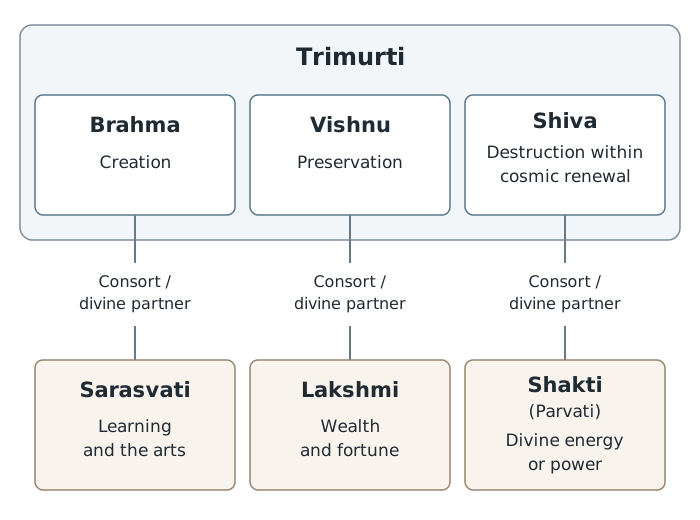
The trimurti links three cosmic roles; each deity also has a divine consort.
The three roles are connected rather than completely separate. In Kūrma Purana 1.6, Brahma wants to begin creation again, but the earth is submerged in water following the destruction at the end of the previous cosmic cycle. He asks Vishnu to recover it. Vishnu takes the form of Varaha, a boar, descends to the underworld and raises the earth on his tusks, placing it on the water. Vishnu’s protection makes Brahma’s renewed creation possible. The present cycle is called the varaha kalpa after this rescue.
Kūrma Purana 1.9 gives another example of this relationship. The demons Madhu and Kaitabha threaten to destroy what Brahma will create. Vishnu produces two beings from his own body, who kill the demons, allowing creation to proceed. The passage also describes Shiva appearing from Brahma’s mouth and Brahma reviving. The crying child receives the name Rudra. Shiva’s eight forms are associated with the sun, water, sky, fire, wind, trees, the bodies of brahmanas and the moon. This presents Shiva as connected with many aspects of the world, not only with its destruction.
Kūrma Purana 1.26 places these divine roles within a changing, cyclical universe. A kalpa is a cosmic cycle, divided into periods called manvantaras. The passage explains that the names of gods and the titles of the seven great sages and Indra change between these periods. It states that six manvantaras have passed in the present kalpa and seven more will follow the current one; afterwards, the world will be destroyed. This helps explain why preservation does not mean keeping the universe unchanged forever: it operates within a cycle which also includes destruction and renewed creation.
An avatara is a divine descent or incarnation into the world. The Varaha narrative shows that an avatara need not have a human form. The form is appropriate to the divine task: Varaha’s tusks lift the submerged earth, demonstrating Vishnu’s preserving role through a concrete act of rescue.
Krishna is especially important in Vaishnava worship and is commonly identified as an avatar of Vishnu. Some Vaishnavas, including those in the Krishna-consciousness tradition, instead regard Krishna as the original Supreme God from whom Vishnu manifests. Krishna is therefore not understood by every worshipper merely as a lesser form of another deity.
His consort is Radha, identified in the Vaishnava tradition as a form of Lakshmi. Krishna is also the divine teacher who addresses Arjuna in the Bhagavad Gita. His importance therefore includes both being worshipped and providing authoritative guidance.
In Bhagavad Gita 4.5, Krishna tells Arjuna: ‘Both you and I have had many births’. He then distinguishes their knowledge: Arjuna has forgotten those births, whereas Krishna remembers them all. The passage presents Krishna as possessing divine knowledge beyond that of an ordinary human being. His appearance in the world does not remove his divine nature.
Bhagavad Gita 4.7–8 explains why this divine appearance occurs. Krishna declares that he manifests when righteousness declines and unrighteousness increases. He comes ‘to protect the righteous, to annihilate the wicked, and to re-establish the principles of dharma’, appearing ‘age after age’. Dharma here means righteousness and the order that sustains life. Avatars are therefore purposeful divine interventions: they protect those threatened by wrongdoing and restore order, rather than simply displaying divine power.
Shakti literally means ‘energy’. She personifies divine power and is associated with nature. Her different forms express different aspects of that power, just as nature can sustain life but can also be dangerous.
As Parvati, she is presented as kind and nurturing. As Durga, she takes a warlike form, equipped to protect her devotees. As Kali, she can appear frightening and fierce. These are not simply unrelated goddesses: they express contrasting aspects of Shakti. A protective deity may need to be fierce against threats while remaining a source of care for devotees.
Shakti is also addressed as Devi, meaning goddess, or Mataji, respected mother. Worship of Shakti can include other goddesses, including Lakshmi and Sarasvati, as at Navaratri. Her importance shows why the trimurti alone does not describe every Hindu’s main focus of worship. For Shaktas, worshippers of Shakti, the Goddess can be understood as the supreme divine reality, not merely another deity’s partner.
A murti is an image or embodied form of a deity used in worship. It provides a visible focus through which a worshipper can direct attention and devotion towards the divine. Its religious importance lies in that relationship, rather than merely in its appearance as an object.
Bhagavad Gita 12.5 explains that worship of the ‘unmanifest’ is ‘exceedingly difficult for embodied beings’. The unmanifest is the divine without a visible form. Human beings experience the world through their bodies and senses, so concentrating on what cannot be seen can be challenging. This gives a reason why a murti can help: a recognisable divine form makes devotion more accessible.
Hindus differ over how they understand the relationship between a murti and the divine. In a symbolic understanding, associated with the Smarta tradition, different deity forms point towards the same ultimate reality, Brahman. Worship is directed through the form towards that reality, rather than towards the material from which the image is made.
For other devotees, a murti is more than a reminder or symbol. Consecration, the ritual dedication of a murti for worship, establishes it as a sacred form through which the deity’s presence and blessings can be encountered. In some Vaishnava and Shaivite traditions, a properly consecrated murti is understood as the deity’s body on the physical plane. Worship before it is therefore a relationship with a present divine being, not simply an exercise in concentration.
These views give different reasons for valuing murti: it may make an unseen reality easier to contemplate, or enable a direct encounter with divine presence. However, Bhagavad Gita 12.5 describes worship of the unmanifest as difficult, not impossible. A justified judgement can recognise murti as central for many devotees without claiming that every Hindu needs one. Its importance depends partly on the worshipper’s understanding of the divine and their chosen way of worship.
In Vaishnavism, Vishnu and his forms are the main focus of worship, and Vishnu—or Krishna in some traditions—is regarded as supreme. Krishna’s teaching and the stories of Vishnu’s protection fit this emphasis. Brahma and Shiva remain significant, but need not be understood as equal to the supreme deity.
In Shaivism, Shiva is regarded as supreme, not merely as a destroyer with one limited task. Shaivite teachings can understand creation, preservation and destruction as powers of Shiva himself. Other deities consequently have roles within an order centred on Shiva. Shakti may be understood as his inseparable manifest power rather than as an entirely separate being.
These traditions show why the trimurti does not mean that every Hindu gives Brahma, Vishnu and Shiva equal status or attention. Nor is the creator necessarily the most widely worshipped deity: Brahma is much less prominent in worship than Vishnu, Shiva or Shakti.
The trimurti remains useful for explaining the linked cosmic roles of creation, preservation and destruction. Yet it is less complete as an explanation of lived devotion, because it does not by itself show which deity a tradition regards as supreme, and it leaves out Shakti as a major focus of worship. Its importance therefore depends on whether the discussion concerns cosmic functions or the divine being at the centre of a devotee’s worship.
Distinguish Brahma, the creator deity, from Brahman, ultimate reality.
Explain how a deity’s role connects to the example: Varaha’s rescue of the earth demonstrates Vishnu’s preservation of creation.
Do not assume that all Hindus worship the three members of the trimurti equally. Compare Vaishnava and Shaivite beliefs about which deity is supreme.
Use Bhagavad Gita 12.5 to explain why a visible focus can help worship; it does not say that every Hindu must use a murti.
Distinguish an avatara, a divine manifestation in the world, from a murti, an image or form used in worship.
When discussing murti, distinguish a symbolic focus from a consecrated form understood to convey divine presence and blessings.
It can see this note and what your specification asks for.
Answers are free with an account.
1 free note left this week
Get more free notesYour answer sets when this note comes back for review, or marks it complete.
Was this note helpful?
Log in to tell us whether it helped, or to report a problem.
Last updated
Trimurti
The three Hindu deities Brahma, Vishnu and Shiva, associated respectively with creation, preservation and destruction.
Brahma
The Hindu deity associated with creating the universe; distinct from Brahman, ultimate reality.
Vishnu
The Hindu deity associated with preserving and protecting the universe, regarded as supreme in Vaishnavism.
Shiva
The Hindu deity associated with destruction within the cycle of creation and renewal, regarded as supreme in Shaivism.
Consort
A divine partner or spouse, such as Lakshmi as the consort of Vishnu.
Shakti
Divine energy or power, personified as the Goddess and worshipped in forms including Parvati, Durga and Kali.
Avatara
A divine descent or incarnation into the world, such as Vishnu’s manifestation as Varaha.
Murti
An image or embodied form of a deity used in Hindu worship; understood by some as a symbol and by others as a form through which divine presence and blessings are encountered.
Vaishnavism
A Hindu tradition which regards Vishnu, or one of his forms such as Krishna, as supreme.
Shaivism
A Hindu tradition which regards Shiva as supreme.
Dharma
Righteousness, duty and the order that sustains life; restoring dharma is a purpose of divine avatars.
Put your knowledge into practice — try past paper questions for Religious Studies (Short Course)
Trimurti
The three Hindu deities Brahma, Vishnu and Shiva, associated respectively with creation, preservation and destruction.
Brahma
The Hindu deity associated with creating the universe; distinct from Brahman, ultimate reality.
Vishnu
The Hindu deity associated with preserving and protecting the universe, regarded as supreme in Vaishnavism.
Shiva
The Hindu deity associated with destruction within the cycle of creation and renewal, regarded as supreme in Shaivism.
Consort
A divine partner or spouse, such as Lakshmi as the consort of Vishnu.
Shakti
Divine energy or power, personified as the Goddess and worshipped in forms including Parvati, Durga and Kali.
Avatara
A divine descent or incarnation into the world, such as Vishnu’s manifestation as Varaha.
Murti
An image or embodied form of a deity used in Hindu worship; understood by some as a symbol and by others as a form through which divine presence and blessings are encountered.
Vaishnavism
A Hindu tradition which regards Vishnu, or one of his forms such as Krishna, as supreme.
Shaivism
A Hindu tradition which regards Shiva as supreme.
Dharma
Righteousness, duty and the order that sustains life; restoring dharma is a purpose of divine avatars.