

Loading…
Loading…
Loading…
Eduqas GCSE History · C100
Eduqas C100 · Methods of Punishment Check the specification (PDF) (opens in a new tab)
Prison reform meant changing both conditions inside prisons and the way prisoners were treated. Earlier prisons had often held people awaiting trial or punishment, as well as debtors. During the eighteenth and nineteenth centuries, imprisonment increasingly became a punishment in its own right. The reduction in offences carrying the death penalty and the gradual abandonment of transportation increased the need for prisons.
Many prisons were poorly suited to this growing role. Debtors and minor offenders mixed with serious criminals; there was often little separation by age or sex. Reformers feared that this allowed prisoners to learn more about crime rather than change their behaviour. Dirty rooms, poor sanitation and disease endangered prisoners and staff. Gaolers charged fees, and even someone found not guilty could remain imprisoned because they could not afford the discharge fee.
These problems encouraged a different question: could prison do more than confine and punish? Reform meant changing offenders’ behaviour so that they would be less likely to offend again. Howard, Paul and Fry shared this aim, but did not always agree about how to achieve it.
As High Sheriff of Bedfordshire, John Howard investigated prison conditions. His findings gave politicians concrete evidence of the need for change. Two minor Acts were passed in 1774 under his influence, but they were not effectively enforced. Passing a law did not automatically change what happened inside local prisons.
Howard continued his investigations and published The State of Prisons in England and Wales in 1777. He exposed the mixing of different prisoners, the detention of people unable to pay discharge fees, and deaths from jail fever, a form of typhus.
His description of Abington Gaol in 1776 makes the problems tangible: prisoners had dirty rooms, vermin-infested straw, no accessible water and inadequate toilet facilities. Even minor offenders were chained in irons. These were not simply uncomfortable conditions; they threatened health and treated prisoners harshly regardless of the seriousness of their offences.
Howard believed that prisoners should usually be kept in solitary confinement to prevent harmful influences. He saw isolation as a route to reform, not just punishment. His major contribution was to investigate, publicise and build political support for change. The weak enforcement of the 1774 measures nevertheless shows the limits of campaigning without effective implementation.
Sir George Onesiphorus Paul, High Sheriff of Gloucestershire, was influenced by Howard. In 1784, he published Thoughts on the Alarming Progress of Gaol Fever. He then worked with architect William Blackburn to develop a new prison at Gloucester.
Its design connected four principles to practical features:
Paul therefore moved beyond exposing problems to showing how a prison could be organised differently. Healthier conditions did not mean abandoning security or discipline. His and Blackburn’s designs influenced the construction of many later prisons in England, giving his reforms an importance beyond Gloucestershire.
Elizabeth Fry was a devout Quaker, whose religious beliefs encouraged her work with prisoners. In 1813, she visited the women’s section of Newgate Prison in London and was appalled by its conditions. Women awaiting trial mixed with convicted prisoners and suffered mistreatment by gaolers.
Fry campaigned for improvements that offered women practical opportunities to change their lives. Her work helped bring about female warders, schools for women prisoners and their children, and employment such as needlework. Education and work could provide useful skills, while female warders changed the supervision of women prisoners.
Like Paul, Fry believed religion could help reform offenders. Unlike Howard, she opposed solitary confinement, believing that contact with others could be beneficial. This disagreement matters: support for prison reform did not produce one agreed method.
Together, the three reformers contributed in different ways. Howard made abuses widely known; Paul demonstrated how reform could shape prison buildings and routines; Fry developed improvements particularly for women. Their influence was substantial, but later harsh prison regimes show that their ideas did not permanently settle the balance between punishment and reform.
Government involvement increased during the nineteenth century. The 1823 Gaols Act, associated with Home Secretary Robert Peel, sought more orderly prison administration, including paid gaolers and the classification of prisoners. It marked progress, although standards were not immediately uniform everywhere.
Purpose-built prisons allowed authorities to control prisoners’ daily lives more closely. Pentonville Prison in London opened in 1842 and became an important model. Although the specification considers new prisons in the later nineteenth century, these developments had begun earlier and continued into that period.
Two influential regimes were the separate system and the silent system. Both attempted to prevent prisoners from communicating and influencing one another, but they did so differently.
Under the separate system, prisoners lived individually in cells, where they worked and prayed. Clergymen visited them to encourage religious reflection. Separation continued outside the cells: chapel seating used individual cubicles, and exercise arrangements kept prisoners apart. The intention was that isolation would prevent the spread of criminal ideas and encourage repentance.
This was more than placing men and women in different sections. It meant isolating one prisoner from another. Its serious weakness was the damage prolonged isolation could cause to mental health, including breakdowns and suicide. It was also expensive to provide and supervise individual accommodation.
Under the silent system, prisoners could work or eat together, but warders enforced silence. Prisoners were physically together yet forbidden to communicate. Harsh discipline and monotonous tasks made prison unpleasant as well as preventing conversation.
Tasks included picking apart old tarred rope to produce oakum, turning a crank and working on a treadmill. Such work could make imprisonment exhausting and repetitive rather than prepare someone for useful employment after release.
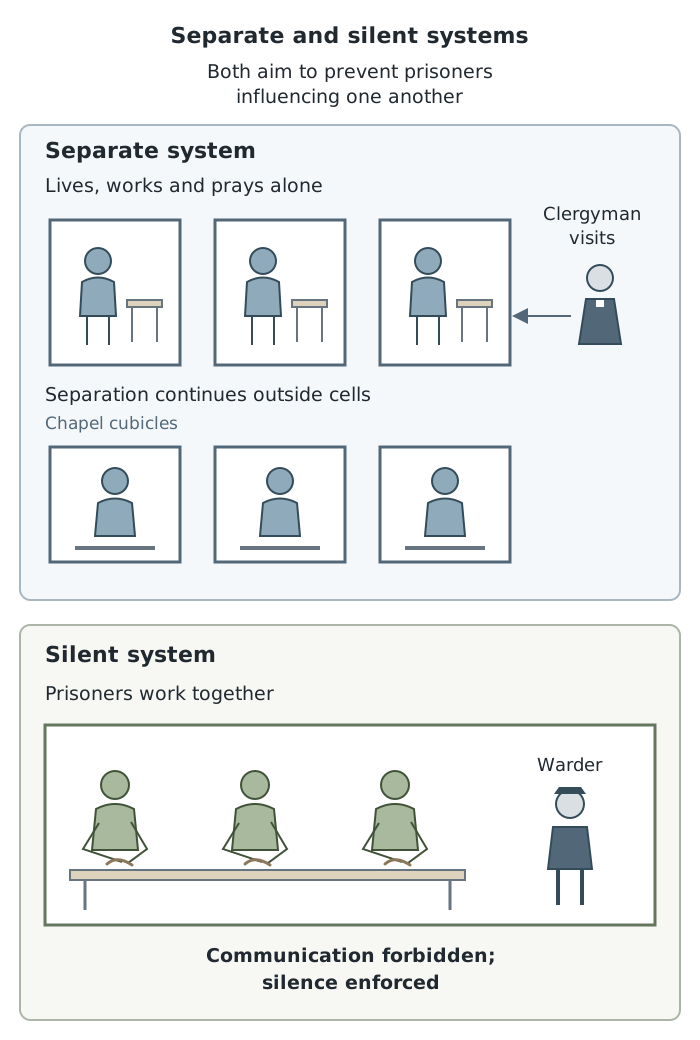
The separate system isolated individuals; the silent system allowed shared space but prohibited communication.
The distinction is therefore isolation versus enforced silence, not simply quiet versus noisy prisons. Both systems tried to prevent harmful contact, but their harshness and the failure to achieve effective reform helped discredit them.
By 1865, the prison regime increasingly emphasised deterrence through three harsh conditions:
The intention was to make prison sufficiently unpleasant to discourage crime. This was a movement away from the earlier confidence that isolation and religion would reform offenders.
In 1877, legislation brought prisons under central government control. Around 115 prisons could now be administered centrally rather than through separate local arrangements. This was a major change in responsibility: government increasingly determined how imprisonment operated.
Twentieth-century developments gave rehabilitation a greater role, without removing discipline or punishment. Young offenders were considered particularly capable of change because their characters were still developing. Keeping them away from older criminals might also prevent harmful influences.
An experiment began in 1902 at Rochester Prison in Borstal, Kent. The 1908 Prevention of Crime Act established the borstal system more widely. Borstals combined custody with structured days, strict rules, education, training and sport. Their approach resembled a demanding boarding school rather than an ordinary adult prison, although discipline could still be harsh.
The aim was to prepare young people for a law-abiding life, not merely hold them until their sentences ended. However, continuing reoffending undermined confidence in the system. Borstals were abolished in 1982, showing that a reforming intention did not guarantee successful rehabilitation.
Open prisons developed in the 1930s; New Hall Camp opened in 1936. Their use expanded after the Second World War, partly to relieve overcrowding in closed prisons.
Category D, or open, prisons hold prisoners considered unlikely to escape. They offer lower security and greater trust than closed prisons. Education, work experience and opportunities to work outside prison can help prisoners prepare for employment and everyday life after release.
This preparation is especially important after a long sentence, when society may have changed greatly. At North Sea Camp in Lincolnshire, governor Graham Batchford explained in 2011 that prisoners needed help readjusting gradually to community life.
Open prisons are cheaper to run than closed prisons and can support resettlement. Critics regard them as a ‘soft’ punishment. The central judgement is whether the benefits of preparation and lower costs justify reduced restrictions for appropriately selected prisoners. They are not suitable for everyone and remain a form of custody, not an alternative to custody itself.
Other developments allowed offenders to remain in, or return to, the community under conditions.
Probation, established through the 1907 Probation of Offenders Act, could be used instead of imprisonment. An offender remained in the community under supervision. This offered a chance to reform without the disruption of prison, while support could help address difficulties connected with offending.
Parole developed with the establishment of the Parole Board in 1967. It allowed conditional release after a prisoner had served part of a sentence. Released prisoners had to follow rules and keep in contact with a supervising officer; breaking conditions could lead to a return to prison. Unlike probation as an alternative sentence, parole followed a period in custody.
Community service, introduced in 1972, required offenders to undertake unpaid work benefiting the community, such as removing graffiti or cleaning public spaces. It combined punishment with making a practical contribution to the community harmed by crime, without requiring a prison sentence.
These methods could reduce pressure on prisons and support a return to ordinary life. They did not mean that all offenders could safely avoid imprisonment. The wider change was towards a range of methods suited to different offenders, rather than relying on one harsh prison regime for everyone.
Distinguish separating prisoners into groups by age, sex or offence from the separate system, which isolated individual prisoners.
Compare reformers through specific contributions: Howard investigated and publicised conditions, Paul developed a practical prison design, and Fry improved the treatment of women.
Keep probation and parole distinct: probation can replace imprisonment; parole is conditional release after part of a prison sentence.
Explain change without implying that reform replaced punishment completely. Discipline, deterrence and rehabilitation often existed together.
Use dates and examples to support explanations, rather than presenting an unexplained list of reforms.
It can see this note and what your specification asks for.
Answers are free with an account.
1 free note left this week
Get more free notesYour answer sets when this note comes back for review, or marks it complete.
Was this note helpful?
Log in to tell us whether it helped, or to report a problem.
Last updated
Reform
Changing an offender’s behaviour so that they are less likely to commit further crimes.
Rehabilitation
Helping an offender prepare for a law-abiding life through support such as education, training and work.
Deterrence
Discouraging crime through the fear of punishment.
Gaoler
An official responsible for guarding prisoners and running a gaol, an older term for a prison.
Discharge fee
A payment demanded by a gaoler before a prisoner could leave prison.
Silent system
A prison regime in which prisoners could be together, particularly for work, but were forbidden to communicate.
Separate system
A prison regime that isolated individual prisoners to prevent contact and encourage reflection, work and religious reform.
Borstal
A custodial institution for young offenders combining strict discipline with education, training and physical activity.
Open prison
A lower-security prison for prisoners considered unlikely to escape, using education and work to help prepare them for release.
Probation
Supervision of an offender in the community, used as an alternative to imprisonment and intended to support reform.
Parole
Conditional release from prison before the end of a sentence, with supervision and rules that the released prisoner must follow.
Community service
Unpaid work ordered by a court as a punishment that benefits the community.
Put your knowledge into practice — try past paper questions for History
Reform
Changing an offender’s behaviour so that they are less likely to commit further crimes.
Rehabilitation
Helping an offender prepare for a law-abiding life through support such as education, training and work.
Deterrence
Discouraging crime through the fear of punishment.
Gaoler
An official responsible for guarding prisoners and running a gaol, an older term for a prison.
Discharge fee
A payment demanded by a gaoler before a prisoner could leave prison.
Silent system
A prison regime in which prisoners could be together, particularly for work, but were forbidden to communicate.
Separate system
A prison regime that isolated individual prisoners to prevent contact and encourage reflection, work and religious reform.
Borstal
A custodial institution for young offenders combining strict discipline with education, training and physical activity.
Open prison
A lower-security prison for prisoners considered unlikely to escape, using education and work to help prepare them for release.
Probation
Supervision of an offender in the community, used as an alternative to imprisonment and intended to support reform.
Parole
Conditional release from prison before the end of a sentence, with supervision and rules that the released prisoner must follow.
Community service
Unpaid work ordered by a court as a punishment that benefits the community.
| Method | Essential recall |
|---|---|
| Borstal | Experiment in 1902; expanded by the 1908 Act. Young offenders: custody, discipline, education and training. Abolished 1982 amid concerns about reoffending. |
| Open prison | Developed in the 1930s; New Hall Camp, 1936. Lower-security custody; work and education prepare prisoners for release. Cheaper, but criticised as ‘soft’. |
| Probation | 1907: supervision in the community instead of imprisonment. |
| Parole | Parole Board, 1967: conditional release after part of a prison sentence; recall possible if conditions are broken. |
| Community service | 1972: unpaid work benefiting the community instead of imprisonment. |
Overall pattern: increasing organisation and government control, followed by a wider range of methods supporting rehabilitation. Punishment and deterrence continued alongside reform.