

Loading…
Loading…
Loading…
Eduqas GCSE Geography B · C112
Eduqas C112 · 1.2.3 Drivers of Urban and Rural Change Check the specification (PDF) (opens in a new tab)
Population movement changes both the places people leave and the places they move to. Internal migration means changing where you live within the same country. It differs from commuting: a commuter travels between home and work without necessarily moving house.
People often weigh up pressures encouraging them to leave against attractions drawing them elsewhere. Unemployment, limited services or expensive housing can encourage departure; employment, education, family connections and a preferred lifestyle can attract people to a destination. These factors work together rather than acting separately.
Regional inequality is the uneven distribution of wealth, employment opportunities and living standards between parts of a country. Economic change has not benefited every UK region equally.
Deindustrialisation—the decline of manufacturing industry and industrial employment—hit areas such as North East England and the South Wales Valleys particularly hard. Losing a major employer reduces local job opportunities. Meanwhile, growth in finance, technology and other services has created opportunities in London, the South East and major university cities.
This helps explain movement from North East England towards London and the South East, and from parts of West Wales towards cities such as Cardiff and Bristol. Younger adults and graduates may move to obtain work that matches their qualifications, earn more or develop a career. Destination cities gain workers and spending, while places of departure can lose skills and younger residents.
The pattern is sometimes called the North–South divide, but this is a broad description, not a rule for every place. Opportunities also exist in northern cities, and higher wages do not automatically mean a better standard of living if housing costs are much higher.
Social factors also influence decisions. Education and family connections can draw people towards cities. Later in life, some people move northwards, westwards or into the countryside for more affordable housing and a preferred lifestyle. The same place can therefore attract one group while losing another.
People do not have to live beside their jobs. Road and rail connections allow workers to live in suburbs, towns or villages while travelling into a city. A commuter belt is the area around a city from which people regularly travel to work there.
London’s commuter belt extends into counties including Kent, Essex, Surrey and Buckinghamshire. Settlements such as Sevenoaks and Guildford allow residents to combine access to London employment with living outside the capital.
Commuting supplies city businesses with a large workforce without requiring every worker to occupy city housing. However, many journeys concentrate at the same times, increasing rush-hour congestion and pressure on transport.
In receiving towns and villages, incoming commuters increase housing demand and can raise property prices, making homes less affordable for existing residents. Their spending can support local shops and services, but community life may change when many residents spend the working day elsewhere. Improved transport therefore changes where people can live, but its benefits are not shared equally.
Teleworking means using digital technology to work away from the usual workplace, often at home. Hybrid working combines working remotely with attending the workplace on some days. Its expansion during the COVID-19 pandemic increased the possibilities for living further from an employer.
If someone only needs to reach an office occasionally, they may accept a longer journey and choose a smaller town or rural home. Home-based professionals in counties such as Devon, Norfolk and Powys illustrate how rural residence can be combined with employment linked to urban areas. Reliable broadband becomes especially important, although not every job can be done remotely.
For cities, fewer commuting journeys can reduce congestion and air pollution. However, fewer daily workers also means fewer customers for cafés, shops and other services near offices. Falling demand can reduce employment and put financial pressure on workers who lose their jobs.
For rural communities, teleworking can bring residents and spending that support local businesses. It can also increase housing demand and pressure on broadband and other infrastructure. Its ability to sustain a community therefore depends on connectivity, suitable employment and available housing—not simply on people wanting to move there.
Immigration is movement into a country from abroad to live there. People come to the UK for employment, study, family reunification or safety. Many settle in cities such as London, Birmingham and Manchester, but rural areas also receive migrants.
In urban areas, migrants can fill labour shortages in healthcare, construction and hospitality. Employment generates tax revenue, while spending and new businesses support the local economy. Immigration also increases cultural diversity through food, festivals, languages and religious life. Leicester is an example of a city with a diverse population.
Population growth increases demand for housing, school places and healthcare. Where provision does not expand quickly enough, overcrowding or pressure on services can result. Language barriers and limited support can make integration harder; social tensions are possible, but are not an inevitable consequence of immigration.
Rural immigration has a different employment focus in some places. Around Boston in Lincolnshire, Eastern European migration has supported agriculture and food processing. Migrant workers also support farming in Herefordshire. They help employers meet labour needs, while their spending supports other businesses.
Incoming families can help maintain schools and services in communities with ageing populations. However, rural places with limited housing or services may struggle to accommodate rapid growth. In some low-paid sectors, competition for work can put pressure on pay, and employers may become reliant on recruitment rather than training local workers. Overall effects depend on the jobs available and whether housing and services keep pace with population change.
Rural depopulation is a fall in the number of people living in a countryside area. It particularly affects some remote places, including parts of the Scottish Highlands and rural Wales. This contrasts with accessible commuter settlements that may be growing.
A key cause is limited employment. Mechanisation allows farming tasks to be completed by fewer workers, reducing agricultural jobs. If few alternative jobs exist, young adults may leave for education or employment in towns and cities.
Remoteness reinforces this pressure. Limited transport makes workplaces and services harder to reach, while poor broadband restricts teleworking opportunities. Harsh upland conditions can also discourage investment. Affordable housing matters too: where young households cannot find suitable homes, they may leave even if they would prefer to stay.
As younger adults leave, the remaining population becomes older. Schools lose pupils, shops lose customers and bus routes lose passengers. Some services become difficult to maintain and close, making the area less attractive to remaining residents. This is a spiral of decline: population loss and service decline reinforce one another.
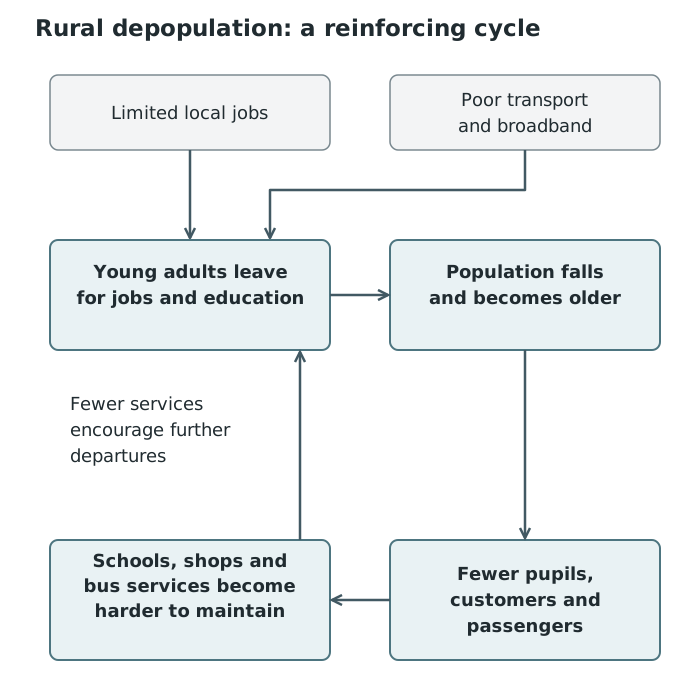
Population loss can reduce demand for services; declining services can then encourage more people to leave.
The factors are connected. Few jobs may start the process, but poor access, service closures and an ageing population can deepen it. Commuting, teleworking or immigration may help sustain some rural communities, yet their success depends on local conditions. Rural change is therefore uneven: some places attract new residents while others continue to lose them.
For an explanation, link the cause to the movement and then to a consequence: fewer rural jobs → young adults leave → the remaining population becomes older.
Distinguish migration, which changes where someone lives, from commuting, which is a regular journey between home and work.
Identify whether a consequence affects the place people leave or the place they move to.
Use named examples accurately, such as London’s commuter belt or agricultural employment around Boston in Lincolnshire.
Avoid assuming that all rural areas are losing population or that migration affects every community in the same way.
It can see this note and what your specification asks for.
Answers are free with an account.
1 free note left this week
Get more free notesYour answer sets when this note comes back for review, or marks it complete.
Was this note helpful?
Log in to tell us whether it helped, or to report a problem.
Last updated
Migration
A change in a person’s usual place of residence.
Internal migration
Movement to a new place of residence within the same country.
Immigration
Movement into a country from another country to live there.
Regional inequality
Uneven wealth, employment opportunities and living standards between different parts of a country.
Deindustrialisation
The decline of manufacturing industry and industrial employment in an area.
Commuting
Regular travel between a person’s home and workplace.
Teleworking
Working away from the usual workplace, often at home, using digital technology to communicate and complete work.
Rural depopulation
A decline in the number of people living in a countryside area.
Spiral of decline
A reinforcing process in which population loss reduces demand for jobs and services, whose decline encourages more people to leave.
Put your knowledge into practice — try past paper questions for Geography B
Migration
A change in a person’s usual place of residence.
Internal migration
Movement to a new place of residence within the same country.
Immigration
Movement into a country from another country to live there.
Regional inequality
Uneven wealth, employment opportunities and living standards between different parts of a country.
Deindustrialisation
The decline of manufacturing industry and industrial employment in an area.
Commuting
Regular travel between a person’s home and workplace.
Teleworking
Working away from the usual workplace, often at home, using digital technology to communicate and complete work.
Rural depopulation
A decline in the number of people living in a countryside area.
Spiral of decline
A reinforcing process in which population loss reduces demand for jobs and services, whose decline encourages more people to leave.
Limited jobs + poor connectivity → young adults leave → ageing population and fewer customers → services close → further departures.
Examples: parts of the Scottish Highlands and rural Wales. Accessible commuter settlements may grow instead.