

Loading…
Loading…
Loading…
Eduqas GCSE Geography B · C112
Eduqas C112 · 1.2.3 Drivers of Urban and Rural Change Check the specification (PDF) (opens in a new tab)
A sustainable community meets people’s needs today without damaging the ability of future generations to meet theirs. This involves more than making a place greener. Residents also need affordable homes, reliable services, opportunities to earn a living and a safe, healthy environment.
These needs connect three dimensions of sustainability. Environmental sustainability means reducing pollution, resource use and damage to habitats. Social sustainability concerns people’s well-being and fair access to housing and services. Economic sustainability means maintaining jobs, businesses and services over the long term. A low-emission neighbourhood is not fully sustainable if only wealthy residents can afford to live there.
Urban and rural communities face different obstacles. Cities concentrate people, buildings and traffic in a small area; rural settlements often have fewer people spread over greater distances. Both need to connect residents to opportunities without excessive environmental damage.
Large urban populations create heavy demand for housing, schools, healthcare, energy and water. Providing these can be expensive, while shortages of housing can increase rents and overcrowding. Older homes may lose heat through poor insulation, raising both energy bills and carbon emissions. Retrofitting them can help, but the initial cost is a barrier.
Cities also generate large quantities of waste. Recycling and reusing materials reduce the resources required to make new products and the amount sent to landfill. These changes need collection systems, investment and participation from households and businesses: infrastructure alone is not enough.
A further challenge is making improvements fair. Investment may create jobs and attractive neighbourhoods, but rising housing costs can prevent poorer residents from benefiting. Affordable housing, community facilities and accessible employment therefore matter alongside environmental improvements.
Green space also has several roles. Sheffield’s Grey to Green project converted former road space into planted areas and footpaths. The planting helps manage surface water and provides wildlife habitat, while the walking space improves the urban environment. Such projects show that sustainability involves how space is used, not just how vehicles move.
Heavy car use causes congestion, air pollution, noise and greenhouse gas emissions. Congestion also wastes time and can increase costs for businesses. However, simply discouraging driving can disadvantage people unless practical alternatives exist.
An integrated transport system connects different forms of travel so that a whole journey is manageable without a car. A bus route to a railway station is useful only if passengers can reach the stop safely and make the connection. Convenient interchanges, coordinated services and clear travel information help the network function as one system.
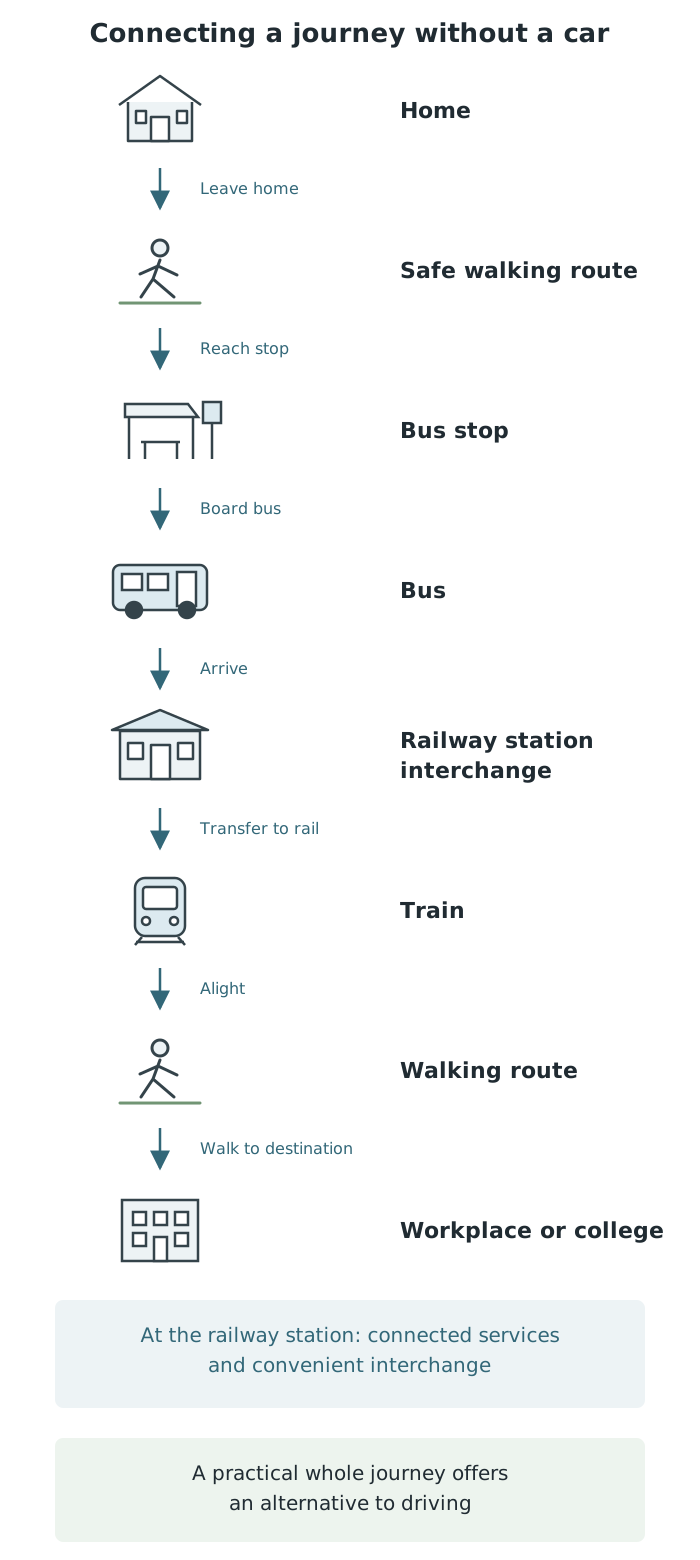
An integrated network makes the connections between stages of a journey practical, not just the individual services.
Manchester’s Metrolink tram network connects outer suburbs with the city centre, providing an alternative to driving. Bristol’s MetroBus links areas of deprivation to jobs and education. The value of these connections is both environmental and social: they can reduce car use while widening access to opportunities.
Cost also influences travel choices. London makes driving in parts of the city more expensive through charging schemes, encouraging alternatives. Yet public transport must itself be affordable, reliable and accessible if people are to use it.
Transport improvements have limits. New infrastructure is costly, and restrictions on driving can shift traffic to surrounding areas. A successful scheme needs to consider the whole journey and neighbouring communities, rather than improving one street at another’s expense.
In rural areas, the main difficulty is often keeping essential services within reach. Small, scattered populations mean fewer passengers for each bus route. Long routes cost money to operate, so services can be infrequent or withdrawn. Residents then become more dependent on cars, increasing travel costs and emissions.
The consequences are unequal. A household with a car may still reach a distant supermarket or clinic, whereas someone without one may become isolated. Older residents can be particularly affected when they cannot drive. Transport therefore influences social inclusion as well as the rural economy.
Housing and employment create further challenges. In popular areas such as Cornwall, second homes and holiday accommodation can increase housing pressure for local families. Tourism provides income, but employment may be seasonal. Communities need affordable homes and dependable livelihoods, not just large visitor numbers in summer.
Visitor pressure can also damage the environment on which tourism depends. Traffic and parking problems affect villages and protected landscapes. Heavy footfall removes vegetation from paths; exposed soil is then more easily worn away, while walkers avoiding damaged sections can widen the path.
Rural transport often needs approaches suited to lower passenger numbers. Devon’s Ring & Ride uses community minibuses and volunteers to help residents, including older people, reach shops and appointments. This improves access, but dependence on funding and volunteers can make long-term provision difficult.
In Eryri, also known as Snowdonia, the Sherpa bus network connects villages and popular walking routes. It gives visitors an alternative to driving between destinations. Park-and-ride and shuttle services can reduce pressure on parking and roads, but must offer useful routes and journey times to attract passengers.
Cleaner vehicles are another part of the solution. Electric vehicle charging can support a shift away from petrol and diesel cars. However, electric cars still require road and parking space, and they do not solve the problem of access for people who cannot drive.
Transport supports many other parts of sustainability: residents can reach employment, businesses can attract customers, and people can access healthcare and education. This makes it a strong foundation for both urban and rural communities.
However, better connections do not themselves provide affordable housing, reduce heat loss from homes or create secure employment. Other initiatives can address needs directly. On Gigha in Scotland, community-owned wind turbines generate income for local services and housing projects. Broadband for the Rural North, or B4RN, provides high-speed fibre broadband in rural Lancashire, supporting businesses and remote working. These approaches can strengthen a community without relying solely on more travel.
A justified judgement is therefore that transport is often essential, especially where poor access excludes residents from services and jobs, but it cannot create a sustainable community on its own. The strongest approach combines suitable transport with affordable housing, resource efficiency, protected environments and a viable local economy. Which improvement deserves priority depends on the community’s most serious problems.
Integrated networks connect walking, cycling and public transport. Better access supports jobs, education and healthcare while offering alternatives to driving.
Limits include investment costs, funding dependence and displaced traffic. Electric cars do not remove congestion or help everyone without a vehicle.
Transport is a foundation, not a complete solution. Combine it with affordable housing, energy efficiency, environmental protection and livelihoods. Recall Sheffield’s Grey to Green, Gigha’s community wind turbines and B4RN rural broadband as complementary approaches.
For an explanation, develop a chain: scattered rural populations → fewer passengers → services are costly to run → limited access for residents without cars.
Support arguments with named places and explain what their schemes contribute, rather than just listing them.
In a ‘to what extent’ answer, weigh transport against other needs, such as affordable housing, employment and resource management. Finish with a judgement that follows from your evidence.
Distinguish an intended benefit from proven success: a scheme designed to reduce car use does not mean that all residents have stopped driving.
It can see this note and what your specification asks for.
Answers are free with an account.
1 free note left this week
Get more free notesYour answer sets when this note comes back for review, or marks it complete.
Was this note helpful?
Log in to tell us whether it helped, or to report a problem.
Last updated
Sustainable community
A community that meets residents’ present needs while protecting the environment and resources needed by future generations, with access to housing, services and livelihoods.
Integrated transport system
A transport network in which different forms of travel connect, allowing people to complete journeys using combinations such as walking, buses and trains.
Car dependency
Reliance on private cars because other ways of reaching work, services or other destinations are limited or impractical.
Accessibility
How easily people can reach a place or service, taking account of distance, journey time, cost and available transport.
Park-and-ride
A system in which people leave their cars at a designated car park and continue their journey by public transport.
Retrofitting
Adding improvements to an existing building, such as insulation or more efficient heating, to reduce its energy use.
Put your knowledge into practice — try past paper questions for Geography B
Sustainable community
A community that meets residents’ present needs while protecting the environment and resources needed by future generations, with access to housing, services and livelihoods.
Integrated transport system
A transport network in which different forms of travel connect, allowing people to complete journeys using combinations such as walking, buses and trains.
Car dependency
Reliance on private cars because other ways of reaching work, services or other destinations are limited or impractical.
Accessibility
How easily people can reach a place or service, taking account of distance, journey time, cost and available transport.
Park-and-ride
A system in which people leave their cars at a designated car park and continue their journey by public transport.
Retrofitting
Adding improvements to an existing building, such as insulation or more efficient heating, to reduce its energy use.