

Loading…
Loading…
Loading…
Eduqas GCSE Geography A · C111
Eduqas C111 · 5.3.2 Ecosystem Processes at Different Scales Check the specification (PDF) (opens in a new tab)
An ecosystem includes living parts, such as plants, animals and humans, and non-living parts, such as soil, water and climate. These parts interact: rainfall supplies plants with water, plants provide animals with food, and dead organisms return nutrients to the soil. A biome is a very large ecosystem with a characteristic climate and vegetation.
Tropical rainforest and savanna are both hot tropical biomes. Their main contrast is the availability of water through the year. This difference affects vegetation, feeding relationships and the movement of nutrients, water and carbon.
Tropical rainforests form a band around the Equator, commonly within about 5° north and south. They occur in countries including Brazil, Costa Rica and the Democratic Republic of the Congo. The Amazon rainforest in Brazil is a named example.
Strong solar heating keeps temperatures above about 25°C throughout the year. Rainfall is heavy, around 1,500–2,000 mm annually, with no prolonged dry season. Warmth and plentiful moisture support rapid plant growth, with trees reaching around 40 m. Their crowns form a canopy, the upper leafy layer that receives much of the sunlight.
Rainforests have high biodiversity: a great variety of plants and animals. The living community depends on the warm, wet conditions, but it also changes its surroundings by storing water and carbon and returning nutrients to the soil.
Savanna grasslands occur within the tropics, often around 5–15° north and south of the Equator, between rainforest regions and hot deserts. Examples occur in Tanzania, Brazil, India and northern Australia.
Temperatures remain high, typically around 23–28°C, but rainfall is seasonal. The summer wet season brings heavy convectional rain: heated, moist air rises, cools and condenses. A dry season can last around four to six months.
Grasses and scattered trees replace the rainforest's dense tree cover. Drought and fire influence which plants survive; drought-resistant trees include acacia and baobab. Water shortage limits growth during the dry season. Soils may develop a hard surface crust when dry, while wet-season rainfall can leach nutrients from them.
Plants need mineral nutrients from the soil to grow. A nutrient store holds nutrients; a nutrient flow transfers them somewhere else. Three important stores are biomass, litter and soil.
Roots take nutrients from the soil into plant biomass. Feeding transfers some of these nutrients to animals. Fallen leaves, dead organisms and waste add material to the litter store. Bacteria and fungi decompose this material, returning mineral nutrients to the soil for plants to use again. Rainwater can also carry dissolved nutrients out of the soil through leaching.
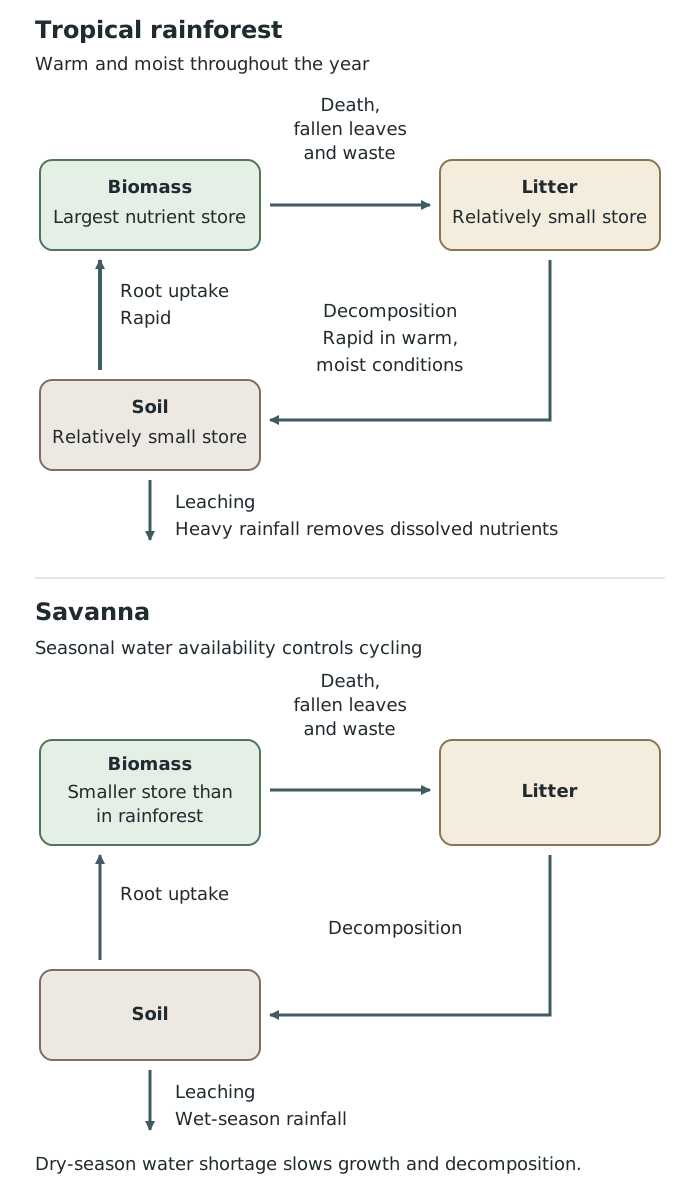
Nutrient stores are connected by flows. Rainforest cycling is rapid, whereas savanna cycling changes with seasonal water availability.
In a rainforest, biomass is the largest nutrient store, because there are many large trees. Warm, moist conditions allow rapid decomposition, so litter does not accumulate into a large store. The soil store is also relatively small: plants take up nutrients quickly, while heavy rain causes leaching. Rapid root uptake is a major flow from soil back into biomass. A lush forest therefore does not necessarily mean a large reserve of nutrients in its soil.
Savanna has a smaller biomass store than rainforest because its long dry season limits growth. Decomposition can be rapid when conditions are warm and moist, but slows when water is scarce. Nutrient cycling therefore varies through the year. Wet-season rain supports renewed plant growth but can also leach nutrients from the soil.
A producer makes its own food using sunlight through photosynthesis. Rainforest trees and savanna grasses are producers. A primary consumer eats plants; a secondary consumer eats primary consumers. A food chain follows one feeding pathway, whereas a food web joins several pathways together.
For example, suppose two plant-eating animals eat the same vegetation, and a predator feeds on both animals. This creates two connected food chains. Draw arrows from the vegetation to each plant-eater, then from each plant-eater to the predator: the arrows show the direction in which food, energy and materials pass.
This relationship helps explain change in either biome. If drought reduces plant growth, plant-eaters have less food, and predators may then have less prey. If one prey species declines, a predator with another food source may be less affected than one dependent on that species alone.
Food webs also connect to nutrient and carbon cycles. Feeding moves nutrients and carbon between organisms; death and waste supply decomposers. Materials are recycled, but energy enters through sunlight and is not recycled in the same way.
The water cycle moves water between the Earth's surface and the atmosphere. Solar energy causes evaporation from water and wet surfaces. Plants take up water through their roots and release water vapour from their leaves through transpiration. Together, these transfers are called evapotranspiration.
Water vapour cools and condenses into clouds, then returns as precipitation. Water is stored in soil, surface water and plant tissues, or flows through streams and rivers.
Rainforest vegetation temporarily holds rainfall on leaves and in plant tissues, while water is also stored in the soil. Evapotranspiration returns moisture to the atmosphere, helping connect the forest to rainfall beyond an individual patch of trees. Clearing vegetation reduces this return of moisture and changes the movement of water over and through the ground.
In savanna, the seasonal contrast is crucial. Wet-season rainfall replenishes water stores and supports growth. During the dry season, limited water constrains plants and animals. Human use can add pressure: water taken for tourist facilities can reduce local reserves, while waste dumped in rivers can pollute supplies.
Plants take carbon dioxide from the atmosphere during photosynthesis and incorporate its carbon into living material. Feeding passes that carbon to animals. Plants, animals and decomposers release carbon dioxide through respiration. Death and waste transfer carbon into litter and soil; decomposition returns some of it to the atmosphere.
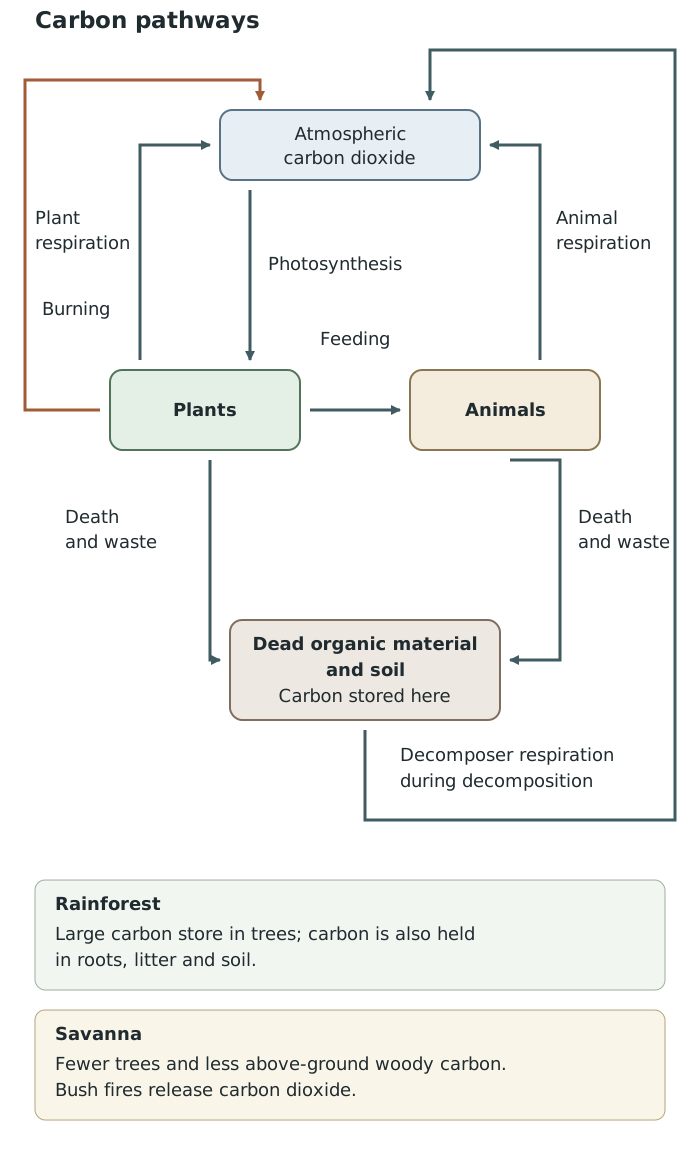
Photosynthesis brings carbon into living organisms; respiration, decomposition and burning return carbon dioxide to the atmosphere.
Rainforest has a large above-ground carbon store in its trees and other living organisms. Carbon is also held in roots, soil and dead material such as fallen wood. Savanna has fewer trees and a smaller above-ground woody carbon store. Bush fires release carbon dioxide when vegetation burns, while dry conditions slow growth and decomposition.
These are global connections because carbon dioxide moves through the atmosphere rather than remaining within one ecosystem. Clearing and burning forest releases stored carbon and leaves fewer trees to remove carbon dioxide through photosynthesis.
Ecosystems provide services, meaning benefits to people. Some are direct products or opportunities; others result from the way natural processes operate.
Rainforest plants provide chemicals used in medicine and agriculture. Maintaining biodiversity preserves a wide variety of organisms that can supply these resources. Forest water storage and recycling also help regulate water supplies. Vegetation slows the movement of rainfall to rivers, helping moderate rapid runoff and reduce flood risk, although it cannot prevent every flood.
Savanna wildlife attracts tourists, bringing income and work. This benefit depends on retaining habitats and biodiversity. Tourism can also damage the resource it relies on if water demand leaves less for plants, animals and local people, or if waste pollutes rivers.
An ecosystem service should therefore be judged by both its benefits and its costs. Tourism may provide valuable income, but managing water use and pollution helps protect the wildlife and water supplies on which that income depends. Similarly, keeping rainforest vegetation can protect water regulation, carbon storage and useful biological resources together. These connections show why changing one part of an ecosystem can have consequences at local, regional and global scales.
Nutrients: soil → root uptake → biomass → death and waste → litter → decomposition → soil.
Build explanations as chains: climate affects a process, which affects a store or flow, which affects organisms or people.
Distinguish a nutrient store from a nutrient flow: biomass is a store; uptake by roots is a flow.
Food-web arrows point from the organism being eaten towards the organism that eats it.
Leaching removes dissolved nutrients in water; erosion removes soil itself.
Compare the same feature in both biomes, such as rainfall seasonality or the amount of carbon stored in trees.
When judging ecosystem services, explain both the benefit and any pressure caused by using it.
It can see this note and what your specification asks for.
Answers are free with an account.
1 free note left this week
Get more free notesYour answer sets when this note comes back for review, or marks it complete.
Was this note helpful?
Log in to tell us whether it helped, or to report a problem.
Last updated
Ecosystem
A community of living organisms interacting with one another and with non-living surroundings, such as soil, water and climate.
Biome
A very large ecosystem characterised by its climate and typical vegetation.
Biodiversity
The variety of living organisms in an area.
Biomass
The living material in an ecosystem, including plants and animals.
Nutrient store
A part of an ecosystem where nutrients are held, such as biomass, litter or soil.
Nutrient flow
The transfer of nutrients between stores, for example from soil into plants through root uptake.
Nutrient cycle
The recycling of nutrients between living organisms, dead organic material and soil.
Litter
Dead organic material on the ground, such as fallen leaves.
Producer
An organism, such as a green plant, that uses sunlight to make its own food through photosynthesis.
Primary consumer
An animal that feeds on producers.
Secondary consumer
An animal that feeds on primary consumers.
Decomposer
An organism, such as a bacterium or fungus, that breaks down dead material and waste, helping nutrients return to the environment.
Food web
A network of connected food chains showing feeding relationships in an ecosystem.
Leaching
The removal of dissolved nutrients from soil by water moving through it.
Evapotranspiration
The combined transfer of water to the atmosphere through evaporation and transpiration from plants.
Carbon cycle
The movement of carbon between stores such as the atmosphere, living organisms, soil and dead organic material.
Ecosystem service
A benefit that people receive from an ecosystem, such as water regulation, medicines or tourism opportunities.
Put your knowledge into practice — try past paper questions for Geography A
Ecosystem
A community of living organisms interacting with one another and with non-living surroundings, such as soil, water and climate.
Biome
A very large ecosystem characterised by its climate and typical vegetation.
Biodiversity
The variety of living organisms in an area.
Biomass
The living material in an ecosystem, including plants and animals.
Nutrient store
A part of an ecosystem where nutrients are held, such as biomass, litter or soil.
Nutrient flow
The transfer of nutrients between stores, for example from soil into plants through root uptake.
Nutrient cycle
The recycling of nutrients between living organisms, dead organic material and soil.
Litter
Dead organic material on the ground, such as fallen leaves.
Producer
An organism, such as a green plant, that uses sunlight to make its own food through photosynthesis.
Primary consumer
An animal that feeds on producers.
Secondary consumer
An animal that feeds on primary consumers.
Decomposer
An organism, such as a bacterium or fungus, that breaks down dead material and waste, helping nutrients return to the environment.
Food web
A network of connected food chains showing feeding relationships in an ecosystem.
Leaching
The removal of dissolved nutrients from soil by water moving through it.
Evapotranspiration
The combined transfer of water to the atmosphere through evaporation and transpiration from plants.
Carbon cycle
The movement of carbon between stores such as the atmosphere, living organisms, soil and dead organic material.
Ecosystem service
A benefit that people receive from an ecosystem, such as water regulation, medicines or tourism opportunities.