

Loading…
Loading…
Loading…
Eduqas GCSE Geography A · C111
Eduqas C111 · 5.3.2 Ecosystem Processes at Different Scales Check the specification (PDF) (opens in a new tab)
An ecosystem includes living organisms and the non-living surroundings with which they interact. At Studland Bay, on the Purbeck peninsula in Dorset, southern England, sand dunes provide a located UK example. The dunes are part of a wider landscape containing beach, lowland heath, woodland, bogs and freshwater habitats. Studying the dunes and their associated wet areas shows how processes can vary over short distances.
The wider south-east Purbeck National Nature Reserve covers 631 hectares and includes about five kilometres of beach. These figures describe the reserve, not just the dunes. Its varied habitats support all six British reptile species, alongside birds such as nightjars and Dartford warblers. Studland's dune slacks are particularly rich in dragonflies and damselflies. Biodiversity is the variety of living organisms: here, differences in sand, moisture and vegetation create different places for species to live.
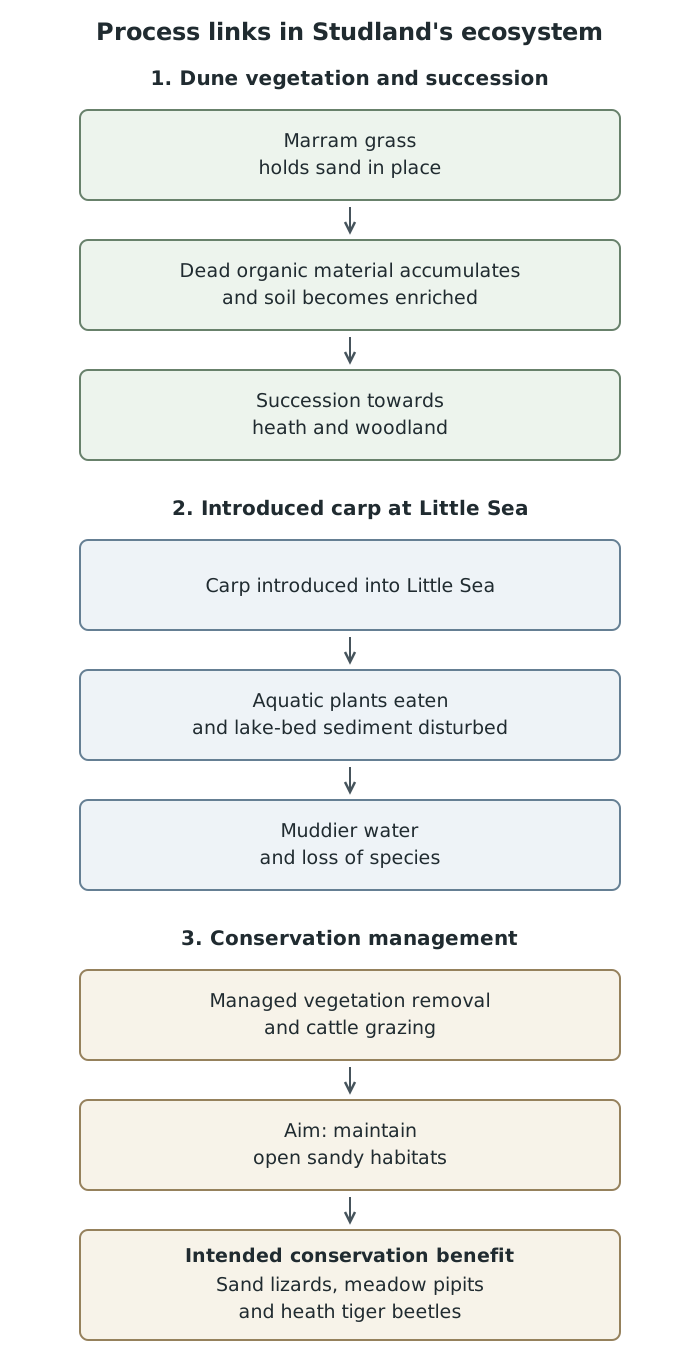
Studland's dune and heath system developed as sand accumulated over roughly the last 600 years. Wind moves sand, while plants help hold it in place. Marram grass is especially important because it stabilises dunes, reducing the movement of sand.
As vegetation becomes established, dead leaves and other organic material accumulate. Decomposers break this material down, returning nutrients to the soil; plants take up nutrients through their roots, and animals obtain them by feeding. Dead organisms and waste return material to the cycle. Nutrients are therefore recycled locally, rather than simply passing through once.
The plants also change conditions for later vegetation. Increasing stability and soil enrichment help other plants establish, allowing succession towards heath and woodland. This connects living and non-living parts of the ecosystem: plants respond to the sand and soil, but also change them.
Water links these habitats too. Rainfall supplies soil moisture, plants take up water and return some to the atmosphere through transpiration, and wetter hollows support different organisms from dune ridges. Little Sea, a freshwater lake within the wider system, provides another habitat. Its formerly clear, acidic, nutrient-poor water supported a variety of wildlife.
Plants and human activities change physical conditions, which in turn affect habitats and biodiversity.
Studland is a popular visitor destination, with summer days attracting as many as 25,000 people to the beach. Recreation gives people access to nature, but concentrated use can damage the ecosystem.
Foot traffic and beach vehicles can crush strandline plants such as sea rocket and their seedlings. Even small amounts of trampling can damage the fore dunes and shifting dunes, including their marram grass. Where plant cover is lost, sand is less securely held and more exposed to wind erosion. Heavy trampling also loosens and churns bare sand. This damages the sand lizards' egg-laying habitat: excessively disturbed sand is unsuitable, and eggs laid there are more likely to be lost.
On the dune heath, trampling breaks dwarf shrubs and dislodges the moss and lichen turf. Trampling can also compact the developed soils of heathland and well-used paths. Compression reduces spaces between soil particles, restricting the movement of water into and through the soil. Less infiltration means more rainfall can flow over the surface, increasing the risk of erosion during heavy rain. This is a different effect from the loosening of bare dune sand: the outcome depends on the ground being trampled.
Dog faeces and urine add nitrogen and phosphorus to the ecosystem. These are extra inputs to the local nutrient cycle, not simply the recycling of nutrients already present. Dog fouling tends to be concentrated near entrances and beside paths; much of the faeces deposited on heathland occurs within about 400 metres of an entrance.
In nutrient-poor heath and dune soils, extra nutrients do not benefit every species equally. They encourage vigorous grasses to grow, increasing competition with specialist plants adapted to low-nutrient conditions. On heathland, lush grassy strips can develop beside paths, while species richness, the number of different species present, falls.
These grassy strips can replace the boundary between heather and bare ground. Many invertebrates depend on this small-scale habitat, so changing the vegetation affects animals as well as plants. More plant growth can therefore mean less biodiversity.
Visitors can also leave litter, disturb wildlife and create a risk of fire. Fire removes plant cover and destroys habitat; severe fires can damage the soil and its seed bank, delaying recovery. Disturbance can disrupt animals' use of feeding or resting areas.
Management includes boardwalks and routed paths, fenced dune-regeneration areas, dog-mess bags and bins, and designated barbecue areas near the visitor centre. Boardwalks and paths concentrate movement away from sensitive vegetation; fencing gives damaged areas an opportunity to recover. Removing dog mess reduces nutrient inputs. These measures can reduce pressure, although their effectiveness depends partly on whether visitors follow them.
Human impacts are not restricted to tourism. Carp were illegally introduced into Little Sea. They eat aquatic plants and churn up sediment on the lake bed, making the water muddy.
This changes both living components and physical conditions. Aquatic vegetation is removed, while suspended sediment reduces the light available beneath the water surface. Plant loss alters habitat and food relationships. Little Sea subsequently experienced a dramatic loss of species and a decline in overwintering birds.
Encouraging predators such as cormorants and otters is intended to reduce carp numbers. This uses a feeding relationship to tackle the disruption, but recovery must be checked rather than assumed.
More vegetation does not always mean greater biodiversity. Over the past century, Studland's dunes have become over-vegetated, reducing the open sandy habitats needed by some specialist species. Surveys in the 1930s recorded about 30% bare sand at Studland Bay; the 2013–2015 resurvey found only about 2% of the dunes was bare sand.
The Dynamic Dunescapes project aims to restore sandy habitats through vegetation removal and livestock grazing. Species expected to benefit include sand lizards, meadow pipits and heath tiger beetles.
In June 2021, Red Devon cattle returned to graze the dune heath for the first time in 80 years. They feed on purple moor grass and willow in wet areas and trample through heather and gorse, helping keep sandy spaces open. Grazing takes place away from the beach and busiest paths.
This creates an important distinction: uncontrolled trampling can damage dunes, while carefully managed disturbance can maintain the habitat variety on which biodiversity depends. Conservation is not simply about preventing every change or allowing vegetation to grow everywhere.
Human activity at Studland has both damaging and potentially beneficial effects. Visitor pressure can change sediment and water flows, enrich nutrient-poor soils and damage wildlife habitats. Introduced carp have changed water conditions and reduced biodiversity. In contrast, managed grazing and vegetation removal aim to restore habitats lost through excessive plant growth.
A balanced judgement considers the type, intensity and location of activity. Management should protect sensitive areas while retaining a mixture of open sand, vegetation and wet habitats. Volunteers monitor dune profiles, wildlife and vegetation so that changes can be assessed. An increase in bare sand alone would not prove success: the key question is whether suitable habitats and the species depending on them recover.
Studland Bay, Purbeck peninsula, Dorset, southern England. Dunes sit within a wider landscape of heath, woodland and wet habitats. Dune slacks support dragonflies and damselflies.
Locate your example precisely: Studland Bay, on the Purbeck peninsula in Dorset, southern England.
Build explanations as linked chains: human activity → change to vegetation, soil or water → effect on organisms and biodiversity.
Distinguish soil compaction on heathland and well-used paths from the loosening and churning of bare dune sand.
Distinguish uncontrolled visitor trampling from carefully managed grazing: both disturb vegetation, but their intensity and location affect the outcome.
When judging management, distinguish an intended benefit from a demonstrated result. Use monitoring evidence to support claims of success.
It can see this note and what your specification asks for.
Answers are free with an account.
1 free note left this week
Get more free notesYour answer sets when this note comes back for review, or marks it complete.
Was this note helpful?
Log in to tell us whether it helped, or to report a problem.
Last updated
Ecosystem
A system in which living organisms interact with one another and with non-living surroundings such as soil, water and climate.
Biodiversity
The variety of living organisms in an area.
Sand dune
A mound or ridge of sand accumulated by wind, often held in place by vegetation.
Dune slack
A low-lying hollow between sand dunes, often containing wetter conditions than the surrounding ridges.
Succession
The gradual change in a community of organisms as species establish and alter environmental conditions, allowing other species to grow.
Nutrient cycle
The movement and recycling of nutrients between organisms, dead organic material and the soil or water.
Infiltration
The movement of water from the ground surface into the soil.
Soil compaction
The compression of soil, reducing the spaces between its particles.
Put your knowledge into practice — try past paper questions for Geography A
Ecosystem
A system in which living organisms interact with one another and with non-living surroundings such as soil, water and climate.
Biodiversity
The variety of living organisms in an area.
Sand dune
A mound or ridge of sand accumulated by wind, often held in place by vegetation.
Dune slack
A low-lying hollow between sand dunes, often containing wetter conditions than the surrounding ridges.
Succession
The gradual change in a community of organisms as species establish and alter environmental conditions, allowing other species to grow.
Nutrient cycle
The movement and recycling of nutrients between organisms, dead organic material and the soil or water.
Infiltration
The movement of water from the ground surface into the soil.
Soil compaction
The compression of soil, reducing the spaces between its particles.
Overall: uncontrolled disturbance can damage biodiversity, but carefully managed disturbance can help conserve it. Check habitat and species monitoring before claiming success.