

Loading…
Loading…
Loading…
Eduqas GCSE Geography A · C111
Eduqas C111 · 5.3.1 Check the specification (PDF) (opens in a new tab)
An ecosystem consists of living organisms interacting with one another and with non-living surroundings such as water, soil and air. Ecosystems exist at different scales: a pond is small, while a tropical rainforest can extend across a vast region.
A biome is a large-scale ecosystem characterised by its climate and its typical plants and animals. The same biome can occur on different continents because similar climates support similar types of vegetation. The species need not be identical: grasslands in Africa and South America can belong to the same broad biome without containing exactly the same animals.
At the global scale, temperature and precipitation are especially important. Plants need water, and their growth depends on suitable temperatures. Vegetation then provides food and habitats for animals. This connects climate to the characteristics and distribution of biomes.
Latitude measures distance north or south of the Equator. Near the Equator, the Sun's energy is concentrated over a smaller area than at high latitudes, so temperatures are generally higher. Towards the poles, sunlight arrives at a lower angle and spreads over a larger area. Temperatures are generally lower, and seasonal differences in daylight become greater.
Rainfall also has a global pattern. Around the Equator, strong heating encourages warm, moist air to rise. As it rises and cools, water vapour condenses, producing clouds and heavy rainfall. These warm, wet conditions support tropical rainforest.
In subtropical regions farther from the Equator, descending air discourages cloud formation and rainfall. This helps explain the occurrence of many hot deserts. Between the wet equatorial regions and the dry desert regions, seasonal rainfall can support savanna grasslands.
These patterns produce broad biome belts, but not unbroken stripes around the Earth. The distribution of land and oceans affects climate, while mountains introduce differences in temperature and rainfall. At smaller scales, altitude and soil also influence vegetation. Biome boundaries are therefore often gradual transitions rather than sharp lines.
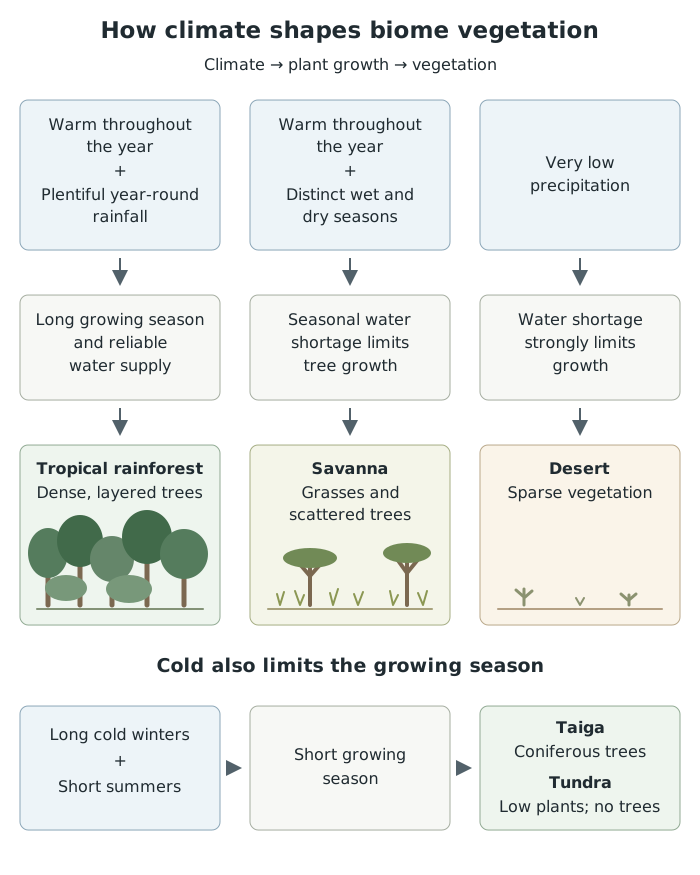
Temperature and the amount and seasonality of precipitation influence the vegetation a region can support.
Tropical rainforest occurs mainly close to the Equator. Most lies within the tropics, with major concentrations in South America, Africa and Asia. The Amazonian rainforest in South America and rainforests in central Africa and Southeast Asia are important examples. Smaller areas occur in Central America and Australasia.
Temperatures remain high throughout the year, with a small annual temperature range. Rainfall is plentiful throughout the year, although there may be wetter and drier seasons. Warmth and a continuing supply of water support dense, layered forest and a great variety of plants and animals.
Savanna, or tropical grassland, occurs between tropical forest and drier regions. Examples include East Africa, Brazil and India. It is warm throughout the year but has distinct wet and dry seasons. Grasses dominate, with scattered drought-tolerant trees such as acacia and baobab. The dry season limits continuous tree growth, so the vegetation is more open than rainforest.
Desert occurs where precipitation is very low, usually less than 250 mm a year. Hot deserts include the Sahara in Africa and deserts in Australia. Water shortage produces sparse vegetation, including drought-tolerant shrubs and, in some deserts, succulents. Some extremely dry areas have almost no vegetation. Not all deserts are hot: the Gobi in Asia experiences cold winters.
The contrast is therefore not simply between hot and cold places. Rainforest, savanna and hot desert can all be warm, but different amounts and seasonal patterns of rainfall support very different vegetation.
Temperate deciduous forest occurs in regions such as Europe, eastern North America and eastern Asia. These regions have warm summers, cooler winters and precipitation throughout the year. Trees such as oak and beech grow during the warmer months and lose their leaves seasonally. The forest changes visibly through the year, unlike the continuously leafy appearance of tropical rainforest.
Temperate grassland occurs in continental regions, including the prairies of North America, the steppes of Eurasia and the pampas of South America. Summers are warm or hot and winters are cold. Rainfall is lower than in many forest regions, so grasses dominate and trees are relatively uncommon. This shows how places at similar latitudes can support different biomes when their moisture supply differs.
Taiga, also called boreal forest, forms a broad belt across northern North America and Eurasia, between temperate regions and tundra. Long, cold winters and short, cool summers limit the growing season. Coniferous trees such as spruce and fir are common, and much precipitation falls as snow.
Tundra occurs farther north, between taiga and the permanently frozen polar regions, including parts of Alaska and northern Asia. Winters are very long and cold, summers are short, and precipitation is low. Permafrost restricts root growth, although the surface layer can thaw in summer. Mosses, grasses and low shrubs grow, but trees are absent. Here, cold and the short growing season limit vegetation as well as water availability.
A location identifies where a particular area is; a distribution describes the wider pattern. On a biome map, first read the key to identify the biome's colour or shading. Then look across the whole map for its latitude, the continents where it occurs, its main concentrations and any smaller areas.
For tropical rainforest, a useful overall description is: most occurs within the tropics, mainly across South America, Africa and Asia, with smaller areas elsewhere such as Central America and Australasia. This gives a global pattern rather than merely naming one rainforest.
To explain that pattern, connect it to climate: equatorial warmth and plentiful rainfall allow dense forest to grow. When comparing biomes, follow the same chain of reasoning: climate conditions → opportunities or limits for plant growth → characteristic vegetation. Global patterns are a starting point; regional climate differences explain why every place at the same latitude does not have the same biome.
Biomes are large-scale ecosystems characterised by climate, plants and animals. Temperature and precipitation largely control their distribution.
Location: where a particular place is.
Distribution: the overall pattern across an area—latitude, continents, concentrations and smaller areas.
For a distribution question, describe the overall pattern: latitude, continents, main concentrations and smaller areas. Naming one location is not enough.
Write that most tropical rainforest lies within the tropics, not all of it.
Link climate to vegetation explicitly: for example, year-round warmth and plentiful rainfall support dense rainforest.
Describe both temperature and precipitation, including their seasonal patterns. Accurate climate figures can help, but are not always necessary.
Do not assume every desert is hot: low precipitation is the defining characteristic.
It can see this note and what your specification asks for.
Answers are free with an account.
1 free note left this week
Get more free notesYour answer sets when this note comes back for review, or marks it complete.
Was this note helpful?
Log in to tell us whether it helped, or to report a problem.
Last updated
Biome
A large-scale ecosystem characterised by its climate and its typical plants and animals.
Ecosystem
A system in which living organisms interact with one another and with their non-living surroundings.
Climate
The average weather conditions of a place over a long period, usually assessed over at least 30 years.
Precipitation
Water falling from the atmosphere, including rain, snow, sleet and hail.
Latitude
Distance north or south of the Equator, measured in degrees.
Distribution
The pattern of where something occurs across an area.
Deciduous tree
A tree that loses its leaves seasonally, usually in autumn in temperate climates.
Permafrost
Ground that remains frozen for at least two consecutive years.
Put your knowledge into practice — try past paper questions for Geography A
Biome
A large-scale ecosystem characterised by its climate and its typical plants and animals.
Ecosystem
A system in which living organisms interact with one another and with their non-living surroundings.
Climate
The average weather conditions of a place over a long period, usually assessed over at least 30 years.
Precipitation
Water falling from the atmosphere, including rain, snow, sleet and hail.
Latitude
Distance north or south of the Equator, measured in degrees.
Distribution
The pattern of where something occurs across an area.
Deciduous tree
A tree that loses its leaves seasonally, usually in autumn in temperate climates.
Permafrost
Ground that remains frozen for at least two consecutive years.