

Loading…
Loading…
Loading…
Eduqas GCSE Design and Technology · C600
Eduqas C600 · Properties and Ecological Footprint Check the specification (PDF) (opens in a new tab)
A fibre is a fine strand: the raw material from which a textile is made. Fibres or filaments can be assembled into a continuous yarn, which can then be woven or knitted into fabric. Fibre choice matters, but the yarn’s thickness, twist and surface also influence the finished fabric’s weight, flexibility, texture and handle—how it feels when touched and handled.
Fibres are classified by their source. Natural fibres come from plants or animals. Cotton comes from the seed bolls of the cotton plant; flax comes from plant stems and is called linen when processed into yarn and fabric. Hemp is a plant fibre obtained from the outer tissues of the stem, known as a bast fibre. These plant fibres contain cellulose. Wool comes from the protective coat of sheep, while silk is produced by silkworms when forming their cocoons. Wool and silk are protein fibres.
Manufactured fibres are produced through industrial processes, but this category contains two important groups. Regenerated fibres, including viscose, are made by chemically processing natural cellulose into a new fibre form. Synthetic fibres, including polyester, nylon, acrylic and elastane, are made from synthetic polymers, usually using chemicals derived from oil. Viscose is therefore manufactured, but it is not classified as synthetic in this distinction.
Elastane is also known as spandex; Lycra is a trade name associated with elastane. Its especially high elasticity makes it useful where clothing must stretch and recover.
Source and length are different ways of classifying fibres. Knowing that a fibre is natural or manufactured does not, by itself, tell you the form of the yarn made from it.
Staple fibres are short lengths. Cotton, flax and wool are examples. Spinning twists many short fibres together into a continuous strand: the fibres overlap and hold together rather than each running the entire length of the yarn.
Continuous filaments are long, uninterrupted lengths. Silk is the important natural exception: it is a continuous filament rather than a staple fibre. Manufactured fibres such as polyester and nylon can be produced as filaments or supplied in cut staple form.
Staple yarns usually have a hairy surface because short fibre ends project from the yarn. These ends help trap air, giving useful insulation. Smooth filament yarns trap less air and are generally poorer insulators unless their structure is modified. This is one reason why changing the form of a yarn can change its end use even when the fibre material stays the same.
Twist also affects performance. A lower twist produces a softer, bulkier but weaker yarn, useful for knitting. A higher twist holds the fibres more firmly together and produces a stronger yarn suitable for weaving. Yarn thickness and tightness therefore help determine whether a fabric feels soft and flexible or firmer and more substantial. Bulk does not necessarily mean high weight: a bulky yarn can contain substantial spaces filled with air.
A textured yarn has deliberately introduced crimps, coils or loops. Thermoplastic filament yarns, such as polyester or nylon, can be shaped and heat-set in this way. Instead of remaining straight and smooth, the yarn becomes bulkier, with a softer handle and greater stretch. Its increased bulk can also help the fabric trap air and feel warmer. Textured yarns are used in products including tights, swimwear, fleece jackets and carpets.
Bulk can also be developed by combining staple fibres with different shrinkage behaviour. Acrylic and cotton are one example used to produce a lightweight, soft, warm, easy-care yarn suitable for knitwear.
Fancy or novelty yarns introduce distinctive surface effects. A slub yarn varies in thickness along its length, while bouclé has a curly or looped appearance. Chenille has short fibres projecting from a central core, creating a soft, fluffy surface. Chenille fabrics have a very soft handle and can be warm to wear: its structure affects function as well as appearance.
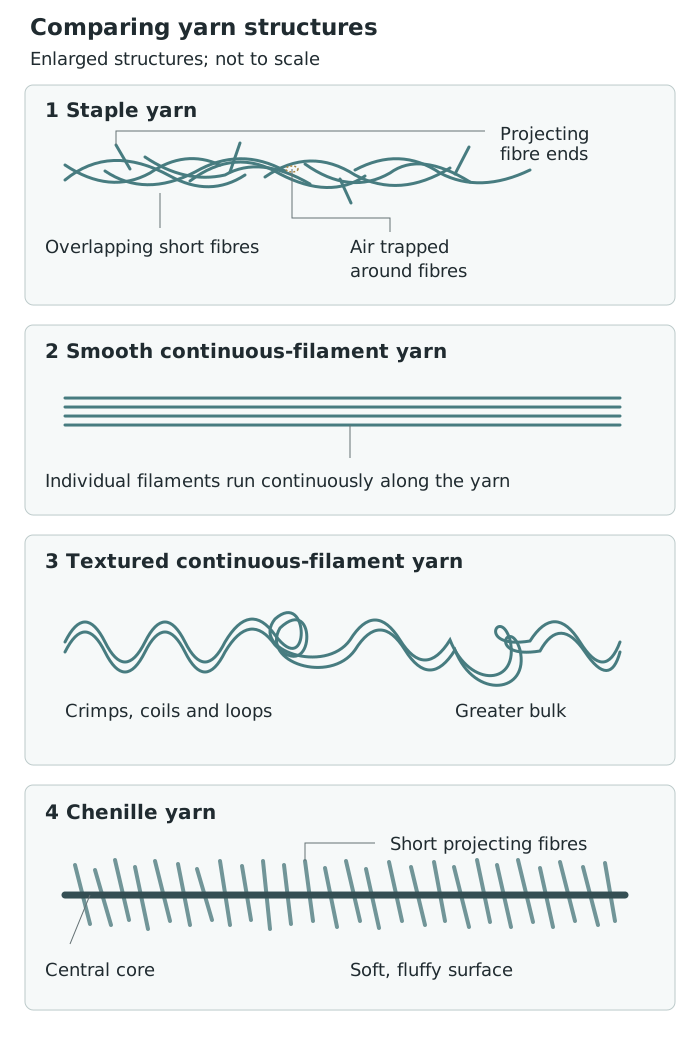
Fibre length and yarn structure change surface texture, bulk and handle.
A different modification is a core-spun yarn. Other fibres are spun around a central core. If that core is elastane, the yarn can stretch and recover its original length. Using it in a woven clothing fabric adds stretch and recovery, helping the garment fit the body and remain comfortable during movement.
Material selection starts with the demands of the product. Strength means resisting a force without breaking; durability means resisting damage over repeated use. A fibre can be strong under tension yet still be damaged by sunlight or unsuitable cleaning.
Elasticity includes recovery, not simply stretching. Absorbency is the ability to take up moisture. An absorbent textile can be useful for towels or clothing worn against the skin, but retaining moisture can increase drying time.
Insulation means reducing heat transfer. Yarn structures that trap air can help retain warmth. A smooth filament and a bulked or hairy yarn need not provide the same insulation, even if both contain the same manufactured fibre.
Other properties concern safety, comfort and exposure during use. Flammability concerns how readily a material ignites and burns. Water repellence concerns resistance to surface wetting. Low absorbency is different: a fibre may absorb little moisture while water still passes through spaces between the yarns. Waterproof performance therefore also depends on fabric construction and treatments.
Anti-static behaviour concerns avoiding a build-up of electrical charge, which can otherwise cause clinging or attract dust. Resistance to acid, bleach and sunlight must also be considered separately. A material that withstands one chemical or exposure may be damaged by another.
Cotton and linen are strong, absorbent textiles with relatively little elasticity. Both become stronger when wet. Cotton is useful for washable clothing and towels because it combines moisture absorption with strength. Linen is particularly strong and absorbent and feels cool to the touch, making it useful for warm-weather clothing. However, their limited elastic recovery means they retain creases. They can also shrink, so finishing and the care instructions affect their suitability.
Cotton is generally a poor insulator compared with an air-trapping, bulky yarn. This helps explain its use in cool clothing rather than relying on it alone for warmth. Cotton and linen can tolerate hotter washing and ironing than many synthetic textiles, but they are readily ignited. Heat tolerance during ironing does not mean fire resistance.
Hemp contributes strength and durability. Its fibres are stronger and more resilient than cotton, and hemp fabrics can have very good resistance to pilling—the formation of small balls of tangled fibres on the surface through rubbing. This makes hemp useful when a hard-wearing textile must retain its appearance. The final performance still depends on the yarn, construction and finishing, not simply the presence of hemp.
Wool offers a different balance. It is absorbent and has very good elasticity, helping it recover from deformation. Its crimp and hairy yarn structure trap air, supporting its use in warm clothing. Individual wool fibres are comparatively weak and become weaker when wet. Heat, moisture and rubbing can cause irreversible matting and shrinkage, so a wool garment needs more careful cleaning than a robust cotton product.
Silk combines high strength, absorbency and good elasticity. Its continuous filaments allow smooth yarns. Nevertheless, durability depends on exposure as well as initial strength: sunlight, heat and moisture can damage silk. A silk garment can therefore be strong yet still need gentle care.
Chemical resistance also distinguishes these fibres. Acids damage cotton and flax, while alkalis such as those in detergents are generally tolerated. Wool has good resistance to dilute acids but is damaged by alkalis. Silk is damaged by mineral acids and strong alkalis. Concentrated chemicals can cause severe damage even where dilute solutions are tolerated.
Chlorine bleach is particularly damaging to wool and silk. Cotton generally tolerates bleaching better, but bleaching can still weaken fibres, remove colour or damage finishes. The finished product’s care label matters, not just the fibre name.
Prolonged sunlight can also reduce durability. Cotton can yellow and weaken; flax has comparatively good light resistance but still deteriorates with prolonged exposure. Wool and silk can yellow and degrade, with silk particularly sensitive to ultraviolet radiation. This matters when choosing textiles for curtains or other products exposed to light for long periods.
Viscose is absorbent, but has relatively low strength and elastic recovery compared with fibres such as nylon. Its moisture absorption can be useful in clothing, while limited recovery makes creasing a consideration. Some viscose fabrics are damaged by washing in water and need specialist cleaning: regenerated-cellulose origin does not mean they can be cared for exactly like cotton.
Nylon has high strength relative to its weight, good abrasion resistance and good recovery from deformation. These properties support its use in hosiery, sportswear, ropes and carpets. It absorbs less moisture than cotton or viscose. Its thermoplastic nature also means excessive ironing heat can melt it. Prolonged sunlight can cause yellowing and weakening, which matters for outdoor products.
Polyester combines strength, good recovery and dimensional stability with very low moisture uptake. This supports easy-care clothing that dries quickly and retains its shape. The limitation is that low moisture absorption is less useful when the product must soak up water. Polyester also has good resistance to acids and better sunlight resistance than nylon, but it can melt under excessive heat.
Acrylic is useful in soft, warm yarns for knitwear and blankets. Its bulk and yarn structure help provide insulation. It has good light stability, making exposure to sunlight a relevant reason to consider it for furnishings. It resists mild acids but can be attacked by strong acids, and excessive ironing heat can damage it.
Elastane provides much greater stretch and recovery than the other common clothing fibres. It is particularly useful in close-fitting garments, swimwear and hosiery. It is often used alongside another fibre rather than chosen to provide every property by itself.
Wool demonstrates why water repellence and absorbency are not opposites. It repels water in light rain, yet can absorb a great deal in heavy rain and then takes a long time to dry. Cotton is very absorbent and also dries slowly. Nylon, polyester and elastane absorb little water and therefore dry quickly. Nylon and polyester also resist water-borne stains. These are useful benefits for frequently washed clothing, but low moisture uptake alone does not make a fabric waterproof.
For static electricity, cotton and wool are generally anti-static, whereas nylon and polyester are prone to a build-up of charge. This can make synthetic clothing cling and attract dust. Thus, an easy-care synthetic fibre may still have a comfort or appearance disadvantage compared with cotton or wool.
Burning behaviour gives another important contrast. Cotton and viscose generally ignite readily and burn rapidly. Nylon, polyester and acrylic are harder to ignite, but their synthetic fibres tend to melt and drip when exposed to flame; they sometimes stop burning when the ignition source is removed. Silk is also harder to ignite than cotton. Wool is relatively resistant to burning and generally does not continue to burn after the flame is removed. This does not make wool fireproof: sufficiently prolonged exposure to flame or intense heat can damage and burn textiles.
A finished fabric’s burning behaviour also depends on its weight, construction and finishes. A blend cannot be assumed to burn like either component on its own: testing is needed to establish its flammability. For example, some cotton/polyester blends can burn rapidly despite polyester being less readily flammable than cotton.
A justified choice weighs benefits against limitations. Nylon’s abrasion resistance may be especially valuable in a carpet, whereas cotton’s absorbency is more important in a towel. For clothing, strength, comfort, handle, recovery and ease of cleaning must be considered together. Fibre properties contribute to performance, but yarn structure and fabric construction also matter.
A blend combines different fibres during spinning, so both fibre types occur within the yarn. A mixture uses different types of yarn in the construction of one fabric. For example, cotton warp yarns and polyester weft yarns make a mixture: the fabric combines the materials, but each yarn need not contain both fibres.
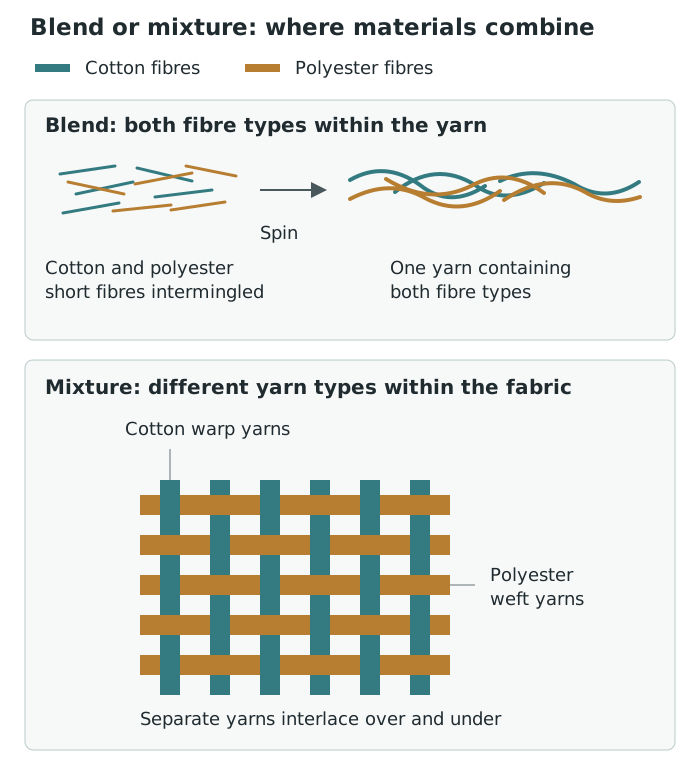
A blend combines fibres within a yarn; a mixture combines different yarn types within a fabric.
Both approaches allow designers to combine useful properties, improve handle or drape, alter colour and texture, reduce cost or make a fabric easier to care for. The aim is not to make every property better simultaneously, but to create a better balance for a particular product.
The specified blends include:
The specified mixtures include cotton and wool, and Lycra with wool, cotton or nylon. Cotton/wool brings cotton’s strength and absorbency together with wool’s elasticity and air-trapping warmth through the fabric’s yarn arrangement. Cotton does not remove wool’s sensitivity to unsuitable washing or chlorine bleach.
Including elastane-containing yarns contributes stretch and recovery. With cotton, this adds elasticity to an absorbent textile; with wool, it increases stretch alongside warmth; with nylon, it combines substantial stretch with strength and abrasion resistance. These combinations are useful where clothing must move with the wearer and return to shape.
The distinction is about where the combination occurs: inside the yarn for a blend, or between yarns in the fabric for a mixture. The proportions and arrangement of the components influence the final balance of properties.
Water: wool repels light rain but absorbs moisture in heavy rain; cotton absorbs readily and dries slowly. Nylon, polyester and elastane absorb little and dry quickly. Low absorbency does not mean waterproofness.
Static: cotton and wool are generally anti-static; nylon and polyester can build up charge and cling.
Flammability: cotton/viscose ignite readily and burn rapidly. Nylon/polyester/acrylic are harder to ignite but can melt and drip. Silk is harder to ignite than cotton; wool generally stops burning when the flame is removed. Blends require testing.
Chemicals and sunlight: acids damage cotton/flax; wool tolerates dilute acids but is sensitive to alkalis; chlorine bleach damages wool/silk. Prolonged sunlight can degrade natural fibres, especially silk. Nylon can yellow and weaken; polyester has better sunlight resistance. Excessive heat can melt nylon, polyester and acrylic.
Distinguish a blend, made by combining fibres during spinning, from a mixture, made using different types of yarn in one fabric.
Silk is the exception to the usual rule that natural fibres are staple fibres. Manufactured fibres can be supplied as continuous filaments or cut into staple lengths.
Link material selection to the product: name a property, explain its benefit and consider a limitation. For example, polyester absorbs little moisture, helping it dry quickly but limiting moisture absorption.
Do not equate low absorbency with waterproofness. Fabric construction and finishes also affect whether water passes through.
Remember the less obvious specified properties: anti-static behaviour and resistance to acid, bleach and sunlight.
Distinguish melting under heat from flammability: a melting point does not tell you how readily a textile ignites or burns.
A blend or mixture balances properties; it does not automatically remove every disadvantage of its component fibres.
It can see this note and what your specification asks for.
Answers are free with an account.
1 free note left this week
Get more free notesYour answer sets when this note comes back for review, or marks it complete.
Was this note helpful?
Log in to tell us whether it helped, or to report a problem.
Last updated
Fibre
A fine strand that forms the raw material of a textile.
Natural fibre
A fibre obtained from a plant or animal, such as cotton or wool.
Manufactured fibre
A fibre produced by an industrial process rather than obtained directly in fibrous form from a plant or animal.
Regenerated fibre
A manufactured fibre made by chemically processing natural cellulose into a new fibre form, such as viscose.
Synthetic fibre
A manufactured fibre made from synthetic polymers, such as polyester or nylon.
Staple fibre
A short fibre that can be spun with other fibres to form a continuous yarn.
Continuous filament
A fibre forming a long, continuous length, rather than a short staple length.
Yarn
A continuous strand of fibres or filaments used to make textile fabrics.
Handle
The way a textile feels when touched and handled, including its softness, smoothness and stiffness.
Textured yarn
A yarn modified to introduce features such as crimps, coils or loops, changing its bulk, handle and performance.
Chenille
A soft, fluffy novelty yarn with short fibres projecting from a central core.
Core-spun yarn
A yarn with a central core surrounded by other fibres; an elastane core provides stretch and recovery.
Fibre blend
A combination of different fibre types within a yarn, produced by bringing the fibres together during spinning.
Fibre mixture
A fabric constructed using yarns of different types, rather than necessarily combining the fibres within each yarn.
Elasticity
The ability of a material to stretch and then recover its original shape when the force is removed.
Absorbency
The ability of a material to take up moisture.
Durability
The ability of a material to resist wear and damage during use.
Insulation
The ability of a material to reduce heat transfer.
Flammability
How readily a material ignites and burns.
Water repellence
Resistance to wetting at a material’s surface; it does not necessarily prevent water passing through a fabric.
Anti-static behaviour
The ability to prevent or reduce a build-up of static electrical charge.
Put your knowledge into practice — try past paper questions for Design and Technology
Fibre
A fine strand that forms the raw material of a textile.
Natural fibre
A fibre obtained from a plant or animal, such as cotton or wool.
Manufactured fibre
A fibre produced by an industrial process rather than obtained directly in fibrous form from a plant or animal.
Regenerated fibre
A manufactured fibre made by chemically processing natural cellulose into a new fibre form, such as viscose.
Synthetic fibre
A manufactured fibre made from synthetic polymers, such as polyester or nylon.
Staple fibre
A short fibre that can be spun with other fibres to form a continuous yarn.
Continuous filament
A fibre forming a long, continuous length, rather than a short staple length.
Yarn
A continuous strand of fibres or filaments used to make textile fabrics.
Handle
The way a textile feels when touched and handled, including its softness, smoothness and stiffness.
Textured yarn
A yarn modified to introduce features such as crimps, coils or loops, changing its bulk, handle and performance.
Chenille
A soft, fluffy novelty yarn with short fibres projecting from a central core.
Core-spun yarn
A yarn with a central core surrounded by other fibres; an elastane core provides stretch and recovery.
Fibre blend
A combination of different fibre types within a yarn, produced by bringing the fibres together during spinning.
Fibre mixture
A fabric constructed using yarns of different types, rather than necessarily combining the fibres within each yarn.
Elasticity
The ability of a material to stretch and then recover its original shape when the force is removed.
Absorbency
The ability of a material to take up moisture.
Durability
The ability of a material to resist wear and damage during use.
Insulation
The ability of a material to reduce heat transfer.
Flammability
How readily a material ignites and burns.
Water repellence
Resistance to wetting at a material’s surface; it does not necessarily prevent water passing through a fabric.
Anti-static behaviour
The ability to prevent or reduce a build-up of static electrical charge.