

Loading…
Loading…
Loading…
Eduqas GCSE Design and Technology · C600
Eduqas C600 · Properties and Ecological Footprint Check the specification (PDF) (opens in a new tab)
A textile is not defined only by its fibres. The way those fibres or yarns are arranged also affects how the fabric stretches, hangs, keeps its shape and withstands use. Woven fabrics use crossing yarns, knitted fabrics use interlocking loops, and non-woven fabrics are made directly from fibres. Existing materials can also be joined into layers to combine useful properties.
Construction works alongside fibre content and finishes. A tightly constructed fabric is generally more stable than a loosely constructed one, so naming a construction method alone does not tell you everything about the finished material.
Weaving interlaces two sets of yarns at right angles. The warp runs along the length of the fabric, while the weft runs across its width. Changing the sequence in which yarns pass over and under one another creates different weaves.
Woven fabrics generally provide more structure than knitted fabrics. This helps products retain a defined shape, but usually gives less freedom to stretch than a looped construction.
Plain weave has a simple alternating over-one, under-one pattern. Each successive row reverses the arrangement. Its frequent interlacings produce a strong, stable fabric, making it useful when a product needs a straightforward, firm construction rather than a highly decorative surface.
Twill weave has interlacings that move along in successive rows, producing visible diagonal lines. It is a strong construction suited to workwear, where resistance to wear matters. Its diagonal appearance also distinguishes it from plain weave.
Satin weave has long floats: sections of yarn passing over several crossing yarns before interlacing again. Warp floats create its characteristic smooth, shiny face. Satin drapes well, making it suitable for flowing or decorative clothing, but the exposed floats can catch and snag. Its attractive surface therefore comes with a durability disadvantage.
Herringbone weave is a variation of twill in which the diagonal direction reverses, creating a zigzag pattern. It provides a patterned surface through construction rather than through printing. A designer might choose it where both a structured fabric and a distinctive appearance are wanted.
Pile weave has an additional yarn forming raised loops or tufts above the base fabric. These may remain as loops or be cut to produce a plush surface, as in velour. The raised surface gives texture and softness. Pile fabrics have a directional nap, so pattern pieces must be cut with the nap running consistently in one direction; otherwise parts of the finished product can appear different shades.
Knitting forms fabric from interlocking loops of yarn. These loops can change shape as the fabric is pulled, allowing stretch. A horizontal row of loops is a course, and a vertical column is a wale.
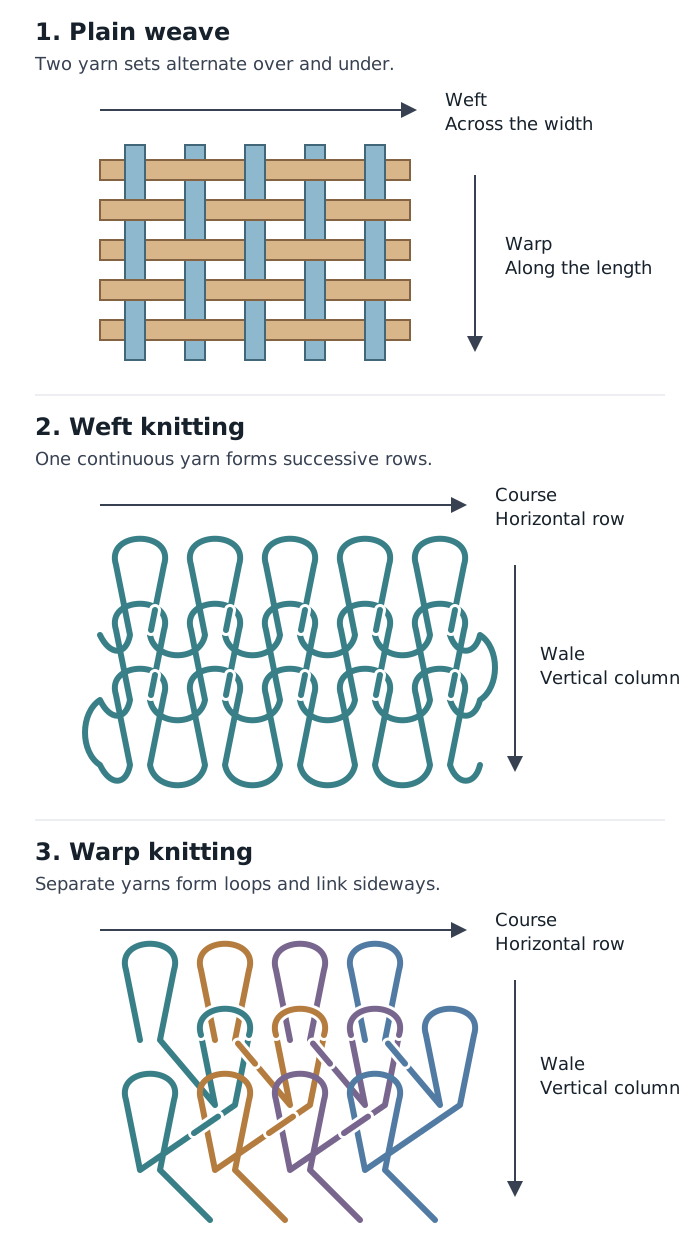
Woven yarns cross at right angles; knitted yarns form interlocking loops. A course runs across a knit and a wale runs along it.
In weft knitting, yarn forms continuous rows of loops across the fabric. Weft knitting can be done by hand or machine and can produce tubular fabric. Single jersey is one example: its front and back have visibly different loop appearances.
Weft-knit fabric stretches readily and drapes softly around the body, making it useful for comfortable clothing that needs to move with the wearer. It does not crease easily, but it can distort or lose shape, especially during washing. A broken or snagged loop can release neighbouring loops, creating a ladder, or run, through the fabric.
The structure traps air and can provide insulation in still conditions. However, moving air can pass through gaps between the loops, reducing its warmth in windy conditions. Polyester fleece is a weft-knitted fabric with an extra yarn knitted into it. Brushing both sides creates a dense, soft nap that traps air, improving insulation.
In warp knitting, many separate yarns form loops along the fabric’s length and link sideways with neighbouring loops. It requires an industrial machine. Compared with weft knit, it is generally firmer and less stretchy, holds its shape better and is difficult to unravel. It does not ladder when cut and lies flat at cut edges.
Warp knitting is faster than weft knitting and cheaper to produce. It is useful when a designer wants some elasticity but better stability than a typical weft knit. The key distinction is not that warp knit has no stretch: it combines stretch with better shape retention.
Non-woven fabrics are made directly from fibres rather than from woven or knitted yarns. A loose sheet of fibres, called a web, can be held together in several ways.
Making fabric directly from fibres generally keeps manufacturing costs low. Non-wovens have no woven grain direction to follow when laying out pieces, which can make them economical to use. They do not fray when cut. However, they are generally weaker and drape less well than woven or knitted fabrics.
These characteristics suit disposable products, filters, liners, insulation and interfacings. An interfacing supports or stiffens part of a garment: here, maintaining a shape can matter more than flowing drape. A non-woven is less suitable where repeated heavy wear and high strength are essential. These are general comparisons; wool felt, for example, can be expensive.
Felting is another way to make a non-woven fabric. Wool fibres have surface scales and a natural ability to mat together. Heat, moisture and mechanical action encourage the fibres to become entangled into a coherent sheet.
Needle felting uses barbed needles to mechanically entangle a web of fibres. Synthetic fibres such as acrylic can be made into needlefelt in this way. The needles repeatedly pass through the web, catching and drawing fibres through it so that the sheet holds together.
Neither method produces the crossing yarns of a weave or the ordered loops of a knit. Felt therefore does not unravel in rows or fray like a yarn-based fabric. Its relatively firm structure can be useful where a sheet needs to retain its form rather than drape softly.
Laminating joins layers of existing materials together. Unlike bonding a loose fibre web, it starts with materials that already have their own structure. The aim is to obtain properties that one layer alone cannot provide.
For all-weather clothing, breathable waterproof membranes such as Gore-Tex and Permatex are bonded to outer fabrics. The membrane system prevents water and wind from penetrating while allowing water vapour from perspiration to escape. This combines weather protection with comfort during activity: waterproofing alone would not address the build-up of moisture from the wearer.
Foam can be bonded to knitted or woven fabrics to improve comfort through cushioning. The fabric supplies a usable surface while the foam adds padding.
Plastic can be bonded to loosely woven cotton to simulate leather. The plastic provides a leather-like surface, while the cotton supports it. This produces an inexpensive alternative when the desired appearance matters but the cost of real leather is unsuitable.
Quilting uses three layers: an outer fabric, polyester wadding in the middle and an inner lining. Stitching passes through all three to hold them securely together.
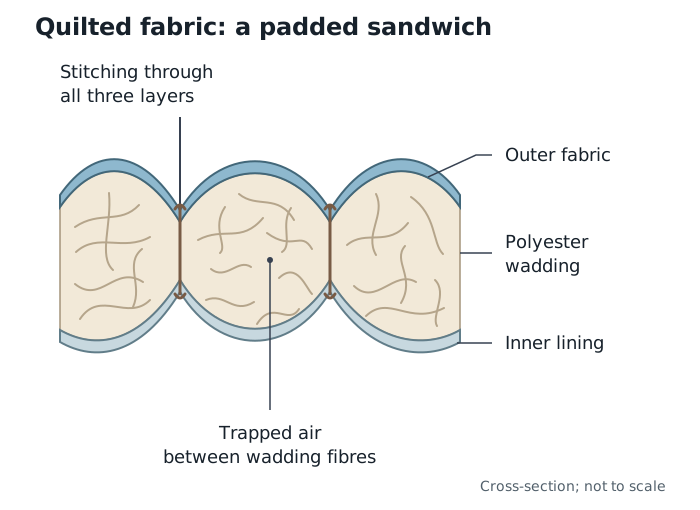
Quilting secures polyester wadding between an outer fabric and a lining. Air trapped in the padded structure provides insulation.
Air becomes trapped between the layers and within the gaps between the wadding fibres, providing insulation. The padding also improves comfort. Quilting can strengthen and protect areas subject to wear, such as knees or elbows, while patterned stitching can create a decorative raised surface.
These properties suit puffer jackets, gilets, quilts and cushions. The choice depends on the product: a jacket may prioritise warmth and comfort, whereas a cushion may also use the stitching pattern for decoration. Quilting supplies padding and insulation; a waterproof membrane laminate supplies weather protection. They solve different problems and should not be treated as interchangeable constructions.
Warp = length; weft = width. Weaving interlaces them at right angles.
| Weave | Recognition and selection |
|---|---|
| Plain | Alternating over–under pattern; strong and stable. |
| Twill | Diagonal lines; strong, suitable for workwear. |
| Satin | Long floats; shiny face and good , but snags easily. |
Link construction to a property and then to the product’s needs: for example, a satin weave has long floats, giving a smooth, shiny surface suitable for decorative clothing, but these floats snag easily.
Keep warp and weft directions distinct: warp runs along the fabric’s length; weft runs across its width.
Distinguish bonding a web of loose fibres from laminating existing fabric layers together.
For quilting, name all three layers: outer fabric, polyester wadding and lining. Explain that trapped air provides insulation.
When selecting a fabric, consider disadvantages as well as advantages. Stretch, warmth or a decorative surface may come with poorer shape retention, wind resistance or snag resistance.
It can see this note and what your specification asks for.
Answers are free with an account.
1 free note left this week
Get more free notesYour answer sets when this note comes back for review, or marks it complete.
Was this note helpful?
Log in to tell us whether it helped, or to report a problem.
Last updated
Weaving
A method of making fabric by interlacing two sets of yarns, warp and weft, at right angles.
Warp
A yarn running along the length of a woven fabric.
Weft
A yarn running across the width of a woven fabric.
Float
A length of yarn that passes over several other yarns without interlacing with each one.
Knitting
A method of making fabric by forming interlocking loops of yarn.
Course
A horizontal row of loops in a knitted fabric.
Wale
A vertical column of loops in a knitted fabric.
Non-woven fabric
Fabric made directly from fibres held together without first weaving or knitting them into yarn-based fabric.
Bonding
The joining of a web of fibres using methods such as adhesive, heat or stitching.
Laminating
The joining of layers of material to combine their properties in one fabric.
Felting
A method of making non-woven fabric by matting or entangling fibres together.
Quilting
Stitching through an outer fabric, a middle layer of wadding and a lining to hold the layers together.
Wadding
A soft, bulky layer of fibres used as padding, especially between the fabric layers of a quilted product.
Drape
The way a fabric hangs and falls into folds.
Nap
A raised surface of fibres with a directional appearance or feel.
Put your knowledge into practice — try past paper questions for Design and Technology
Weaving
A method of making fabric by interlacing two sets of yarns, warp and weft, at right angles.
Warp
A yarn running along the length of a woven fabric.
Weft
A yarn running across the width of a woven fabric.
Float
A length of yarn that passes over several other yarns without interlacing with each one.
Knitting
A method of making fabric by forming interlocking loops of yarn.
Course
A horizontal row of loops in a knitted fabric.
Wale
A vertical column of loops in a knitted fabric.
Non-woven fabric
Fabric made directly from fibres held together without first weaving or knitting them into yarn-based fabric.
Bonding
The joining of a web of fibres using methods such as adhesive, heat or stitching.
Laminating
The joining of layers of material to combine their properties in one fabric.
Felting
A method of making non-woven fabric by matting or entangling fibres together.
Quilting
Stitching through an outer fabric, a middle layer of wadding and a lining to hold the layers together.
Wadding
A soft, bulky layer of fibres used as padding, especially between the fabric layers of a quilted product.
Drape
The way a fabric hangs and falls into folds.
Nap
A raised surface of fibres with a directional appearance or feel.
| Herringbone | Reversing twill diagonals form a zigzag. |
| Pile | Raised loops or cut tufts; soft, textured surface. Cut pieces in a consistent nap direction. |
Course = horizontal row; wale = vertical column.
Made directly from fibres:
Generally economical, no grain and no fraying; usually weaker and poorer drape than woven or knitted fabric. Uses: disposables, interfacings, filters, liners and insulation.
Judge construction + fibre content + tightness + finishes. Connect each advantage or disadvantage to the intended end use.