

Loading…
Loading…
Loading…
Eduqas GCSE Design and Technology · C600
Eduqas C600 · Properties and Ecological Footprint Check the specification (PDF) (opens in a new tab)
A garment’s environmental impact begins before the fabric is made and continues after it is sold. Its ecological footprint includes the land, water, raw materials and energy used, as well as pollution, greenhouse gas emissions and waste. Its social footprint concerns people: the conditions under which workers produce it and the effects on surrounding communities.
These footprints are international. Fibres, fabrics and finished garments can be produced in different countries before reaching the customer. China, Bangladesh and Turkey are major suppliers of textiles to the European Union. Buying clothing in Europe can therefore create demand for water, energy and manufacturing elsewhere; the environmental impacts are not confined to the country where the clothing is worn.
Life-cycle analysis (LCA) evaluates environmental impacts across the whole life of a material or product. This is often described as looking from cradle to grave: from obtaining raw materials to final disposal. Reuse and recycling can extend that life or return materials to production.
For a cotton T-shirt, an LCA considers growing and harvesting cotton, producing yarn and fabric, making the garment, transporting and selling it, washing and caring for it, and what happens when it is no longer wanted. At each stage, designers consider resources used, emissions, pollution and waste. This helps them identify where changes would have the greatest benefit rather than improving one stage while overlooking another.
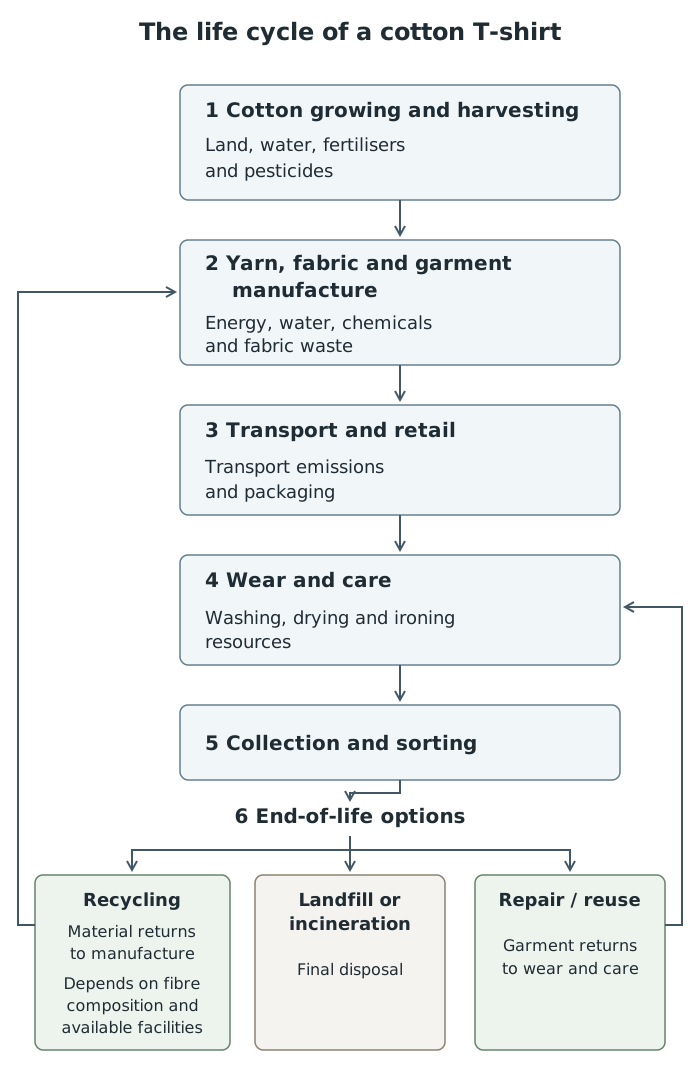
Following a T-shirt through its life reveals impacts at each stage and opportunities to keep products or materials in use.
Cotton is a natural plant fibre. It is renewable, because another crop can be grown, and it is biodegradable. However, growing and harvesting cotton can require substantial water, fertilisers and pesticides. These inputs can affect soil and waterways, while cultivation also occupies land. More efficient irrigation can reduce water use.
Polyester is a manufactured synthetic fibre made using fossil-based chemical feedstocks. Its production uses energy and chemicals, contributing to resource use and greenhouse gas emissions. Unlike cotton, it is not biodegradable.
Neither label alone settles which fibre is the better choice. Cotton’s renewable origin is a benefit, but its cultivation has impacts. Polyester’s production has disadvantages, but its durability and care requirements can offer benefits later in the garment’s life. A fair comparison considers the same intended function and how long each product will actually be used.
Turning fibres into yarn, fabric and finished clothing requires machinery, energy and often water and chemicals. Dyeing and other chemical treatments can produce polluted wastewater. If it is not properly treated, this can contaminate waterways and harm ecosystems and communities that depend on them. Energy use can create greenhouse gas emissions, and cutting fabric generates offcuts. Transport adds emissions, while distribution and retail can create packaging waste.
The textile industry also provides employment, but low production costs must not be achieved at the expense of workers. Socially responsible production includes fair wages, safe working conditions and avoiding exploitation. Workers handling machinery or chemicals need appropriate protection and safe procedures. Designers and manufacturers should consider working conditions throughout the supply chain, not just in the final garment factory.
Environmental and social responsibility are connected: controlling chemical pollution can protect both ecosystems and people. Choosing a lower-impact fibre alone does not guarantee responsible production if processing is polluting or working conditions are unsafe.
Washing, drying and ironing use water, detergents and energy. The impact depends on how frequently the garment is cleaned, its care requirements and how long it lasts.
Polyester garments dry quickly and resist creasing, so they can need less drying energy and ironing. Their durability can extend their useful life. However, washing polyester releases microfibres into wastewater, contributing to microplastic pollution. These are benefits and drawbacks within the same life cycle, not reasons to call polyester simply ‘good’ or ‘bad’.
Designing a garment to be durable and easy to care for can reduce impacts. This only delivers its full benefit if people keep wearing it: a strong garment discarded after a few wears still wastes the resources invested in making it.
When a garment is no longer wanted, it does not necessarily have to become waste. A wearable item can be passed on, sold second-hand or donated for reuse. Repairing a seam can keep the whole garment useful. Repurposing changes its use, such as turning worn clothing into cleaning cloths.
Recycling is different: it processes the textile material for use in another product. Separate collection and sorting are important because recycling options depend on the textile’s condition and composition. Mixed fibres can be complex and expensive to recycle, and suitable facilities may not be available.
If textiles enter general waste, they may be landfilled or incinerated. Biodegradability is a useful property, but it does not make throwing away usable clothing harmless: the resources and pollution involved in production have already occurred.
Changing society’s view of waste means treating unwanted textiles as products or materials that may still have value. Buying fewer unnecessary items, repairing, swapping and using collection schemes can support this change. Recycling matters, but keeping an existing garment in use should usually come first.
Sustainable textile design links decisions across the life cycle. A designer can reduce production waste, avoid hazardous chemicals, choose durable materials, make repairs easier and consider how materials will be separated for recycling.
For example, a school uniform should withstand repeated wear and washing. Strong seams and repairable construction can help it last and be passed on. An easy-care fabric may reduce ironing, but its fibre composition may make recycling more difficult. The designer should weigh these advantages and limitations rather than selecting a fabric on one property alone.
A justified decision explains which impacts matter most for the intended product and how the chosen design reduces them. LCA supports that decision; responsible sourcing adds consideration of the people involved. Together, design choices and changes in purchasing, care and disposal can help people live in a greener world.
Follow raw materials → manufacture → transport and retail → use and care → reuse, recycling or disposal.
Identify major impacts, compare alternatives serving the same purpose and choose changes that reduce harm across the whole life cycle.
Link each impact to a stage and a cause: for example, cotton cultivation uses pesticides, which can pollute soil and waterways.
Do not assume that natural fibres are always more sustainable. Consider cultivation, processing, care, durability and disposal together.
Distinguish reuse from recycling: passing on a garment keeps the product in use; recycling processes its material.
When evaluating a design choice, give its benefit, any limitation and a justified judgement linked to the product’s intended use.
A recyclable garment is not necessarily recycled: collection, material separation and suitable facilities must also be available.
It can see this note and what your specification asks for.
Answers are free with an account.
1 free note left this week
Get more free notesYour answer sets when this note comes back for review, or marks it complete.
Was this note helpful?
Log in to tell us whether it helped, or to report a problem.
Last updated
Ecological footprint
The effects of producing, using and disposing of a material or product on the environment, including resource use, pollution, emissions and waste.
Social footprint
The effects of producing, using and disposing of a material or product on people, including workers’ pay, safety and the wellbeing of communities.
Life-cycle analysis
A method of evaluating a material’s or product’s environmental impacts throughout its life, from obtaining raw materials through manufacture and use to reuse, recycling or disposal.
Reuse
Using a product again without processing it back into raw material, such as passing a wearable garment to another person.
Recycling
Processing waste materials so that they can be used to make new materials or products.
Biodegradable
Able to be broken down by microorganisms. How quickly this happens depends on the material and the disposal conditions.
Sustainable design
Designing products to reduce environmental harm through choices about materials, production, useful life, maintenance and end-of-life options.
Microfibre
Very small strands shed from textiles, including during washing. Those released from synthetic fibres such as polyester contribute to microplastic pollution.
Put your knowledge into practice — try past paper questions for Design and Technology
Ecological footprint
The effects of producing, using and disposing of a material or product on the environment, including resource use, pollution, emissions and waste.
Social footprint
The effects of producing, using and disposing of a material or product on people, including workers’ pay, safety and the wellbeing of communities.
Life-cycle analysis
A method of evaluating a material’s or product’s environmental impacts throughout its life, from obtaining raw materials through manufacture and use to reuse, recycling or disposal.
Reuse
Using a product again without processing it back into raw material, such as passing a wearable garment to another person.
Recycling
Processing waste materials so that they can be used to make new materials or products.
Biodegradable
Able to be broken down by microorganisms. How quickly this happens depends on the material and the disposal conditions.
Sustainable design
Designing products to reduce environmental harm through choices about materials, production, useful life, maintenance and end-of-life options.
Microfibre
Very small strands shed from textiles, including during washing. Those released from synthetic fibres such as polyester contribute to microplastic pollution.
Prioritise longer use: buy less, design for durability, repair and reuse. Reduce manufacturing waste and harmful chemicals; consider care requirements and recyclability.
Reuse keeps the product; recycling processes the material. Mixed fibres can complicate recycling. Collection and suitable facilities are essential. Judge a textile across its whole life, not simply by whether it is natural or synthetic.