

Loading…
Loading…
Loading…
Eduqas GCSE Design and Technology · C600
Eduqas C600 · Factors Influencing Textile Selection Check the specification (PDF) (opens in a new tab)
A fabric’s fibres and construction give it its starting properties, but these may not meet every requirement of a product. A fabric finish is a treatment that changes its appearance, performance or durability. A decorative fabric might need a glossy surface; a wool garment might need protection against shrinking; an outdoor jacket needs protection from the weather.
Finishes have three main purposes: enhancing aesthetic qualities—how the fabric looks and feels—protecting or prolonging its life, and improving its function. These purposes overlap. A stain-resistant finish keeps a fabric looking good while also helping it remain usable for longer.
Mechanical finishes use physical action, such as rollers or brushes. Chemical finishes use substances applied to the fabric to change its properties. Some processes combine both: glazing uses rollers alongside resins or stiffeners.
Colouring and surface decoration change a fabric’s appearance through dyeing, printing or painting. Dyeing gives colour to the textile, while printing and painting can create surface designs. The choice depends on whether the designer wants colour across the fabric or a particular decorative pattern.
Lustre means surface sheen or shine. Calendering increases lustre by passing fabric through rollers which smooth and flatten the fibres. A smoother surface gives a more lustrous appearance, making this useful where a polished finish is wanted.
Embossing uses a similar roller process, but the rollers impress a design onto the fabric rather than simply smoothing it. This gives surface decoration without relying only on colour. A related calendered finish is the moiré effect: a wavy, watered appearance that can be produced on silk.
Glazing is similar to calendering, but resins or stiffeners are added to make the finish more permanent. Stiffening makes fabric firmer and less floppy, which is useful when retaining shape matters more than a soft, flowing appearance. These choices therefore affect both appearance and how the fabric behaves.
Mercerising is a chemical rather than mechanical way of increasing lustre. The treatment causes changes in the fibres, including swelling and shrinking, leaving a smoother, more lustrous fabric. It is used on natural fibres, such as cotton. Calendering and mercerising can achieve a similar visual aim, but by different processes.
Brushing exposes fabric to wire brushes that raise fibres from its surface. The raised fibres create a fluffy appearance and improve insulation. This makes brushing useful when both a soft-looking surface and warmth are wanted, rather than the smooth shine produced by calendering.
Stain resistance is a chemical finish that helps prevent stains from permanently discolouring and spoiling fabric. Named examples are Scotchguard and Teflon finishes. For a frequently used furnishing fabric, this can help preserve appearance and extend useful life. It does not remove the need to clean the product.
A flame-retardant finish makes fabric less likely to ignite or reduces how quickly it burns. Proban is a named treatment used for this purpose. Slowing burning can provide valuable time to escape a fire, so the benefit is protection rather than decoration. Flame retardancy does not mean that a textile can never burn.
Moth proofing is a chemical treatment that repels moths and their larvae and prevents feeding damage to wool fibres. It helps protect wool products against holes and deterioration, preserving both their appearance and useful life.
The appropriate treatment depends on the risk. Moth proofing addresses damage to wool; flame retardancy addresses fire risk. Neither is a general substitute for the other.
Crease resistance uses resin to reduce creasing. The fabric needs less ironing, making it easier to care for. This is useful where maintaining a neat appearance with limited maintenance is important.
Shrink resistance uses chlorine treatment, particularly for wool. Wool fibres have surface scales which can lock together and cause the fabric to shrink. The treatment prevents this locking action, helping the product retain its size. Shrink resistance and crease resistance solve different problems: one protects dimensions, while the other reduces wrinkles.
An anti-static finish reduces the build-up of electrostatic charge caused by friction. This charge can make fabric cling to the body. Reducing it improves comfort and helps the garment hang more naturally.
Showerproofing repels light exposure to moisture. Treatments using PVA, PVC or wax can make fabric moisture resistant. This can be suitable for brief, light showers, but showerproofing should not be treated as full protection against prolonged rain.
Wax illustrates why durability matters when selecting a finish. It gives water repellency, but rubbing and cleaning can remove it, so its protection can decline with use.
Waterproofing prevents liquid water penetrating the fabric under its intended conditions of use. Silicones are used in water-protection treatments, but their form matters. A sprayed silicone finish gives surface water repellency, encouraging water to bead and run off rather than wet the fibres. This sprayed finish is not permanent and needs maintenance; it does not necessarily form a waterproof barrier against water penetration.
Fabric can also be coated with PVC, neoprene, silicone rubber or polyurethane. A coating adds a protective layer to the textile. A continuous, non-porous coating—including a silicone-rubber barrier coating—forms a barrier to liquid water, which can be useful for products such as outdoor covers. However, a solid non-porous coating also blocks air and water vapour. That limitation matters much more in clothing than in a cover: perspiration can become trapped inside a garment.
The same material can be used in different forms of treatment. A light moisture-resistant treatment and a continuous coating should therefore not be assumed to provide identical performance.
A person moving in a waterproof jacket produces perspiration. Breathability means that water vapour can pass out through the fabric; it does not mean that rain can pass in.
A breathable barrier membrane can be laminated, or bonded, to an outer or inner shell fabric. The shell is the fabric layer, while the membrane provides the barrier. Together they can make a textile waterproof yet breathable: liquid water is kept out while water vapour from perspiration can escape.
Membranes may use a microporous structure or a hydrophilic film that transfers moisture through the layer. The bonding method must preserve this vapour movement rather than seal it off with a completely impermeable adhesive layer.
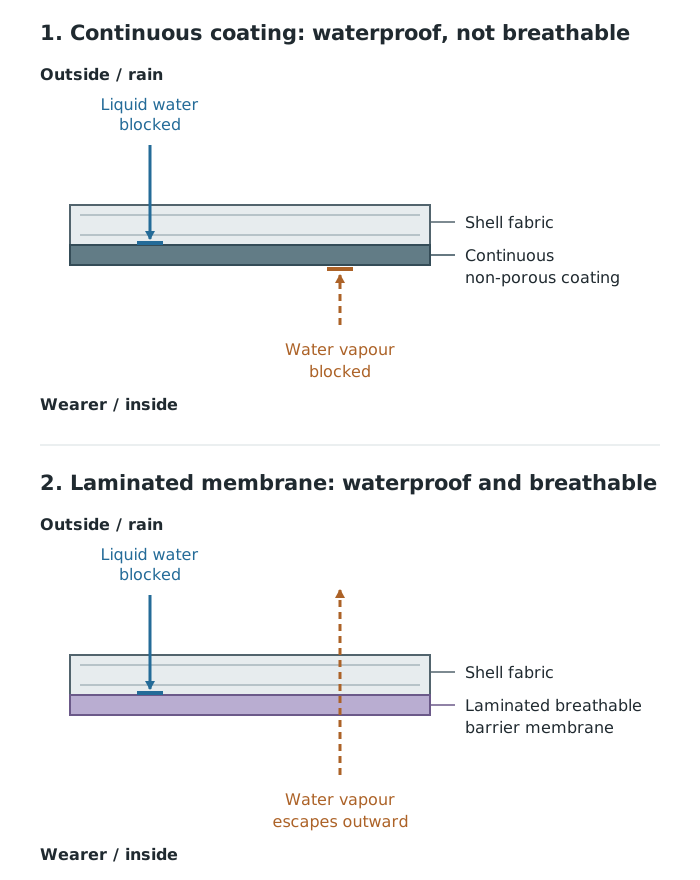
Both constructions can keep liquid water out. A breathable barrier membrane also allows water vapour from perspiration to escape.
This distinction explains why a breathable membrane is valuable for active outdoor clothing. A solid waterproof coating may keep rain out, but a waterproof, breathable construction also addresses moisture produced by the wearer.
Windproof materials can be made using a very close weave construction. Closely packed yarns reduce the gaps through which air can pass. This is a construction choice rather than simply an added chemical finish. Windproofing concerns air movement; waterproofing concerns liquid water, so one property does not automatically guarantee the other.
A designer should choose finishes by connecting the product’s needs to the properties each process changes. For example, a glossy decorative fabric could use calendering or glazing, whereas a warm fabric could benefit from brushing. A wool garment might need moth proofing and shrink resistance. An active outdoor jacket needs more than a shiny surface or a showerproof treatment: rain protection, vapour escape and wind resistance may all matter.
The best choice is not necessarily the fabric with the most finishes. It is the combination that meets the intended use, remains effective through wear and care, and avoids unnecessary treatments.
Link each finish to a particular product need: name the process, explain the property it changes and show why that matters.
Keep the chemical–purpose pairs clear: resin for crease resistance and chlorine treatment for shrink resistance. For silicones, distinguish a water-repellent spray from a continuous waterproof silicone-rubber coating.
Distinguish showerproof, waterproof, breathable and windproof. These describe different properties, not interchangeable levels of protection.
Flame-retardant does not mean completely fireproof, and a waterproof fabric is not automatically breathable.
Remember that one finish can serve more than one purpose: brushing improves appearance and insulation; stain resistance protects appearance and fabric life.
It can see this note and what your specification asks for.
Answers are free with an account.
1 free note left this week
Get more free notesYour answer sets when this note comes back for review, or marks it complete.
Was this note helpful?
Log in to tell us whether it helped, or to report a problem.
Last updated
Fabric finish
A treatment applied to a textile fabric to change its appearance, performance or durability.
Mechanical finish
A treatment that changes fabric through physical action, such as rolling or brushing.
Chemical finish
A treatment that uses chemicals to change a fabric’s properties.
Lustre
The sheen or shine of a fabric’s surface as it reflects light.
Calendering
A mechanical finishing process in which fabric passes through rollers that smooth and flatten its surface, increasing lustre.
Embossing
A finishing process using patterned rollers to impress a design onto fabric.
Moiré effect
A wavy, watered appearance produced on fabric, such as silk, by calendering.
Mercerising
A chemical treatment of natural fibres that produces a smoother, more lustrous fabric.
Flame-retardant finish
A chemical treatment that reduces how readily a fabric ignites or how quickly it burns.
Showerproofing
The ability of a fabric to repel light exposure to moisture, rather than provide full protection against water penetration.
Waterproofing
The ability of a textile to prevent liquid water from penetrating it under its intended conditions of use.
Breathability
The ability of a fabric to allow water vapour from perspiration to pass through it.
Breathable barrier membrane
A thin protective layer that can be bonded to fabric to block liquid water while allowing water vapour to pass through.
Lamination
Bonding layers together, for example attaching a barrier membrane to a textile shell.
Windproofing
The ability of a textile to resist air passing through it, helping protect the wearer against wind.
Put your knowledge into practice — try past paper questions for Design and Technology
Fabric finish
A treatment applied to a textile fabric to change its appearance, performance or durability.
Mechanical finish
A treatment that changes fabric through physical action, such as rolling or brushing.
Chemical finish
A treatment that uses chemicals to change a fabric’s properties.
Lustre
The sheen or shine of a fabric’s surface as it reflects light.
Calendering
A mechanical finishing process in which fabric passes through rollers that smooth and flatten its surface, increasing lustre.
Embossing
A finishing process using patterned rollers to impress a design onto fabric.
Moiré effect
A wavy, watered appearance produced on fabric, such as silk, by calendering.
Mercerising
A chemical treatment of natural fibres that produces a smoother, more lustrous fabric.
Flame-retardant finish
A chemical treatment that reduces how readily a fabric ignites or how quickly it burns.
Showerproofing
The ability of a fabric to repel light exposure to moisture, rather than provide full protection against water penetration.
Waterproofing
The ability of a textile to prevent liquid water from penetrating it under its intended conditions of use.
Breathability
The ability of a fabric to allow water vapour from perspiration to pass through it.
Breathable barrier membrane
A thin protective layer that can be bonded to fabric to block liquid water while allowing water vapour to pass through.
Lamination
Bonding layers together, for example attaching a barrier membrane to a textile shell.
Windproofing
The ability of a textile to resist air passing through it, helping protect the wearer against wind.
Match the finish to the product’s appearance, protection, comfort and care needs. Check whether its benefit will last through use and cleaning.