

Loading…
Loading…
Loading…
Eduqas GCSE Design and Technology · C600
Eduqas C600 · Factors Influencing Textile Selection Check the specification (PDF) (opens in a new tab)
A textile product may be attractive, functional and inexpensive, yet still cause harm during its manufacture or disposal. Responsible design considers both people and the environment throughout the product’s life: obtaining fibres, processing fabric, making the product, using it and dealing with it afterwards.
Designers influence these effects through their choices of materials, components and construction. Manufacturers influence them through sourcing, factory conditions and production processes. Responsibility therefore extends along the supply chain, rather than stopping at the business that sells the finished product.
Textile production can provide employment and income in lower-income countries. Lower labour costs can also reduce manufacturing costs and make products more affordable. However, a low price is not sufficient justification for poor treatment of employees.
Poverty can make workers dependent on available employment and less able to refuse unfair conditions. Exploitation means taking unfair advantage of that vulnerability. Designers and manufacturers should consider whether employees receive fair pay, work reasonable hours and have safe working conditions, rather than judging a supplier only by its price.
A legal minimum wage is the lowest permitted rate of pay. A living wage is pay sufficient to meet the basic needs of workers and their families within a normal working week. The two are not necessarily equal: legally paid employment can still leave a family unable to afford essentials.
A 2008 trade union case study described Juana Suarez Mendez, a jeans factory worker near San Pedro Sula in Honduras. Her basic wage covered a 44-hour week; with bonuses, she earned about US$63 a week, while food for her family alone cost about US$70. High production targets led her to shorten lunch breaks, stay late and sometimes work on Saturday mornings without overtime pay to meet them. The factory did not pay sick leave, and missing a single day meant losing the attendance bonus for the whole week. This shows how low wages, demanding targets and insecure income can reinforce poverty: workers need extra earnings but have little financial protection if they become ill.
Limited alternatives also weaken workers’ bargaining position. Research conducted in India in 2012–13 surveyed 432 garment workers. More than four in five said they could not move to better jobs because they lacked skills or there were no other jobs. Four-fifths reported working more hours or days than agreed when recruited; overtime was often involuntary and sometimes unpaid. These findings concern the surveyed workplaces, not every factory in India.
The same research also found benefits: about nine in ten workers said wages were always or most often paid regularly and on time, and most were registered for social security schemes. Overseas textile employment is therefore not automatically unethical. The responsibility is to preserve valuable employment while preventing exploitation, rather than treating low costs as proof either of good value or of abuse.
Responsible sourcing involves knowing where production takes place and requiring fair labour standards throughout the supply chain. Transparency makes it easier to identify who is responsible for working conditions. Manufacturers should provide clear employment terms, reasonable hours, properly paid overtime, safe workplaces and respectful treatment.
Safety must be checked in practice. More than 1,000 garment workers died in the Rana Plaza building collapse in Bangladesh in 2013. Binding safety agreements such as the Accord provide for independent factory safety inspections. Selecting suppliers on price alone is inadequate when workers’ lives depend on safe premises and effective oversight.
Workers also need a voice. Collective bargaining allows trade unions to negotiate pay and conditions with employers. Respecting workers’ right to organise helps them challenge unfair treatment together, rather than leaving each individual to risk losing an essential income.
Brands and manufacturers must consider their own buying practices. Demanding very low supplier prices can make adequate pay harder to fund, while urgent orders can put pressure on working hours. Responsible purchasing should allow suppliers enough money and time to meet labour standards, with checks that those standards are actually followed. A written promise to pay fairly is not the same as employees receiving fair pay.
These decisions involve competing pressures. Better working conditions may increase costs, but protecting employees is a responsibility, not simply an optional feature of a premium product. A justified decision should consider affordability alongside the welfare of the people making the textile.
Textile manufacture uses resources and can pollute air, water and soil. Its effects begin before fabric reaches a factory. Cotton cultivation, for example, uses land and water, and agricultural chemicals can degrade soil and pollute waterways. Synthetic fibres can release microfibres that contribute to microplastic pollution. Production and transport also contribute to greenhouse gas emissions.
A designer should therefore compare the effects of obtaining and processing a material as well as its performance in use. A natural fibre is not automatically harmless, and a renewable resource still needs responsible management. Safer chemistry, reduced microfibre release and responsible sourcing can reduce harm while maintaining the function of the product.
A linear system takes resources, makes products and discards them. A circular economy aims instead to keep products and materials useful for longer. This reduces the need to grow or extract replacement materials and reduces the impacts of production and disposal.
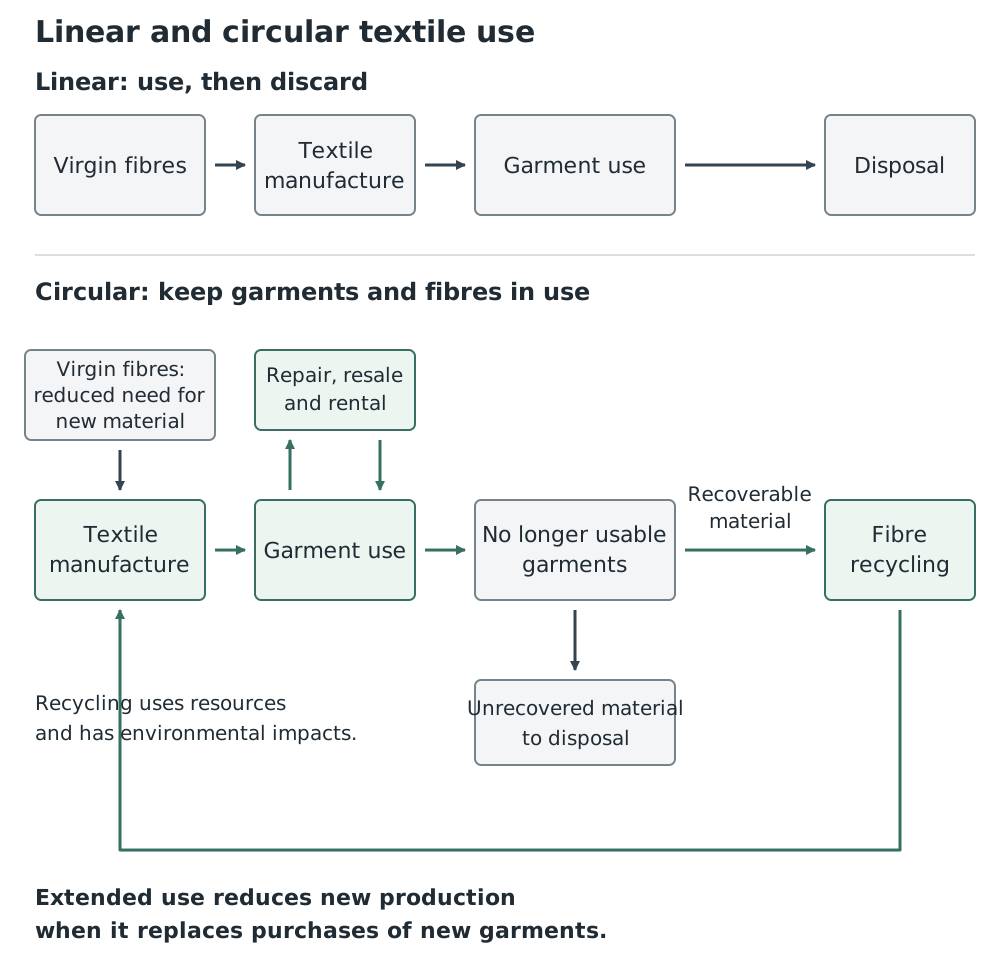
Garments leave use when no longer usable; recoverable material then flows to fibre recycling and back into manufacture. Keeping garments and fibres in use can reduce demand for new materials.
Designing a garment to resist wear, be cleaned and be repaired helps extend its useful life. It must also remain desirable: a garment that is physically sound but no longer wanted may still be discarded. Resale and rental can give products further use, but their environmental benefit depends on replacing purchases of new garments rather than simply adding more consumption.
When a product can no longer be used, recycling can recover its material value. Recyclability must be considered during design, not only when the product becomes waste. Material and component choices should make recovery practical.
For example, Napapijri’s Circular Series jackets use one material, Nylon 6, for the fabric, filling and trimmings. This simplified material choice supports recyclability while providing a durable, functional jacket. Blended textiles need not be impossible to recycle, but they may require specialist separation: the Green Machine, developed by HKRITA and the H&M Foundation, separates cotton and polyester blends for recycling into new fibres.
Biodiversity is the variety of living organisms and ecosystems. Textile production can damage it through habitat degradation, excessive resource use, pollution and climate change. For example, land used for fibre production can place pressure on natural habitats, while contaminated waterways can harm living organisms.
The relationship works in both directions. Cotton, wool and wood-derived fibres such as viscose depend on agricultural or forestry systems. Healthy, biodiverse systems support soil fertility, organism health and water availability, and are more resilient to floods and droughts. Protecting biodiversity therefore helps protect future material supplies as well as nature.
Designers and manufacturers can reduce this pressure by keeping clothes and fibres in use, choosing safer chemistry and reducing microfibre release. Sourcing renewable materials produced in regenerative ways can also help restore soil health and biodiversity, rather than merely reducing further damage.
Consider a jacket that needs to be durable, affordable and recyclable. A single-material design may simplify recycling, but it must still provide the required protection and comfort. Repairable construction can extend its life, while responsible sourcing must address the conditions of the workers making it.
The strongest choice is not necessarily the cheapest material or the one labelled ‘natural’. It is a choice justified by the product’s function, likely useful life, practical recovery route, environmental effects and treatment of employees. Environmental improvements do not cancel out exploitation, just as fair working conditions do not remove responsibility for waste.
Link each responsibility to a decision and its consequence: for example, choosing an easily recyclable material can reduce demand for virgin fibres.
Low labour costs do not automatically prove exploitation. Consider pay, hours, safety and treatment of employees.
Distinguish reuse from recycling: reuse keeps a product in service; recycling processes its materials into new products.
When assessing a choice, weigh cost and performance against environmental and social effects, then justify your conclusion.
Do not assume that natural fibres are always environmentally preferable: growing them can require land, water and agricultural chemicals.
Distinguish a legal minimum wage from a living wage: meeting the legal minimum does not necessarily mean that workers can afford their basic needs.
It can see this note and what your specification asks for.
Answers are free with an account.
1 free note left this week
Get more free notesYour answer sets when this note comes back for review, or marks it complete.
Was this note helpful?
Log in to tell us whether it helped, or to report a problem.
Last updated
Responsible textile manufacture
Designing and producing textiles with regard for workers’ welfare, environmental effects and the responsible use of resources.
Employee exploitation
Taking unfair advantage of workers, for example through inadequate pay, unsafe conditions or unreasonable demands.
Supply chain
The connected businesses and stages involved in obtaining raw materials, processing them, making a product and supplying it to customers.
Living wage
Pay sufficient for workers and their families to meet basic needs within a normal working week.
Minimum wage
The lowest rate of pay that an employer is legally permitted to pay an eligible worker.
Collective bargaining
Negotiation between employers and workers’ representatives, usually trade unions, over pay and working conditions.
Biodiversity
The variety of living organisms, including variation within species, between species and among ecosystems.
Circular economy
An approach that reduces waste and pollution by keeping products and materials in use and supporting the regeneration of natural systems.
Recyclability
The extent to which a product’s materials can be recovered and processed into usable materials for new products.
Virgin material
A newly grown or extracted material that has not previously been used in a product.
Microfibre
A very small fibre released from a textile. Synthetic microfibres contribute to microplastic pollution.
Put your knowledge into practice — try past paper questions for Design and Technology
Responsible textile manufacture
Designing and producing textiles with regard for workers’ welfare, environmental effects and the responsible use of resources.
Employee exploitation
Taking unfair advantage of workers, for example through inadequate pay, unsafe conditions or unreasonable demands.
Supply chain
The connected businesses and stages involved in obtaining raw materials, processing them, making a product and supplying it to customers.
Living wage
Pay sufficient for workers and their families to meet basic needs within a normal working week.
Minimum wage
The lowest rate of pay that an employer is legally permitted to pay an eligible worker.
Collective bargaining
Negotiation between employers and workers’ representatives, usually trade unions, over pay and working conditions.
Biodiversity
The variety of living organisms, including variation within species, between species and among ecosystems.
Circular economy
An approach that reduces waste and pollution by keeping products and materials in use and supporting the regeneration of natural systems.
Recyclability
The extent to which a product’s materials can be recovered and processed into usable materials for new products.
Virgin material
A newly grown or extracted material that has not previously been used in a product.
Microfibre
A very small fibre released from a textile. Synthetic microfibres contribute to microplastic pollution.
Balance function, cost and useful life against workers’ welfare, resource use, pollution, waste and biodiversity. Explain why the chosen option is preferable, including its limitations.