

Loading…
Loading…
Loading…
Eduqas GCSE Design and Technology · C600
Eduqas C600 · Properties and Ecological Footprint Check the specification (PDF) (opens in a new tab)
Paper and board are made from fibres. Wood is an important source, while used paper supplies fibres for recycled products. Before a sheet can be formed, these fibres must be separated into pulp. A papermill then turns a watery mixture of pulp into a continuous sheet.
For wood pulp, logs are first debarked because the bark is unsuitable for papermaking. The stripped wood is chipped into small pieces. The chips can then follow either a mechanical or a chemical pulping route.
Mechanical pulping grinds the woodchips to separate their fibres. This pulp is used for high-volume printing products such as newsprint and magazine paper.
Chemical pulping cooks the woodchips with chemicals to remove lignin, the substance that binds the wood fibres together. The key distinction is therefore the way the fibres are released: physical grinding in mechanical pulping, or removal of lignin in chemical pulping. Burning by-products from chemical pulping can supply energy for the process.
The separated fibres are washed and screened to remove unwanted material. Prepared pulp can be used directly or bleached where a white paper is required.
Recycled paper also needs to be reduced to pulp. Used paper is mixed with water and broken apart to separate its component fibres. This is repulping, rather than starting again with woodchips.
Printing ink and adhesives need to be removed. De-inking can use flotation to separate these unwanted materials from the pulp. The recovered fibres then enter the sheet-making process. Recycling changes the source and preparation of the fibres, but it does not remove the need to form, press and dry the new sheet.
The pulp is diluted with a large amount of water so that the fibres can spread across the machine. Each stage removes more water or improves the sheet’s surface:
The moving sheet is called a web. Notice the difference between pressing and drying: pressing squeezes out water mechanically, whereas heated cylinders dry the sheet using heat.
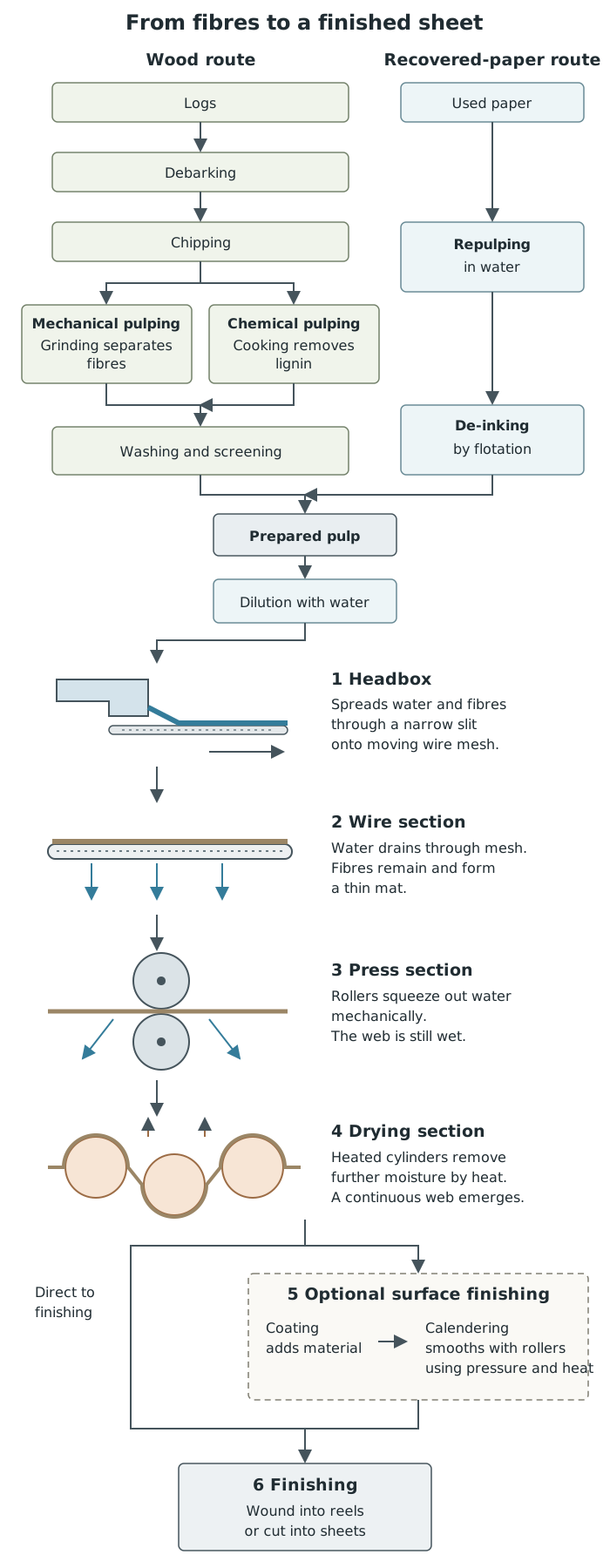
Wood fibres and recovered paper fibres enter the same sheet-making process after preparation. Water is removed progressively by drainage, pressing and heated drying.
Hand papermaking uses separated fibres and water too, but individual sheets are formed using a small frame rather than a continuous moving machine.
Soaked waste paper can be broken down by beating small handfuls with a pestle and mortar. A bucket and a stout piece of wood can serve the same purpose. Continue until there are no recognisable pieces of newspaper. To check the pulp, shake a small sample with water in a closed, clear jar: remaining lumps show that more pulping is needed.
A liquidiser breaks down the soaked paper more quickly. Process small batches with cold water, using short bursts rather than running the machine continuously. The aim is separated fibres in water, not a mixture containing pieces of intact paper.
Use a liquidiser only with teacher supervision and according to its operating instructions. Fit the lid before switching it on, keep hands away from the blades and disconnect the power before clearing or cleaning it. Keep the electrical base and plug dry, and wipe up water spills promptly. When beating pulp by hand, keep the container stable and fingers clear of the pestle.
The mould is a flat frame with tightly stretched mesh across it. The deckle is a matching frame without mesh, placed on top to define the edges of the paper. For an A4 sheet, the frame’s internal dimensions are 29.7 cm by 21.0 cm. The mesh provides a surface to hold the fibres while water can pass through it, applying the same drainage principle as the wire section of a papermill.
The frames should lie flat and have smooth, sanded edges. Any fixings must be secure; drawing pins used to attach mesh should be on the sides, not the working face.
After moulding, smooth couching felts support the wet pulp during pressing. Their surface matters: a textured cloth or one with small holes can spoil the paper’s appearance. Cloths measuring 34 cm by 25 cm provide a margin around an A4 sheet.
A simple hand press uses two boards with the supported sheets between them, held together by bolts and wing nuts. The boards distribute pressure across the sheets. Keep fingers clear as the boards are brought together. As in commercial manufacture, pressing removes water by squeezing; it is not the same operation as drying.
The wet fibres cannot initially support themselves as a sheet. The mesh holds them during drainage, then a felt supports them during pressing and the early stages of drying.
Use a stable work surface and wipe up spills throughout. Air-drying avoids the hazards of heating wet work and reduces the risk of curled edges. Wash the vat, mould and buckets after each batch so that dried pulp does not spoil the next sheets.
Hand and machine papermaking share the same underlying sequence: form the fibre layer, drain, press and dry. The difference is that the hand process makes and transfers one sheet at a time, while the papermill produces a continuous web.
A finish can be aesthetic, changing the appearance or feel, or functional, changing how the material performs. A finish may do both.
At the papermill, a coating containing pigments, binding agents and other additives can be spread over the paper to improve its printing properties. Calendering passes the sheet between rollers, using pressure and heat to give it a smoother, glossier surface. Coating adds material; calendering compresses and smooths the sheet.
Other finishes are chosen for the final product:
| Finish | What it does | Typical application |
|---|---|---|
| Varnishing | Adds a glossy surface; selected areas can be varnished to stand out | A logo or brand name on packaging |
| UV varnishing | Produces a high-gloss finish | Business cards and other marketing materials |
| Edge staining | Applies dye to the edges | Decorative book edges |
| Embossing | Stamps raised shapes or patterns into the surface | Greetings cards, invitations and perfume boxes |
| Laminating | Adds another layer, changing properties such as thickness, strength or resistance to liquids | Food containers, drinks cartons and bookbinding |
| Wax coating | Helps resist the absorption of moisture | The inside of food packaging |
A board’s stiffness alone cannot prevent a liquid from soaking into it. Food and drink packaging must combine suitable structure with an appropriate barrier finish.
Physical properties describe what a material is like. Working properties describe how it behaves when processed, for example when folded. Material selection means matching these properties to the product’s needs, rather than choosing the strongest or thickest material for every job.
| Property | Meaning and design significance |
|---|---|
| Texture | How rough or smooth the surface feels. Textured cartridge paper suits art materials, while smooth paper suits printing. |
| Weight | Sheet weight is expressed in grams per square metre, or gsm. It describes mass for a given area, not the total mass of every sheet regardless of size. |
| Thickness | The distance between the two faces of the sheet. Board thickness is measured in microns; 1,000 microns equals 1 mm. |
| Strength | The ability to withstand forces without failing. Packaging must withstand handling and protect its contents. |
| Surface finish | The surface’s appearance and condition, such as glossy, matt, coated or uncoated. It affects both presentation and use. |
| Transparency | How much can be seen through the material. Translucent paper allows an underlying drawing to be seen; opaque paper hides it. |
Weight and thickness are related, but they are not interchangeable measurements. Likewise, strength and rigidity are different: a material may resist tearing yet still bend readily.
Tracing paper, typically 40–90 gsm, is translucent, smooth, strong and non-absorbent. Its translucency makes it useful for copying drawings and working with overlays.
Layout paper, around 50 gsm, is smooth, translucent and inexpensive. It suits sketching and developing design ideas where many sheets may be used.
Copier paper, commonly 80 gsm, has a smooth, opaque, clean white surface. It is uncoated and suitable for printing and photocopying.
Cartridge paper, typically 80–140 gsm, has a thicker, textured, creamy off-white surface. It works with paints, watercolours, pastels and inks. For an art task, this surface may be more useful than the smooth white finish chosen for a printed document.
Corrugated cardboard, with a representative thickness of 3,000 microns, combines strength with low weight. Its wavy, fluted structure provides rigidity, making it useful for packaging. Different thicknesses are available. Untreated corrugated cardboard is not water-resistant, so it is not automatically suitable for wet conditions.
Mounting board, around 1,400 microns thick, is rigid and smooth. It suits picture mounts, architectural scale models and concept models where a stable surface and shape are important.
Folding boxboard, approximately 300–1,699 microns thick, is stiff and normally made from recycled paper. It scores and folds well without splitting, making it useful for supermarket food cartons. Scored crease lines allow a flat blank to fold into its intended shape.
These choices involve trade-offs. Rigidity is helpful for a display model, but a carton also needs controlled folding. Corrugated cardboard offers lightweight structural packaging, but a food container may additionally need a coating or laminate to resist absorption. A justified choice connects the material, its properties and any finish to the actual use.
Link a material property to the product’s needs: ‘folding boxboard folds without splitting, so it is suitable for a carton’ is stronger than simply calling it suitable.
Distinguish gsm, which measures mass per unit area, from microns, which measure thickness. A higher gsm does not automatically mean a thicker sheet.
Mechanical pulping separates fibres by grinding; chemical pulping cooks woodchips to remove lignin. Both routes still require sheet formation, pressing and drying.
Distinguish a surface treatment from the material underneath: a liquid container needs a suitable barrier finish, not just stiff board.
For hand papermaking, distinguish the mesh-covered mould from the deckle: the mould supports the fibres, while the deckle is the open frame placed above it.
It can see this note and what your specification asks for.
Answers are free with an account.
1 free note left this week
Get more free notesYour answer sets when this note comes back for review, or marks it complete.
Was this note helpful?
Log in to tell us whether it helped, or to report a problem.
Last updated
Pulp
A mixture of separated plant fibres used to make paper and board.
Lignin
A substance in wood that binds fibres together; chemical pulping removes it to release the fibres.
Mechanical pulping
Separating wood fibres by grinding woodchips.
Chemical pulping
Cooking woodchips with chemicals to remove lignin and separate the fibres.
De-inking
Removing printing ink from recycled paper pulp, for example by flotation.
Mould
A frame covered with tightly stretched mesh, used to support the fibres when forming a sheet of handmade paper.
Deckle
An open frame placed on top of a papermaking mould to define the sheet’s edges.
Couching felt
A smooth cloth that supports a wet handmade paper sheet after moulding and during pressing.
Couching
Transferring a wet handmade paper sheet from its mould onto a supporting felt.
Post
A stack of alternating wet handmade paper sheets and couching felts, ready for pressing.
Gsm
Grams per square metre: the mass of one square metre of a sheet material.
Micron
A unit of length used to measure board thickness: one micron equals .
Calendering
Passing paper between rollers that apply pressure and heat to produce a smoother, glossier surface.
Laminating
Bonding an additional layer to paper, card or board to change its properties.
Embossing
Creating raised patterns or shapes in a material, usually by stamping.
Absorbency
The ability of a material to take up a liquid.
Put your knowledge into practice — try past paper questions for Design and Technology
Pulp
A mixture of separated plant fibres used to make paper and board.
Lignin
A substance in wood that binds fibres together; chemical pulping removes it to release the fibres.
Mechanical pulping
Separating wood fibres by grinding woodchips.
Chemical pulping
Cooking woodchips with chemicals to remove lignin and separate the fibres.
De-inking
Removing printing ink from recycled paper pulp, for example by flotation.
Mould
A frame covered with tightly stretched mesh, used to support the fibres when forming a sheet of handmade paper.
Deckle
An open frame placed on top of a papermaking mould to define the sheet’s edges.
Couching felt
A smooth cloth that supports a wet handmade paper sheet after moulding and during pressing.
Couching
Transferring a wet handmade paper sheet from its mould onto a supporting felt.
Post
A stack of alternating wet handmade paper sheets and couching felts, ready for pressing.
Gsm
Grams per square metre: the mass of one square metre of a sheet material.
Micron
A unit of length used to measure board thickness: one micron equals .
Calendering
Passing paper between rollers that apply pressure and heat to produce a smoother, glossier surface.
Laminating
Bonding an additional layer to paper, card or board to change its properties.
Embossing
Creating raised patterns or shapes in a material, usually by stamping.
Absorbency
The ability of a material to take up a liquid.
| Folding ability | How readily a sheet bends into a fold without splitting. This is important for cartons made from flat blanks. |
| Absorbency | How readily a material takes up liquid. It matters when applying wet art materials or containing food and drink. |
Headbox → wire mesh → press rollers → heated drying cylinders → optional coating/calendering → reels or sheets.
Prepare lump-free pulp → dilute and stir in a vat → dip mould and deckle → lift, gently shake and drain → remove deckle → couch onto felt → build a post → press → dry and flatten.
Recall: texture, weight, thickness, strength, surface finish, transparency, folding ability and absorbency.