

Loading…
Loading…
Loading…
Eduqas GCSE Design and Technology · C600
Eduqas C600 · Properties and Ecological Footprint Check the specification (PDF) (opens in a new tab)
A paper bag or cardboard box has impacts before anyone uses it and after it is discarded. Its ecological footprint includes the resources used, pollution, greenhouse gas emissions and waste produced throughout its life. Its social footprint concerns effects on people, such as the working conditions of those who supply the raw materials and manufacture the product.
These footprints are connected. Responsible sourcing can help protect forests while also supporting safer working conditions. A low-cost sheet of board is not necessarily a responsible choice if its production causes avoidable environmental harm or exposes workers to unsafe conditions.
New paper fibres come from wood pulp. Using more new pulp increases demand for timber, so the way forests are managed matters. Poorly managed sourcing can damage habitats. Choosing wood from sustainably managed forests helps address this concern; Forest Stewardship Council (FSC) certification is one way of identifying responsibly sourced forest materials.
Manufacturing paper and board uses resources and energy. The chemicals involved in production also need responsible handling to minimise environmental harm and protect workers. Designers should therefore consider both where a material comes from and how it is processed, rather than judging it only by its appearance.
Greenhouse gases, including carbon dioxide, trap heat in the atmosphere and contribute to global warming. Burning fossil fuels to supply manufacturing energy or power delivery vehicles produces emissions. Transporting raw materials, delivering finished products and collecting waste all contribute to a product’s carbon footprint. Energy efficiency, renewable energy and fewer delivery journeys can reduce these impacts.
Carbon footprint is only one part of environmental impact: a lower-carbon choice still needs to be considered alongside resource use, pollution and waste.
Life-cycle analysis (LCA) examines environmental impacts from obtaining raw materials to dealing with a product after use. This is often called a ‘cradle-to-grave’ approach. It helps designers identify where improvements will make a meaningful difference, rather than merely moving a problem from one stage to another.
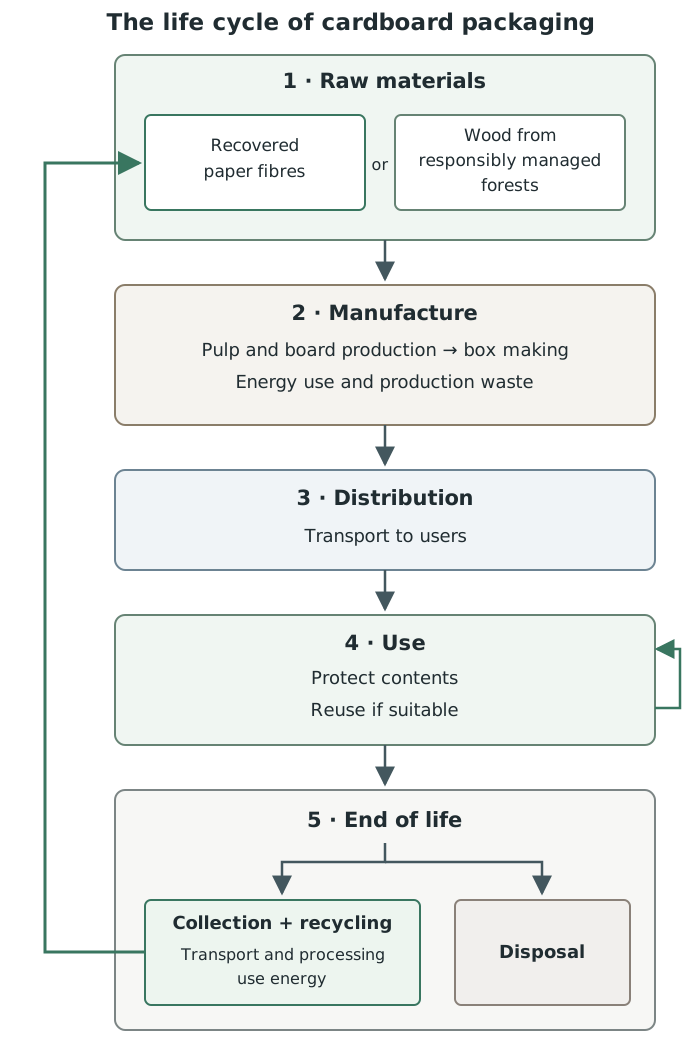
Life-cycle analysis follows a box beyond manufacture. Recycling can return material to production, while reuse extends the use stage.
For a cardboard box, consider:
Compare designs that perform the same job. A lighter box uses less material, but if it fails to protect its contents, replacing damaged products could outweigh that saving. Similarly, reusable packaging only delivers the benefit of repeated use if people actually use it again.
A real carbon study of one candidate’s two GCSE English language examinations in 2022 found that travel to the examinations and energy used at the venue together accounted for about 81% of emissions. Printing still mattered, but it was not the largest contributor. This shows why the boundaries of an assessment matter: examining paper production alone gives a different picture from examining the whole activity that uses the paper.
Packaging uses materials and energy and creates waste, so unnecessary layers should be avoided. However, packaging can protect goods during handling and transport and provide information. Removing it without considering these functions may increase damage and waste.
Suppose a designer is developing a board box for a fragile product. An extra decorative outer sleeve may add little useful protection and could be removed. The protective box itself may still be justified because it prevents damage. The aim is enough packaging to perform the necessary functions, without avoidable excess.
A justified decision weighs both sides: what resources does the packaging consume, and what loss or waste does it prevent? There is no single answer for every product.
Treating packaging as something to discard immediately encourages a throwaway approach. Treating used materials as resources encourages reuse and recycling. Reusing a sound cardboard box avoids making another box for that job; recycling discarded paper provides fibres for new products and reduces demand for new raw materials.
Recycling still requires collection, transport and processing. It is therefore valuable, but it does not make unnecessary consumption harmless. Reducing waste in the first place and reusing suitable products can avoid some of these activities.
Designers, manufacturers and users all influence what happens. Designers can select recyclable materials and provide clear disposal information. Manufacturers can reduce production waste and use recycled fibres. Accessible collection systems help people recycle paper, board and other accepted materials correctly. Consumers can avoid excess packaging, reuse boxes and follow local collection guidance.
Sustainable design builds these decisions into a product from the start. For paper and board products, useful choices include responsibly sourced or recycled fibres, fewer unnecessary components, efficient use of material, lower-energy production and designs that can be reused or recycled.
For example, exam boards have reduced paper use by minimising blank pages and avoiding reprints through better quality control. They have also used recycled packaging materials and combined deliveries to reduce journeys. These are practical improvements at different life-cycle stages.
The best proposal explains how it meets the user’s needs, reduces harm and remains workable. ‘Use less board’ is incomplete; ‘remove the decorative sleeve while retaining the protective box’ connects sustainability to the product’s function.
Raw materials → manufacture → distribution → use → end of life.
Compare options that perform the same function. Consider the whole life cycle, not just one improvement.
Reduce unnecessary material and waste; use responsibly sourced or recycled fibres; improve energy efficiency; reduce delivery journeys; design for reuse and .
Link a design decision to its effect: using recycled fibres reduces demand for new wood pulp, rather than simply saying it is ‘greener’.
For a packaging evaluation, weigh the resources used by the packaging against the waste it prevents, then give a conclusion suited to the product.
Distinguish recycled content from recyclability: one describes the material used to make a product; the other describes what can happen after use.
Consider the whole life cycle. Reducing one impact does not prove that a design has the lowest overall impact.
It can see this note and what your specification asks for.
Answers are free with an account.
1 free note left this week
Get more free notesYour answer sets when this note comes back for review, or marks it complete.
Was this note helpful?
Log in to tell us whether it helped, or to report a problem.
Last updated
Ecological footprint
The effects that a material or product has on the environment across its life cycle, including resource use, pollution, waste and greenhouse gas emissions.
Social footprint
The effects that producing, using and disposing of a material or product have on people, including working conditions and community wellbeing.
Greenhouse gas
A gas that traps heat in the atmosphere and contributes to global warming, such as carbon dioxide.
Carbon footprint
The total greenhouse gas emissions associated with an activity or product, commonly expressed as carbon dioxide equivalent (CO₂e).
Life-cycle analysis
An assessment of environmental impacts throughout a material or product’s life, from obtaining raw materials through manufacture, distribution and use to end-of-life treatment.
Recycling
Processing discarded materials into materials for new products.
Reuse
Using a product or material again without first processing it into a new material.
Sustainable design
Designing to meet people’s needs while reducing environmental harm and resource use, and considering effects on people throughout the product’s life.
Put your knowledge into practice — try past paper questions for Design and Technology
Ecological footprint
The effects that a material or product has on the environment across its life cycle, including resource use, pollution, waste and greenhouse gas emissions.
Social footprint
The effects that producing, using and disposing of a material or product have on people, including working conditions and community wellbeing.
Greenhouse gas
A gas that traps heat in the atmosphere and contributes to global warming, such as carbon dioxide.
Carbon footprint
The total greenhouse gas emissions associated with an activity or product, commonly expressed as carbon dioxide equivalent (CO₂e).
Life-cycle analysis
An assessment of environmental impacts throughout a material or product’s life, from obtaining raw materials through manufacture, distribution and use to end-of-life treatment.
Recycling
Processing discarded materials into materials for new products.
Reuse
Using a product or material again without first processing it into a new material.
Sustainable design
Designing to meet people’s needs while reducing environmental harm and resource use, and considering effects on people throughout the product’s life.
Reuse keeps a product in use. Recycling processes its material into new material. Both depend on what users and collection systems actually do.