

Loading…
Loading…
Loading…
Eduqas GCSE Design and Technology · C600
Eduqas C600 · Material Properties and Applications Check the specification (PDF) (opens in a new tab)
A polymer is a material made from very large molecules containing many repeating units. Familiar plastics are polymers, but polymers also occur naturally: wool, silk, cellulose and proteins are examples. Synthetic polymers are manufactured through chemical processes, commonly using raw materials obtained from crude oil.
The source of a polymer and its behaviour when heated are two different ways of describing it. Natural or synthetic tells you about its origin; thermoforming or thermosetting tells you whether its shape can be changed again after it has been formed.
Thermoforming polymers, also called thermoplastics, soften when heated. They can then be shaped and allowed to cool, when they harden and retain their new shape. Heating and cooling can be repeated without the permanent chemical change associated with setting a thermoset. This makes thermoplastics suitable for recycling by melting and remoulding.
A thermosetting polymer sets permanently during a process called curing. Depending on the material, curing may involve heat or mixing a resin with a hardener. The material undergoes a chemical change and cannot then be softened and remoulded like a thermoplastic. Excessive reheating damages it rather than making it ready to reshape. Thermosets therefore cannot be recycled by melting and remoulding.
Heat resistance does not mean that a polymer remains unaffected at every temperature. For example, polypropylene has useful heat resistance in service but is still a thermoplastic that can be softened for forming.
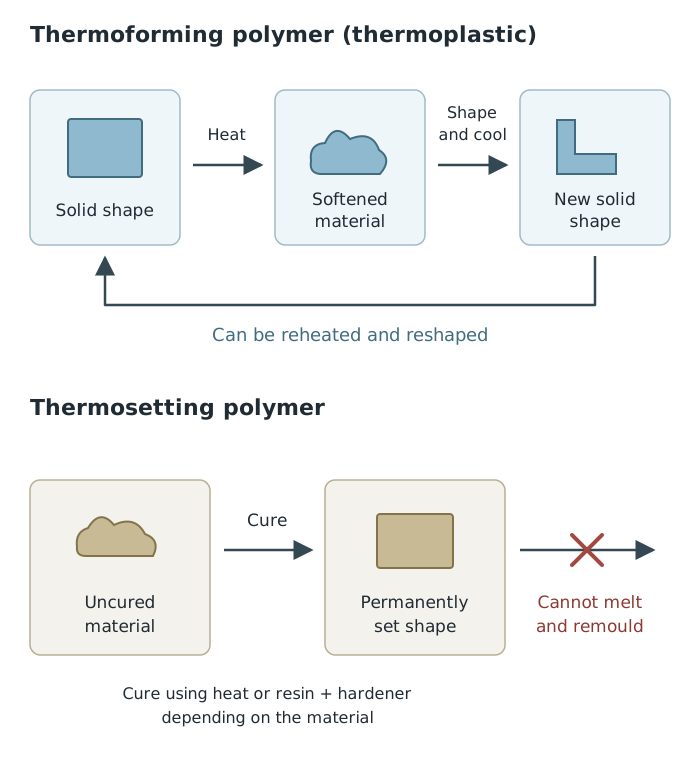
Thermoplastics can repeat the heating–shaping–cooling cycle. Thermosets set permanently during curing.
A designer needs more than the label ‘plastic’. Different polymers suit different loads, temperatures and surroundings.
Stiffness is also useful when comparing polymers: it describes resistance to bending or changing shape under a load. It is not the same as strength. Chemical resistance, weather resistance, surface appearance and cost can also affect the final choice.
The following polymers can all be reheated and reshaped, but they do not have identical properties.
| Thermoplastic | Important properties | Applications and reasons |
|---|---|---|
| Polythene, including high-density polythene (HDPE) | HDPE is lightweight, stiff and chemically resistant. It shapes readily when heated and has good toughness and durability. | Buckets, bottles, pipes and washing-up bowls benefit from low weight, durability and resistance to chemicals. |
| Polystyrene (PS) | Inexpensive; available as sheet or foam, and in opaque colours or transparent forms. Sheet material can be shaped when heated. | Used for school vacuum-forming work because heated sheet can be formed over a mould. High-impact polystyrene is a tougher form used for products such as fridge linings. |
| Polypropylene (PP) | Lightweight, strong and tough, with good heat and chemical resistance. | Patio chairs need strength without excessive weight; children's toys need toughness. PP is also used for computer game cases and food-wrapping film. |
| Polyvinyl chloride (PVC) | Low-cost, strong, chemically resistant and weather-resistant. Available in rigid or flexible forms, with glossy or matt finishes. | Rigid PVC is used for window and door frames, guttering and building cladding because these products must withstand outdoor conditions. Flexible PVC is used for electrical cable insulation. |
Notice that a polymer name does not always imply one fixed level of flexibility. PVC can be supplied in rigid and flexible forms. Likewise, the properties of HDPE should not automatically be assumed to describe every form of polythene.
Thermosets are useful where a product needs a permanently set shape, a durable surface or resistance to heat. Their individual properties still need to match the application.
| Thermosetting polymer | Important properties | Applications and reasons |
|---|---|---|
| Urea formaldehyde (UF) | Hard and stiff, with excellent electrical insulation. | Switches, plugs and electrical fittings need a rigid material that restricts the passage of electric current. |
| Melamine formaldehyde (MF) | Resists heat, moisture, scratching and staining. | Tableware and the surface layer of kitchen-worktop laminates need to withstand hot items, spills and repeated use. |
| Polyester resin (PR) | Hard and rigid when cured, with good chemical resistance. Can be combined with fibres to improve strength. | Used in sheet moulding compound and glass-fibre-reinforced plastic, including boat hulls and car body panels. The resin and reinforcement work together to form the composite. |
| Epoxy resin (ER) | Produces a very strong adhesive bond, with good chemical and heat resistance and thermal insulation. Supplied as resin and hardener, which are mixed before curing. |
For epoxy resin, mixing the two parts starts the permanent setting process. It is not simply a liquid thermoplastic that will become liquid again on reheating.
Polymers are sold as sheet, film, bar, rod and tube. These describe the supplied shape, not a different polymer family.
Sheet is a flat form suitable for cutting or forming; film is very thin and suits wrapping. Bar is solid stock, commonly with a square or rectangular cross-section; rod is solid stock with a circular cross-section; tube is hollow. For example, polystyrene sheet can be chosen for vacuum forming, while polypropylene film can be chosen for food wrapping.
A useful material choice brings together the polymer, its properties and its stock form. For a kitchen-worktop surface, MF's resistance to heat, moisture, scratching and staining gives several relevant reasons for choosing it. For a bucket, lightweight, tough and chemically resistant HDPE is a better match. Neither material is universally ‘best’: each suits a different set of requirements.
| Polymer | Property → use |
|---|---|
| Polythene / HDPE | Lightweight, stiff, tough, chemically resistant → buckets, bottles, pipes |
| PS | Inexpensive, available as sheet or foam; heat-formable sheet → vacuum forming |
| PP | Lightweight, strong, tough, heat- and chemical-resistant → chairs, toys, cases, wrapping film |
| PVC | Rigid or flexible; strong, weather- and chemical-resistant → frames, guttering, cable insulation |
Justify a material choice by linking a named property to a product requirement: UF is an electrical insulator, so it is suitable for electrical fittings.
Do not confuse hardness with toughness: resisting scratches is different from resisting impact without breaking.
Thermoforming describes behaviour when heated, not flexibility at room temperature. A thermoplastic can be rigid.
Explain that thermosets cannot be recycled by melting and remoulding; do not suggest that reheating reverses their permanent setting.
Learn the full names behind PP, PVC, UF, MF, PR and ER.
It can see this note and what your specification asks for.
Answers are free with an account.
1 free note left this week
Get more free notesYour answer sets when this note comes back for review, or marks it complete.
Was this note helpful?
Log in to tell us whether it helped, or to report a problem.
Last updated
Polymer
A material made from very large molecules containing many repeating units. Polymers can come from natural or synthetic resources.
Thermoforming polymer
A polymer that softens when heated and hardens when cooled, allowing it to be reheated and reshaped. Also called a thermoplastic.
Thermosetting polymer
A polymer that sets permanently during curing and cannot subsequently be melted and remoulded.
Curing
The chemical process in which a resin sets permanently, often through heating or mixing it with a hardener.
Hardness
Resistance to scratching, indentation and surface wear.
Elasticity
The ability to return to an original shape after a deforming force is removed.
Toughness
The ability to withstand impact and absorb energy without breaking.
Strength
The ability to withstand an applied force without failing.
Conductivity
The ability of a material to transfer heat or carry an electric current.
Insulation
Resistance to the transfer of heat or the passage of electric current. Thermal insulation and electrical insulation are distinct properties.
Stock form
The standard shape in which a material is supplied, such as sheet, film, bar, rod or tube.
Put your knowledge into practice — try past paper questions for Design and Technology
Polymer
A material made from very large molecules containing many repeating units. Polymers can come from natural or synthetic resources.
Thermoforming polymer
A polymer that softens when heated and hardens when cooled, allowing it to be reheated and reshaped. Also called a thermoplastic.
Thermosetting polymer
A polymer that sets permanently during curing and cannot subsequently be melted and remoulded.
Curing
The chemical process in which a resin sets permanently, often through heating or mixing it with a hardener.
Hardness
Resistance to scratching, indentation and surface wear.
Elasticity
The ability to return to an original shape after a deforming force is removed.
Toughness
The ability to withstand impact and absorb energy without breaking.
Strength
The ability to withstand an applied force without failing.
Conductivity
The ability of a material to transfer heat or carry an electric current.
Insulation
Resistance to the transfer of heat or the passage of electric current. Thermal insulation and electrical insulation are distinct properties.
Stock form
The standard shape in which a material is supplied, such as sheet, film, bar, rod or tube.
| Used as an adhesive where a strong, durable bond is needed, and as a resin in fibre-reinforced composites. |
| Polymer | Property → use |
|---|---|
| UF: urea formaldehyde | Hard, stiff, electrical insulator → switches, plugs, electrical fittings |
| MF: melamine formaldehyde | Heat-, moisture-, scratch- and stain-resistant → worktop laminates, tableware |
| PR: polyester resin | Hard, rigid, chemically resistant; combines with fibres → reinforced mouldings, boat hulls |
| ER: epoxy resin | Strong adhesive; heat- and chemical-resistant; resin + hardener → bonding, reinforced composites |
Compare weight, hardness, elasticity, conductivity/insulation, toughness and strength against the product's needs.
Stock forms: sheet, film, bar, rod, tube. Choose both a suitable polymer and a suitable supplied form.