

Loading…
Loading…
Loading…
Eduqas GCSE Design and Technology · C600
Eduqas C600 · Material Properties and Applications Check the specification (PDF) (opens in a new tab)
Choosing a metal involves more than deciding whether it looks attractive. A designer must consider how it will behave in use, how easily it can be shaped and whether its surface needs protection.
Ferrous metals contain iron. Cast iron, mild steel, medium carbon steel and high carbon steel are all ferrous. These common examples are magnetic and prone to rusting, so protection is often important.
Non-ferrous metals do not contain iron. Aluminium, copper, brass and bronze belong to this group. They do not rust, because rust is an iron corrosion product, but this does not mean their surfaces never deteriorate or change colour.
An alloy is a metal combined with one or more other elements, metal or non-metal, to give it different properties or a different look. Alloy is not a third category separate from ferrous and non-ferrous: an alloy can be either. Steel is a ferrous alloy containing iron and carbon, whereas brass is a non-ferrous alloy of copper and zinc.
A metal’s working properties affect how it can be shaped and joined during manufacture. Its properties also determine how well the finished product performs.
Hardness is resistance to scratching, indentation and wear. It matters for a tool edge or a moving component whose surface must resist abrasion. Toughness is resistance to fracturing under forces or impacts. A metal can be hard but brittle: resisting surface wear does not necessarily mean it can survive a knock.
Tensile strength describes resistance to pulling forces. This differs from compressive strength, which concerns pushing or crushing forces. The direction of loading therefore matters when selecting a metal.
Elasticity is the ability to recover the original shape after a force is removed, as long as the elastic limit has not been exceeded. This is different from permanently shaping a metal. Malleability allows a metal to be bent, pressed or hammered into shape without cracking; ductility allows it to be drawn into wire or stretched without fracturing.
Conductivity concerns the movement of heat or electricity through a material. Thermal conductivity is useful in a saucepan; electrical conductivity is useful in wiring. A designer must identify which type the product needs.
Cast iron can be cast into a mould and has high compressive strength. It is useful for manhole covers, drains and the bodies of vices. However, it is brittle, particularly in thin sections, and has poor corrosion resistance. Its ability to withstand compression should not be mistaken for an ability to bend without breaking.
Mild steel, also called low carbon steel, is tough and ductile. It is relatively easy to shape, braze and weld, making it useful for bicycle frames, car parts, nuts, bolts and screws. Its weakness is that it corrodes readily unless protected.
Medium carbon steel offers a balance of strength, ductility and wear resistance. It is used for components such as shafts, axles and gears, where the material must withstand loads and repeated movement. It can be heat-treated to improve its mechanical properties.
High carbon steel, often called tool steel, is hard but comparatively brittle and less malleable than mild steel. It is used for tools such as screwdrivers and chisels, where resistance to wear is important. It is less suitable when a component needs extensive bending or shaping.
These steels illustrate a design trade-off: gaining hardness and wear resistance can mean sacrificing ease of shaping. The best choice depends on the job, not on finding a metal that is simply ‘strongest’.
Aluminium is lightweight, malleable and a good conductor of heat and electricity. Its low weight and ease of shaping suit drinks cans; its thermal conductivity suits saucepans. It is also used for cycle frames, where reducing weight is valuable.
Copper is very malleable and an excellent conductor of heat and electricity. It is useful for plumbing and central-heating pipes, which must be shaped and transfer heat effectively. Polished copper is orange-brown, but its surface can oxidise and become green. This is not rusting.
Brass is a copper–zinc alloy. It is strong, ductile and works well when cast. Its workability and durability suit taps, door handles, hinges, locks and musical instruments. Its golden colour also provides aesthetic appeal, although it darkens with age.
Bronze is a copper-based alloy that is hard and corrosion-resistant. Its low friction makes it useful for bearings, where parts move against one another. Its corrosion resistance also suits outdoor monuments and marine components. It is generally darker and more reddish-brown than copper.
Alloying can also improve ferrous metals. For example, stainless steel contains iron but has good resistance to corrosion, making it useful for sinks and cutlery. Containing iron does not mean that every alloy rusts equally readily.
Metals are supplied in standard forms so that manufacturers can choose a starting shape close to the finished component.
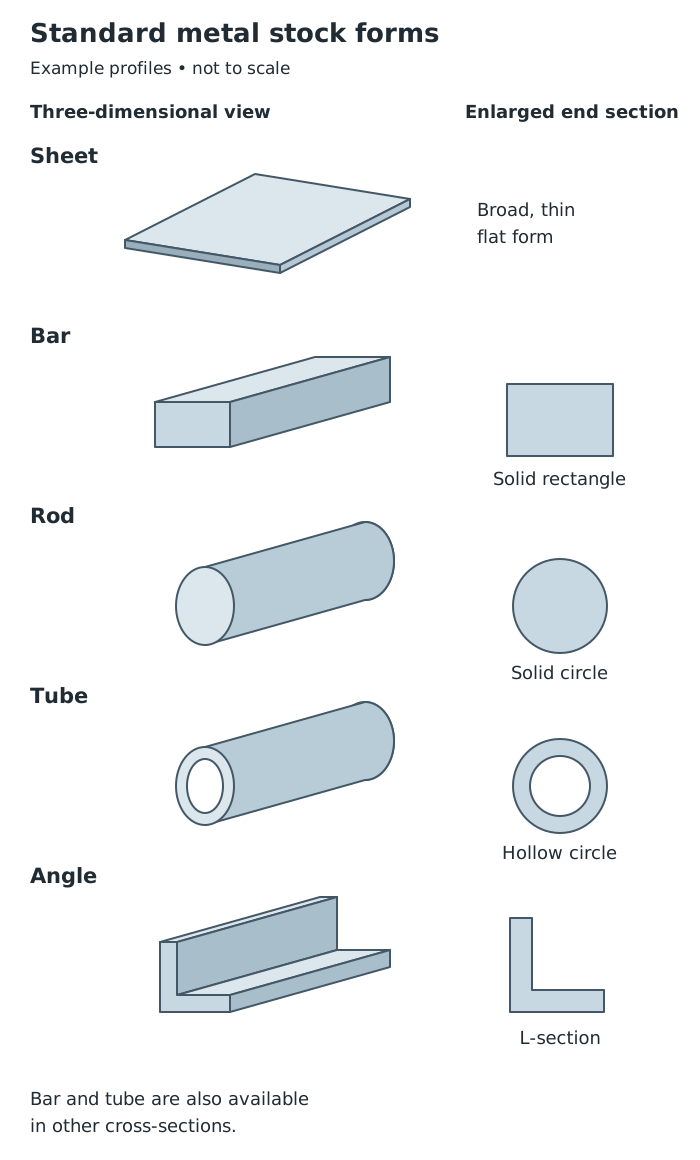
The end cross-section helps distinguish solid bar and rod, hollow tube and L-shaped angle.
A rod and a tube may look similar from the side, but looking at their ends reveals the difference: the rod is solid and the tube is hollow. Choosing a suitable stock form can reduce the amount of material that must be removed or reshaped.
A finish changes a metal’s surface for protection, appearance or both. Rust-prone ferrous metals may need a coating that separates the surface from its surroundings. For example, powder coating can provide a coloured protective surface on a steel product.
Non-ferrous metals may also need finishing. They do not rust, but protection may still be needed against other corrosion or unwanted changes in appearance. Anodising is a finish used on aluminium, while electroplating coats a metal with another metal.
Other finishing methods include brushing and buff polishing, which alter the surface appearance. A polished surface can improve aesthetic appeal, but polishing alone should not be assumed to provide lasting corrosion protection.
The finish must therefore suit both the material and its environment. An outdoor steel component needs protection as well as an attractive appearance; a decorative metal fitting may need a finish that preserves its colour or surface quality.
| Metal | Key properties | Typical uses |
|---|---|---|
| Cast iron | Strong in compression; brittle; castable | Manhole covers, vices |
| Mild steel | Tough, ductile, easy to shape and weld | Frames, nuts and bolts |
| Medium carbon steel | Strength, wear resistance and some ductility | Shafts, axles, gears |
| High carbon steel | Hard; brittle; less malleable | Screwdrivers, chisels |
| Aluminium | Lightweight, malleable, conductive |
Justify a material choice by linking a named property to the product’s needs: ‘Copper conducts heat well, so it is suitable for central-heating pipes.’
Do not confuse hardness with toughness: a hard metal can still be brittle.
Brass and bronze are both non-ferrous metals and alloys. These categories overlap.
Non-ferrous metals do not rust, but they can still corrode or change appearance.
Treat mild, medium carbon and high carbon steel as separate materials, not one interchangeable type.
It can see this note and what your specification asks for.
Answers are free with an account.
1 free note left this week
Get more free notesYour answer sets when this note comes back for review, or marks it complete.
Was this note helpful?
Log in to tell us whether it helped, or to report a problem.
Last updated
Ferrous metal
A metal containing iron, such as cast iron or mild steel.
Non-ferrous metal
A metal that does not contain iron, such as aluminium or copper.
Alloy
A metal combined with one or more other elements, metal or non-metal, to give it different properties or a different look.
Hardness
Resistance to scratching, indentation and wear caused by friction or abrasion.
Elasticity
The ability to return to the original size and shape after a force is removed, provided the elastic limit has not been exceeded.
Conductivity
The ability of a material to allow heat or electricity to pass through it.
Toughness
The ability to withstand forces or impacts without fracturing.
Ductility
The ability to be drawn into wire or stretched without fracturing.
Tensile strength
The ability to withstand pulling forces without breaking.
Malleability
The ability to be bent, pressed or hammered into shape without cracking.
Corrosion
The deterioration of a material through chemical reactions with its surroundings. Rusting is a type of corrosion affecting iron.
Stock form
A standard shape in which a material is supplied before it is made into a product.
Put your knowledge into practice — try past paper questions for Design and Technology
Ferrous metal
A metal containing iron, such as cast iron or mild steel.
Non-ferrous metal
A metal that does not contain iron, such as aluminium or copper.
Alloy
A metal combined with one or more other elements, metal or non-metal, to give it different properties or a different look.
Hardness
Resistance to scratching, indentation and wear caused by friction or abrasion.
Elasticity
The ability to return to the original size and shape after a force is removed, provided the elastic limit has not been exceeded.
Conductivity
The ability of a material to allow heat or electricity to pass through it.
Toughness
The ability to withstand forces or impacts without fracturing.
Ductility
The ability to be drawn into wire or stretched without fracturing.
Tensile strength
The ability to withstand pulling forces without breaking.
Malleability
The ability to be bent, pressed or hammered into shape without cracking.
Corrosion
The deterioration of a material through chemical reactions with its surroundings. Rusting is a type of corrosion affecting iron.
Stock form
A standard shape in which a material is supplied before it is made into a product.
| Cans, cycle frames, saucepans |
| Copper | Very malleable; excellent conductor | Plumbing, central heating |
| Brass | Strong, ductile, castable; golden colour | Taps, door fittings |
| Bronze | Hard, low friction, corrosion-resistant | Bearings, marine components |
Sheet: thin and flat. Bar: solid, commonly square/rectangular. Rod: solid and round. Tube: hollow. Angle: L-shaped.
Ferrous and non-ferrous metals may need protective or aesthetic finishes. Examples include powder coating, anodising, electroplating, brushing and polishing. Non-ferrous does not mean corrosion-proof.