

Loading…
Loading…
Loading…
Eduqas GCSE Design and Technology · C600
Eduqas C600 · Material Properties and Applications Check the specification (PDF) (opens in a new tab)
A fibre is a fine, hair-like structure: the raw material from which textiles are made. Fibres are commonly spun, or twisted together, into yarn. Yarns can then be made into fabrics. Some fabrics are made directly from fibres instead; these are non-woven textiles.
Choosing a textile involves two separate questions: what are its fibres made from, and how is the fabric constructed? A cotton fabric and a nylon fabric have different raw materials. A woven cotton fabric and a knitted cotton fabric have the same fibre source but different structures, so they behave differently.
Natural fibres come from plants, animals or insects. Plant fibres contain cellulose, a natural polymer. Animal and insect fibres are based on proteins.
| Source | Fibres to recognise |
|---|---|
| Plant | Cotton, linen, hemp and jute |
| Animal | Wool/fleece, mohair, cashmere, angora, alpaca and camel hair |
| Insect | Silk |
Synthetic fibres are manufactured from chemically produced polymers, commonly using coal, oil or petrochemical raw materials. They include polyester, polypropylene, nylon, acrylic, elastane and aramid. Lycra is a trade name associated with elastane, rather than a separate natural fibre.
There is also an important category between a directly harvested natural fibre and a synthetic fibre: regenerated fibres. Their starting material is a natural polymer, but it is processed and re-formed into fibres. Rayon/viscose is therefore associated with plant polymers because of its cellulose source, while the fibre itself is manufactured. Tencel (Lyocell) is also regenerated cellulose.
Microfibres are exceptionally fine fibres. The term describes their fineness, not a separate raw-material source. Tactel is a manufactured synthetic fibre, whereas Tencel (Lyocell) is a manufactured regenerated-cellulose fibre. Both are names to recognise in this area. Fine fibres can be engineered into textiles with useful strength, softness and crease resistance, including sportswear, underwear and high-performance clothing. Do not assume that every microfibre has identical properties.
A woven textile is made on a loom by interlacing two sets of yarns at right angles. The lengthwise yarns are the warp, and the yarns running across the fabric are the weft. In a plain weave, each weft yarn passes alternately over and under the warp yarns, with the next row reversing the pattern. This produces a strong, stable structure.
A knitted textile is made from interlocking loops of yarn. The loops can change shape under tension, allowing the fabric to stretch. This is a structural source of stretch: a fabric can stretch because it is knitted, because it contains an elastic fibre such as elastane, or because of both.
In weft knitting, one continuous yarn forms rows of loops across the fabric. It can be made by hand or machine. It stretches readily but can lose shape; a cut or broken loop can allow stitches to unravel, producing a ladder or run. In warp knitting, yarns interlock along the length of the fabric. This is made by machine, holds its shape well and is more difficult to unravel; it does not ladder when cut.
A non-woven textile is made directly from fibres bonded or entangled together, without first weaving or knitting yarns. Wool felt is an example: heat, moisture and mechanical action cause the scales on wool fibres to mat together. Synthetic fibres can also be entangled mechanically using barbed needles to make needle felt.
Non-wovens are generally inexpensive to manufacture and do not fray when cut, because there are no woven yarns to pull out at the edge. However, they are generally weaker than woven or knitted fabrics. The fibres and bonding method still affect the finished material’s strength and flexibility.
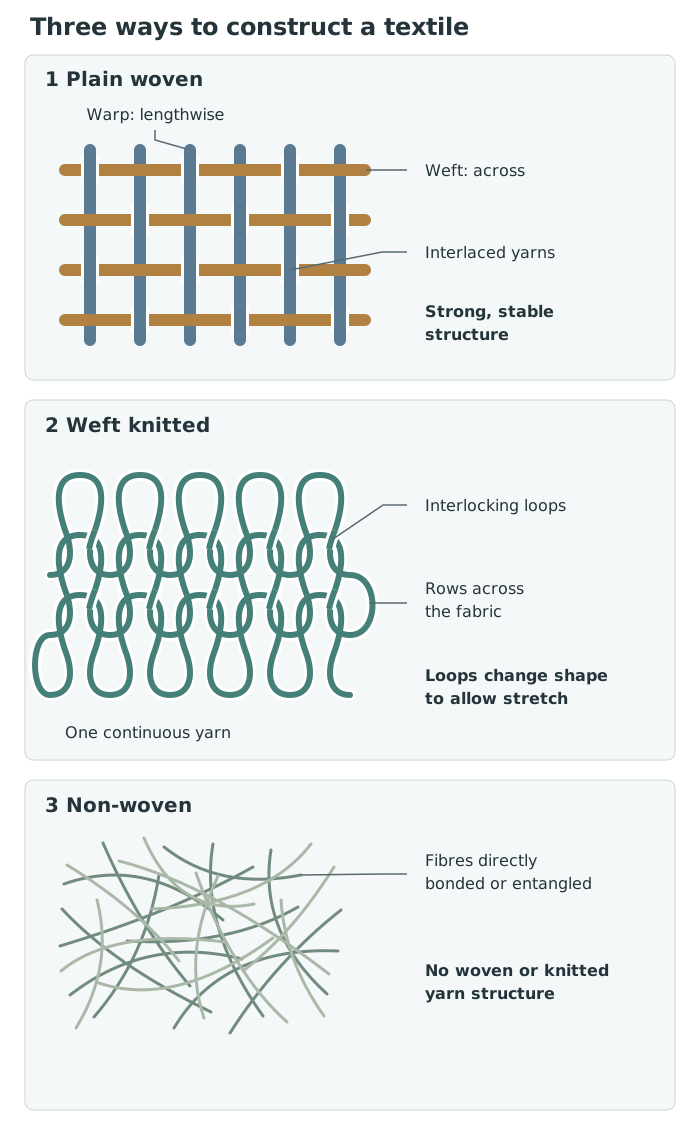
Woven fabrics interlace yarns, knitted fabrics interlock loops, and non-wovens join fibres directly.
These structures create different working properties. Plain woven fabric offers stability, whereas weft knitting offers easy stretch but needs care to prevent unravelling. A non-woven offers a clean, non-fraying cut edge but may not provide the strength needed for repeated loading. Fibre choice and construction must therefore be considered together.
Yarn structure matters too. Short fibres are called staple fibres; natural fibres are usually staple fibres, with silk the important exception. Silk forms a long, continuous filament. Hairy staple yarns trap air, helping insulation, whereas smooth filament yarns generally trap less air. This explains why identifying the fibre alone is not enough to predict the behaviour of the finished textile.
Strength means resisting a force without breaking. Tensile strength is resistance to being pulled apart. Durability is broader: it concerns how well a textile survives repeated use, rubbing, cleaning and other damage. A strong fibre is useful, but a product also needs to remain serviceable over time.
Elasticity is the ability to stretch and recover. It matters in close-fitting clothing that must move with the wearer. Absorbency is the ability to take up moisture, useful in towels and comfortable clothing. Insulation means reducing heat transfer; a textile that traps air can help keep the wearer warm.
Water-repellence means resisting wetting at the surface, not necessarily preventing water from passing through the whole fabric. Wool can absorb moisture while also being water-repellent at its surface: these properties are not opposites.
Flammability concerns how readily a material catches fire and burns. Low flammability or flame resistance is useful near heat, but does not make a textile fireproof. Many synthetic fibres are also thermoplastic: excessive heat can soften or melt them.
An anti-static fibre resists the build-up of electrical charge. Static can make clothing cling and attract dust. Finally, resistance to acid, bleach and sunlight affects both use and care. These are separate forms of resistance: a fibre that tolerates one does not necessarily tolerate the others.
| Fibre | Useful properties | Limitations to consider |
|---|---|---|
| Cotton | Absorbent, strong, cool and comfortable to wear; generally easy to care for | Creases, can shrink, is flammable and is damaged by strong acids |
| Linen | Absorbent, strong, durable and cool to wear | Creases readily, is flammable and is vulnerable to strong acids; repeated sharp creasing can weaken it |
| Hemp | Absorbent, strong, lustrous, anti-static and antibacterial | Select the finished fabric for the required feel and construction, not strength alone |
| Jute | Highly absorbent, non-static and high in tensile strength | High absorbency would not meet a requirement to resist taking up water |
| Wool/fleece | Warm, absorbent, elastic, crease resistant, water-repellent and low in flammability |
These comparisons help explain design choices. Cotton’s absorbency makes it a useful choice where moisture uptake matters. Linen combines strength with coolness, but a design requiring a permanently smooth appearance must account for its tendency to crease. Wool’s insulation and elasticity suit warm clothing, while its care requirements may be a disadvantage for a product intended for frequent, vigorous washing.
Silk’s sheen can be an aesthetic advantage, but an unprotected textile exposed to strong sunlight needs more than an attractive appearance: resistance to deterioration matters too.
| Fibre | Useful properties | Limitations or care considerations |
|---|---|---|
| Polyester | Strong, tough, hardwearing and crease resistant; relatively flame resistant | Can build up static, retain oily stains and melt if overheated |
| Nylon (polyamide) | Strong, durable, elastic and highly abrasion resistant | Low moisture absorption, static build-up and sensitivity to strong sunlight; excessive heat can melt it |
| Acrylic | Lightweight, strong when dry and resistant to mildew, acids and sunlight damage | Can pill, build up static and melt if overheated |
| Polypropylene | Strong, hardwearing, crease resistant and resistant to chemicals | Thermoplastic with a low melting point, so heat resistance must not be assumed |
| Elastane/Lycra | Lightweight, strong and highly elastic, giving stretch and recovery | Chlorine bleach and heat can damage it |
| Aramid | Engineered for high strength, heat resistance and abrasion resistance | Its specialist performance should be matched to a genuine product need |
For example, nylon’s abrasion resistance makes it useful where a textile repeatedly rubs against other surfaces. Elastane is useful where close fit and freedom of movement matter. Aramid is a stronger candidate when high strength and resistance to heat are central requirements.
Chemical resistance must be considered specifically. Acrylic’s acid resistance does not mean every synthetic fibre tolerates every cleaning chemical. Chlorine bleach can damage wool, silk and elastane, and can also weaken some treated cotton or rayon fabrics. Cleaning instructions therefore depend on the finished textile and its treatments, not just its broad fibre category.
A blend combines different fibre types during spinning so that they are present within the same yarn. A mixture combines different yarn types when making the fabric. For example, a woven mixture can have cotton warp yarns and polyester weft yarns.
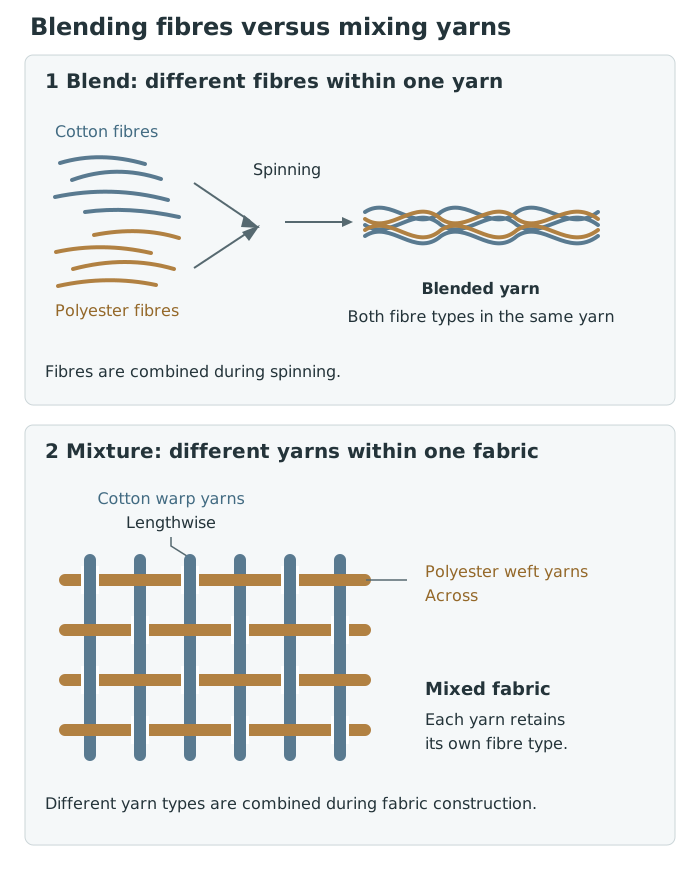
A blend combines fibres within a yarn; a mixture combines different yarn types within the fabric.
Both approaches combine useful properties, but at different stages of manufacture. A polyester–cotton blend combines cotton’s absorbency and comfort with polyester’s strength, crease resistance and easier care. This broadens the range of uses compared with relying on either fibre alone.
Other combinations to recognise include silk and viscose, wool and acrylic, and hemp and cotton. Silk and viscose can combine sheen with softness and absorbency. Wool and acrylic can combine warmth with a lighter, easier-care textile. Hemp and cotton bring together strong, absorbent plant fibres.
Blending and mixing can also reduce cost, improve colour or texture, and improve handle—how a fabric feels—or drape—how it hangs and falls. The outcome depends on the proportions, yarn structure and fabric construction. Combining fibres is not a guarantee that every limitation disappears.
Start with the product’s most important needs, then compare benefits and drawbacks. For a frequently washed shirt, a polyester–cotton blend may offer a useful balance of comfort, durability and reduced creasing. For close-fitting activewear, elasticity and recovery may make elastane valuable, but bleach and heat sensitivity remain relevant.
A justified choice connects property → performance → suitability, while acknowledging a significant limitation. The best textile is not the one with the longest list of advantages: it is the one whose properties and construction fit the intended use.
Fibre source and fabric construction are separate classifications.
Link a property to the product’s needs: ‘nylon is abrasion resistant, so it withstands repeated rubbing’ is stronger than simply listing properties.
Distinguish a fibre’s source from a fabric’s construction: cotton can be woven or knitted.
A blend combines different fibres within a yarn; a mixture uses different yarn types within the fabric.
Do not equate water-repellence with waterproofing, or flame resistance with being fireproof.
When selecting a textile, consider limitations as well as benefits, including cleaning, heat, bleach and sunlight.
It can see this note and what your specification asks for.
Answers are free with an account.
1 free note left this week
Get more free notesYour answer sets when this note comes back for review, or marks it complete.
Was this note helpful?
Log in to tell us whether it helped, or to report a problem.
Last updated
Fibre
A fine, hair-like structure used as the raw material for textiles.
Yarn
A continuous strand of fibres, commonly held together by spinning or twisting, used to make fabrics.
Natural fibre
A fibre obtained from a plant, animal or insect.
Synthetic fibre
A manufactured fibre made from chemically produced polymers, usually using petrochemical raw materials.
Regenerated fibre
A manufactured fibre made by processing a naturally occurring polymer, such as plant cellulose, and forming it into new fibres.
Microfibre
A very fine fibre engineered to give particular textile properties; fineness does not by itself identify the raw material.
Fibre blend
A yarn containing two or more fibre types combined during spinning.
Mixed fabric
A fabric containing different types of yarn, such as cotton warp yarns and polyester weft yarns.
Woven textile
A fabric made by interlacing two sets of yarns at right angles: warp and weft.
Warp
A yarn running along the length of a woven fabric.
Weft
A yarn running across the width of a woven fabric.
Knitted textile
A fabric made from interlocking loops of yarn.
Non-woven textile
A fabric made directly from fibres bonded or entangled together, rather than from woven or knitted yarns.
Strength
The ability of a material to withstand a force without breaking.
Elasticity
The ability of a material to stretch or change shape and then return towards its original shape when the force is removed.
Absorbency
The ability of a material to take up moisture.
Durability
The ability of a material to withstand wear and damage during use.
Insulation
The reduction of heat transfer; textiles that trap air can provide thermal insulation and help keep a wearer warm.
Flammability
How readily a material catches fire and burns.
Water-repellence
The ability of a material’s surface to resist wetting; this does not necessarily make the whole fabric waterproof.
Anti-static property
Resistance to the build-up of static electrical charge.
Put your knowledge into practice — try past paper questions for Design and Technology
Fibre
A fine, hair-like structure used as the raw material for textiles.
Yarn
A continuous strand of fibres, commonly held together by spinning or twisting, used to make fabrics.
Natural fibre
A fibre obtained from a plant, animal or insect.
Synthetic fibre
A manufactured fibre made from chemically produced polymers, usually using petrochemical raw materials.
Regenerated fibre
A manufactured fibre made by processing a naturally occurring polymer, such as plant cellulose, and forming it into new fibres.
Microfibre
A very fine fibre engineered to give particular textile properties; fineness does not by itself identify the raw material.
Fibre blend
A yarn containing two or more fibre types combined during spinning.
Mixed fabric
A fabric containing different types of yarn, such as cotton warp yarns and polyester weft yarns.
Woven textile
A fabric made by interlacing two sets of yarns at right angles: warp and weft.
Warp
A yarn running along the length of a woven fabric.
Weft
A yarn running across the width of a woven fabric.
Knitted textile
A fabric made from interlocking loops of yarn.
Non-woven textile
A fabric made directly from fibres bonded or entangled together, rather than from woven or knitted yarns.
Strength
The ability of a material to withstand a force without breaking.
Elasticity
The ability of a material to stretch or change shape and then return towards its original shape when the force is removed.
Absorbency
The ability of a material to take up moisture.
Durability
The ability of a material to withstand wear and damage during use.
Insulation
The reduction of heat transfer; textiles that trap air can provide thermal insulation and help keep a wearer warm.
Flammability
How readily a material catches fire and burns.
Water-repellence
The ability of a material’s surface to resist wetting; this does not necessarily make the whole fabric waterproof.
Anti-static property
Resistance to the build-up of static electrical charge.
| Can shrink or felt during unsuitable washing; chlorine bleach damages it |
| Silk | Lustrous, absorbent, comfortable and strong when dry | Can crease; loses strength when wet and is weakened by sunlight and chlorine bleach |
| Rayon/viscose | Highly absorbent, breathable, lightweight, soft and comfortable | Conventional rayon weakens when wet, can crease and is damaged by strong acids |
| Tencel (Lyocell) | Strong, soft, absorbent and crease resistant | Its regenerated origin should not be confused with directly harvested plant fibres |
Check strength, elasticity, absorbency, durability, insulation, flammability, water-repellence, anti-static behaviour, and resistance to acid, bleach and sunlight.
Choose by linking a property to the intended use and weighing a relevant drawback.