

Loading…
Loading…
Loading…
Eduqas GCSE Design and Technology · C600
Eduqas C600 · Material Properties and Applications Check the specification (PDF) (opens in a new tab)
Natural timber is wood harvested from trees. Hardwoods come from deciduous trees, which generally lose their leaves in autumn. Softwoods come from coniferous trees, which commonly have needles and cones. Many conifers are evergreen, although larch is an exception.
Hardwoods generally grow more slowly, so supplies tend to be more limited and expensive. Softwoods generally grow faster, are more readily available and cost less. These are useful broad comparisons, but choosing a material requires the properties of the particular timber, not just its category.
A timber's strength is its ability to withstand forces without failing. Durability concerns how well it lasts in use. A strong material is not automatically suitable outdoors: exposure to moisture and the need for protection also matter.
Grain is the direction and pattern of the wood fibres. It contributes to both the appearance of timber and its working characteristics. Close, straight grain, darker markings and visible knots help distinguish timbers. Texture describes the character of the surface, while surface finish describes the appearance and quality achieved on it, such as a smooth polished surface.
Absorbency is the ability to take in liquid. It matters both when timber is exposed to moisture and when a finish is applied. Oils can soak into wood, while a sealing finish helps protect the surface. Particularly absorbent surfaces, such as exposed MDF edges, need sealing before painting.
To identify a timber, use several clues together: weight, colour, grain, texture, durability and ease of working. Colour alone is not reliable because a stain can change it. Ease of working includes how readily the material can be cut, shaped and finished.
The following examples show why the individual timber matters.
| Timber | Identifying and working properties | Suitable uses |
|---|---|---|
| Oak — hardwood | Mid-brown with a noticeable, often close and straight grain; strong, tough and durable; polishes well | High-quality furniture, doors, skirting and staircases |
| Beech — hardwood | Pink-tinted, closely grained, tough and durable; can be finished smoothly | Products needing a hard-wearing, robust material |
| Mahogany — hardwood | Dark red-brown with very close grain; cuts and polishes easily, producing a rich finish | Furniture and cabinets |
| Pine — |
For example, oak's durability and ability to polish well suit furniture that must withstand use while retaining an attractive appearance. Pine offers a lighter, easily worked option where lower cost is important. Cedar shows why an outdoor application does not necessarily require the strongest timber: suitability for exposure is also part of the choice.
After harvesting, timber is cut at a sawmill and seasoned, meaning dried before use. It may be sold sawn, with a relatively rough surface, or planed, with smoother surfaces. PSE means planed with squared edge.
Natural timber is supplied in standard lengths and sectional forms:
These names describe the supplied shape, not the species. Oak and pine, for instance, can both be supplied in different stock forms. Choosing stock close to the required shape reduces the amount that must be removed.
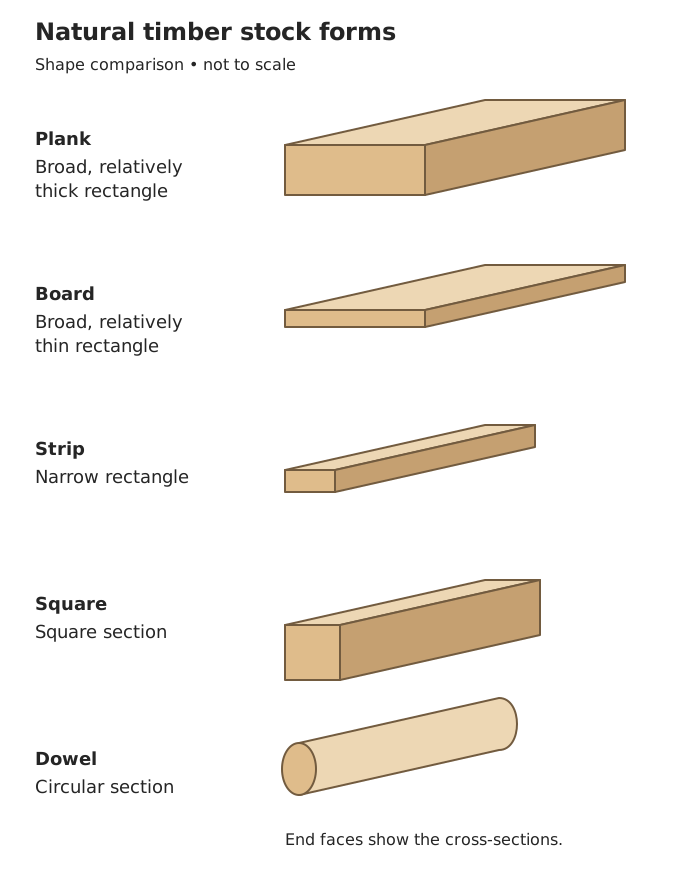
Stock form describes the supplied shape, not the species of timber.
Manufactured boards are made from natural timber that has been broken into fibres or particles, or cut into thin layers, and bonded together. Some use recovered wood materials. They are supplied as sheets, making them useful where a broad panel is needed.
MDF — medium density fibreboard is made from small wood fibres mixed with wax and resin, then heated and compressed. It has no natural grain direction, is easy to work and is a relatively inexpensive, versatile choice for interior furniture. Its absorbency is important: exposed edges readily absorb paint unless sealed first.
Chipboard is made from small wood chips bonded into a dense sheet. Its exposed surface can be unattractive, so it is often covered. Kitchen worktops can use a chipboard core with a decorative melamine surface that provides heat, scratch and water resistance.
Hardboard is a manufactured fibreboard made from pulped or shredded wood compressed together. It is supplied as thin sheet material; a typical thickness is 3.2 mm.
Plywood is made from thin wood veneers glued together. The grain direction in each layer is at 90° to the grain in the next layer. This cross-lamination increases strength and rigidity. The exposed edges show the layers and can be less attractive than the faces. A high-quality face veneer, such as birch, improves the appearance.
Veneered boards have a thin natural-wood covering bonded to a board underneath. The veneer provides the colour and grain of the chosen wood, while the underlying board provides the main structure. Veneering is a way to improve appearance; it does not turn the whole board into solid hardwood.
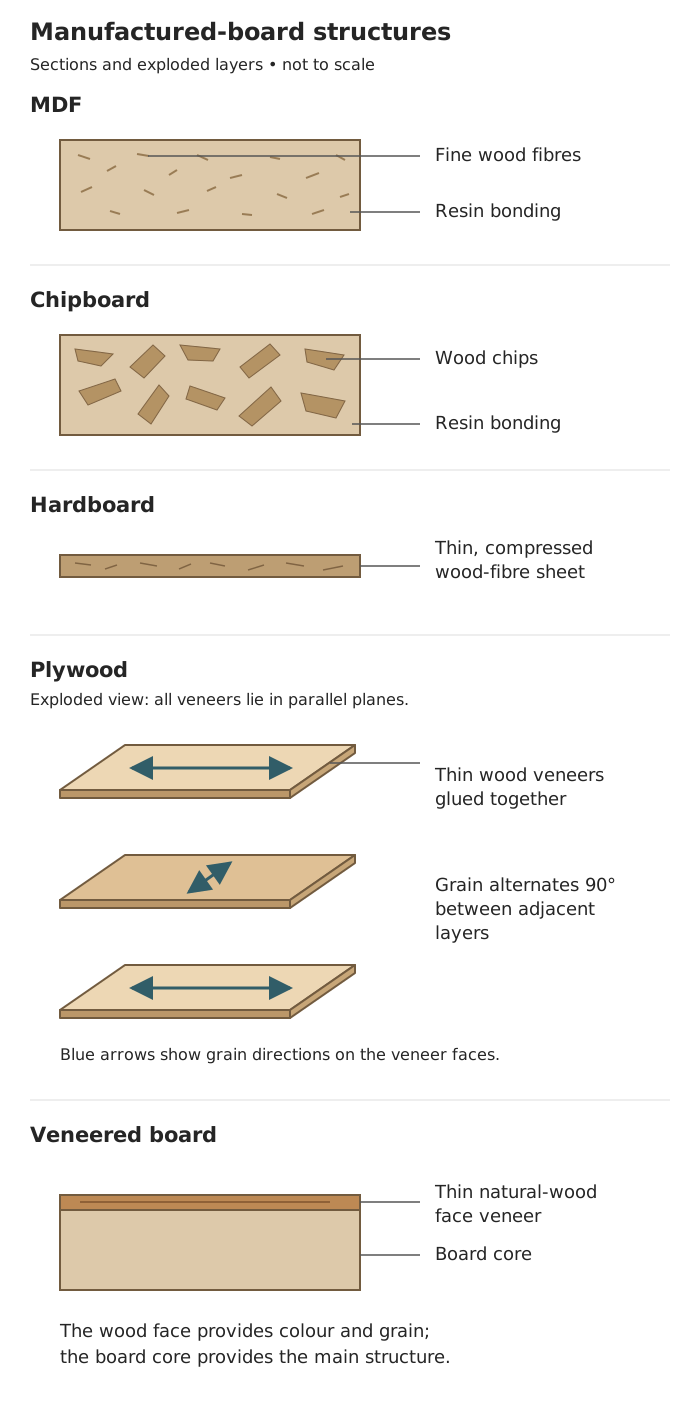
Manufactured boards use fibres, chips or layers. Plywood gains strength and rigidity from alternating grain directions.
Manufactured boards are sold in standard sheet sizes and a choice of thicknesses. Typical sheet dimensions are 2440 mm × 1220 mm; smaller sheets include 1220 mm × 610 mm.
| Board | Typical thicknesses |
|---|---|
| MDF | 4, 6, 9, 12, 15, 18, 22 and 25 mm |
| Plywood | 4, 6, 9, 12, 15, 18 and 24 mm |
| Hardboard | 3.2 mm |
Sheet dimensions describe the length and width; thickness is a separate measurement. A designer must choose both the material and an appropriate stock thickness for the component being made.
A finish can have a functional purpose, such as resisting moisture or wear, and an aesthetic purpose, such as enhancing grain or changing colour. The right finish depends on the material, the product's location and the desired appearance.
A frequently used timber floor may need a hard-wearing, sealing polyurethane finish, available in oil- or water-based forms and different levels of gloss. A decorative cabinet may instead prioritise the appearance of its grain.
Manufactured boards also need suitable finishes. Plywood with an attractive face veneer can be varnished or lacquered. MDF can be painted or stained, but its exposed edges should be sealed first to prevent excessive absorption. Chipboard can receive a natural-wood veneer for appearance or a melamine covering for both appearance and resistance to everyday wear. The covering and the board underneath perform different jobs, so both matter when selecting the material.
Hardwood and softwood describe the type of tree, not a guaranteed level of hardness or strength.
Justify a timber choice by linking a specific property to the product: for example, oak's strength and durability suit a frequently used door.
In plywood, adjacent layers have their grain directions at 90° to each other; the layers themselves lie flat together.
Distinguish a wood veneer from a melamine surface: veneer is thin natural wood, whereas melamine provides a decorative, resistant covering.
Give sheet dimensions and thickness separately, with units. Standard sizes are typical stock sizes, not the only sizes available.
Do not assume that staining alone seals timber. A coat of varnish is normally used to seal the stain.
It can see this note and what your specification asks for.
Answers are free with an account.
1 free note left this week
Get more free notesYour answer sets when this note comes back for review, or marks it complete.
Was this note helpful?
Log in to tell us whether it helped, or to report a problem.
Last updated
Natural timber
Wood obtained from trees and used as a material for making products.
Hardwood
Timber from deciduous trees, such as oak, beech and mahogany. The name identifies its botanical category rather than guaranteeing its hardness.
Softwood
Timber from coniferous trees, such as pine, cedar and larch. The name does not mean that every softwood is weak or soft.
Grain
The direction and pattern of the wood fibres, visible as lines or markings in natural timber.
Absorbency
A material's ability to take in liquid, affecting its response to moisture and the way it accepts finishes.
Durability
A material's ability to remain useful over time while resisting wear or deterioration.
Stock form
The standard shape and size in which a material is supplied before it is made into a product.
Manufactured board
A sheet material made by bonding wood particles, fibres or layers together.
Veneer
A thin layer of natural wood, used as a decorative covering or as a layer in plywood.
Lamination
Bonding layers of material together; plywood uses wood layers with alternating grain directions to increase strength and rigidity.
Finish
A surface treatment or covering used to protect a material, alter its appearance, or both.
Put your knowledge into practice — try past paper questions for Design and Technology
Natural timber
Wood obtained from trees and used as a material for making products.
Hardwood
Timber from deciduous trees, such as oak, beech and mahogany. The name identifies its botanical category rather than guaranteeing its hardness.
Softwood
Timber from coniferous trees, such as pine, cedar and larch. The name does not mean that every softwood is weak or soft.
Grain
The direction and pattern of the wood fibres, visible as lines or markings in natural timber.
Absorbency
A material's ability to take in liquid, affecting its response to moisture and the way it accepts finishes.
Durability
A material's ability to remain useful over time while resisting wear or deterioration.
Stock form
The standard shape and size in which a material is supplied before it is made into a product.
Manufactured board
A sheet material made by bonding wood particles, fibres or layers together.
Veneer
A thin layer of natural wood, used as a decorative covering or as a layer in plywood.
Lamination
Bonding layers of material together; plywood uses wood layers with alternating grain directions to increase strength and rigidity.
Finish
A surface treatment or covering used to protect a material, alter its appearance, or both.
| Pale yellow or whitish with darker grain markings; often knotty; lightweight and easy to work |
| Construction and furniture |
| Cedar — softwood | Pale, lightweight and evenly textured; more expensive than pine but not as strong | Outdoor fencing, decking and sheds |
| Larch — softwood | Darker colouring with brown grain; water-resistant and durable; relatively expensive for a softwood | Exterior cladding and boats |
Examples: oak — strong, durable, polishes well; beech — tough and smooth-finishing; mahogany — red-brown, easily cut and polished; pine — pale, lightweight, easily worked; cedar — lightweight, suitable outdoors; larch — water-resistant and durable.
Plank, board, strip, square and dowel. Timber is seasoned before use and may be sawn or planed. PSE = planed with squared edge.
Typical sheets: 2440 × 1220 mm; smaller size 1220 × 610 mm.
Thicknesses: MDF — 4, 6, 9, 12, 15, 18, 22, 25 mm; plywood — 4, 6, 9, 12, 15, 18, 24 mm; hardboard — 3.2 mm.
Board choices: seal MDF edges before painting; varnish/lacquer attractive plywood faces; veneer or melamine-cover chipboard. Melamine adds heat, scratch and water resistance.