

Loading…
Loading…
Loading…
Eduqas GCSE Design and Technology · C600
Eduqas C600 · Material Properties and Applications Check the specification (PDF) (opens in a new tab)
Paper-based materials are used throughout designing: for sketching ideas, printing information, making models and producing packaging. They are commonly made from wood pulp, which is formed into sheets at a paper mill. Recovered paper fibres can also supply the pulp.
Paper is generally thin and flexible; card and board are generally heavier and stiffer. Their suitability depends on more than their category. A drawing overlay needs to let you see the lines underneath, whereas a delivery box needs to protect its contents.
Four properties help explain these choices. Strength is the ability to withstand forces without failing, for example by tearing. Folding ability concerns how easily a sheet bends or creases without splitting. Surface finish includes smoothness, texture, colour and gloss. Absorbency is the ability to take liquid into the material. Absorbency can help an art paper accept paint, but is undesirable in packaging that must retain a drink.
Aesthetic properties affect appearance; functional properties affect performance. A smooth white surface can serve both purposes: it looks clean and allows printed information to be reproduced clearly.
The standard ISO A-series runs from A0 down to A10. A0 is the largest in this series, and A10 is approximately postage-stamp size. A3 and A4 are common in schools.
Each successive size has half the area of the previous one. Cutting or folding A3 in half gives two A4-sized sections; two A5 sheets together have the area of one A4 sheet. A4 measures 210 × 297 mm, while A3 measures 297 × 420 mm.
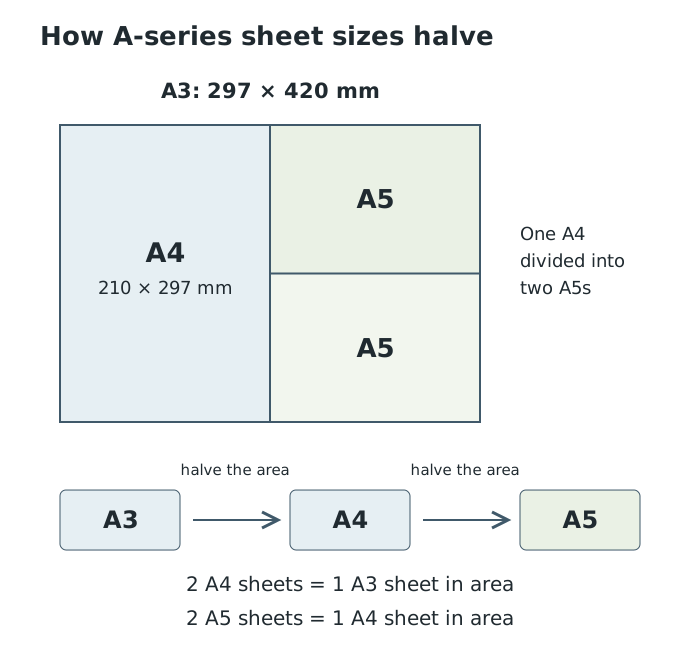
Each step from A3 to A4 to A5 halves the sheet’s area.
Grammage measures mass per unit area, in grams per square metre, abbreviated gsm. An 80 gsm paper has a mass of 80 g for every square metre of sheet. It does not mean that each A4 sheet weighs 80 g. Sheets of different sizes can have the same grammage.
Grammage is not a direct measurement of thickness. Card and board thickness is measured in microns: 1,000 microns equals 1 mm. For example, mounting board that is 1,400 microns thick is 1.4 mm thick. Designers therefore need to distinguish the size of a sheet, its grammage and its thickness.
Different papers offer different combinations of surface, transparency and liquid absorption.
| Paper | Typical properties | Suitable use and reason |
|---|---|---|
| Layout paper | Around 50 gsm; smooth, translucent and inexpensive | Sketching and developing ideas; its translucency helps when working over an existing drawing. |
| Tracing paper | Around 40–90 gsm; smooth, strong, translucent and non-absorbent | Copying drawings and making overlays because underlying lines remain visible. |
| Copier paper | Around 80 gsm; smooth, opaque, clean white and uncoated | Printing and photocopying; the white, opaque sheet provides a clear background for information. |
| Cartridge paper | Around 80–140 gsm; relatively thick, textured and creamy off-white | Artwork using paints, watercolours, pastels and inks; its surface suits these media. |
These figures describe typical materials rather than every available grade. A designer should match the actual paper to the task: inexpensive layout paper suits repeated idea development, while cartridge paper is a more suitable choice for a painted presentation.
Mounting board has a smooth surface and is rigid, with a typical thickness of about 1,400 microns. Black and white are common, although other colours are available. Its rigidity helps picture mounts stay flat and architectural models retain their shape.
Folding boxboard is stiff but scores and folds well, bending without splitting. Typical thicknesses range from 300 to 1,699 microns. It is normally made from recycled paper and suits supermarket food packaging. Its useful combination is stiffness in the finished box and controlled folding at the creases.
Corrugated board has a wavy, fluted sheet between flat layers. This construction produces a strong, lightweight and rigid board. The spaces created by the flutes help it cushion knocks, making it useful for fragile goods in transport. They also provide heat insulation, useful in pizza boxes. Around 3,000 microns is a typical thickness, although different thicknesses and double-wall constructions are available. Untreated corrugated board is recyclable but not water-resistant.
Foam board is a composite: a polystyrene foam core is sandwiched between thin paper or card faces. The different materials work together to produce a lightweight, rigid board with a smooth surface. A common thickness is 5 mm, or 5,000 microns. It suits models and point-of-sale displays where low weight and rigidity matter.
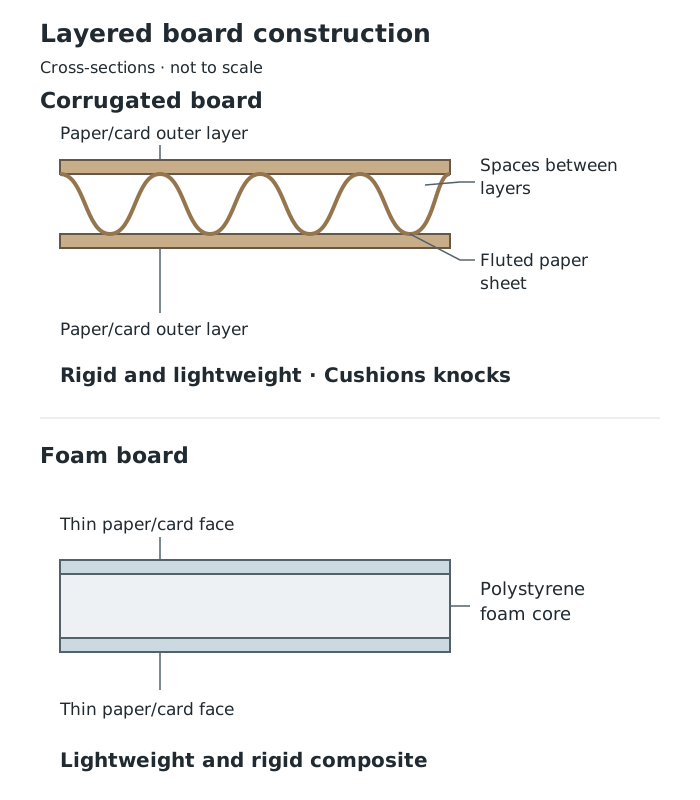
Different layered constructions produce boards suited to protection, modelling and display.
These materials solve different problems. Mounting board suits a flat, firm display; folding boxboard suits packaging assembled from a flat sheet; corrugated board suits protective transport packaging. Greater rigidity is not always an advantage if the design must fold easily.
Lamination bonds an additional layer to paper, card or board. The layer changes the properties of the whole material: it can add thickness and strength, improve the surface finish and enhance appearance.
In food containers and drinks cartons, suitable laminated layers help retain the contents hygienically and keep produce fresh. The paper-based material provides structure, while the added layer provides a barrier. Laminated cardboard is also useful in bookbinding.
Other surface finishes change appearance without creating the same layered structure. Varnish can give card a glossy finish, and applying it to only a logo can make that detail stand out. UV varnishing produces a high-gloss surface used on marketing materials such as business cards. Embossing creates raised patterns or lettering, often on greetings cards, invitations and perfume packaging.
The finish should support the purpose. A visually attractive package still needs sufficient strength, suitable folds and protection against liquid where required. For example, a sandwich container can have crease lines for assembly and a waxed inner surface to resist absorption.
Recycled paper is manufactured using recovered paper fibres. These can come from used paper, rejected sheets or printing offcuts. The recovered fibres supply pulp for new sheets, sometimes mixed with new, unused pulp. This reduces waste and demand for new raw material.
Recycled paper is not one fixed material grade. It can be brown, coloured or white, and its brightness, opacity and surface quality depend on the recovered fibres, additives and finishing treatments. Coatings can improve its texture and printing performance. A designer choosing recycled paper for a leaflet therefore still needs a suitable surface for clear print; recycled content alone does not guarantee a particular appearance.
Fibre quality also affects strength. Poor-quality recovered fibres can reduce performance, so recycled paper must be selected to withstand the tearing and handling expected in use. Its folding ability should be judged for the actual product: a folded leaflet needs a neat crease without splitting, while a package also needs to hold its shape. Recycled fibres do not prevent good folding—folding boxboard commonly uses recycled paper and folds well at scored lines.
Absorbency remains important. Recycled paper can take up water, so it should not be assumed to provide a liquid barrier. Suitable grades can be used for writing, printing and packaging, but liquid-containing or food-contact packaging needs appropriate protective layers and a material suitable for that use.
Recycled fibres are also used in boards. Folding boxboard commonly uses recycled paper; duplex board has layers mostly made from waste paper pulp and can have a smooth, white, medium-gloss finish. This shows that using recovered fibres need not mean accepting a rough or dull-looking product.
Recycled content and recyclability are different: the first concerns what a product is made from, and the second concerns what can happen to it after use. Uncoated corrugated board offers a recyclable packaging option, but added layers and finishes must also be considered when planning the product’s end of life. An effective choice balances the required strength, folding ability, finish and absorbency with responsible material use.
Link a named property to the product’s need: corrugated board cushions knocks, so it protects fragile goods in transport.
Distinguish sheet size, grammage and thickness: A4 describes size, gsm describes mass per square metre, and microns describe thickness.
A3 has twice the area of A4, not twice both its dimensions.
Do not describe untreated corrugated board as waterproof. Liquid-containing packaging needs a suitable barrier layer.
When comparing materials, consider both appearance and performance rather than simply saying one is ‘better’.
It can see this note and what your specification asks for.
Answers are free with an account.
1 free note left this week
Get more free notesYour answer sets when this note comes back for review, or marks it complete.
Was this note helpful?
Log in to tell us whether it helped, or to report a problem.
Last updated
Grammage
The mass of paper or card per unit area, measured in grams per square metre (gsm).
Micron
A unit of length used to measure card and board thickness. One micron is 0.001 mm.
Absorbency
A material’s ability to take liquid into its structure.
Translucent
Allowing some light through, without giving a completely clear view through the material.
Opaque
Not allowing light to pass through.
Rigidity
Resistance to bending or changing shape.
Lamination
Bonding an additional layer to a material to improve properties such as strength, surface finish and appearance.
Composite material
A material made by combining distinct materials so that their properties work together.
Flute
The wavy sheet within corrugated board, which separates its flat outer layers.
Aesthetic property
A property concerned with appearance, such as colour, texture or gloss.
Functional property
A property that affects how well a material performs its intended job.
Recycled paper
Paper manufactured using recovered paper fibres, sometimes mixed with new, unused pulp.
Put your knowledge into practice — try past paper questions for Design and Technology
Grammage
The mass of paper or card per unit area, measured in grams per square metre (gsm).
Micron
A unit of length used to measure card and board thickness. One micron is 0.001 mm.
Absorbency
A material’s ability to take liquid into its structure.
Translucent
Allowing some light through, without giving a completely clear view through the material.
Opaque
Not allowing light to pass through.
Rigidity
Resistance to bending or changing shape.
Lamination
Bonding an additional layer to a material to improve properties such as strength, surface finish and appearance.
Composite material
A material made by combining distinct materials so that their properties work together.
Flute
The wavy sheet within corrugated board, which separates its flat outer layers.
Aesthetic property
A property concerned with appearance, such as colour, texture or gloss.
Functional property
A property that affects how well a material performs its intended job.
Recycled paper
Paper manufactured using recovered paper fibres, sometimes mixed with new, unused pulp.
Compare strength, folding ability, surface finish and absorbency against the product’s needs.