Loading…


Loading…
Loading…
Loading…
Edexcel GCSE Combined Science · 1SC0
Edexcel 1SC0 · Momentum and stopping distances Check the specification (PDF) (opens in a new tab)
When you walk, your foot pushes backwards on the ground, and the ground pushes forwards on your foot. These are two forces arising from one interaction between two objects.
Newton’s third law states that whenever two objects interact, the forces they exert on each other are equal in magnitude and opposite in direction. The forces act at the same time, act on different objects and are the same type of force. In walking, both are contact forces.
The forces do not cancel out on your body: the forward force acts on you, while the backward force acts on the ground. To explain the motion of one object, consider the forces acting on that object, not its forces on other objects.
An object is in equilibrium when its resultant force is zero. It has no acceleration, so it can remain at rest or move at constant velocity.
Consider a book resting on a table. Earth’s gravitational pull on the book acts downwards, and the table’s contact force on the book acts upwards. These forces balance because the book is in equilibrium. However, they are not a third-law pair: both act on the book, and they are different types of force.
There are two separate interactions here:
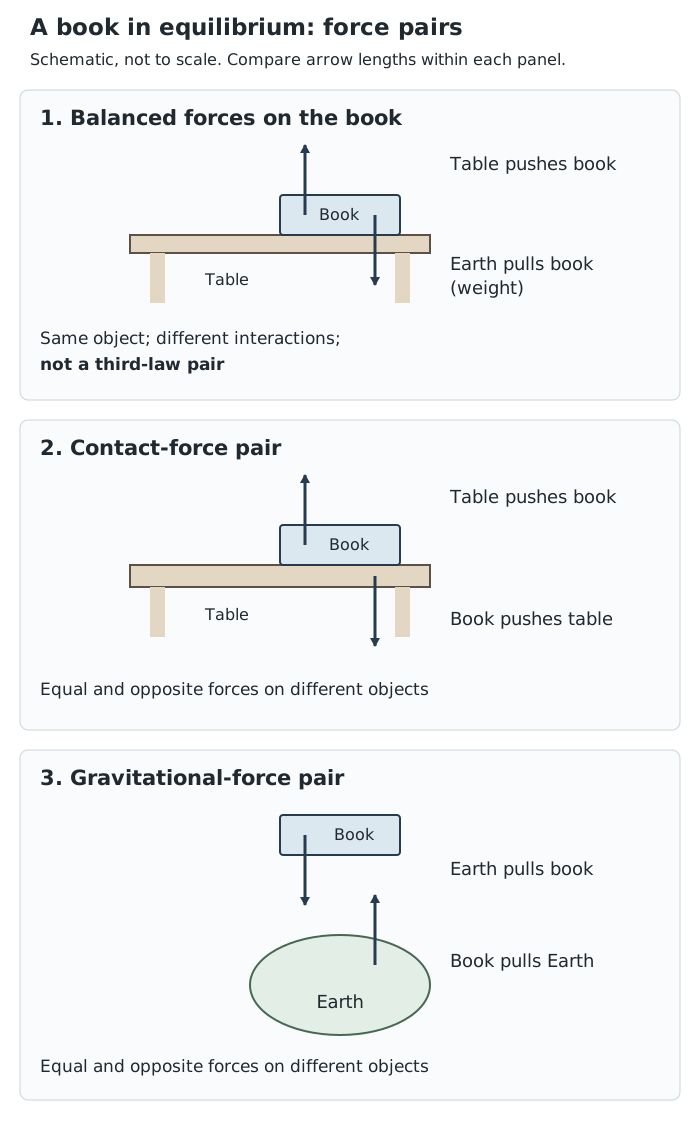
Balanced forces act on one object. A third-law pair acts on two different objects.
Momentum is the product of an object’s mass and velocity:
Here, is momentum in kilogram metres per second (kg m/s), is mass in kilograms (kg), and is velocity in metres per second (m/s).
At the same velocity, a more massive object has more momentum. For the same mass, doubling the velocity doubles the momentum. An object at rest has zero momentum because its velocity is zero.
Momentum is a vector: it has both magnitude and direction. If rightwards is chosen as positive, leftwards velocities and momenta are negative. A negative momentum describes direction, not a negative mass.
For example, a 2 kg trolley travelling rightwards at 3 m/s has momentum rightwards. Travelling leftwards at the same speed, its momentum would be with this sign convention.
Imagine trolley A moving rightwards towards stationary trolley B. During contact, A pushes B rightwards, while B pushes A leftwards with an equally large force. B accelerates rightwards, while A slows down.
The equal forces do not necessarily produce equal accelerations. From , the less massive trolley has the greater acceleration magnitude for the same force. Equal masses have equal acceleration magnitudes in opposite directions, provided these interaction forces are their resultant forces.
Newton’s third law also explains why momentum is transferred rather than created during the collision. The interaction forces are equal and opposite and act for the same contact time. The trolleys therefore undergo equal and opposite changes in momentum: the momentum gained by one is balanced by the momentum lost by the other.
For the two trolleys considered together, total momentum before the collision equals total momentum afterwards, provided there is no resultant external force. Forces between the trolleys are internal to this system; an external force, such as friction from the track, could change its total momentum.
For example, let the moving trolley have mass 2 kg and velocity 3 m/s rightwards, and let the stationary trolley also have mass 2 kg. Suppose they stick together after colliding, with external forces negligible.
Their total initial momentum is . Afterwards, the combined mass is 4 kg, so their shared velocity is rightwards.
The first trolley’s momentum falls from 6 to 3 kg m/s, while the second’s rises from zero to 3 kg m/s. Their individual momenta change, but the total remains 6 kg m/s.
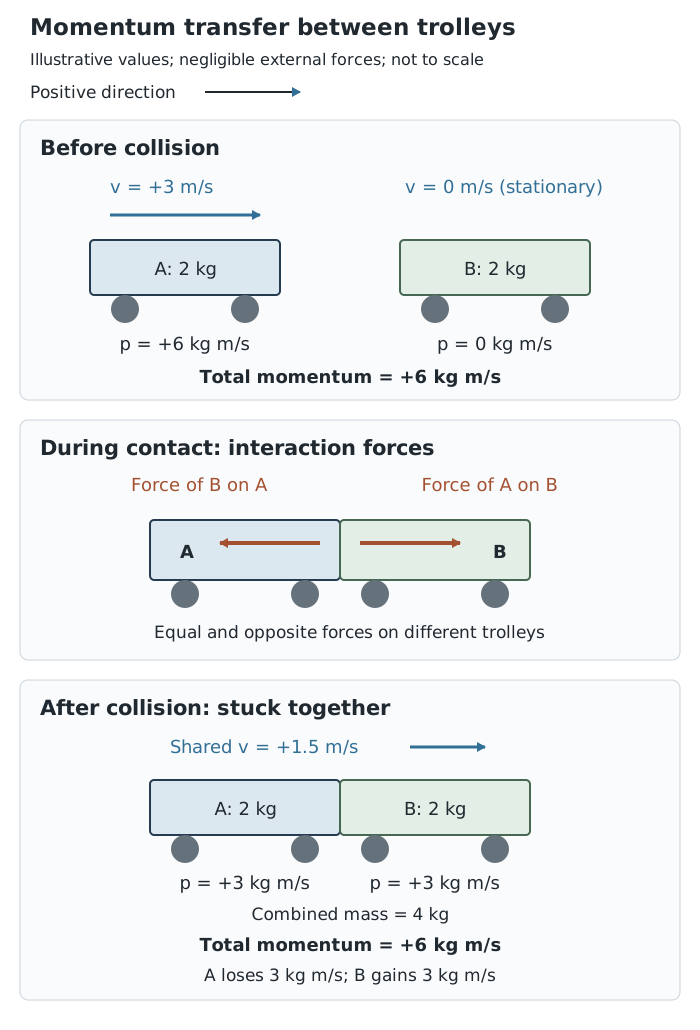
Collision: individual momenta change, but total momentum remains constant when external forces are negligible.
A resultant force changes an object’s velocity and therefore its momentum. Newton’s second law can be written as:
Here, is force in newtons (N), is the object’s constant mass in kilograms, is its initial velocity, is its final velocity, and is the time taken in seconds. If the force varies during contact, this calculation gives the average resultant force.
For the same change in momentum, a shorter contact time means a greater average force. For example, when a tennis ball hits a racket, changing its momentum over a shorter time produces a larger average interaction force. By Newton’s third law, the ball and racket exert equally large, oppositely directed forces on each other.
Direction matters especially when an object rebounds. For example, a 0.06 kg ball approaches a racket at and leaves at after 0.05 s of contact. Its change in momentum is . The average force on the ball is therefore : a force of magnitude 30 N opposite to its original motion.
Get unlimited access to all revision notes, key terms, and exam tips.
The interacting objects exert equal and opposite forces for the same time, giving equal and opposite momentum changes.
Total momentum before = total momentum after, if there is no resultant external force.
: kg m/s; : kg; : m/s. Momentum has direction; an object at rest has zero momentum.
is initial velocity; is final velocity; is time in seconds; is in newtons.
For the same momentum change, shorter time means greater average force.
Get unlimited access to all revision notes, key terms, and exam tips.
Name both interacting objects when identifying a third-law pair: ‘A pushes B; B pushes A’. The forces act on different objects.
Equal and opposite forces on one object may be balanced forces, but they are not a third-law pair.
Choose a positive direction before calculating momentum. A rebound reverses the sign of velocity.
Calculate change in momentum as final minus initial, and use kilograms, metres per second and seconds.
Newton’s third law
When two objects interact, each exerts a force on the other that is equal in magnitude and opposite in direction. These forces act on different objects and are the same type of force.
Equilibrium
A situation in which the resultant force on an object is zero, so it has no acceleration.
Momentum
The product of an object’s mass and velocity: . Momentum is a vector quantity, measured in kilogram metres per second (kg m/s).
Conservation of momentum
The total momentum of a system remains constant when there is no resultant external force acting on it.
Put your knowledge into practice — try past paper questions for Combined Science
Newton’s third law
When two objects interact, each exerts a force on the other that is equal in magnitude and opposite in direction. These forces act on different objects and are the same type of force.
Equilibrium
A situation in which the resultant force on an object is zero, so it has no acceleration.
Momentum
The product of an object’s mass and velocity: . Momentum is a vector quantity, measured in kilogram metres per second (kg m/s).
Conservation of momentum
The total momentum of a system remains constant when there is no resultant external force acting on it.