Loading…


Loading…
Loading…
Loading…
Edexcel GCSE Combined Science · 1SC0
Edexcel 1SC0 · Newton's laws and weight Check the specification (PDF) (opens in a new tab)
Earth attracts objects towards its centre. The force of this gravitational attraction on an object is its weight. Like other forces, weight is measured in newtons (N) and has a direction: near Earth’s surface, it acts downwards, towards the centre of Earth.
In everyday speech, people often use ‘weight’ when they mean mass. In physics, these are different quantities. Mass measures the amount of matter in an object and is measured in kilograms (kg). Weight describes the gravitational force acting on that mass.
Taking a suitcase from Earth to the Moon does not remove any of its matter, so its mass stays the same. Its weight changes because the Moon’s gravitational field is weaker.
Gravitational field strength, represented by , is the gravitational force per kilogram of mass at a particular location. Its unit is newtons per kilogram (N/kg).
Near Earth’s surface, we usually use at GCSE. This means that each kilogram of mass experiences a gravitational force of approximately 10 N. A 2 kg object therefore has twice the weight of a 1 kg object in the same gravitational field.
Weight, mass and gravitational field strength are connected by:
Here, is weight in newtons, is mass in kilograms and is gravitational field strength in newtons per kilogram. Multiplying kilograms by newtons per kilogram gives an answer in newtons.
You can also rearrange the equation to find mass or gravitational field strength:
Dividing weight by gravitational field strength finds the mass experiencing that force. Dividing weight by mass finds the gravitational force on each kilogram.
A newton meter, also called a spring balance, measures weight directly. It contains a spring, a hook for the object and a calibrated scale marked in newtons. The object pulls on the spring, stretching it; the scale converts this stretch into a force reading.
Choose a newton meter whose range can accommodate the object’s weight, and check that it reads zero before attaching the object. Hold or support the meter vertically and hang the object from its hook. Let the object hang freely without touching a surface. Once it is stationary, read the scale at eye level and record the weight in newtons.
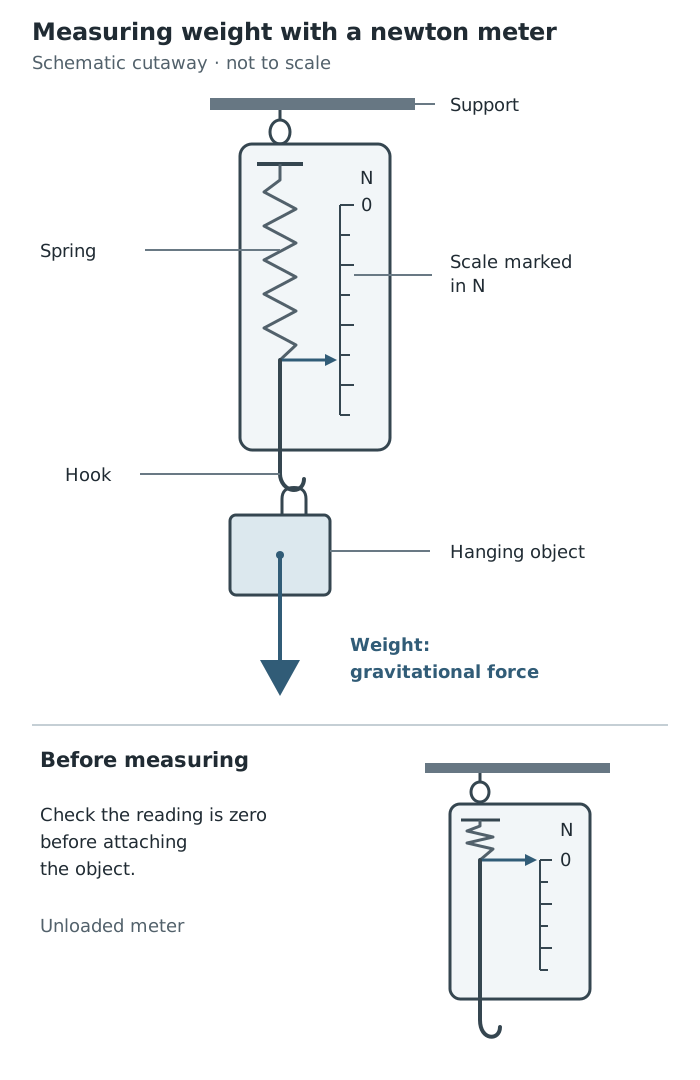
A newton meter measures weight directly. Let the object hang freely and become stationary, then read the scale in newtons.
A top-pan balance normally gives a reading of mass, rather than weight. You can measure mass with the balance and then calculate weight using , provided you know the gravitational field strength at that location. This is an indirect measurement of weight.
For an object whose mass stays constant, its weight is directly proportional to gravitational field strength. Doubling doubles its weight; halving halves its weight. The object has not gained or lost matter—the gravitational force acting on it has changed.
The Moon’s gravitational field strength is about , compared with about on Earth. The same object therefore weighs roughly one-sixth as much on the Moon, while retaining the same mass. It is easier to support against gravity there because its weight is smaller.
The equation also shows a second relationship: at a fixed gravitational field strength, weight is directly proportional to mass. Twice as much mass experiences twice as much gravitational force.
Get unlimited access to all revision notes, key terms, and exam tips.
is gravitational field strength in N/kg. Near Earth’s surface, use approximately unless another value is given.
Get unlimited access to all revision notes, key terms, and exam tips.
Use kilograms in W = mg. Convert grams to kilograms by dividing by 1000.
Give weight in newtons (N), mass in kilograms (kg) and gravitational field strength in newtons per kilogram (N/kg).
Use the value of g stated in the question. Near Earth’s surface, 10 N/kg is the usual GCSE approximation.
When comparing weights in different places, state that the object’s mass stays the same; it is the gravitational field strength that changes.
For a direct measurement of weight, name a newton meter and explain that the object is hung from its hook and the force is read from its scale.
Weight
The force acting on an object due to gravitational attraction, measured in newtons (N).
Mass
A measure of the amount of matter in an object, measured in kilograms (kg). Moving the object to a different gravitational field does not change its mass.
Gravitational field strength
The gravitational force per kilogram of mass at a particular location, measured in newtons per kilogram (N/kg): .
Newton meter
An instrument that measures force using a calibrated spring and a scale marked in newtons; also called a spring balance.
Direct proportion
A relationship in which multiplying one quantity by a factor multiplies the other by the same factor, so their ratio remains constant.
Put your knowledge into practice — try past paper questions for Combined Science
Weight
The force acting on an object due to gravitational attraction, measured in newtons (N).
Mass
A measure of the amount of matter in an object, measured in kilograms (kg). Moving the object to a different gravitational field does not change its mass.
Gravitational field strength
The gravitational force per kilogram of mass at a particular location, measured in newtons per kilogram (N/kg): .
Newton meter
An instrument that measures force using a calibrated spring and a scale marked in newtons; also called a spring balance.
Direct proportion
A relationship in which multiplying one quantity by a factor multiplies the other by the same factor, so their ratio remains constant.